You may be staring at the Sunday readings and wondering, “What does my congregation need to hear right now?” The strongest homily topics usually connect three things: the biblical readings, the season or occasion, and a real experience people are carrying into worship. A clear message does not need to cover every idea in the readings. It needs to help listeners recognize God’s presence, their own responsibility, and one practical next step.
Good homily preparation begins with a focused question rather than a clever theme. Ask what the readings reveal about God, what human struggle they address, and how that truth can shape the decisions people make during the coming week. The topic should be faithful to Scripture while remaining concrete enough for a parent, student, worker, older adult, or visitor to understand.
Begin by reading the assigned passages slowly, preferably more than once. Look for repeated ideas, contrasts, changes in attitude, commands, promises, and moments when a person responds to God. A single detail may provide a better topic than an attempt to explain every verse.
For example, a reading about forgiveness might lead to a topic on releasing resentment, restoring trust, or receiving mercy after failure. A passage about the disciples’ fear might become a homily about faithful action in uncertainty rather than a general discussion of courage. The best choice depends on what the text actually emphasizes and what your community is experiencing.
What does this passage show about God? Consider mercy, justice, patience, holiness, compassion, authority, or faithfulness.
What human problem appears in the reading? Look for fear, pride, isolation, grief, temptation, injustice, doubt, or indifference.
What change does the passage invite? The response may involve repentance, trust, service, reconciliation, prayer, courage, or gratitude.
What image or action will people remember? A road, meal, storm, seed, wound, doorway, or act of service can make an abstract truth easier to recall.
What can listeners practice this week? Give the message a visible expression in ordinary life rather than leaving it as a broad ideal.
When several readings seem equally important, identify the common thread instead of treating them as separate mini-sermons. The connection may be God’s call, the danger of self-reliance, the dignity of every person, or the movement from hearing to doing. If no clear connection exists, choose the reading that offers the most direct pastoral help and mention the others briefly.
Practical test: State the homily topic in one sentence beginning with “Because God…,” “We are called to…,” or “The Gospel invites us to….” If the sentence contains several unrelated ideas, the topic needs narrowing.
A topic should also fit the people in front of you. A parish facing grief may need a message about God’s companionship in suffering. A congregation celebrating a baptism may need to hear about belonging and responsibility. The same passage can support different homily topics because context changes the pastoral question.
Practical homily topics for ordinary Sundays
Ordinary Sundays often call for themes that help people connect worship with family life, work, relationships, and personal choices. These topics are broad enough to adapt to many readings, but each should be tied to a specific biblical image or teaching. Avoid presenting them as disconnected advice; show how the Scripture gives the topic its shape.
Trusting God during uncertainty: Explore how faith affects decisions when the outcome is unclear, while acknowledging that trust does not remove every risk.
Choosing mercy over retaliation: Connect forgiveness with the difficult work of refusing revenge, setting healthy boundaries, and seeking repair.
Hearing before speaking: Consider how attentive listening can change prayer, family conflict, parish life, and relationships with people who feel ignored.
The danger of spiritual pride: Show how religious knowledge or public devotion can become empty when it is separated from humility and compassion.
Faith expressed through action: Explain that belief becomes visible through service, honesty, generosity, courage, and care for vulnerable people.
Receiving help with humility: Reflect on why people resist dependence and how accepting support can become an act of trust rather than weakness.
God’s concern for the overlooked: Apply the reading to people excluded by poverty, illness, age, disability, immigration status, loneliness, or social stigma.
Finding hope after failure: Focus on repentance, restoration, and the difference between taking responsibility and believing you are beyond mercy.
Making room for silence: Discuss how constant noise can prevent reflection and how short periods of quiet can prepare people to notice God and others.
Gratitude that changes behavior: Move beyond saying thank you by showing how gratitude leads to generosity, contentment, and attention to the gifts already present.
Resisting comparison: Explore envy, status, achievement, and the freedom that comes from receiving your own vocation instead of measuring it against someone else’s.
Keeping promises: Connect covenant, marriage, friendship, work, and Christian commitment with the daily actions that make trust possible.
When prayer feels unanswered: Make room for lament and patience while explaining that faithful prayer is not a demand for immediate control.
Hospitality as a spiritual practice: Show how welcoming a stranger or making space for someone difficult can reveal the character of God’s kingdom.
Living with a clear conscience: Address integrity in private choices, online behavior, finances, speech, and relationships.
Choose one main topic and support it with no more than a few related movements. For example, a homily on comparison could explain how comparison distorts gratitude, damages relationships, and distracts from vocation. It does not also need to become a full treatment of ambition, wealth, social media, parenting, and mental health.
Concrete examples help listeners locate themselves in the message. Instead of saying that people should be more compassionate, describe the person who sits alone after worship, the coworker whose mistake is being discussed, or the family member who has stopped returning calls. Specific situations make moral reflection recognizable without requiring you to expose anyone’s private story.
Homily topics for seasons and special celebrations
Liturgical seasons and special occasions give a homily a natural setting. They also create expectations, so the message should honor the meaning of the celebration without repeating familiar phrases that listeners have heard many times. A seasonal topic becomes stronger when it addresses the tension people actually feel during that period.
Advent supports topics such as waiting with purpose, preparing the heart, hope during darkness, and recognizing God’s presence in ordinary circumstances. You might address the difference between passive waiting and active readiness: people can pray, repair relationships, practice generosity, and make room for what they claim to hope for.
Christmas homilies can focus on God entering human vulnerability, the dignity of embodied life, or the people who feel especially lonely during a joyful season. A message for Epiphany may explore seeking, welcoming outsiders, following light, or allowing an encounter with Christ to change the direction of life.
Lent, Holy Week, and Easter
Lenten homily topics include honest self-examination, conversion, fasting from harmful habits, reconciliation, generosity, and prayer that changes conduct. Avoid treating these practices as a spiritual self-improvement program. Connect them with freedom, love of neighbor, and a renewed ability to receive grace.
Holy Week calls for restraint and attention. Topics might include humble service, betrayal and loyalty, the cost of love, remaining present in suffering, or the silence surrounding death. Easter invites messages about new life, hope that survives grief, the courage to testify, and the responsibility to become a community where resurrection can be recognized through changed lives.
Pentecost and the seasons after Easter
Pentecost provides a setting for topics about the Holy Spirit’s work, unity amid difference, shared gifts, bold witness, and the mission of the Church. Be careful not to reduce spiritual gifts to talent or personality. Emphasize that gifts are given for service and the building up of the community.
The Sundays after Easter can address discipleship in ordinary routines: recognizing Christ, sharing meals, serving others, persevering after disappointment, and allowing faith to shape public and private decisions. These themes help listeners see that the Easter message belongs in Monday morning responsibilities as much as in worship.
Funerals, weddings, baptisms, and confirmations
A funeral homily should speak honestly about grief while proclaiming Christian hope. It is not the place for a complete biography or an attempt to explain why death happened. Focus on God’s faithfulness, the person’s dignity, the reality of sorrow, and the promise that love and life are held within God’s care.
Wedding homily topics can include covenant, mutual self-giving, patience, fidelity, hospitality, and the community’s role in supporting a marriage. Keep the message connected to the couple’s promises rather than turning it into general relationship advice. A baptism homily may focus on belonging, the responsibility of sponsors and family, and the way a community helps a child grow in faith.
Confirmation invites reflection on mature commitment, the Spirit’s guidance, courage, service, and the difference between receiving a sacrament and merely completing a ceremony. Speak to the candidates without treating them as the only people responsible for Christian witness. Parents, sponsors, and the whole congregation share that responsibility.
How to develop one homily topic into a clear message
Once you have selected a topic, write a single central claim. “Love is important” is too broad to guide a homily. “Christian love refuses to reduce a difficult person to their worst action” is more focused and gives you a direction for interpretation and application.
A useful homily can develop through four movements. They do not need to sound like a formal outline, but listeners should be able to follow the progression from Scripture to life and response.
Name the human experience. Begin with a recognizable situation, question, conflict, or desire. This gives the congregation a reason to pay attention.
Open the biblical passage. Explain what the text reveals, including details that may be missed in a quick reading. Keep interpretation connected to the central claim.
Connect the message to discipleship. Show how the passage challenges assumptions, comforts the wounded, or calls for a different way of living.
Offer a concrete response. Give people one or two actions they can take in prayer, relationships, service, repentance, or witness.
Stories can serve the message when they are brief, truthful, and relevant. A personal story may build trust, but it should not make the preacher the center of attention. Stories about unnamed situations, history, parish life, or ordinary human behavior can work well when they illuminate the reading rather than replace it.
Application should be specific enough to attempt. “Be more loving” gives little direction. “Before responding to a tense message this week, pause, pray, and ask what response protects the other person’s dignity” gives the listener a practice. One memorable action is better than a long list of demands.
Keep the focus visible: Write the central claim at the top of your notes. Remove any example, explanation, or quotation that does not clarify that claim, reveal the reading, or help people respond.
Use language that ordinary listeners can understand. Technical theological terms may be necessary, but define them in plain English and use them only when they add precision. A homily is not weakened by simple language; it is weakened when familiar words conceal an unclear thought.
Homily topics that address common struggles
Many congregations arrive with concerns they may never state aloud. They may be carrying anxiety about money, conflict at home, loneliness, illness, regret, political division, or uncertainty about the future. Homily topics can acknowledge these burdens without pretending that one sermon solves them.
Anxiety and fear can be addressed through God’s presence, wise action, community support, and the discipline of bringing worry into prayer. Avoid suggesting that anxious people simply need stronger faith. A faithful message can recognize real danger while asking how fear influences judgment, relationships, and care for others.
Grief and loss require patience and honest language. A homily may explore lament, the importance of accompaniment, memories that remain meaningful, and hope that does not erase sorrow. Give people permission to grieve without setting a timetable for emotional recovery.
Conflict and division can lead to topics about truth-telling, reconciliation, humility, and the refusal to dehumanize opponents. Reconciliation does not always mean immediate closeness or the removal of boundaries. A mature message can distinguish forgiveness from denying harm and peace from avoiding difficult truth.
Poverty and service should preserve the dignity of people who need assistance. Rather than presenting charity as a way for the comfortable to feel generous, address justice, shared responsibility, practical solidarity, and the structures that leave people vulnerable. Invite listeners to serve with humility and to learn from the people they hope to help.
Doubt and spiritual dryness can be approached as experiences that deserve honesty rather than shame. A homily may encourage questions, patient prayer, participation in community, and trust that faith can include seasons of uncertainty. Do not offer shallow certainty where the tradition itself makes room for lament and searching.
Temptation and repeated failure call for both mercy and responsibility. Listeners need to hear that change may involve confession, restitution, professional help, accountability, and practical limits—not only good intentions. Grace does not excuse harm, but it can make repentance and repair possible.
When addressing a sensitive topic, avoid making assumptions about who in the congregation has experienced it. Speak with care, do not reveal confidential details, and recognize that a single room may contain people on very different sides of the issue. A strong homily offers truth without using vulnerable people as illustrations.
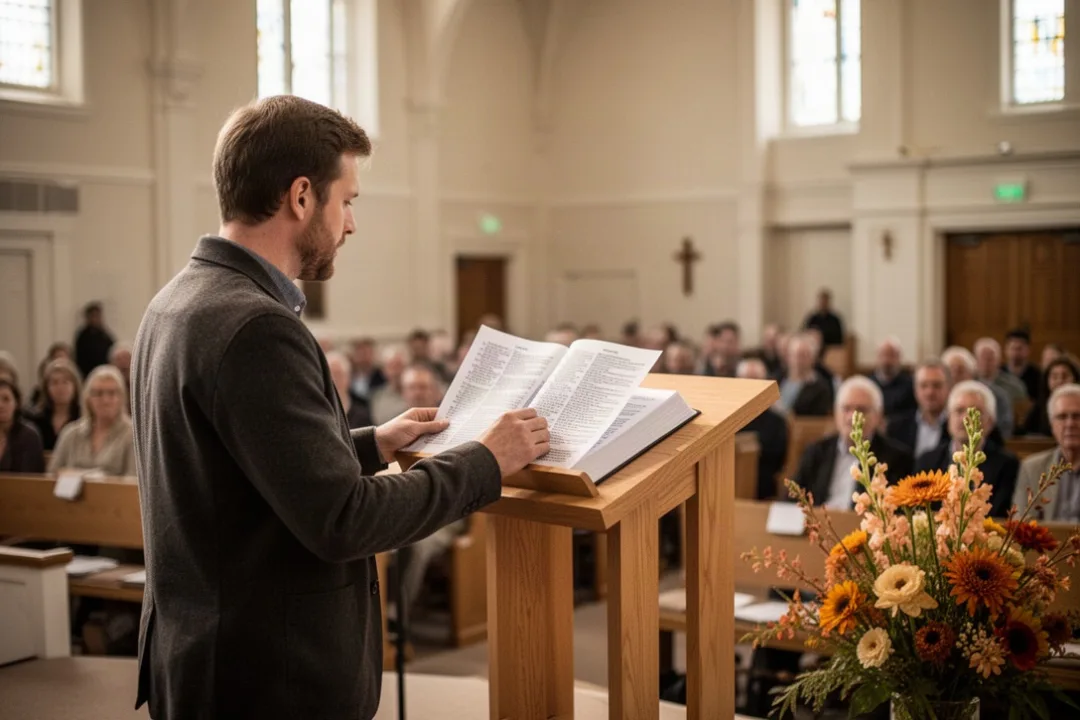
A well-chosen topic can still lose its impact if the delivery is unfocused. Before preaching, identify the one sentence you want people to remember. Then test every paragraph against it. If listeners remember only the topic, the Scripture reference, and one practical response, the homily has still given them a usable gift.
Read the homily aloud during preparation. Spoken language is different from written language, and sentences that look polished on a page may sound complicated from the pulpit. Mark places to pause, slow down, or make eye contact. Remove repeated explanations and long openings that delay the central message.
Use a clear beginning: Start with a real human question or situation rather than a vague statement about the readings.
Keep one controlling idea: Related points should serve the main topic instead of competing with it.
Vary your pace: Allow important statements and moments of grief to breathe rather than rushing through them.
Choose inclusive examples: Avoid assuming every listener is married, wealthy, healthy, a parent, or at peace with family.
End with direction: Leave people with a prayer, practice, question, or act of service connected to the central message.
Use humor sparingly and never at the expense of someone’s pain, identity, failure, or public crisis. A warm tone can make a difficult message approachable, but the congregation should sense that the subject is being treated with reverence. The goal is not to perform; it is to help people hear and respond.
It can help to keep a planning list of homily topics, but do not force a favorite theme onto every reading. Record questions raised by parish life, recurring pastoral needs, and images that emerge during prayer. When the readings later meet one of those needs, you will have a starting point without replacing careful preparation.
After preaching, reflect on the message with humility. Ask whether the topic was faithful to the text, whether the application was realistic, and whether the people most affected by the subject would have felt respected. Feedback from trusted parishioners can reveal where the homily was clear, where it wandered, and which phrase genuinely helped.
The most effective homily topics are not necessarily the most original. They are the ones that let ancient faith speak honestly to present human life. When the message is rooted in Scripture, shaped by compassion, and directed toward a concrete response, listeners have a better chance of carrying it from worship into the ordinary decisions of the week.
Frequently asked questions
How long should a homily be?
The right length depends on the setting, tradition, and congregation, but clarity matters more than a fixed word count. A homily should allow enough time to explain the reading, connect it with life, and offer a response without repeating itself. Read it aloud and remove material that does not strengthen the central claim.
How many points should a homily include?
Most homilies benefit from one main point supported by two or three movements. Too many points make the message difficult to remember and can weaken the connection with the readings. If you have several good ideas, save them for another occasion or combine them under one clearly stated theme.
Can a homily include current events?
Yes, when current events genuinely illuminate the Scripture and are handled with care. Use them to address human experiences such as grief, injustice, fear, or responsibility rather than to promote a partisan argument. Avoid unverified details, unnecessary controversy, and examples that exploit people directly affected by a crisis.
What makes a homily different from a sermon?
The terms overlap, and usage varies among Christian traditions. “Homily” often refers to preaching that explains and applies the readings within a worship service, especially in Catholic settings. “Sermon” is broader and may describe preaching in many contexts. In practice, both should communicate biblical truth clearly and call listeners toward faithful living.
















Leave a Reply