Ezekiel 17 explained: The riddle, judgment, and hope
Ezekiel 17 explained: The riddle, judgment, and hope
Ezekiel 17 is a riddle about Judah’s rebellion against Babylon, told through the images of two great eagles, a cedar tree, and a vine. Its main message is that Jerusalem’s leaders broke a sworn covenant with Babylon by seeking help from Egypt, so their political strategy would end in judgment.
The chapter also carries a message of hope. After describing the failure of human rulers, God promises to plant a tender branch on a high mountain. That final image points to God’s ability to establish a lasting kingdom when human power, diplomacy, and ambition have failed.
Ezekiel spoke to the people of Judah during the period when Babylon dominated the region. Jerusalem had already experienced a major defeat, and Babylon had taken members of Judah’s royal and professional classes into exile. The chapter addresses the political crisis that followed, especially the actions of the king ruling in Jerusalem.
The first eagle represents Babylon and its king, Nebuchadnezzar. The cedar represents the royal house of David, while the highest branch represents the king and leading officials taken away to Babylon. Babylon then placed another member of Judah’s royal family in Jerusalem and required him to rule as a dependent king.
That ruler is generally identified as Zedekiah, who had been installed after Jehoiachin was taken into exile. The arrangement was meant to keep Judah under Babylonian control. Zedekiah remained on the throne, but his authority depended on loyalty to the empire that had placed him there.
Instead of remaining faithful to that agreement, Zedekiah turned toward Egypt for military support. Ezekiel presents this decision not merely as a questionable diplomatic choice but as a violation of an oath made before God. The chapter therefore joins international politics, personal responsibility, and covenant faithfulness.
Central idea: Ezekiel 17 says that Judah’s downfall came from relying on a foreign power while breaking a sworn agreement. The chapter treats political rebellion as a spiritual matter because God held the oath accountable.
How the riddle of Ezekiel 17 works
The chapter begins with God telling Ezekiel to present a riddle and a parable to the people of Israel. A riddle invites the audience to think beneath the surface, while a parable uses familiar images to make a difficult reality visible. The symbols are not decorative; each one represents a person, nation, or political action.
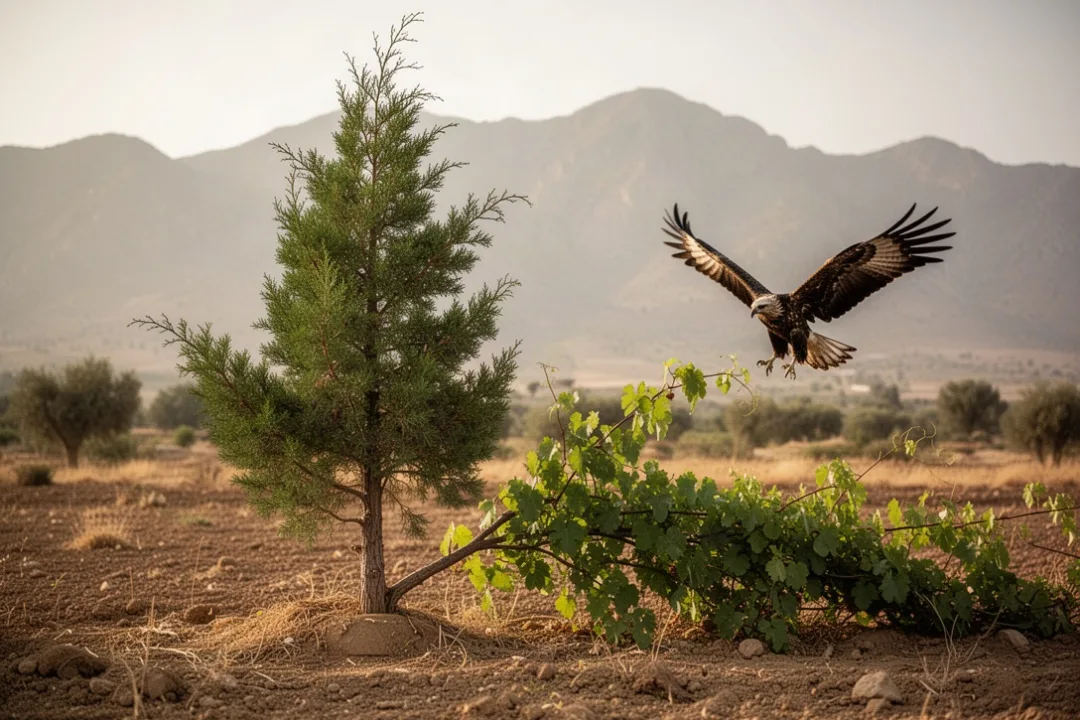
The first great eagle: Babylon’s imperial power and its ruler.
The cedar: Judah’s royal house, especially the Davidic monarchy.
The topmost shoot: the king and leadership taken from Jerusalem into exile.
The planted seed: a new ruler placed in Jerusalem under Babylonian authority.
The second eagle: Egypt, the foreign power Judah sought for help.
The vine: Judah, which depended on the first eagle but turned toward the second.
The imagery is designed to show that Judah’s relationship with Babylon was not accidental. The first eagle takes a branch from the cedar, carries it away, and plants another seed in the land. This describes a controlled transfer of royal authority rather than the complete destruction of Judah’s political structure.
The planted vine grows low rather than towering upward. Its position reflects Judah’s reduced status: the nation still exists, but it no longer stands as an independent empire. It has enough life to survive, yet it remains dependent on the power that planted and watered it.
What the first eagle and cedar represent
The first eagle is described as large, powerful, and associated with broad wings and many feathers. These details communicate imperial reach and political strength. The eagle comes to Lebanon, where the cedar grows, and takes the highest branch. Lebanon’s cedar was a natural image of majesty, durability, and royal splendor.
In the riddle, the cedar is not simply a picture of Jerusalem’s buildings or geography. It represents the Davidic royal line, whose kings were expected to lead Judah. Removing the highest branch pictures the removal of the reigning king and his court from Jerusalem.
The eagle carries the branch to a land of merchants and plants it in a city associated with trade. This reflects the exile of Judah’s leadership to Babylon, a major center of imperial administration and commerce. The image emphasizes that the king’s removal was part of Babylon’s organized policy, not a random act of violence.
The eagle also takes seed from the land and plants it in fertile soil near abundant water. That seed represents the ruler Babylon installed in Jerusalem. The new king is given a chance to grow, but his position remains dependent on the eagle’s authority.
Why the low vine matters in the parable
The vine begins to grow toward the first eagle, with its roots beneath the eagle and its branches directed toward it. This posture portrays dependence, submission, and limited prosperity. Judah can survive under Babylon’s authority if it accepts the arrangement.
The vine does not need to become a mighty tree to fulfill its purpose. Its future depends on remaining where it was planted and receiving water from the source provided. In political terms, Judah could retain a measure of stability by keeping its covenant with Babylon.
The image also exposes the weakness of the vine. It has growth, but not independence. It is not portrayed as a rival to the eagle or as a tree that can establish its own dominion. Ezekiel’s point is that Judah’s safest course was humble submission rather than an attempt to recover power through another empire.
This does not mean Ezekiel presents Babylon as morally righteous in every respect. The chapter focuses on Judah’s specific obligation after Babylon’s intervention. God can use a foreign empire as an instrument of judgment while still holding that empire accountable for its own conduct elsewhere in Scripture.
Why the second eagle represents a disastrous choice
The second eagle is another powerful bird, but the vine turns toward it in the hope that it will receive water and flourish. This symbolizes Judah’s appeal to Egypt for military help. The vine’s roots are no longer content with the place where the first eagle planted it.
The question at the center of the parable is whether the vine will prosper after pulling itself toward another power. Ezekiel’s answer is no. The vine has been uprooted, its fruit dries up, and its new growth becomes weak rather than productive.
The political lesson is direct: Judah exchanged a difficult but established obligation for a dangerous alliance. Egypt might appear to offer an escape from Babylon, but the chapter portrays that hope as unreliable. Judah’s rebellion would expose Jerusalem to the consequences of Babylonian retaliation.
The second eagle therefore represents more than Egypt’s military presence. It represents the temptation to seek security through a new alliance while ignoring an existing responsibility. The people wanted deliverance, but Ezekiel argues that their chosen method would bring greater disaster.
How Ezekiel connects politics with covenant faithfulness
The most serious charge in the chapter is not simply that Judah miscalculated. God says that the ruler in Jerusalem despised an oath and broke a covenant. Because that oath had been made under God’s authority, breaking it was treated as an offense against God himself.
Ancient treaties often involved solemn promises before a deity. Ezekiel uses that setting to explain why Zedekiah’s decision was spiritually significant. The king might have viewed the agreement with Babylon as a temporary political arrangement, but God regarded the promise as binding.
The chapter therefore challenges the idea that religious faithfulness concerns only worship practices. Truthfulness, public promises, and political decisions also fall under God’s judgment. A leader’s word matters because leadership affects an entire people.
This does not make every political agreement permanent or prevent a nation from responding to injustice. Ezekiel’s emphasis is narrower: Judah accepted a covenant, benefited from the stability it provided, and then violated it by seeking another empire’s help.
What Ezekiel 17 says about leadership and responsibility
The chapter places special responsibility on the ruler who breaks the covenant. Zedekiah did not act as a private citizen whose choices affected only his household. As king, he represented the nation and made decisions that exposed Jerusalem to war.
His position also reveals the limits of power. Zedekiah occupied the throne, but he did not possess full freedom. He ruled under Babylonian supervision, and his attempt to escape that position brought consequences he could not control.
Ezekiel does not present the king as trapped by circumstances without moral agency. The ruler had a choice: remain faithful to the agreement or pursue another alliance. The chapter insists that pressure does not erase responsibility, especially when a leader’s decision places others at risk.
Power does not remove accountability. A king remains answerable for promises and decisions.
Short-term escape can create long-term ruin. Seeking immediate relief may worsen the original crisis.
Public trust depends on truthful commitments. Agreements lose their meaning when leaders treat them as disposable.
Dependence should be recognized honestly. Pretending to be independent can lead to reckless choices.
Why Ezekiel 17 announces judgment on Jerusalem
The chapter describes judgment through the language of uprooting, drying, and withering. The vine that once had room to grow will be removed from the soil where it was planted. Its fruit will not mature, and its shoots will not become a strong tree.
This imagery anticipates the collapse of Judah’s political hopes. Babylon will respond to rebellion, and Egypt will not provide the secure rescue Judah expects. The result is not renewed independence but a deeper crisis for the city and its rulers.
The judgment is proportionate to the offense described. The ruler who broke the covenant will be taken into Babylon, where he will face the consequences of his rebellion. The people who trusted Egypt will discover that Egypt cannot replace the protection and stability they abandoned.
Ezekiel’s wording also underscores divine control over events. The chapter does not describe history as a series of disconnected accidents. God is presented as the one who evaluates the oath, exposes the motives behind the alliance, and announces what will happen to the vine.
What the tender sprig means in Ezekiel 17:22-24
After the judgment oracle, the chapter turns toward hope. God says that he will take a tender sprig from the top of the cedar and plant it on a high mountain. Unlike the failed vine, this new planting will become a noble tree with branches, fruit, and shelter for birds.
The change in imagery matters. Earlier, Judah’s leaders were moved and planted by an imperial power. In the final promise, God himself chooses, plants, and establishes the branch. The future does not depend on Babylon, Egypt, or the political schemes of Judah’s rulers.
The tender sprig is often understood as a future Davidic ruler or kingdom. The chapter does not spell out every later theological association, so interpretations differ in detail. Christian readers commonly connect this promise with the hope of the Messiah, while Jewish interpretation often reads it within the continuing expectation of restoration for David’s line and Israel.
The high mountain recalls a place of public visibility and significance. The tree will not remain hidden or obscure; it will become prominent. Its growth reverses the humiliation represented by the removed cedar branch.
The birds sheltering in its branches suggest that many peoples will find a place under this future kingdom. The final picture is not merely the survival of Judah as a small political unit. It is a vision of God-established authority that offers broad refuge.
Read the ending as a deliberate contrast: human rulers use alliances to preserve power, but God plants a kingdom that grows through his own purpose. The failed vine and the flourishing tree show two different foundations for security.
How Ezekiel 17 differs from other biblical tree images
Biblical writers often use trees to represent kings, nations, prosperity, or protection. Ezekiel 17 uses those associations in a particularly concentrated way. The cedar represents royal height, the vine represents dependent political life, and the final tree represents a restored kingdom.
The chapter should not be reduced to a simple statement that trees are always good or eagles are always bad. The first eagle acts as the agent that removes and plants, while the second eagle becomes the object of misplaced trust. The meaning comes from the relationships between the symbols.
The contrast also prevents a shallow reading of restoration. God’s future work is not presented as a return to the exact political arrangements that existed before judgment. The new planting is a renewed work, established by God rather than recovered through human strategy.
Major themes to notice when reading Ezekiel 17
God sees the motives behind political decisions
The chapter looks beneath official explanations. Judah may have described its alliance with Egypt as necessary self-defense, but Ezekiel presents it as a rejection of a binding commitment. God evaluates not only the public action but also the underlying refusal to honor the covenant.
Promises remain serious during unstable times
Political upheaval can make old agreements feel inconvenient or impossible. Ezekiel 17 argues that instability does not automatically cancel responsibility. A promise made under pressure may still be a promise, especially when it was confirmed by an oath before God.
False security often looks attractive
The second eagle appears to offer a fresh source of water and growth. That image captures the appeal of a new alliance: it promises relief without requiring the patience and humility of remaining under an unwelcome arrangement. Ezekiel exposes the difference between an attractive prospect and a dependable foundation.
Judgment does not eliminate God’s purpose
The chapter moves from failed leadership to divine restoration. Judah’s rulers cannot preserve the kingdom through their own plans, but their failure does not mean God has abandoned his larger purpose. The tender sprig shows that judgment and hope can appear in the same prophetic message.
How Ezekiel 17 applies to personal and community life
Ezekiel 17 is first a message about Judah’s historical crisis, so it should not be turned into a simplistic formula for every modern political situation. Still, its themes can speak to personal and community decisions. The chapter asks what happens when people make commitments and later treat them as disposable.
One application concerns integrity. A promise may become difficult, embarrassing, or costly, but difficulty does not make it meaningless. Wisdom includes understanding what you have agreed to, recognizing the people affected by your word, and seeking honest ways to address a commitment when circumstances change.
Another application concerns misplaced dependence. The vine’s problem is not that it needs water; the problem is that it reaches toward a new source in a way that violates its responsibility. People and institutions can likewise confuse a powerful helper with a trustworthy foundation.
The chapter also encourages humility about control. Judah’s leaders attempted to manage competing empires through strategy, but their decisions produced consequences they could not contain. Careful planning is valuable, yet no plan can substitute for truthfulness and moral responsibility.
Identify the commitment. Ask what promise, agreement, or responsibility is actually in force.
Examine the motive. Determine whether a new plan is guided by wisdom or by fear and impatience.
Consider who bears the consequences. Leaders should not treat community costs as private risks.
Choose honest correction. If an agreement must change, address it openly rather than breaking it secretly.
Place ultimate hope in God. Human alliances can shift, but God’s purposes do not depend on unstable powers.
Questions for studying Ezekiel 17 in context
When reading the chapter, begin by identifying the symbols and then connect each one to the historical situation. Ask who takes the branch, who plants the seed, why the vine turns toward the second eagle, and what action causes the judgment.
Next, pay attention to the shift in speaker and tone. The riddle describes political events indirectly, the explanation exposes the king’s offense, and the final promise presents God as the one who will establish the future branch. That movement from concealment to explanation to hope is central to the chapter’s design.
It also helps to read Ezekiel 17 alongside the surrounding chapters and the historical accounts of Jerusalem’s final years. Related passages in Ezekiel discuss the responsibility of rulers, the consequences of rebellion, and the hope of a restored people. The books of Kings and Chronicles provide additional background for the political events Ezekiel addresses.
Keep the two parts together. If you read only the judgment, the chapter may seem to offer nothing but political disaster. If you read only the tender branch, you may miss why the judgment was necessary. Ezekiel holds both truths together: God confronts unfaithfulness, yet he preserves hope through his own initiative.
What Ezekiel 17 ultimately teaches about hope
The chapter’s hope is not based on Judah’s ability to recover through clever diplomacy. The first vine fails because it tries to secure its future by turning from one power to another. The promised tree succeeds because God establishes it.
That distinction gives the final image its force. Restoration is not simply the reversal of a military defeat or the return of an exiled king. It is the creation of a stable kingdom whose source is God’s faithfulness rather than human maneuvering.
For Christian readers, the tender branch can be read as part of the biblical expectation that culminates in Christ’s reign. For Jewish readers, it remains connected to the hope that God will renew Davidic rule and restore his people. Across these readings, the enduring emphasis is that God can bring lasting life from what human failure has cut down.
Ezekiel 17 therefore moves from a broken oath to a trustworthy promise. Judah’s leaders reach for security through competing empires and lose what they hoped to preserve. God, however, promises a kingdom that will grow, bear fruit, and provide shelter because it rests on his decision rather than on the unstable plans of human rulers.
Frequently asked questions
Who is the first eagle in Ezekiel 17?
The first eagle is generally understood to represent Babylon and its king, Nebuchadnezzar. He removes the top branch of the cedar, symbolizing the exile of Judah’s king and leadership, and plants another ruler in Jerusalem. The eagle’s actions portray Babylon’s control over Judah’s monarchy and political affairs.
Who is the second eagle in Ezekiel 17?
The second eagle represents Egypt, the foreign power Judah sought for military assistance. The vine turning toward this eagle pictures Judah’s attempt to escape Babylonian control by forming another alliance. Ezekiel presents that decision as both politically disastrous and morally wrong because it involved breaking a sworn covenant.
What does the vine symbolize in Ezekiel 17?
The vine symbolizes Judah under Babylonian authority. It is planted low and receives water, showing that Judah can survive in a dependent position. When it turns toward Egypt, the vine represents rebellion against the arrangement that sustained it. Its withering symbolizes the judgment that follows this act of disloyalty.
Is Ezekiel 17 a prophecy about the Messiah?
The tender sprig at the end of the chapter is commonly understood as a promise of future Davidic restoration. Christian interpreters often connect it with the Messiah and Christ’s kingdom. Jewish interpretations may emphasize the restoration of Davidic rule and Israel. The shared theme is God establishing a lasting kingdom after human rulers fail.









Leave a Reply