Genesis 3 and 4 show how human rebellion begins and how quickly its damage spreads through relationships, work, worship, and society. Genesis 3 centers on Adam and Eve’s disobedience in the garden, while Genesis 4 follows the consequences through Cain, Abel, and the growth of violence. Together, the chapters explain why the world is marked by alienation and death while also preserving signs of God’s patience and future hope.
Genesis 1 and 2 present God as the creator of an ordered and good world. Human beings are made in God’s image and placed in the garden of Eden with a particular responsibility: to cultivate and guard it. Genesis 3 interrupts that harmony, and Genesis 4 traces what happens when distrust of God becomes a pattern of human behavior.
The two chapters belong to the early part of Genesis often called the primeval history. This section addresses broad questions about humanity rather than focusing first on one nation or family. It explains the origins of sin, shame, conflict, murder, family divisions, cities, music, metalworking, and religious worship.
Genesis 3 and 4 should be read as connected stories. The garden disobedience damages the relationship between humans and God; Cain’s murder of Abel reveals the damage within the human family. In both chapters, people try to hide, shift blame, or resist responsibility, yet God continues to speak and act rather than abandoning them immediately.
Central idea: Genesis 3 explains the entrance of sin and alienation, while Genesis 4 shows sin becoming violence against another person. The chapters move from broken trust with God to broken trust between human beings.
Genesis 3 explained step by step
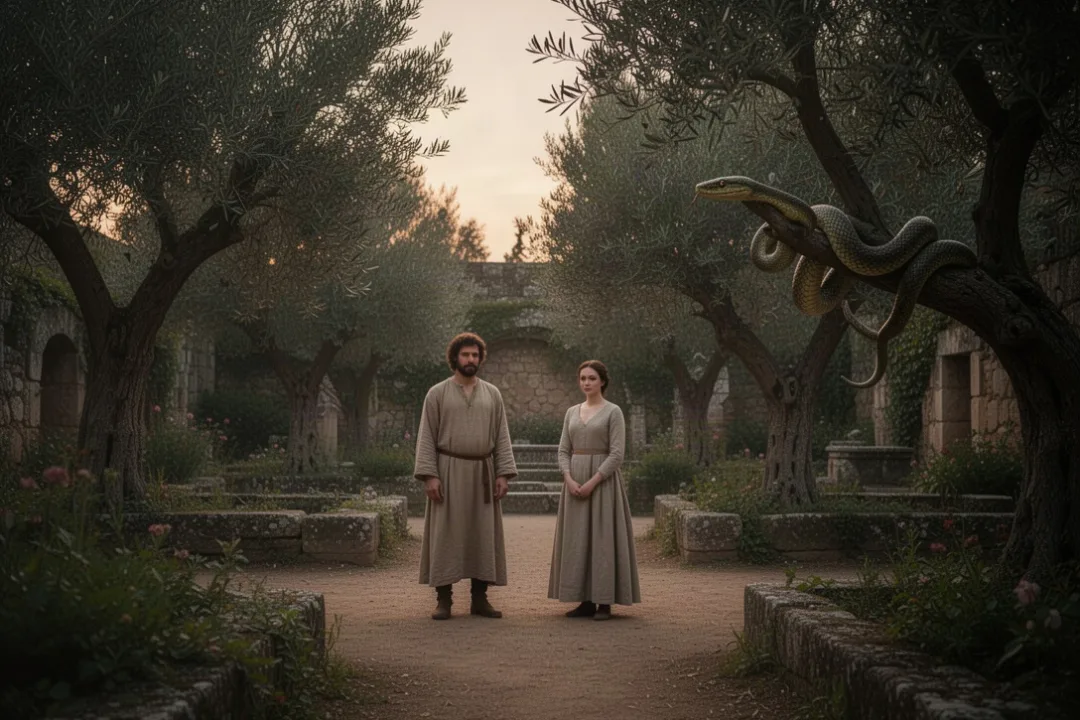
The serpent questions God’s command. The serpent approaches the woman and reframes God’s prohibition as if it were unreasonable. The conversation shifts attention away from God’s generous provision and toward the one restriction.
The woman and man eat the forbidden fruit. The woman sees the tree as desirable for food, appearance, and wisdom. She eats and gives some to the man, who is with her and also eats.
Shame enters their experience. Their eyes are described as opened, but the result is not the satisfying wisdom they expected. They recognize their nakedness and try to cover themselves.
They hide from God. When they hear God in the garden, they withdraw. Their fear reveals a changed relationship: the God associated with life and fellowship is now perceived as a threat.
Blame replaces confession. The man points to the woman and indirectly to God, while the woman points to the serpent. Neither accepts full responsibility for the choice.
God announces judgment and mercy. The serpent, woman, and man each receive consequences. Yet the humans are clothed, and their lives are preserved outside the garden.
Why the serpent’s temptation matters
The serpent begins by questioning what God said. Its strategy is not simply to deny God’s command but to distort God’s character. The question makes God seem restrictive, even though the garden contains abundant provision and only one prohibited tree.
The woman’s response also changes the wording of the command. The text presents a conversation in which God’s instruction is recalled and discussed, but the focus gradually moves from trust to suspicion. The temptation promises that eating will make the humans like divine beings, able to know good and evil. The desire for wisdom is not itself evil; the problem is the attempt to obtain it through independence from God.
Genesis does not identify the serpent by name as Satan in this chapter. Later biblical writings connect the serpent with the devil, but Genesis 3 itself emphasizes the serpent’s craftiness and the human decision to disobey. That distinction allows readers to see both the external temptation and the internal responsibility of the people who eat.
What the forbidden tree represents
The tree of the knowledge of good and evil marks a boundary. God gives the humans freedom within creation, but that freedom is not unlimited autonomy. The command asks them to trust God’s wisdom rather than seize moral authority for themselves.
“Knowing good and evil” can carry more than one shade of meaning in Scripture. It may refer to moral discernment, the experience of good and evil, or the authority to determine what is right. In Genesis 3, the phrase is tied to the desire to become like God. The issue is therefore not that knowledge is bad, but that the humans seek a status and authority that do not belong to them.
The fruit itself is not presented as magical in a modern sense. The tree functions as the concrete point at which the humans choose between trusting God’s word and defining reality on their own terms. Their action becomes a model of sin as disordered desire, distrust, and refusal to accept creaturely limits.
How Genesis 3 describes the consequences of sin
After eating, the man and woman experience shame. Their nakedness was previously associated with innocence and lack of fear; now it becomes a source of vulnerability. Their attempt to sew leaves together shows the first human effort to manage the consequences of sin without repairing the underlying relationship.
They also hide from God. God’s questions do not suggest ignorance, as if God were trying to discover what happened. The questions draw the people into an account of their actions. They expose the movement from disobedience to fear and from fear to blame.
The man says the woman gave him the fruit, and he also links her presence to God’s gift. The woman says the serpent deceived her. Their statements contain facts, but neither functions as a complete confession. Genesis presents blame-shifting as part of the disorder produced by sin.
The consequences reach every major area of life. The serpent is humiliated and placed in conflict with the woman’s offspring. The woman’s experience of childbirth and family relationships becomes marked by pain and tension. The man’s work becomes difficult, and the ground no longer yields food without struggle. Finally, death enters the horizon because the humans are barred from the tree of life.
What Genesis 3:15 means in different traditions
God’s words to the serpent include a promise that the serpent and the woman, along with their offspring, will remain in conflict. The serpent’s head will be crushed, while the serpent will strike the offspring’s heel. At the immediate level, the passage explains continuing hostility between humans and serpents.
Many Christian interpreters have also read this statement as the first gospel promise, sometimes called the protoevangelium. In that reading, the woman’s offspring points forward to Christ’s victory over Satan and sin. Jewish interpretation generally reads the passage within the ongoing conflict between humanity and the serpent, without treating it as a direct prediction of Jesus.
Readers should distinguish the passage’s original narrative setting from later theological interpretations. Genesis 3 presents judgment, conflict, and hope in the same speech. It does not erase the consequences of disobedience, but it leaves open the possibility that evil will not have the final word.
Why God clothes Adam and Eve before sending them out
God makes garments for the man and woman from animal skins. The text does not explicitly explain a sacrificial system here, so readers should avoid treating the clothing as a detailed ritual instruction. The immediate meaning is clear: even after judgment, God provides for the humans’ vulnerability.
This act combines mercy and consequence. The people are not allowed to remain in the garden and eat from the tree of life in their fallen condition, but they are not destroyed. Their expulsion protects the boundary of the garden and establishes the difficult setting in which human life will continue.
Some Christian traditions connect the animal skins with sacrifice and later atonement themes. That connection can be meaningful within a larger biblical theology, but Genesis 3 itself emphasizes clothing, care, and the loss of access to Eden more directly than it explains a complete doctrine of sacrifice.
Genesis 4 explained through Cain and Abel
Genesis 4 begins with the birth of Cain and Abel. Cain works the soil, while Abel keeps sheep. Both bring an offering to God, but the narrative says that God regards Abel and his offering favorably and does not regard Cain and his offering in the same way.
The text does not state that farming was inferior to shepherding, nor does it give a simple explanation that one offering was plant material and the other was an animal. The later biblical law includes offerings from crops and animals. Genesis focuses more on the condition of Cain and his response than on a universal rule about acceptable professions or materials.
Cain becomes angry and discouraged. God warns him that sin is crouching at the door and desires to control him, but Cain must rule over it. The image portrays sin as an active danger waiting to dominate. Cain is not described as helpless; he is confronted with a choice about what he will do with his anger.
Cain then takes Abel into the field and kills him. The first sibling relationship in the chapter becomes the setting for the first recorded murder. Genesis 3 showed humans hiding from God; Genesis 4 shows one human treating another as an obstacle that can be removed.
How God questions Cain after Abel’s death
God asks Cain where Abel is. Cain replies that he does not know and asks whether he is his brother’s keeper. The question is evasive, but it also introduces one of the chapter’s central moral issues: people do have obligations toward one another.
God describes Abel’s blood as crying out from the ground. This language gives the murdered brother a voice after Cain has silenced him. It also portrays the ground as responding to violence. Cain’s crime affects not only his family but also the land from which he had previously earned his living.
Cain is condemned to become a restless wanderer. The soil will no longer provide its strength to him as it once did. His punishment fits the story: the man whose work depended on the ground has defiled that ground with his brother’s blood, and his relationship to it is now broken.
Why Cain fears revenge and receives a mark
Cain fears that someone will kill him. His fear indicates that violence could continue in a cycle of retaliation. God responds by placing a mark on Cain and declaring that anyone who kills him will face vengeance. The mark protects Cain from being murdered, although Genesis does not describe what the mark looked like.
The passage does not authorize readers to identify a particular race, skin color, tattoo, or physical feature as Cain’s mark. Such claims are not supported by the text and have historically been used to promote racist interpretations. The mark’s purpose is protection, not ethnic classification.
Read the mark carefully: Cain receives punishment for murder, but God also prevents immediate revenge against him. Genesis 4 presents justice and restraint together rather than endorsing an endless cycle of violence.
What Cain’s city and descendants reveal about human culture
After leaving God’s presence, Cain has a son named Enoch and builds a city associated with him. The passage does not say that cities are inherently sinful. Instead, it shows that organized human culture continues even in a world marked by alienation. People build, produce, create, and develop communities, but cultural achievement does not by itself heal the human heart.
Cain’s descendants include figures connected with herding, music, and metalworking. These details show the development of ordinary human skills and social life. Genesis is not arguing that these pursuits are worthless. It is showing that civilization can advance while violence and pride also intensify.
Lamech, a later descendant of Cain, takes two wives and boasts about killing a man who wounded him. His speech expands Cain’s violence into a celebration of disproportionate revenge. Cain feared that someone might kill him; Lamech treats vengeance as a source of honor and claims that he deserves greater protection than Cain.
This progression reveals a pattern: sin moves from private disobedience to damaged relationships, then to murder and finally to public boasting about violence. Genesis 4 does not portray evil as a single isolated act. It shows how wrongdoing can become normalized, defended, and magnified across generations.
How Seth and Enosh provide a different direction
Genesis 4 closes with the birth of Seth, whom Eve sees as a replacement for Abel. Seth’s son is named Enosh, and the text says that people begin to call on the name of the Lord. This final note does not claim that everyone has become faithful or that violence has disappeared. It provides a contrasting path to the line of Cain.
Cain’s line is associated with building, productivity, and escalating violence. Seth’s line is associated with continuing the family line and renewed public worship. The contrast is not between culture and faith, as though work were automatically bad. It is between a life organized around self-protection and self-glory and a life that acknowledges dependence on God.
The closing reference to worship also prepares the reader for the genealogies and later stories in Genesis. The promise and purpose of humanity have not disappeared, even though the garden has been lost and Abel has died. God’s work continues through a damaged human family.
The main themes shared by Genesis 3 and 4
Distrust of God: The serpent’s temptation and Cain’s anger both grow from resistance to God’s word and judgment.
Disordered desire: The humans want wisdom on their own terms, while Cain wants acceptance without confronting his response to disappointment.
Shame and hiding: Adam and Eve hide from God, and Cain becomes a fugitive from human community and divine presence.
Blame and denial: Adam blames the woman, the woman blames the serpent, and Cain denies knowledge of Abel’s location.
Violence as a spreading power: The damage introduced in the garden becomes murder and then proud revenge.
Justice with mercy: God judges disobedience and murder, yet provides clothing, protection, and the continuation of human life.
Hope after judgment: The conflict with the serpent, the preservation of Cain, the birth of Seth, and the calling on God’s name all keep the story from ending in total ruin.
How Genesis 3 and 4 apply to relationships and responsibility
These chapters challenge the habit of treating sin as a private matter with no effect on anyone else. Adam and Eve’s choice affects their marriage, work, children, and relationship with God. Cain’s anger affects Abel, the family, the soil, and Cain’s own future.
The story of Cain especially emphasizes responsibility for another person. Cain’s question about being his brother’s keeper is answered by the narrative itself: Abel’s life matters, and Cain cannot make the murder disappear through denial. Human beings are not responsible for controlling every aspect of another person’s life, but they are responsible for refusing violence, protecting the vulnerable, and telling the truth about harm.
The chapters also caution against ignoring anger. God addresses Cain before the murder takes place, giving him an opportunity to master the desire that threatens to master him. The warning does not make Cain’s later action inevitable. It shows that unchecked resentment can become a doorway to destructive choices.
How to read Genesis 3 and 4 responsibly
Read each scene in its setting. The garden story concerns command, temptation, shame, and expulsion; the Cain story concerns worship, anger, murder, judgment, and protection.
Separate what the text says from later interpretations. For example, Genesis 3 does not name the serpent Satan, and Genesis 4 does not describe the mark of Cain’s appearance.
Notice repeated patterns. Pay attention to questions, hiding, blame, divine warnings, and the ways people respond after wrongdoing.
Hold judgment and mercy together. God does not ignore sin, but neither does God respond by destroying every offender immediately.
Read the chapters as part of a larger story. Later biblical books revisit creation, sin, death, violence, sacrifice, justice, worship, and hope in different ways.
For Christian readers, Genesis 3 and 4 help explain why the New Testament speaks about sin, death, reconciliation, and Christ’s victory. For Jewish readers, these chapters remain foundational accounts of human moral failure, responsibility, violence, and the continuing need to call upon God. For any reader, they offer a serious account of how distrust can become alienation and how alienation can become harm.
Questions Genesis 3 and 4 leave open
The chapters are precise about some matters and deliberately silent about others. Genesis does not identify the fruit, describe the serpent’s origin, explain exactly how Cain’s offering differed from Abel’s in God’s eyes, or reveal the appearance of Cain’s mark. Those unanswered details keep attention on the theological and moral movement of the stories.
The chapters ask readers to consider questions that remain relevant: What happens when desire overrides trust? How do people respond when they are confronted with wrongdoing? Can punishment prevent further violence? What responsibilities do people have toward their families and neighbors? Where can hope be found after guilt, loss, and exile?
Genesis 3 and 4 answer these questions without minimizing the seriousness of evil. Human beings are responsible for their choices, violence cries out for justice, and life outside Eden is painful. Yet God continues to address people, restrain violence, preserve life, sustain a human future, and receive worship. The story’s movement is therefore not from goodness to hopelessness, but from brokenness toward the possibility of redemption.
Frequently asked questions
Are Genesis 3 and 4 meant to be read as literal history?
Interpretations differ among Jewish and Christian communities. Some readers understand the chapters as historical accounts, while others read them as theological narratives that communicate truth through symbolism and archetypal characters. The text clearly addresses real questions about disobedience, shame, violence, responsibility, and God’s mercy, regardless of how a reader understands its literary form.
What was the forbidden fruit in Genesis 3?
Genesis never identifies the fruit by species. The later association with an apple comes from tradition and language-related symbolism, not from the biblical text. The story’s emphasis is on the command, the temptation, and the decision to distrust God, rather than on the botanical identity of the fruit.
Why did God accept Abel’s offering but not Cain’s?
Genesis does not give a single explicit explanation. The wording may place emphasis on the person presenting the offering as well as the offering itself, and later Scripture connects acceptable worship with faith and integrity. It is safer not to claim that farming or plant offerings were automatically inferior, since biblical worship includes both agricultural and animal offerings.
What does the mark of Cain mean?
The mark identifies Cain as someone under God’s protection from revenge. Genesis does not say what it looked like or connect it with race, skin color, or ethnicity. Interpretations that use the mark to justify racism go beyond the passage and contradict its immediate purpose: limiting further bloodshed after Cain’s murder of Abel.