Ezekiel 36 speaks to Israel during the Babylonian exile, a period when Jerusalem had been conquered, the temple destroyed, and many Judeans taken from their homeland. The chapter answers a painful question: could a people who had rebelled against God, suffered judgment, and lost their land ever be restored?
The answer is yes, but the reason for restoration is not Israel’s merit. God repeatedly explains that he will act for the sake of his holy name, not because Israel has earned a second chance. The chapter therefore holds two truths together: Israel’s sin was serious, and God’s mercy is greater than the nation’s failure.
Ezekiel 36 follows a message against Edom and other nations that had mocked Israel’s ruin. The opening section addresses the mountains of Israel, using the land as a representative image of the nation itself. The later verses turn directly toward Israel’s people and describe physical, spiritual, and communal renewal.
Central idea: Ezekiel 36 is not merely a prediction of improved circumstances. It presents restoration as God’s work from beginning to end: he gathers his people, cleanses them, changes their inner life, gives them his Spirit, and makes the land fruitful again.
What happens in Ezekiel 36, step by step
The chapter develops through a series of connected promises. Reading them in order helps show how outward restoration and inward transformation belong together.
God addresses the mountains of Israel. The land that has been mocked and desolated will no longer remain under contempt. Its future will be one of fruitfulness and habitation.
God confronts the nations that seized or ridiculed Israel. Their arrogance and hostility have not escaped his judgment.
God promises Israel’s return. The scattered people will be gathered from the nations and brought back to their own land.
God promises cleansing. He will cleanse the people from their uncleanness and idols, dealing with the spiritual pollution that contributed to their judgment.
God promises a new heart and spirit. He will remove the hardened heart and give his people an inner disposition that responds to him.
God promises his Spirit. His Spirit will enable the people to live according to his ways rather than merely hearing commands they cannot keep.
God promises renewed community life. The people will live in the land, become his people, and experience the restoration of cities, crops, and population.
God explains his purpose. The nations will recognize that he is the Lord when they see what he has done for Israel.
This sequence matters. The chapter does not treat restoration as a simple political reversal. The people need more than a return address. They need cleansing, a changed heart, and divine help to live faithfully in the restored relationship.
How Ezekiel 36 explains Israel’s exile
Ezekiel does not portray the exile as bad luck or as a defeat of God by Babylon. Israel’s judgment came because the people had repeatedly turned away from God, practiced idolatry, and violated the covenant. Their conduct had brought impurity into the land and dishonored the God who had placed his name among them.
Earlier parts of Ezekiel describe these failures in forceful terms. The nation had adopted the worship practices of surrounding peoples, oppressed others, and treated sacred things as ordinary. Ezekiel 36 assumes this background when God describes Israel as having polluted the land through its behavior.
Yet the chapter also describes how other nations interpreted Israel’s defeat. They saw the exiles and their ruined land and concluded that Israel’s God had been unable to protect his people. In this sense, Israel’s sin had caused the nations to treat God’s name with contempt.
The phrase “for the sake of my holy name”, found throughout the chapter’s argument, does not mean God ignores Israel’s wrongdoing. Instead, it means that his reputation, faithfulness, and covenant purposes are at stake. He will restore the people in a way that shows the nations that Israel’s God remains holy and sovereign.
What “for the sake of my holy name” means
God’s name in the Bible represents more than a label. It points to his character, reputation, and revealed identity. When God acts for his name, he acts consistently with who he has shown himself to be: holy, just, merciful, and faithful to his promises.
Ezekiel 36 makes a striking theological point: grace does not begin with human deserving. Israel has not persuaded God to restore it by presenting a record of good behavior. God takes the initiative because his purposes cannot be reduced to Israel’s failures.
This emphasis guards against two opposite mistakes. One mistake is pride, as though restoration proves that Israel was morally superior. The other is despair, as though Israel’s sin has made restoration impossible. The chapter rejects both ideas. Israel has no grounds for boasting, but it is not beyond God’s mercy.
The nations will eventually see that the restoration is not a human achievement. A scattered and defiled people will be gathered, cleansed, and renewed by God. Their transformation will become evidence of God’s holiness and power.
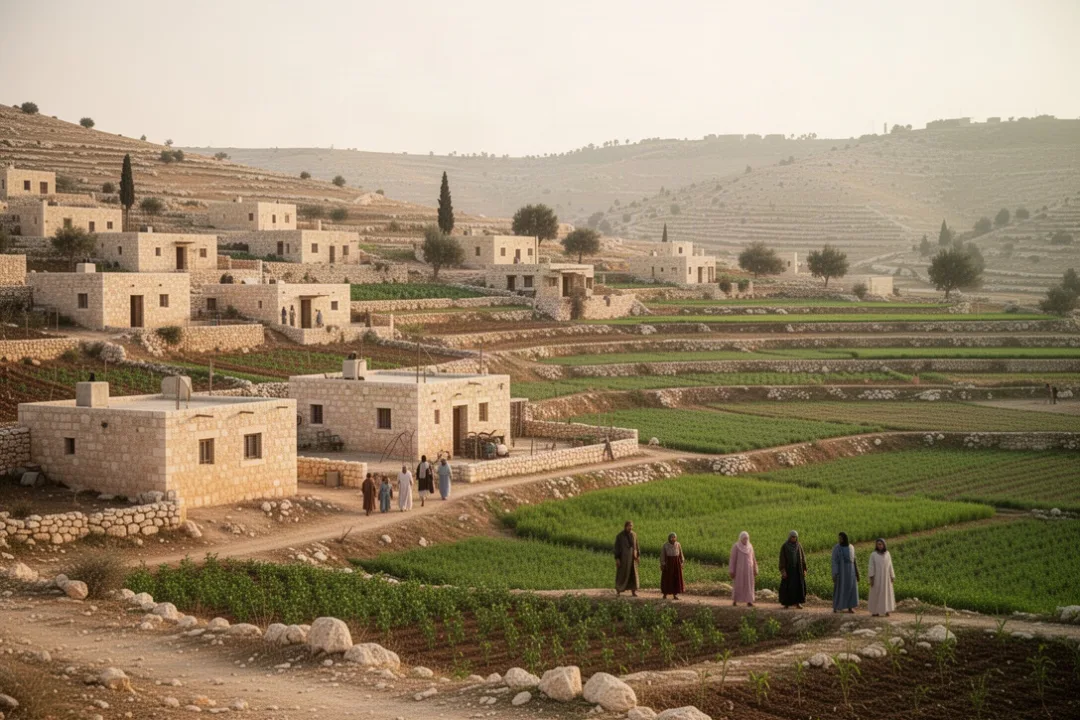
The first part of the chapter speaks to the mountains, valleys, waterways, and abandoned places of Israel. The land has suffered because of war, exile, and neglect, but God promises that it will become productive again. Formerly ruined settlements will be rebuilt, cultivated fields will yield crops, and the population will grow.
These promises are concrete. Ezekiel is not speaking only about an invisible spiritual condition. He describes homes, cities, fields, livestock, and people. For exiles who had lost their homeland, physical return and agricultural renewal represented a profound form of hope.
The land is also connected to God’s presence and covenant purposes. Israel’s failure had defiled it, but God promises to restore it after cleansing the people. This connection shows that biblical restoration is comprehensive: it includes the relationship between God, his people, and the place where they live.
Different Jewish and Christian traditions interpret the land promises in different ways. Some understand them primarily in relation to Israel’s historical return and continuing covenant identity. Many Christian interpreters also see them as part of a larger pattern that points toward the renewal of creation. These interpretations should not erase the chapter’s original focus on Israel and its land.
Reading carefully: The promise of a fruitful land should not be turned into a blanket guarantee of personal wealth or material success. Ezekiel 36 addresses Israel’s covenant restoration after exile, not a formula promising that every faithful person will prosper financially.
Why cleansing comes before the new heart
God promises to sprinkle clean water on Israel and cleanse the people from their uncleanness and idols. The language draws on familiar ideas of ritual purification, but the promise reaches beyond ceremonial washing. It describes God removing the spiritual defilement created by idolatry and rebellion.
The order is significant. Restoration is not simply a change of location. The people must be cleansed from the practices that corrupted their relationship with God. Returning to the land without abandoning idolatry would only reproduce the conditions that led to exile.
The cleansing promise also shows that renewal is God’s action. Israel does not cleanse itself through self-improvement. The chapter presents God as the one who washes, removes, gives, and enables. Human response remains important, but divine grace comes first.
For Christian readers, this language is often connected with wider biblical themes of forgiveness and spiritual purification. The connections can be meaningful, but Ezekiel 36 should still be read in its own setting: God is promising to purify exiled Israel and restore the covenant relationship.
What the new heart and new spirit signify
The best-known promise in Ezekiel 36 is God’s pledge to give Israel a new heart and a new spirit. In biblical language, the heart is not merely the seat of emotion. It represents the center of thought, will, desire, and moral decision.
A “heart of stone” pictures stubbornness, resistance, and insensitivity toward God. A “heart of flesh” pictures a living, responsive inner life. The contrast is not between a bad physical organ and a good one. It is between a hardened disposition and a teachable one.
God’s promise addresses a central problem in Israel’s history. The people had received commandments, warnings, prophets, and opportunities to repent, but external instruction had not produced lasting faithfulness. Ezekiel 36 points to an inward transformation that changes what the people want and how they respond.
The “new spirit” can describe a renewed disposition within the people, while the following promise of God’s Spirit emphasizes divine presence and power. Together, the expressions communicate inner renewal supported by God himself.
How the new heart changes obedience
God says that he will put his Spirit within the people and cause them to walk in his statutes. This does not suggest that obedience becomes automatic or that human responsibility disappears. It means that God provides the inward ability and desire that Israel previously lacked.
Obedience in this chapter is therefore not a way to earn restoration. It is the result of restoration. God first cleanses and renews his people, then enables them to live in faithful relationship with him.
This distinction matters for interpreting the chapter’s message about grace. The people do not obey in order to persuade God to love them. They obey because God has acted mercifully and changed their relationship with him.
External commands reveal what faithful living should look like.
A new heart changes the person’s inner orientation toward God.
God’s Spirit provides ongoing divine help and presence.
Faithful conduct becomes the visible result of inward renewal.
How Ezekiel 36 relates to covenant restoration
Ezekiel 36 does not use only one phrase to describe the future relationship between God and Israel, but its promises closely resemble the broader biblical hope of covenant renewal. God will take the people from the nations, gather them, cleanse them, and reestablish them as his people.
The statement that Israel will be God’s people and that he will be their God summarizes the restored relationship. This is not merely a political arrangement. It describes renewed belonging, loyalty, worship, and identity.
The chapter also addresses the problem of repeated failure. If the people return to the land but remain spiritually unchanged, restoration will not last. The promise of a new heart and God’s Spirit therefore provides the foundation for a more durable covenant life.
Jeremiah 31 contains a related promise of a new covenant written on the heart, while Ezekiel 37 continues Ezekiel’s restoration vision with the image of dry bones receiving life. These passages are related, but each contributes a distinct emphasis. Ezekiel 36 focuses especially on cleansing, inner renewal, the Spirit, and the land.
What Ezekiel 36 teaches about grace and human responsibility
The chapter repeatedly insists that Israel’s restoration does not happen because the people deserve it. God tells them that their past actions have not earned his favor. This language strips away human boasting and places the initiative with God.
At the same time, grace does not make sin unimportant. Ezekiel tells the restored people to remember their former ways and feel shame over their wrongdoing. Their self-understanding changes: they recognize both the seriousness of their rebellion and the undeserved mercy they have received.
This combination is central to the chapter’s message. Genuine restoration does not produce arrogance. It produces humility, gratitude, and a renewed desire to live faithfully.
For personal reflection, Ezekiel 36 offers several questions:
Have you confused outward religious activity with inward transformation?
Do you view repentance as merely feeling guilty, or as turning away from what corrupts your relationship with God?
Are you relying on personal effort alone instead of asking for God’s help to live faithfully?
Does receiving mercy make you more humble and obedient, or more self-confident?
How different traditions read Ezekiel 36 today
Jewish interpretation generally reads the chapter in relation to Israel’s exile, return, covenant identity, and future restoration. The promises concerning the land and the people remain significant within Jewish understandings of Israel’s relationship with God.
Christian interpretation often reads Ezekiel 36 alongside the New Testament’s teaching about regeneration, forgiveness, baptism, and the work of the Holy Spirit. Many Christians see the new heart and Spirit as anticipating the spiritual renewal experienced through faith in Christ.
Some Christian traditions connect the chapter primarily with the church as the people of God. Others maintain a stronger distinction between Israel and the church and expect a future fulfillment involving national Israel. Still others see layers of fulfillment, including historical restoration, present spiritual renewal, and final restoration.
These readings differ, but responsible interpretation should preserve the chapter’s main claims. God is the initiator of restoration, Israel’s sin is real, the land and people matter in the original context, and inward renewal is essential to lasting faithfulness.
Common mistakes when interpreting Ezekiel 36
Ezekiel 36 is rich in promise, but several shortcuts can distort its meaning. The chapter becomes clearer when its original audience and repeated themes remain in view.
Reducing it to a prosperity promise: The abundance of crops and rebuilt cities concerns covenant restoration, not a guarantee that believers will receive wealth.
Ignoring Israel’s sin: The promise of mercy does not cancel the chapter’s explanation of idolatry, defilement, and judgment.
Separating spiritual and physical restoration: The chapter joins a renewed land with a renewed people. Neither dimension should erase the other.
Making the new heart self-generated: God is the one who cleanses, removes the stone-like heart, gives the new heart, and places his Spirit within the people.
Using the passage to predict current events carelessly: The text should not be treated as a simple code for assigning prophetic meaning to every modern political development.
Forgetting the purpose of God’s name: Restoration is meant to reveal God’s holiness and faithfulness, not to make human beings the heroes of the story.
How Ezekiel 36 can shape faith and practice
Ezekiel 36 gives language for hope when failure seems permanent. The exiles could look at Jerusalem’s ruins and assume that the story was over. God’s promise shows that judgment is not the final word for those whom he purposes to restore.
The chapter also challenges shallow ideas of change. A new setting does not automatically produce a new life. People can relocate, adopt new routines, or improve their public image while keeping the same hardened inner disposition. Ezekiel points to a deeper work that reaches the will, desires, and spiritual identity.
For a person seeking God, the passage encourages honest repentance without hopelessness. It does not minimize wrongdoing, but it also does not suggest that failure has the power to defeat God’s mercy. The appropriate response is to confess sin, receive grace with humility, and seek the Spirit’s help for faithful living.
For a religious community, Ezekiel 36 warns against relying on heritage, institutions, or outward symbols while neglecting holiness. A community may possess a respected history and still need cleansing and renewal. God’s people are called to reflect his character rather than depend on their reputation.
The chapter also offers a careful definition of hope. Biblical hope is not wishful thinking or denial of suffering. It rests on God’s character and promise. The God who judges evil is also able to restore what sin has ruined, renew those who have become hardened, and bring life to places that appear abandoned.
How to study Ezekiel 36 closely
A thoughtful study can follow the chapter’s movement from public disgrace to restored holiness and renewed life. Read the chapter more than once, marking every promise God makes and every reason he gives for acting.
Identify the verses that describe the land and the verses that describe the people.
Mark each reference to God’s name, holiness, or the nations’ recognition.
Separate what God promises to do from what the restored people will become.
Compare the promises of cleansing, a new heart, and the Spirit.
Read Ezekiel 35 and 37 with the chapter to see how judgment and restoration connect.
Compare Ezekiel 36 with Jeremiah 31, while observing the distinctive emphasis of each passage.
One useful question is, “What problem does each promise solve?” The return to the land answers exile. Cleansing answers defilement. The new heart answers stubbornness. The Spirit answers inability to live faithfully. The renewed land answers desolation. God’s holy name answers the nations’ misunderstanding of his character.
That pattern reveals the chapter’s unity. Ezekiel 36 is not a collection of unrelated predictions. It is a carefully connected vision in which God restores his people outwardly and inwardly so that his holiness becomes visible among the nations.
Why Ezekiel 36 remains a message of hope
Ezekiel 36 speaks to people who have seen the consequences of sin, loss, and displacement. Its hope is substantial because it does not depend on pretending that the past did not happen. God acknowledges the people’s guilt and still promises to act with mercy.
The chapter’s strongest encouragement is that renewal begins with God’s faithfulness. He does not wait for Israel to become worthy before extending restoration. He cleanses the unclean, softens the hardened, gathers the scattered, and gives his Spirit to those who need transformation.
That promise does not remove the need for repentance or obedience. Instead, it places both within a larger work of grace. God restores his people so they can belong to him, live differently, and display the holiness of the God who saved them.
Frequently asked questions
What is the main message of Ezekiel 36?
The main message is that God will restore Israel after exile, cleanse the people from idolatry, renew their inner life, and give them his Spirit. He emphasizes that this restoration is not earned by Israel’s goodness. God acts for the sake of his holy name, demonstrating his faithfulness and holiness to Israel and the surrounding nations.
What does the new heart mean in Ezekiel 36?
The new heart represents a transformed inner life. Instead of remaining stubborn and resistant toward God, the restored people will receive a living, responsive disposition. The image concerns the will, desires, and moral direction, not a physical organ. It describes God changing the people from within so they can live faithfully.
Does Ezekiel 36 predict the modern state of Israel?
Interpretations differ. Some readers connect the chapter with Israel’s historical return and continuing national restoration, while others expect a future fulfillment or read parts of it through a broader Christian theological framework. The passage itself addresses Israel’s exile, land, covenant relationship, and spiritual renewal, so modern political events should not be treated as a simple one-to-one fulfillment.
How is Ezekiel 36 connected to the Holy Spirit?
Ezekiel 36 promises that God will put his Spirit within his people and enable them to follow his ways. The Spirit is presented as God’s renewing presence, not merely as an impersonal force. Christian readers commonly connect this promise with the New Testament’s teaching about spiritual rebirth and the Spirit’s work, while the original chapter focuses on Israel’s covenant restoration.














Leave a Reply