Babylon in the Bible: History, meaning, and symbolism
Babylon in the Bible: History, meaning, and symbolism
Babylon in the Bible is both a real ancient city and a powerful symbol. Historically, Babylon was the capital of a major Mesopotamian empire that conquered Jerusalem, destroyed the temple, and carried many people of Judah into exile. In later biblical writing, Babylon also represents human pride, corrupt power, oppression, and rebellion against God.
The name appears from the story of the Tower of Babel in Genesis through the final visions of Revelation. To understand its meaning, you need to distinguish between Babylon the historical kingdom, Babylon as the setting of Jewish exile, and “Babylon” as a symbolic name for an arrogant world system.
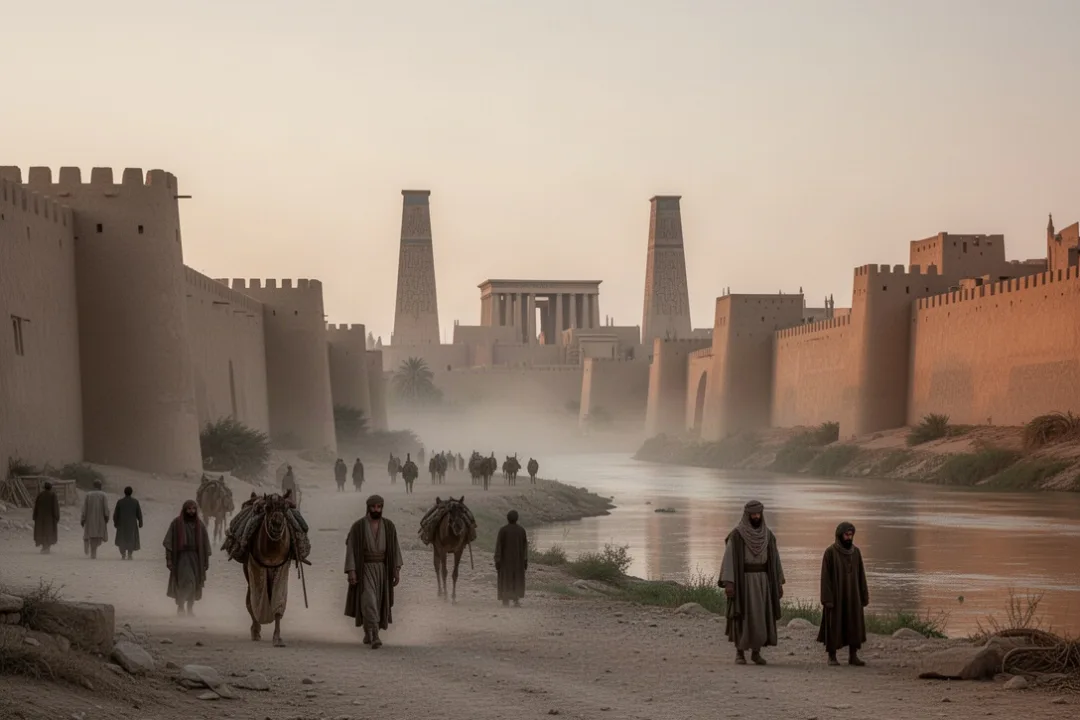
Babylon was an ancient city on the Euphrates River in Mesopotamia, in the region associated with modern-day Iraq. Its influence reached far beyond its walls, especially under the Neo-Babylonian king Nebuchadnezzar II. The Bible presents the city as wealthy, impressive, militarily powerful, and deeply opposed to God’s people.
The biblical name is connected with Babel, which appears in Genesis 11. In that story, people unite to build a city and a tower intended to reach the heavens and make a lasting name for themselves. God disrupts their shared language, and the place becomes associated with confusion. The account establishes an important theme: organized human ambition can become an attempt to secure glory and independence apart from God.
Later, Babylon becomes more than a memory of Babel. It becomes the empire that invades Judah, burns Jerusalem, destroys the temple, and removes many Judeans from their homeland. That historical trauma gives the name Babylon emotional and theological weight throughout the rest of Scripture.
Key distinction: Babel and Babylon are closely connected in biblical language, but the Bible uses Babylon in different settings. Genesis emphasizes humanity’s pride and scattered unity; the historical books emphasize imperial conquest; Revelation uses Babylon as a symbol of corrupt power.
How Babylon’s story develops across the Bible
You can follow Babylon’s role through several major stages. Each stage adds a different layer to the name rather than replacing the earlier meaning.
Babel represents proud human ambition. Genesis 11 describes a unified population seeking security and fame through a monumental city and tower.
Babylon becomes a military empire. In the books of Kings and Chronicles, Babylon rises against Judah and takes control of Jerusalem.
The exile becomes a test of faith. Psalms, Jeremiah, Ezekiel, and Daniel reflect the grief, questions, and hope of people living under Babylonian rule.
Prophets announce Babylon’s judgment. Isaiah and Jeremiah describe the empire’s downfall, showing that no earthly power is beyond God’s authority.
Daniel contrasts Babylon’s kings with God’s kingdom. Nebuchadnezzar’s pride and the mysterious writing at Belshazzar’s feast illustrate the limits of royal power.
Revelation turns Babylon into a final symbol. The “great Babylon” represents a lavish but corrupt power destined to fall under divine judgment.
This progression explains why a Bible reference to Babylon can mean different things. A passage in 2 Kings may describe a specific invasion. A passage in Revelation may use the city’s name symbolically. The surrounding text determines which meaning is primary.
Babylon’s role in Judah’s exile
Babylon became central to Israel’s history when it defeated the kingdom of Judah. The Bible describes more than one deportation from Jerusalem. Among the exiles were members of the royal family, officials, skilled workers, and others whose removal weakened Judah and served Babylon’s imperial policy.
The decisive catastrophe came when Babylon captured Jerusalem, destroyed the temple, and ended the city’s political independence. The account in 2 Kings 24–25 and the parallel material in 2 Chronicles 36 connects this disaster with Judah’s long pattern of idolatry, injustice, and refusal to heed prophetic warnings. The biblical writers therefore see the defeat as both a political event and an act of divine judgment.
That interpretation does not make the suffering insignificant. The book of Lamentations mourns Jerusalem’s destruction with intense grief. Psalm 137 remembers the pain of exiles who were forced to live far from home. Its harsh language reflects trauma rather than offering a simple slogan about revenge.
Jeremiah gives the exiles a difficult but practical message: they should build homes, establish families, and seek the welfare of the city where they have been sent. The instruction, recorded in Jeremiah 29, does not approve Babylon’s injustice. It tells displaced people how to remain faithful during a long period they cannot immediately change.
What the Babylonian exile meant for Jewish faith
The exile raised difficult questions. If Jerusalem was God’s chosen city and the temple was the center of worship, how could Babylon destroy them? Had God abandoned his people? Was Babylon’s victory proof that Babylon’s gods were stronger?
The biblical response is consistent but not simplistic. The prophets say Judah’s destruction was not evidence of Babylonian superiority. God permitted judgment on Judah, but Babylon itself would also be judged for its violence, arrogance, and cruelty. This preserved both sides of the biblical message: Judah was accountable, and Babylon was not morally innocent.
The exile also changed how faith was practiced. People had to seek God without relying on the temple’s physical presence. Prayer, Scripture, community life, and faithfulness in foreign surroundings became especially important. The experiences of figures such as Daniel, Hananiah, Mishael, and Azariah show how Jewish identity could endure within a dominant culture.
For many readers, Babylon therefore represents a place where faith is tested under pressure. The question is not only how to escape a hostile environment. It is also how to live with integrity while surrounded by values, practices, and loyalties that may conflict with worship of God.
What Daniel teaches through Babylon’s royal court
The book of Daniel places faithful Jews inside Babylon’s government and educational system. Daniel and his companions are given new names, trained in the language and literature of the empire, and prepared for service in the royal court. The narrative recognizes the power of cultural pressure while showing that service within an empire does not require surrendering religious convictions.
Daniel’s refusal to eat the king’s food, his continued prayer, and his interpretation of royal dreams all communicate the same central idea: God remains sovereign even when an empire appears unstoppable. Daniel can work in Babylon without treating Babylon as ultimate.
Nebuchadnezzar’s dream of the statue
In Daniel 2, Nebuchadnezzar dreams of a large statue made of different materials. Daniel explains that the statue represents a sequence of kingdoms, while a stone not shaped by human hands destroys it and grows into something greater. The vision places Babylon within a succession of temporary empires.
The image challenges the assumption that political power lasts forever. Babylon may stand at the center of the known world, but its authority is limited. The kingdom associated with human glory will eventually give way to a rule established by God.
Nebuchadnezzar’s humiliation
Daniel 4 presents Nebuchadnezzar as a king who boasts about the greatness of Babylon. He is then humbled and loses the stability associated with royal power. Afterward, he acknowledges that heaven rules over earthly kingdoms.
The story does not deny the city’s magnificence. Instead, it asks whether splendor should lead to worship of the ruler. Babylon’s buildings and achievements cannot protect a king from accountability. The passage turns political pride into a spiritual warning.
The writing at Belshazzar’s feast
Daniel 5 describes a royal banquet in which sacred vessels taken from Jerusalem’s temple are used for a celebration honoring Babylonian gods. A mysterious message appears on the wall, and Daniel interprets it as a declaration that the king’s reign has been evaluated and found wanting.
The story links sacrilege, arrogance, and sudden judgment. Babylon’s rulers behave as though conquest has made them invulnerable, but the narrative insists that wealth and military power do not erase moral limits. That same night, according to the biblical account, the kingdom changes hands.
How the Bible describes Babylon’s fall
Several prophetic passages announce Babylon’s downfall before or around the period of its decline. Isaiah 13–14 portrays Babylon as destined for judgment, while Jeremiah 50–51 describes its defeat and the release of captives. These chapters use vivid poetic language, so not every image should be read as a technical report of military events.
Historically, the Persian ruler Cyrus captured Babylon in 539 BCE. The change of empire opened the way for exiled Judeans to return under Persian authority. The books of Ezra and Nehemiah describe later stages of restoration, including the rebuilding of the temple and Jerusalem’s walls.
The Bible treats the end of Babylon as a sign of God’s ability to bring down an apparently permanent empire. Yet Babylon did not disappear from human memory immediately. Its cultural reputation, political legacy, and symbolic significance continued long after its supremacy ended.
That pattern matters for reading prophecy. A passage about Babylon may speak to a historical judgment while also establishing a wider principle: oppressive systems can flourish for a time, but their success is not the same as approval and their power is not permanent.
Babylon’s symbolic meaning grows from several biblical themes that appear together. The city is associated with monumental building, imperial conquest, luxury, idolatry, violence, and confidence in its own permanence. These qualities make it a fitting symbol for societies that place wealth and control above justice and humility.
Its pride is not simply confidence or achievement. The biblical criticism focuses on self-exalting power that refuses accountability. Babylon says, in effect, that its strength comes from itself and that no higher authority can judge it. The problem is not that the city is organized or successful; the problem is that success becomes a substitute for God.
Babylon also symbolizes the way power can reshape moral judgment. A prosperous empire may call conquest security, exploitation success, and luxury proof of blessing. The prophets expose that distortion by asking what happened to the vulnerable people beneath the empire’s wealth.
Reading tip: When a passage uses Babylon symbolically, ask what feature it emphasizes: arrogance, economic exploitation, political domination, idolatry, persecution, or false security. The answer will usually clarify the passage more than treating Babylon as a simple label for every disliked institution.
What “Babylon” means in Revelation
Revelation 17–18 presents “Babylon the Great” as a dramatic vision of a corrupt power. She is portrayed as wealthy, influential, morally compromised, and connected with the rulers and merchants of the earth. The image draws on earlier biblical descriptions of Babylon while expanding the symbol beyond the ancient city.
Revelation emphasizes the relationship between political power, luxury, commerce, and spiritual unfaithfulness. The merchants mourn Babylon’s collapse because their profits disappear. The passage is therefore not only about one ruler or one military state. It also criticizes an economic order that benefits from exploitation and treats human lives as merchandise.
The vision calls God’s people to separate themselves from Babylon’s sins. This does not necessarily mean physical isolation from every society or economic activity. It means refusing participation in the values Revelation condemns: worship of power, greed, oppression, moral compromise, and dependence on wealth for security.
Revelation’s Babylon is eventually judged with striking finality. The city that appeared richly dressed and secure is exposed as corrupt and brought down. The contrast between public splendor and hidden injustice is central to the message.
Does Revelation’s Babylon represent Rome?
Many interpreters understand Revelation’s Babylon as an indirect reference to Rome, especially because the book was written in a setting where direct criticism of imperial power could be dangerous. Rome dominated the Mediterranean world and was known for wealth, military force, political control, and persecution of Christians in some periods.
That historical interpretation is widely discussed, but Revelation’s symbol is not limited to one ancient capital. The imagery deliberately reaches back to Babel and the Babylonian empire. It can therefore describe any power that combines political domination, economic exploitation, idolatry, and hostility toward God.
Readers should avoid assigning the name Babylon to a modern nation or organization too quickly. The text’s central concern is the character of a corrupt system, not a simple prediction that provides a modern political label. Careful interpretation begins with Revelation’s own images and its connections to the Old Testament.
How Babylon contrasts with Jerusalem
Babylon and Jerusalem often function as opposing city images in the Bible. Babylon represents human glory built through domination, while Jerusalem can represent God’s covenant purposes and the hope of restoration. Revelation intensifies this contrast by setting Babylon against the holy city, the New Jerusalem.
The contrast is not a claim that every historical resident of one city was good and every resident of the other was evil. Jerusalem’s own leaders and people are repeatedly judged in Scripture. The city becomes a positive symbol only when it is connected with repentance, justice, God’s presence, and renewed creation.
Babylon’s city is marked by commerce, luxury, violence, and mourning when profits vanish. The New Jerusalem is associated with God’s presence, healing, open access, and the removal of death and grief. These images present two different visions of human flourishing: one based on accumulation and control, the other on communion, justice, and life from God.
If you are studying the subject, these passages provide a useful reading path. Read each one in its literary setting rather than treating isolated verses as complete explanations.
Genesis 10–11: introduces Babel and the themes of scattered humanity, pride, and the desire to make a name.
2 Kings 24–25: records Babylon’s conquest of Judah, the destruction of Jerusalem, and the beginning of the exile.
2 Chronicles 36: summarizes Judah’s failure to heed warnings and Babylon’s destruction of the temple.
Psalm 137: expresses the grief and anger of Judeans living in exile.
Isaiah 13–14: announces judgment against Babylon through vivid prophetic poetry.
Jeremiah 25, 29, and 50–51: addresses the exile, life in Babylon, and the empire’s eventual judgment.
Daniel 1–5: portrays faithful Jews serving in Babylon and shows the limits of royal power.
1 Peter 5:13: uses “Babylon” in a way many interpreters understand as a symbolic reference to Rome, though the identification is interpretive.
Revelation 17–18: presents Babylon as a symbolic power marked by luxury, corruption, persecution, and sudden collapse.
How to study a passage about Babylon carefully
A few basic questions can keep the interpretation grounded. The same name may be historical in one passage, poetic in another, and symbolic in a third.
Identify the setting. Ask whether the passage belongs to Genesis, Israel’s historical books, prophetic poetry, wisdom literature, a Gospel-era letter, or Revelation.
Separate history from imagery. A prophet may describe a real empire with symbolic language. A vision may use a historical city to represent a wider spiritual reality.
Look for the specific charge. Is Babylon condemned for violence, idolatry, pride, exploitation, persecution, or all of these?
Read the surrounding chapters. The verses before and after often explain whether the focus is judgment, exile, repentance, restoration, or final hope.
Compare related passages. Revelation’s Babylon becomes clearer when read alongside Genesis 11, Isaiah, Jeremiah, and Daniel.
Apply the principle carefully. Ask how the passage challenges dependence on wealth, status, military power, or cultural approval without forcing every detail onto a modern event.
This approach also prevents two common mistakes. One is reducing Babylon to an ancient archaeological site and missing its theological meaning. The other is turning every reference into a confident prediction about current politics without first understanding the biblical text.
What Babylon can mean for readers today
Babylon can function as a warning about systems that reward pride and conceal suffering. It asks you to examine what a culture celebrates, who benefits from its prosperity, and whether power is treated as accountable to justice. The symbol is especially relevant wherever wealth, influence, and security become objects of devotion.
The exile adds another dimension. Faithful people may live within institutions they did not choose and cannot immediately transform. Daniel’s example suggests that integrity can include responsible public service, wise resistance, prayer, and refusal to worship political authority.
Jeremiah’s message to the exiles also discourages a shallow approach to culture. The exiles were told to seek the welfare of their city, even though Babylon had harmed them. Faithfulness involved neither total assimilation nor total withdrawal. It required discernment, patience, and hope in God’s promises.
Finally, Babylon’s fall assures readers that injustice is not permanent. The Bible does not promise that oppressive systems collapse quickly. It does insist that grandeur cannot guarantee survival, profit cannot erase guilt, and no empire has the final word.
Babylon’s central message in the Bible
Across its different appearances, Babylon carries one consistent warning: human power becomes destructive when it seeks glory without God, wealth without justice, and security without humility. The ancient city was real, but the Bible uses its history to address recurring patterns in human life.
Babylon can therefore be read as a place of exile, a proud empire, a judgment against oppression, and a symbol of corrupt civilization. Its story also points beyond judgment toward restoration. The Bible’s larger hope is not merely that Babylon will fall, but that God will establish a world in which power serves life, worship is true, and justice is no longer overturned by wealth.
Frequently asked questions
Was Babylon a real city in the Bible?
Yes. Babylon was a real ancient city in Mesopotamia, located near the Euphrates River. It became the capital of the Neo-Babylonian Empire and played a major role in Judah’s history. Babylonian forces captured Jerusalem, destroyed the temple, and deported many Judeans. Biblical authors later used the city as a symbol of pride, oppression, luxury, and resistance to God.
Why did Babylon destroy Jerusalem?
The Bible explains Jerusalem’s destruction in two connected ways. Historically, Babylon conquered Judah as part of its imperial expansion. Theologically, the biblical writers describe the defeat as judgment for persistent idolatry, injustice, and refusal to heed prophetic warnings. Babylon was still held accountable for its own cruelty and arrogance, so Judah’s judgment did not mean Babylon was morally justified.
Is Babylon in Revelation the United States?
Revelation does not identify the United States by name. Many interpreters first connect its Babylon imagery with Rome, while others see a broader symbol of corrupt political, commercial, and religious power. Applying the image to a modern country requires caution. The passage focuses on arrogance, exploitation, luxury, persecution, and false security rather than providing a simple label for one present-day nation.
What is the difference between Babel and Babylon?
Babel appears in Genesis 11 as the city where humanity attempts to build a tower and make a name for itself before God scatters the people’s language. Babylon is the later empire that conquers Judah and sends its people into exile. The names are closely related in biblical language, and both carry themes of pride, human power, and rebellion, but they belong to different historical settings.














Leave a Reply