You may have seen an eight-pointed white cross on a coat of arms, a medical badge, a piece of jewelry, or a flag and wondered what it means. The symbol is commonly called the Cross of St John, the Maltese cross, or the cross of the Knights Hospitaller.
It is associated with St John the Baptist, the medieval Order of St John, charitable care for the sick, and the island of Malta. Although its shape is now familiar around the world, the cross carries several layers of meaning. Its history connects religious devotion, military service, hospitality, medicine, heraldry, and national identity.
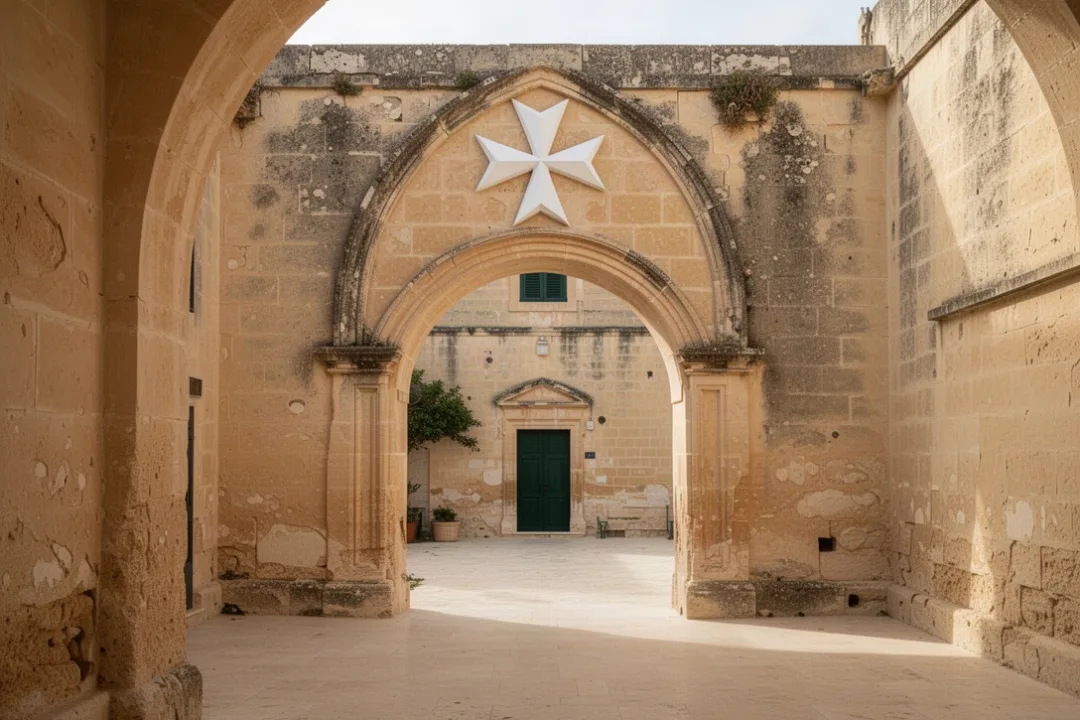
The Cross of St John has four broad arms that widen toward their outer ends. Each arm divides into two sharp points, creating eight points in total. The arms meet around a compact central area, giving the design a balanced, almost star-like appearance without making it a star.
The most recognized version is a white cross on a red background. You may also see a white cross by itself, a red cross on a white background, or a decorative version worked into stone, metal, fabric, or stained glass. The color and setting can change according to the organization or tradition using it.
The eight-pointed design is not the same as every cross with pointed or forked ends. In particular, it should not automatically be confused with the cross of the Knights Templar, the cross pattée, the Greek cross, or the red cross used by the International Red Cross and Red Crescent Movement.
Quick identification: If the arms form four distinct V-shaped ends and produce eight outer points, you are probably looking at the Cross of St John or a related Maltese cross design.
Why it is called the Cross of St John
The name comes from the Order of St John, a Christian religious and military order whose members became known as the Hospitallers. The order took its name from St John the Baptist and was connected with a hospital established in Jerusalem to care for pilgrims and other travelers.
Over time, the order developed from a charitable religious community into an organization that also defended territories and protected routes in the eastern Mediterranean. Its members wore and displayed a distinctive cross as a sign of faith, membership, and service.
The name “Cross of St John” is therefore historical and institutional. It does not mean that St John the Baptist personally designed the symbol or that the Bible describes this particular shape. The cross became associated with him because of the order that served under his name.
The symbol is also called the Maltese cross because the Order of St John ruled Malta for centuries. That name became especially widespread after the order established its headquarters and military presence on the islands. In many modern contexts, “Maltese cross” and “Cross of St John” refer to the same basic eight-pointed design.
How the cross developed through the Order of St John
The Order of St John began in the setting of medieval pilgrimage and charitable care in Jerusalem. Its members helped sick and vulnerable travelers, an activity reflected in the word Hospitallers. As political conditions changed, the order moved from the Holy Land to other Mediterranean locations before settling on Malta.
The cross used by the order did not necessarily appear in one perfectly fixed form from the beginning. Medieval symbols often varied according to local artistic practice, available materials, and the purpose of an object. Over generations, the design became increasingly recognizable as the eight-pointed cross now associated with the order.
On Malta, the cross appeared in architecture, military equipment, official objects, flags, coins, clothing, and religious art. The symbol became so closely linked with the island and its rulers that it acquired the name Maltese cross, even though its roots belong to the wider history of the Order of St John.
The order’s changing locations help explain why the cross can have both a religious and a civic meaning. It represented a Christian brotherhood, but it also became a sign of government, defense, organized relief, and public identity. The same emblem could appear in a chapel, on a fortress, or on an item connected with medical care.
What the eight points symbolize
The eight points are commonly interpreted as the eight obligations or virtues expected of members of the Order of St John. Wording varies among sources and modern organizations, but the ideas generally involve a life shaped by faith, honesty, compassion, courage, and service to others.
Some traditions connect the points with the Beatitudes, the teachings of Jesus in the Sermon on the Mount. Others describe them as qualities that a member should practice in daily life. These interpretations are related, but they are not always presented in exactly the same way.
A practical way to understand the symbolism is to see the eight points as a reminder that Christian identity should influence conduct. The cross is not merely an emblem of rank or ancestry; it points toward humility, mercy, discipline, and responsibility.
Faith: living according to Christian belief rather than treating the cross as decoration alone.
Truthfulness: acting honestly and keeping one’s word.
Humility: serving without placing personal status above the needs of others.
Justice: treating people fairly and defending those who need protection.
Compassion: responding to illness, poverty, fear, and suffering with practical care.
Courage: doing what is right even when service involves risk or difficulty.
Generosity: offering time, skill, resources, or attention to people in need.
Endurance: remaining faithful to service when results are slow or demanding.
These meanings should be treated as a traditional interpretation, not as a single universally fixed definition. Different branches, orders, and charitable bodies may explain the points using slightly different words. Their common theme is the connection between spiritual commitment and active service.
How the cross reflects hospitality and care for the sick
The Hospitallers were known for caring for people who were ill or injured. That history gives the Cross of St John a strong association with hospitality, medical assistance, and organized relief. The word hospitality originally carried a more serious meaning than welcoming guests at home: it included receiving, sheltering, and caring for people in need.
This background explains why related organizations have used the cross in first aid, ambulance work, nursing, and community service. The emblem can communicate a promise that trained people will respond to suffering with competence and compassion.
Its medical associations should still be distinguished from the emblems protected under international humanitarian law. The red cross emblem has a specific legal and humanitarian function and is not simply another color arrangement of the Maltese cross. A visually similar mark may be restricted or inappropriate when used in a way that could cause confusion.
Use with care: A Cross of St John may suggest first aid or charitable service, but it is not automatically an official medical emblem. Organizations should check applicable trademark, heraldic, and humanitarian-emblem rules before adopting it.
How the Cross of St John differs from related crosses
Many cross designs have broad arms, pointed ends, or a connection with Christian history. Their visual similarities can make identification difficult, especially when a symbol appears on a small badge or an old object. Looking at the number and shape of the points is a useful starting place, but context matters as well.
Cross of St John: usually has four arms, each ending in two points, for eight points overall.
Cross pattée: has arms that widen toward the ends, but its outer edges may be rounded, straight, or only lightly divided rather than forming the distinctive eight-pointed shape.
Knights Templar cross: is commonly shown as a red cross with arms that flare outward, but it is not normally the same eight-pointed Maltese design.
Greek cross: has four arms of equal length and generally squared ends, creating a simple four-armed shape.
Latin cross: has a longer vertical arm below the crossing point and is the familiar form used in many Christian settings.
International Red Cross emblem: is a red Greek cross on a white background and has a distinct humanitarian meaning.
Color alone cannot settle the question. A white eight-pointed cross may appear on a black or red field, while a red eight-pointed cross may be used in a modern logo or decorative object. The silhouette, historical setting, surrounding symbols, and stated owner provide stronger clues than color by itself.
The cross remains visible in places connected with the Sovereign Order of Malta, historic sites in Malta, and organizations that preserve the charitable tradition of the Order of St John. It may appear on uniforms, medals, certificates, buildings, flags, ambulances, and relief materials.
Related St John organizations in several countries use versions of the cross in connection with first aid training and community service. Their names, badges, and exact emblems are not identical everywhere, so the cross may be combined with additional symbols or placed inside a shield.
Tourism and popular culture have also made the design common on souvenirs. You might find it on Maltese pottery, jewelry, carved stone, hotel signs, wall plaques, or decorative ironwork. In those settings, it often represents Malta’s history and identity rather than membership in a religious or charitable order.
Fire departments and other public-service groups sometimes use Maltese-style crosses in badges or insignia. Those designs may reflect the idea of bravery and service without claiming a direct historical connection to the Order of St John. The exact meaning belongs to the organization that adopted the emblem.
What the cross means in jewelry and personal symbols
People wear a Cross of St John for different reasons. For some, it is a Christian devotional symbol that represents faith expressed through service. For others, it honors family heritage, a connection to Malta, an interest in medieval history, or work in medicine and emergency response.
A pendant or ring may also serve as a reminder of the eight virtues traditionally connected with the cross. In that use, the design carries a personal commitment to compassion, courage, and helpful action rather than simply identifying an institution.
Before buying or giving one as a gift, consider the intended meaning. A plain eight-pointed cross may be suitable as a historical or decorative item, while an official-looking badge, uniform insignia, or medal could imply membership or authority that the wearer does not have.
Materials affect appearance but not the basic symbolism. Silver, gold, enamel, wood, and stone versions can all represent the same general design. An inscription, coat of arms, crown, shield, or surrounding motto may add a more specific institutional or family meaning.
Practical tips for identifying the symbol accurately
If you encounter the cross on an old building, a flag, or an inherited object, avoid identifying it from shape alone. A few additional details can reveal whether it is a historical Cross of St John, a Maltese national reference, a service badge, or a modern decorative adaptation.
Count the outer points. Look for four arms with two points at the end of each arm.
Examine the colors. Record the background, the cross, and any border or enamel outline.
Look for companion symbols. Crowns, shields, lions, stars, medical tools, or heraldic animals may identify the organization.
Check the location. Malta, former Hospitaller sites, churches, hospitals, and first-aid buildings provide useful historical context.
Read any inscription separately. A motto or name can be more informative than the cross itself.
Compare the entire emblem. An organization’s badge may use an eight-pointed cross but combine it with a unique border or coat of arms.
Ask about provenance. For an inherited object, family records, military papers, or the history of the building may clarify its origin.
Common mistakes when interpreting the Cross of St John
Assuming every eight-pointed cross is ancient. Modern logos and decorative designs often borrow the shape without a direct historical connection.
Calling every pointed cross a Maltese cross. The eight-pointed structure is the most useful identifying feature, not simply a generally flared arm.
Confusing it with the Red Cross emblem. The two symbols have different designs, histories, and legal uses.
Treating one interpretation of the eight points as universal. Organizations may explain the virtues or Beatitudes in different ways.
Assuming the symbol proves membership. A souvenir, tattoo, or piece of jewelry does not establish a person’s connection with an order.
Ignoring the surrounding design. A shield, crown, motto, or medical badge may change the meaning of an otherwise familiar cross.
How Malta uses the cross in national identity
The Cross of St John is deeply connected with Malta’s historical identity because the Order of St John governed the islands for a long period. The cross appears in museums, historic fortifications, public monuments, churches, and cultural material throughout Malta.
It is also associated with the George Cross, which is a separate decoration connected with Malta’s history during World War II. The two should not be confused: the George Cross is a distinct medal and heraldic symbol, while the Maltese cross refers to the eight-pointed emblem of the Order of St John.
In Maltese settings, the cross can therefore suggest several related ideas at once: the island’s connection to the Hospitallers, its fortified history, its Christian heritage, and its long relationship with maritime travel and Mediterranean politics. Context determines which association is strongest.
Heraldry uses the Cross of St John as a recognizable charge, badge, or component of a larger coat of arms. It may be placed alone or combined with a shield, crown, supporters, motto, or other symbols. Its clean geometry makes it especially effective in embroidered badges, carved stone, metalwork, and flags.
Designers often simplify the cross for small-scale use. On a pin or digital mark, the central area may be enlarged and the points made more distinct so the shape remains visible. A decorative version may have curved edges, an outline, jewels, or extra borders, but those additions can make identification less certain.
Historic examples may show uneven arms, hand-painted color, chipped enamel, or changes caused by restoration. Small differences do not automatically mean the object is a different symbol. The combination of shape, provenance, and surrounding imagery matters more than perfect geometric precision.
Why the Cross of St John still matters
The enduring appeal of the Cross of St John comes from the way it joins belief with action. It recalls an order that connected religious life with care for the sick, protection of travelers, and organized service. That combination gives the symbol a broader meaning than a simple identifier for a medieval institution.
For historians, it helps explain the legacy of the Hospitallers and Malta. For charitable workers, it can represent practical assistance. For people of faith, it can be a reminder that compassion and courage belong together. For designers and collectors, it offers a distinctive form with a long visual history.
The most accurate interpretation depends on where the cross appears. On a fortress, it may point to the Order of St John’s political and military history. On a first-aid badge, it may emphasize service and care. On a Maltese souvenir, it may represent national heritage. On jewelry, it may carry a private spiritual or family meaning.
Across those settings, the central idea remains recognizable: the eight-pointed Cross of St John is a symbol shaped by faith, hospitality, courage, and service. Understanding its history makes it easier to recognize the difference between the original tradition and the many modern uses inspired by it.
Frequently asked questions
Is the Cross of St John the same as the Maltese cross?
Usually, yes. “Maltese cross” is the common name for the eight-pointed cross historically associated with the Order of St John, especially because of the order’s long connection with Malta. “Cross of St John” emphasizes the order’s religious identity and link to St John the Baptist. Some organizations use one name preferentially, but the basic design is generally the same.
What do the eight points on the cross represent?
The eight points are traditionally connected with virtues or obligations expected of members of the Order of St John. Common interpretations include faith, honesty, humility, justice, compassion, courage, generosity, and endurance. Some traditions relate the points to the Beatitudes, so the exact wording can vary among organizations and historical sources.
Can anyone wear a Cross of St John?
A person can wear a decorative or devotional Cross of St John, but an official badge, medal, uniform emblem, or insignia may be reserved for members of a particular order or service organization. If you are using the symbol publicly or commercially, check the relevant organization’s rules and trademark restrictions, especially when the design could imply official status.
Is the Cross of St John a medical symbol?
It can be associated with first aid, nursing, ambulance work, and charitable care because of the Hospitallers’ history and modern St John organizations. However, it is not the same as the legally protected red cross emblem used by the International Red Cross and Red Crescent Movement. Similar-looking medical symbols should not be used interchangeably without permission.














Leave a Reply