Deut 21 is Deuteronomy 21, a chapter that addresses difficult cases involving violence, family relationships, warfare, inheritance, and public punishment. Its laws were given to ancient Israel within the covenant framework of the Torah, not as isolated rules detached from their historical and religious setting.
Deuteronomy 21 moves through five situations that could threaten the moral and social order of Israel: an unsolved killing, a captive woman taken in war, competing claims between a firstborn son and a favored son, a persistently rebellious son, and the treatment of a person executed and displayed on a tree.
The subjects may seem unrelated, but they share a concern with responsibility, justice, family order, and the holiness of the land. The chapter repeatedly limits the damage caused by violence, favoritism, uncontrolled authority, and public disgrace.
Verses 1–9: responsibility for an unsolved murder.
Verses 10–14: rules concerning a woman captured in war.
Verses 15–17: inheritance rights of the firstborn son.
Verses 18–21: a persistently rebellious son.
Verses 22–23: burial and the defilement associated with a publicly executed body.
Central idea: Deuteronomy 21 does not present private power as unlimited. It places duties on elders, families, husbands, and the community when serious harm or conflict occurs.
Historical and literary context for Deut 21
Deuteronomy presents Moses addressing Israel before the people enter the land promised to them. The chapter belongs to a larger section of covenant instruction that explains how Israel should live as a distinct people under God’s authority.
These laws assume an ancient agrarian society organized around households, tribal relationships, elders, local settlements, and inherited land. They also reflect a world in which warfare, clan responsibility, public execution, and family-based inheritance were part of legal and social life.
That context helps explain the chapter, but it does not make every passage easy. Modern readers often struggle with the treatment of women captured in war, the severe penalty for a rebellious son, and the references to hanging a body. A careful reading should acknowledge those difficulties rather than minimize them.
Deuteronomy 21 should also be read alongside related laws elsewhere in Deuteronomy and the wider Hebrew Bible. Some passages clarify how Israel’s courts, families, warfare, and burial practices functioned. The chapter’s purpose is not to give a complete legal code for every possible circumstance, but to address particular cases that could destabilize the community.
Deuteronomy 21:1–9 and responsibility for an unsolved murder
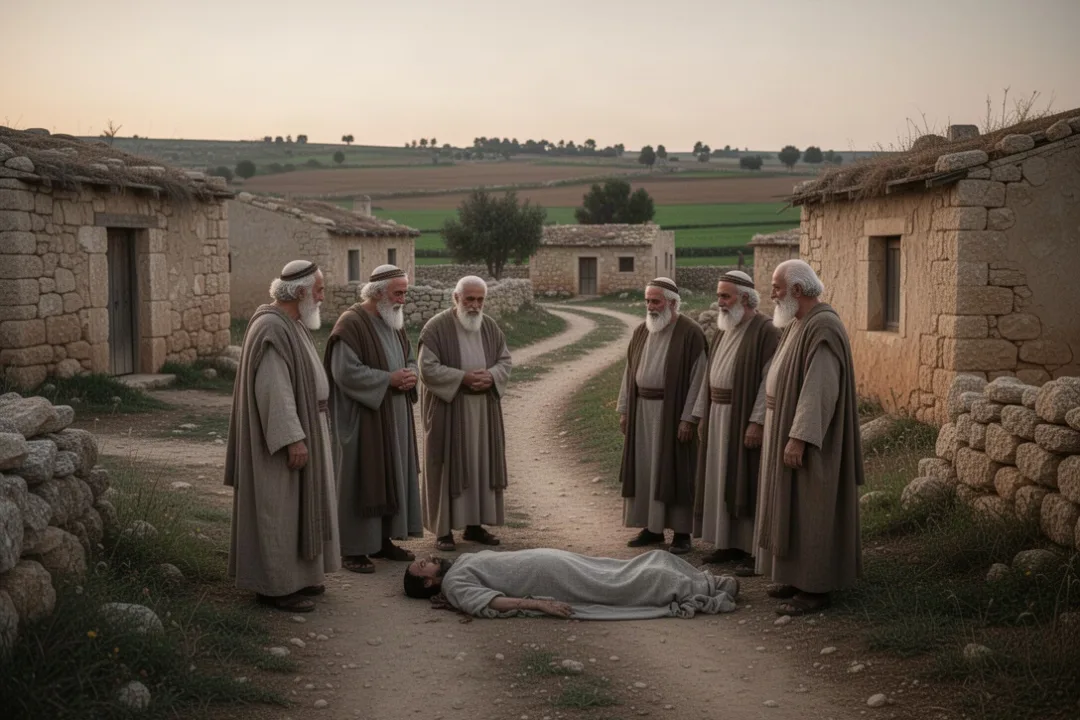
The chapter begins with a body found in the countryside when no one knows who killed the person. The law does not allow the community to treat the death as someone else’s problem. Instead, the elders and judges measure which nearby town is closest to the body and begin a communal process of responsibility.
The elders of that town take a young cow that has not been used for labor and bring it to a valley with flowing water, a place described as neither plowed nor planted. There, they perform a ritual and declare that the town’s people did not shed the victim’s blood and did not witness the killing.
The ritual includes washing their hands over the animal and asking God not to hold the people accountable for innocent blood. The exact symbolism has been interpreted in different ways, but the overall message is clear: unresolved violence creates a moral burden for the surrounding community.
Why the nearest town becomes involved
The nearest town is not necessarily accused of committing the murder. Its role is to accept responsibility for seeking purification and asking for mercy when the guilty person cannot be identified. The law therefore distinguishes between personal guilt and communal responsibility.
This distinction matters. The community is not told to invent an offender or punish an innocent person. Instead, it must recognize the victim, confront the seriousness of the death, and seek restoration before the land is left under the stain of bloodshed.
The elders’ declaration also emphasizes that the town did not witness the killing. This suggests that the ritual addresses both the unknown killer and the danger of collective indifference. Even when a crime cannot be solved, the people are expected to respond publicly and responsibly.
What the first section teaches about justice
Several principles appear in this opening case:
Every human death matters: an unidentified victim is not treated as insignificant.
Communities have obligations: people may share responsibility for addressing violence even when they are not individually guilty.
Justice should not be fabricated: the ritual seeks cleansing without naming an offender whose guilt has not been established.
The land is morally significant: bloodshed affects the community’s relationship with God and the land it inhabits.
For contemporary readers, the passage can prompt questions about public accountability, unsolved violence, and the responsibility of institutions. Its ancient ritual form differs from modern criminal procedure, but its concern with honoring victims and refusing indifference remains understandable.
Deuteronomy 21:10–14 and the woman captured in war
The next law concerns an Israelite man who sees a woman among captives taken in war and wants to marry her. The text permits marriage only after a prescribed period and requires the woman to leave behind visible signs of mourning. She is brought into the man’s house, allowed to mourn her parents for a full month, and then may become his wife.
The passage is difficult because it concerns a woman taken during warfare, a setting marked by unequal power and potential coercion. The text does not describe a modern concept of freely negotiated marriage. Any responsible interpretation must recognize that vulnerability rather than presenting the situation as an ordinary courtship.
Restrictions placed on the Israelite man
The law includes several restrictions. The man cannot immediately treat the captive woman as a sexual object or household possession. He must allow time for mourning, and if he later decides that he does not want her, he must let her go rather than sell her or treat her as a slave.
Those limits do not erase the troubling reality of the situation, but they do restrain the man’s power within the world described by the text. He is not given unrestricted permission to sell her, retain her as property, or dismiss her according to his convenience.
The wording also says that if the man no longer wants her, he must release her because he has humiliated her. That detail recognizes that his actions have affected her status and dignity. The law does not permit him to profit from a relationship he has abandoned.
How interpreters understand this law
Jewish and Christian interpreters have approached the passage in different ways. Some read it as a restrictive law that limits the behavior of soldiers in a violent ancient setting. Others emphasize the text’s failure to describe the woman’s consent in terms modern readers expect, and therefore see the passage as evidence of the distance between ancient law and contemporary ethics.
These approaches need not be reduced to a simple choice between approval and rejection. A careful reading can identify the protection the law provides while also acknowledging the power imbalance and the suffering associated with wartime captivity.
Reading tip: Do not use Deuteronomy 21 to justify forced marriage or sexual violence. The passage describes an ancient legal setting; it does not provide moral permission for modern abuse, trafficking, or coercion.
Deuteronomy 21:15–17 and the rights of the firstborn son
The third case involves a man with two wives, one loved and one disliked or less favored. If the firstborn son belongs to the less favored wife, the father must still recognize that son’s birthright. He cannot transfer the firstborn’s inheritance to the son of the wife he prefers simply because of personal affection.
The firstborn receives a double portion of the inheritance. In practical terms, this means the firstborn is entitled to two shares compared with the single share assigned to each other son. The father must identify the true firstborn and record the decision formally rather than allowing favoritism to determine the outcome.
Why inheritance law confronts favoritism
The passage assumes that family affection may be unequal, but it refuses to let private preference control a legal right. The father’s emotional preference does not cancel the firstborn’s status. Authority within the household is placed under a rule that limits arbitrary power.
This law also protects family stability. Inheritance decisions could determine land ownership, economic survival, and the standing of a household for generations. If a father could simply redirect the firstborn’s share to a favored son, family conflict and long-term injustice would be more likely.
The story of Jacob’s family elsewhere in Genesis provides a useful background for thinking about favoritism among children, although Deuteronomy 21 is not retelling that story. The law addresses the practical consequences of unequal affection by requiring an objective standard for inheritance.
What the firstborn rule does and does not mean
The double portion does not mean that the firstborn son is more valuable as a human being. It describes a legal and economic position within the household. Nor does the rule say that every family must reproduce the same inheritance arrangement today.
Its broader ethical concern is that people with power should not alter established rights simply to reward the child they favor. The passage challenges nepotism, arbitrary favoritism, and inheritance decisions driven by resentment.
Deuteronomy 21:18–21 and the rebellious son
The fourth section describes a son who is persistently stubborn and rebellious, refuses to obey his parents, and continues in serious forms of excess. The parents are instructed to bring him before the elders at the gate of the town and state the problem publicly. If the community confirms the case, the son receives the death penalty by stoning.
This is one of the chapter’s most controversial passages. A casual reading can make it sound as if ordinary teenage disobedience were a capital crime. The text, however, presents a persistent and serious pattern involving refusal to respond to parental discipline, not a single argument or minor act of disrespect.
Why the case goes before the elders
The parents do not carry out the punishment privately. They bring the son before the town’s elders, who serve as the public authority. This requirement is significant because it places the case outside the parents’ personal control and creates a formal setting for judgment.
The son is portrayed as a continuing threat to the household and community, associated with a refusal to live within the obligations of the covenant society. The stated concern is that the punishment will remove evil from among the people and cause others to take warning.
Even so, the passage does not give modern readers a model for disciplining children. It belongs to an ancient legal system with penalties that modern legal and ethical standards reject. It should never be used to defend child abuse, violent parenting, or a parent’s unilateral authority to harm a child.
Questions about abuse and false accusations
Readers should be alert to the possibility of abuse when interpreting this text. Parents can misuse religious language to label a child rebellious, especially when the child is questioning authority, reporting mistreatment, or showing signs of emotional distress.
The passage places the matter before elders rather than authorizing secret family violence, but that ancient safeguard is not enough for modern child protection. Today, a child facing abuse needs access to trusted adults, medical care, law enforcement, child-protection services, or other appropriate support. Religious disagreement is not evidence that a child deserves harm.
The severity of the law also shows the seriousness with which ancient Israel viewed social disorder and family authority. Yet Christians and Jews do not generally apply this penalty as a current legal rule. Interpretation depends on understanding the historical covenant system and the development of later legal and religious traditions.
Deuteronomy 21:22–23 and the burial of an executed person
The final section addresses a person who has been put to death for a capital offense and whose body is hung on a tree. The body must not remain there overnight. It must be buried that same day because a publicly displayed body is associated with a curse, and leaving it exposed would defile the land given to Israel.
The passage does not describe hanging as the method of execution itself in the way modern readers might assume. It refers to a body being displayed after death, although the exact historical practice may have varied. The central instruction concerns the time limit and the duty to bury the body promptly.
Why burial is required even after execution
The requirement to bury the body places a limit on public disgrace. A condemned person has been judged and punished, but the body is not to remain indefinitely as a warning or spectacle. The law recognizes that the dead must be removed from public exposure.
The connection with defiling the land shows that burial is not merely a matter of private mourning. The community’s treatment of a dead body affects the holiness of the land. The rule combines judgment with a remaining obligation to handle the dead respectfully.
How this passage is used in the New Testament
The Gospel of John refers to Jesus’ death in relation to this law, and Paul cites the passage in Galatians 3 when discussing the significance of being hung on a tree. These New Testament writers interpret Jesus’ crucifixion through the language of Deuteronomy 21.
Paul’s use of the passage connects the curse associated with being hung on a tree to Christ’s death and to his argument about redemption from the curse of the law. Different Christian traditions explain that connection in distinct ways, but the quotation should not be separated from its setting: Deuteronomy 21 requires burial and limits the exposure of the executed body.
Because Bible translations differ and many modern translations are copyrighted, the passage is best discussed by reference and paraphrase rather than by reproducing a translation word for word.
Major themes that connect the five laws
Although the chapter shifts rapidly between subjects, several themes bind it together. Deuteronomy 21 repeatedly asks what happens when human power, family preference, violence, or public punishment threatens the community’s relationship with God.
Community responsibility: the nearest town responds to an unsolved killing instead of ignoring it.
Limits on power: a soldier, father, parent, and public authority each face restrictions.
Protection against arbitrary decisions: inheritance cannot be changed simply because one son is favored.
Recognition of human dignity: the captive woman must be released rather than sold, and an executed body must be buried.
Concern for the land: bloodshed and an exposed body are treated as matters affecting the whole covenant community.
The chapter’s laws do not all offer protection in the same way, and some remain morally difficult. Still, the repeated pattern is that authority must operate within defined boundaries. The powerful are not given permission to act solely according to desire.
A responsible reading begins by identifying the passage’s original setting before applying it directly to modern life. Ask who is speaking, which institutions are involved, what social conditions the law assumes, and what problem the rule addresses.
It also helps to separate description, regulation, and endorsement. A law may regulate a practice that exists in an ancient society without presenting every aspect of that practice as an ideal for all cultures and eras. This distinction is especially important for the captive woman and the rebellious son.
Use these steps when studying the chapter:
Read the complete chapter: avoid building an interpretation on one isolated verse.
Identify the case being addressed: distinguish an unsolved murder from an ordinary death, or persistent rebellion from a single act of disobedience.
Observe who holds authority: note the roles of elders, parents, husbands, and the wider community.
Look for limits on power: ask how the law restrains favoritism, exploitation, public disgrace, or neglect.
Compare related passages carefully: use cross-references to clarify themes without assuming every passage has the same purpose.
Apply moral principles rather than ancient penalties: do not transfer the chapter’s civil punishments directly into modern family or legal practice.
Common misunderstandings about Deuteronomy 21
“Deut 21 permits any kind of forced marriage”
The passage concerns a specific ancient wartime situation and places restrictions on the Israelite man. It does not establish a general permission for modern forced marriage. Modern readers should also recognize that the woman’s vulnerable position makes the passage ethically difficult, even where the law limits the man’s behavior.
“A disobedient child could simply be executed”
The chapter describes a formal public case involving persistent, serious rebellion and the involvement of town elders. It is not a license for parents to punish children violently. Modern child protection and criminal law reject such a penalty, and no responsible reading should use the passage to excuse abuse.
“The firstborn was worth twice as much as other children”
The double portion refers to inheritance, not human value. It establishes a legal share within an ancient family economy. The rule specifically prevents a father from changing the inheritance because he prefers another son.
“Hanging on a tree always means modern hanging”
Deuteronomy 21 discusses the public display of a body after execution and requires burial before nightfall. The wording is connected with later biblical discussions of Jesus’ death, but the original law focuses on exposure, curse, burial, and the holiness of the land.
Why Deuteronomy 21 still matters for Bible study
Deut 21 is useful for readers who want to understand how biblical law addresses real conflicts rather than abstract ideals alone. It shows a society dealing with murder investigations, wartime vulnerability, family favoritism, unruly authority, and the treatment of the dead.
The chapter also teaches the value of reading difficult scripture with patience. Its laws cannot be responsibly understood through modern assumptions alone, but historical context should not be used to hide their troubling features. Good interpretation holds both realities together: the text places meaningful limits on certain forms of power, and some of the social arrangements it regulates remain deeply difficult for modern readers.
For Christian readers, the chapter also provides background for New Testament references to inheritance, public shame, burial, and the curse associated with being hung on a tree. For Jewish readers, it remains part of the Torah’s larger legal and covenantal vision, interpreted through centuries of rabbinic discussion and communal practice.
The most consistent lesson is that violence, family authority, and public judgment are never treated as matters of personal convenience. Deuteronomy 21 demands a response from the community and places boundaries around those who have power over others.
Frequently asked questions
What is the main message of Deuteronomy 21?
The chapter emphasizes communal responsibility and limits on authority. It addresses what Israel should do when a murder remains unsolved, how a captive woman is to be treated, how inheritance must be assigned, how serious rebellion is judged, and how an executed person’s body must be buried. Together, these laws show concern for justice, social order, the dignity of the dead, and the holiness of the land.
Does Deuteronomy 21 support forced marriage today?
No. The passage describes an ancient wartime practice involving a woman captured during conflict, and it places restrictions on the Israelite man. It does not provide a legitimate basis for forced marriage, sexual coercion, trafficking, or abuse today. The woman’s vulnerability should be taken seriously when interpreting the text, even while recognizing the limits the law imposes on the man.
What does the rebellious son passage mean?
It describes a persistent and serious pattern of rebellion brought before the town elders, not an ordinary disagreement or one act of childhood disobedience. The passage belongs to an ancient legal system and should not be used to justify violent parenting or child abuse. Modern legal and ethical standards reject the death penalty described there, and religious discipline must never endanger a child.
Why does Deuteronomy 21 require burial before nightfall?
The final section limits the public exposure of a person executed for a capital offense. Leaving the body displayed overnight would defile the land, so burial had to occur the same day. The rule shows that punishment did not remove every communal obligation toward the dead. In the New Testament, this passage also becomes significant in interpretations of Jesus’ crucifixion.














Leave a Reply