Bible Marriage Laws: A Comprehensive Guide to Biblical Rules
Marriage in the Bible spans a wide arc from ancient covenantal norms to New Testament teachings. It includes narrative cases, legal codes, prophetic admonitions, and apostolic guidance. This article provides a thorough, educational overview of the major categories of biblical marriage laws, how they function in different biblical genres, and how they are interpreted today. Along the way, you’ll encounter key terms such as betrothal, mosaic law, Levirate marriage, and divorce within both the Old and New Testament frameworks. The aim is to present a clear, historical, and ethical guide to how biblical authors describe marriage, its responsibilities, and its boundaries.
Foundational concepts: what marriage means in the Bible
At its core, biblical marriage is often described as a covenant between a man and a woman, established before God and within a community context. This covenant encompasses companionship, mutual obligation, and a framework for procreation and the nurture of the family. Unlike modern consumer-oriented concepts of a contract, many biblical passages describe marriage as a lifelong commitment rooted in divine intention. Important strands include:
Covenant before God and valid in the divine presence.
Unity and mutual responsibility between spouses, especially in roles of love, respect, and service.
Fertility and family as part of the biblical mandate for human flourishing.
Law and custom shaping who may marry whom, and under what conditions.
Old Covenant groundwork: Mosaic law and marriage
The books of the Torah give the clearest and most detailed set of rules about marriage in the Bible. They establish norms for who may marry whom, what to do in cases of betrothal, divorce, and inheritance, and how to handle the duties of a husband and wife within the community.
Key features of the biblical Mosaic law related to marriage include:
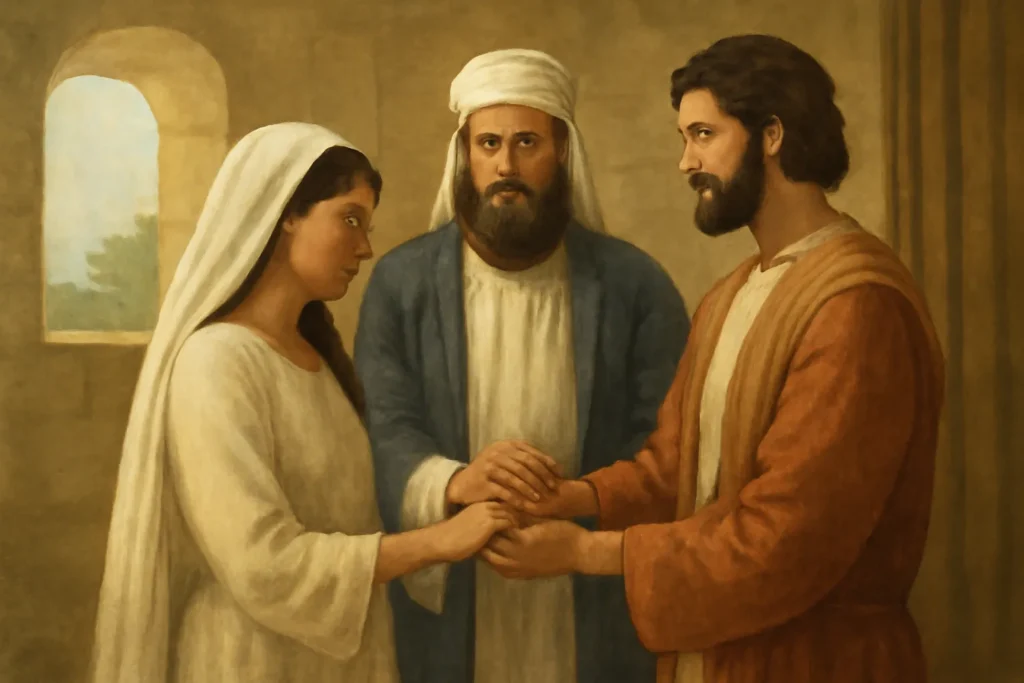
Betrothal and formalization: Betrothal is a serious commitment, often requiring a formal action or ceremony and carrying legal weight similar to marriage; it situates a couple within a social and legal framework even before the actual consummation.
Incest and forbidden unions: The Torah forbids marriages within certain family lines and between certain relationships, creating a structure of prohibited relations that shapes social order.
Dowry and mohar: Financial arrangements and the return of the bride wealth or dowry appear as a social mechanism surrounding marriage and its transfer of status.
Divorce and remarriage rules: The law provides specific procedures for divorce and remarriage, reflecting social and spiritual concerns about fidelity and lineage.
Priestly marriage restrictions: Some priestly roles impose stricter rules on whom a priest may marry, reflecting concerns about ritual purity and communal integrity.
Two historical practices are especially notable in the Old Testament narrative: Levirate marriage and a broader pattern of polygamy in patriarchal literature. These reflect ancient Near Eastern customs, purposes of lineage preservation, and the occasional moral complexities found in biblical stories. The New Testament, however, develops a more unified stance in favor of monogamy in church leadership and household ethics, sometimes shaping later Christian doctrine on marriage.
Core categories of biblical marriage rules
Betrothal, consent, and the ceremony
In biblical times, betrothal is a binding phase that precedes consummation. Consent is essential, but the social weight of betrothal can be great, making it more binding than modern engagement. The couple’s status could be altered by a formal act, the death of a partner, or a formal dissolution under specific conditions. When marriage is celebrated, the ceremony anchors the relationship within the covenantal framework that includes the family and the wider community.
The Bible presents a comprehensive set of prohibitions on intimate unions that would threaten family integrity and spiritual fidelity. These include relationships with close relatives and certain in-law connections. The prohibition is found in multiple places, including Leviticus 18 and 20, which articulate boundaries intended to protect moral and communal order. Incest laws are not merely social taboos; they function as moral regulations with religious significance.
Levirate marriage and widow remarriage
The Levirate marriage law (Deuteronomy 25:5-10) requires a man to marry his deceased brother’s widow under certain circumstances to preserve the brother’s lineage. This practice demonstrates aspects of social responsibility, family loyalty, and provision for widows in the ancient economy. Ruth’s story in the book of Ruth is often cited as a narrative illustration of Levirate-like obligations and the broader theme of faithful kinship within the community of faith.
Dowry, bride price, and financial arrangements
Financial arrangements surrounding marriage appear in various forms across the biblical corpus. The bride price or mohar appears in several places as a transfer of resources that legitimizes the marriage and ensures the wife’s protection and status within the family. These practices reflect economic realities and social protocols of the ancient world.
In the Old Testament, several prominent figures have multiple wives (for example, Abraham, Jacob, David, and Solomon), and the text sometimes records the complexity of these relationships. The biblical narrative does not present a single, universal prohibition on polygamy in all contexts, but it does record moral and theological critiques of polygamous practices. By the time of the New Testament, the moral counsel and leadership standards in the church tend toward monogamy, especially for elders and deacons (see passages like 1 Timothy 3 and Titus 1). This shift is often discussed in biblical interpretation as a movement toward a more uniform standard in Christian practice.
Divorce and remarriage in biblical law
Divorce appears in multiple legal and narrative contexts. The Mosaic law offers procedures for divorce, but Jesus’ teaching in the New Testament restricts remarriage in several passages, emphasizing the seriousness of the marriage bond. In Matthew 19, Jesus references creation ordination of marriage and allows divorce only in cases of sexual immorality, signaling a stricter understanding of remarriage in many Christian interpretations. Paul’s letters further address marriage, divorce, and the treatment of believers married to nonbelievers, offering pastoral guidance for diverse circumstances.
Priestly and Levitical marriage rules
Within the priestly code, certain marriages are constrained to protect ritual purity and the sacred vocation of the priesthood. Leviticus 21, for example, limits who priests may marry, with prohibitions that reflect concerns about religious legitimacy and ceremonial cleanliness. These rules demonstrate how marriage could intersect with religious leadership and communal worship.
Intermarriage and religious boundaries
Several biblical texts address intermarriage with people of other faith communities. The concern is not merely about social differences but about spiritual influence and the risk of leading the people away from covenant loyalty. The guidance given to ancient Israel regarding marriage to foreign spouses is often framed as a cautionary measure to maintain faithfulness to the God of Israel, while later interpretations emphasize grace, mission, and discernment in a diverse world.
The New Testament perspective: Christ-centered marriage ethics
With the advent of the New Covenant, biblical marriage teaching expands to include the life of the church and the person of Christ as the authoritative model for marital relationship. The apostolic writings present a balanced ethic that emphasizes love, humility, and spiritual unity between husband and wife.
The household code: Ephesians 5 and related passages
In Ephesians 5:22-33, the apostle Paul presents a nuanced, biblically grounded model of marital love. He instructs wives to submit to their husbands as to the Lord and husbands to love their wives as Christ loves the church, sacrificing self for the good of the other. The passage is often discussed as a pattern of mutual respect and reciprocal responsibility, with the husband’s love characterized by self-giving service and the wife’s respect characterized by gratitude and trust. The broader principle is mutual submission in love, reflecting the harmony of the Trinity and the unity of the Christian household.
Pauline guidance on marriage, singleness, and division
In 1 Corinthians 7, Paul addresses questions about marriage, celibacy, remarriage, and the ordering of life according to God’s call. He emphasizes that marriage can be a good and appropriate path, yet singleness is also a valid and honorable option, especially for devotion to prayer and service. This guidance recognizes diverse life situations and offers practical counsel for living faithfully within one’s vocation.
What the New Testament says about divorce and remarriage
Jesus’ teaching in Matthew 19:3-9 (and parallel passages in Mark 10) frames marriage as a divine created institution from the beginning. He allows divorce only for sexual immorality and grounds the union in God’s original design. The apostle Paul adds pastoral wisdom for believers married to unbelievers (1 Corinthians 7:12-16), encouraging peace and preservation of the marriage where possible, while acknowledging that separation may occur in some circumstances.
Church leadership and marriage expectations
In the pastoral letters, standards for church leaders often include requirements about marriage. For example, some translations and interpretations require that an elder or bishop be “the husband of one wife,” indicating a preference for monogamy in leadership roles. These criteria reflect broader biblical values about fidelity, spiritual integrity, and the witness of Christian households to the world.
Practical application: how to study biblical marriage laws today
Reading biblical marriage laws responsibly requires careful study of genre, context, and purpose. Here are practical guidelines to help readers navigate these texts:
Distinguish genres: Narrative, law, poetry, wisdom literature, and prophecy each convey meaning differently. Don’t treat legal material as timeless moral instruction in the same way you treat prophetic poetry or gospel narratives.
Consider historical context: Cultural norms in ancient Israel and the early Christian communities shaped the laws and expectations surrounding marriage. Modern readers should differentiate eternal ethical principles from historical practices that served a particular time and place.
Identify overarching themes: Covenant faithfulness, mutual love, justice for the vulnerable (such as widows and orphans), and the integrity of family lineage recur across biblical texts. These themes help interpret specific rules.
Respect differences in modern application: Different Christian traditions interpret and apply biblical marriage laws in distinct ways. Some emphasize traditional permanence of marriage and strict boundaries on divorce, while others emphasize pastoral grace, inclusion, and the protection of vulnerable spouses.
Balance law and gospel: Old Testament laws point forward to New Testament revelation in Christ. When applying biblical marriage texts today, many readers seek to harmonize the moral imperatives with the gospel’s message of grace, renewal, and reconciliation.
Guided questions for personal study
What is the primary aim of a given biblical command about marriage in its own context?
How does Jesus’ teaching reinterpret or fulfill the underlying intention of the Mosaic laws on marriage?
What responsibilities do biblical models assign to each spouse, and how do these reflect virtue and spiritual formation?
How should a church community respond to situations involving divorce, remarriage, or unequal covenants in contemporary life?
Modern considerations and ethical implications
While the biblical texts speak to specific communities, Christians today often apply their principles to contemporary settings, including issues such as consent, gender equality, domestic violence, and family stability. A responsible approach emphasizes dignity for all parties, protection for the vulnerable, and fidelity to the larger biblical narrative about love, justice, and holiness. In practice, this means:
Encouraging mutual respect and consent within marriages and engagements.
Protecting vulnerable spouses, including women and children, from coercion or abuse.
Providing pastoral care for couples facing conflict, divorce, or remarriage, guided by compassion and truth.
Seeking wise counsel from Scripture, tradition, and communal discernment when issues arise that test biblical principles.
Frequently asked questions about biblical marriage laws
Q: Do biblical marriage laws require polygamy?
A: No. While the Old Testament records polygamous practices among some patriarchs and rulers, the New Testament emphasizes monogamy for church leadership and presents monogamous marriage as the normative standard for Christian ethics. Many churches teach that the ideal pattern for Christian marriage is one man with one wife, although Scripture contains examples and cautions from earlier periods that require careful interpretation and pastoral sensitivity.
Q: What about divorce and remarriage?
A: Biblical guidance on divorce and remarriage is complex and varies by tradition. Jesus acknowledges divorce only in the context of sexual immorality in Matthew 19, while Paul provides pastoral guidance about marriage to unbelievers, separation, and reconciliation in 1 Corinthians 7. Christians often distinguish between situations that warrant pastoral care, reconciliation, or a biblically permissible remarriage, and those that call for abstaining or seeking restoration where possible.
Q: How should believers treat interfaith marriages today?
A: The biblical texts emphasize faithfulness to God and the potential spiritual influence within a marriage. In modern contexts, many Christians approach interfaith marriages with grace, careful discernment, and pastoral guidance, recognizing complex personal, cultural, and relational factors while seeking to honor biblical principles about faith, hope, and love.
Q: Are there universal age requirements for marriage in the Bible?
A: The Bible does not provide a single, universal age requirement. Age and maturity varied across cultures and historical periods. Contemporary societies often rely on civil laws and ethical considerations to determine appropriate age of consent and marriage readiness, while many Christian traditions also emphasize the readiness of both partners for commitment and covenantal life.
Conclusion: key takeaways from biblical marriage laws
Across the Bible, marriage is presented as a sacred relationship established by God, with responsibilities that extend beyond private affection to the welfare of families, communities, and faith commitments. The Old Testament law provides a framework for family structure, lineage, and social order, including provisions like betrothal, incest rules, Levirate obligations, and the dynamics of divorce and remarriage. The New Testament reorients marriage toward the gospel, emphasizing mutual love, respect, and fidelity, with special attention to the example of Christ and the church, as well as leadership standards within the church community. Together, these strands form a cohesive picture of biblical marriage that still speaks to questions of love, covenant, and human flourishing in contemporary life.
For readers exploring this topic, consider the following final cautions and opportunities:
Approach biblical marriage laws with attention to genre and historical context.
Seek harmony between law, wisdom, and gospel in applying ancient rules today.
Honor the dignity of every person while pursuing a faithful understanding of marriage as a covenant before God.
















Leave a Reply