First Maccabees is a historical narrative about the Jewish revolt against the Seleucid Empire in the second century BCE. The book focuses especially on the priestly family of Mattathias and his sons, including Judas Maccabeus, who resisted the policies of King Antiochus IV.
The book is part of the Deuterocanonical books in Catholic and Eastern Orthodox Bibles. Many Protestant traditions place it among the Apocrypha rather than treating it as part of the Old Testament canon. Jewish and Protestant readers may still study it as an important historical source for the period between the Old and New Testaments.
The chapter uses the calendar of the Greek, or Seleucid, era. The year 137 in that system corresponds approximately to 175 BCE, the year Antiochus IV came to power. The events later in the chapter occur around 169 and 167 BCE, when Antiochus attacked Jerusalem and imposed policies intended to replace Jewish religious practice with Greek customs.
What happens in 1 Maccabees 1, step by step
Alexander the Great conquers a vast empire. The chapter begins with Alexander of Macedon defeating the Persian ruler Darius and extending his power across many lands.
Alexander dies and his kingdom is divided. His generals take control of separate regions, and the chapter presents their succession as the beginning of competing Hellenistic kingdoms.
Some Jews adopt Greek customs. Lawless members of the Jewish community encourage an alliance with surrounding peoples and persuade others to abandon traditional practices.
A gymnasium is established in Jerusalem. Some Jewish leaders seek to erase the visible distinction between themselves and the Gentile nations.
Antiochus IV becomes king. He launches campaigns against Egypt and later turns his attention toward Jerusalem and the temple.
The temple is plundered. Antiochus takes sacred vessels, gold, silver, and other valuables from the sanctuary.
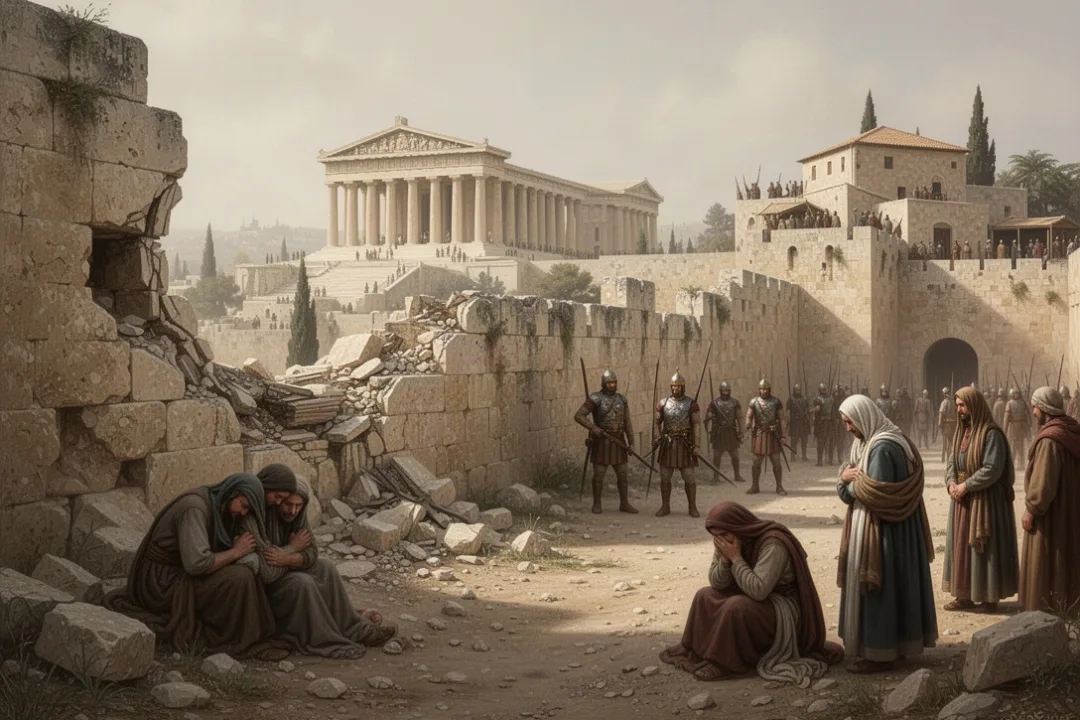
Jerusalem is attacked again. A military force enters the city, kills many people, burns buildings, tears down defensive walls, and builds a fortified settlement near the temple.
Jewish worship is outlawed. Royal orders prohibit sacrifices, Sabbath observance, festivals, circumcision, and obedience to the law of Moses.
The temple is desecrated. An idolatrous object or altar is placed on the temple altar, and copies of the law are destroyed.
Faithful Jews refuse to surrender. The chapter ends by showing that some Israelites remain loyal despite threats, arrests, and executions.
Alexander’s rise and the division of his empire
The opening section of 1 Maccabees 1 presents Alexander as a ruler who moves rapidly from one conquest to another. His victories over the Persian Empire create a political world in which Greek language, institutions, and cultural ideals spread far beyond Macedonia and Greece.
The chapter is not mainly interested in Alexander’s military techniques. Instead, it uses his success to explain the political background of the crisis that eventually reaches Jerusalem. Alexander’s empire does not remain united after his death. His servants and generals divide the territory, and their rival kingdoms compete for control of strategic regions.
Judea lies between major powers, especially the kingdoms based in Egypt and Syria. That location makes the area vulnerable to changing rulers and military campaigns. The kingdom relevant to the later events is the Seleucid Empire, which controlled Judea when Antiochus IV began enforcing his religious policy.
Historical perspective: The chapter connects a broad imperial change with a local religious crisis. The story begins with the rise of Alexander but focuses increasingly on what foreign rule means for Jerusalem, the temple, and Jewish community life.
Why the gymnasium matters in the chapter
Some Jewish leaders decide to cooperate with the surrounding nations and adopt their customs. They build a gymnasium in Jerusalem, a practice associated with Greek education, athletics, and civic culture. The gymnasium itself is not presented as a neutral building in this narrative; it represents a deliberate attempt to reshape Jerusalem according to Greek ideals.
For the people who support this change, adopting Greek customs may seem practical. Greek culture offers access to public life, education, political influence, and a wider regional identity. The leaders described in the chapter appear to believe that becoming more like their neighbors will bring social acceptance and political advantage.
For the narrator, however, this movement is a form of apostasy. The issue is not simply clothing, language, sports, or architecture. It is the decision to treat the covenant as disposable and to replace distinctive Jewish practices with customs that conflict with the law.
The account specifically refers to men concealing or reversing the marks of circumcision. This detail shows the depth of the pressure to assimilate. Circumcision was a physical sign of the covenant with God, so rejecting it means more than changing personal preference. It signals a desire to erase the community’s religious identity.
Antiochus IV and the move from pressure to persecution
Antiochus IV enters the chapter as a powerful Seleucid king involved in campaigns against Egypt. The narrative describes his movement into Egypt, his victories, and his seizure of wealth. When Roman intervention later prevents him from achieving everything he wants in Egypt, he turns back toward Jerusalem.
The chapter portrays this return as a moment of humiliation transformed into violence. Antiochus enters the city with force, attacks its inhabitants, and removes valuable objects from the temple. The sacred treasury becomes part of the wealth extracted by an imperial ruler.
The temple’s plunder is especially serious because the sanctuary is not merely a valuable building. It is the center of Jewish worship and a visible sign of God’s relationship with Israel. Removing its vessels and treasures communicates both economic exploitation and religious contempt.
First Maccabees does not describe Antiochus as someone who merely misunderstands Jewish customs. It presents him as a ruler who knowingly acts with arrogance and seeks to control the community’s worship. His authority reaches into the most personal parts of religious life.
The destruction of Jerusalem and the fortified settlement
After the temple is plundered, Jerusalem suffers another attack. The king’s representative arrives with a large force and uses deception before beginning the assault. The city is burned, many people are killed, and families are taken into captivity.
The destruction of the city has several dimensions:
Human loss: Residents are killed, imprisoned, or displaced.
Physical destruction: Buildings burn and the city’s walls are torn down.
Political control: A fortified settlement is built to house hostile forces.
Religious surveillance: The stronghold allows enemies to monitor and pressure the population.
Economic deprivation: Resources and valuables are seized for the benefit of the ruling power.
The fortified settlement is described as a stronghold overlooking the temple. Its location matters because it turns the sanctuary into a place under constant military pressure. The temple is no longer only a center of worship; it has become a contested space controlled by soldiers and collaborators.
The chapter describes the stronghold as a trap for the people and an adversary of Israel. That language shows how military occupation and religious persecution reinforce each other. The garrison can intimidate worshipers, protect the new policies, and prevent the city from returning easily to its former practices.
How the chapter describes the loss of sacred time
One of the most striking effects of the persecution is the destruction of the religious calendar. The chapter says that festivals become mourning, Sabbaths become objects of dishonor, and the former glory of the people turns into shame.
These references show that oppression changes more than public institutions. It interrupts the rhythms that organize family, worship, memory, and community. Sabbath observance and annual festivals are ways of marking time as belonging to God. When those practices are forbidden, the authorities are attempting to control the community’s identity at its roots.
The effect is also emotional. Days that should bring joy become occasions for grief. Holy places become polluted, and public gatherings become dangerous. The chapter therefore describes persecution as a condition in which both space and time are taken away from the people.
“Her dishonor was great.” — 1 Maccabees 1:40, expressed in paraphrase
This brief description captures the chapter’s sorrowful tone. Jerusalem’s humiliation is not limited to military defeat. The city has been stripped of its walls, its treasures, its worship, and its public dignity.
The royal decree against Jewish religious practice
The king eventually issues a decree designed to make all the peoples in his empire follow one set of customs. In Judea, that policy requires people to abandon the law of Moses and accept practices associated with the surrounding nations.
The orders listed in the chapter include prohibitions against:
Offering sacrifices in the temple according to Jewish law.
Observing the Sabbath and other appointed festivals.
Maintaining the sanctuary as a holy place.
Practicing circumcision.
Possessing or following copies of the law.
Living according to the covenant’s commands.
The decree also requires pagan sacrifices and the construction of altars throughout the towns of Judea. This means the policy is not satisfied with private assimilation. The authorities want visible, public compliance. Religious loyalty must be replaced by ceremonies that demonstrate allegiance to the king’s command.
The harsh penalties reveal that the policy is enforced through fear. People who refuse to obey can be arrested and killed. Women who have their sons circumcised are executed along with their families, and infants are treated as evidence of resistance. The chapter includes these details to show the cruelty of the persecution and the cost of remaining faithful.
The meaning of the desecrated altar
On the fifteenth day of the month Kislev in the year 145 of the Greek era, an offensive object is placed upon the altar in the temple. Many translations describe it as the “abomination of desolation,” a phrase that later becomes important in Jewish and Christian apocalyptic interpretation.
The wording points to something both idolatrous and devastating. The altar, which should be dedicated to Israel’s God, is used for a forbidden form of worship. The desecration is therefore a direct attack on the holiness of the sanctuary.
The chapter also reports that pagan altars are built across Judea. The temple’s defilement is part of a wider program, not an isolated act. The ruling authorities seek to make idolatrous worship normal and covenant obedience punishable.
Readers should distinguish the immediate setting of 1 Maccabees 1 from later uses of the same expression. The chapter describes a specific event during the persecution under Antiochus IV. Later biblical passages, including Daniel and sayings attributed to Jesus in the Gospels, use related language in ways that have generated additional interpretations.
The destruction of the law and the attack on memory
Officials search for copies of the law and burn them. Anyone found possessing such a scroll is condemned. This detail reveals that the authorities understand written Scripture as a source of resistance.
A written law preserves more than rules. It keeps alive the community’s account of creation, covenant, deliverance, worship, justice, and hope. Destroying the scrolls is an attempt to weaken religious memory and prevent the next generation from learning an alternative allegiance.
The policy also forces families to choose between public safety and covenant faithfulness. Parents cannot treat the law as a private interest when possessing it may bring death. The chapter’s emphasis on scrolls, circumcision, and Sabbath observance shows that the persecution reaches into homes as well as public institutions.
This is why the final statement about faithful Israelites matters. Despite the pressure, some people refuse to abandon the law. Their resistance is not described as easy or consequence-free. It is costly, vulnerable, and carried out under the threat of execution.
Central conflict: 1 Maccabees 1 asks whether political power can redefine a community’s worship and identity. The faithful Israelites answer through endurance, refusing to treat the king’s decree as higher than the covenant.
Major themes in 1 Maccabees 1
Assimilation and identity
The chapter begins its Jewish crisis before the royal decree appears. Some members of the community voluntarily seek Greek customs and distance themselves from the covenant. That sequence suggests that external persecution becomes more effective when internal leaders have already decided that religious distinctiveness is a burden.
The chapter does not present every contact with Greek culture as automatically evil. Its concern is the deliberate abandonment of Jewish obligations in order to gain social and political acceptance. The important question is whether cultural participation becomes a reason to reject the covenant.
Imperial power and religious control
Antiochus IV uses military force, confiscation, legislation, and public ritual to reshape Judea. His policy shows how an empire can attempt to govern not only land and taxes but also belief, family practice, and sacred time.
The chapter treats this effort as a misuse of political authority. The king may command armies and collect tribute, but his decree cannot rightfully determine how Israel worships God. The conflict is therefore both political and theological.
The temple as the center of communal life
The temple’s plunder and desecration carry more weight than the loss of any ordinary building. The sanctuary represents God’s presence, the nation’s worship, and the continuity of Israel’s covenant life.
When the temple is defiled, the damage reaches the whole people. The chapter’s descriptions of mourning, shame, and desolation reflect the conviction that Jerusalem’s spiritual center has been attacked.
The closing verses do not yet describe the organized revolt led by Mattathias and Judas. They establish the moral condition that makes resistance necessary. Some Israelites remain firm because obedience to God matters more than compliance with the king.
This faithfulness is shown through concrete practices: keeping the law, refusing pagan worship, preserving circumcision, honoring the Sabbath, and protecting the written Scriptures. In the chapter’s view, loyalty is not merely an inner feeling. It is visible in choices that may carry severe consequences.
How 1 Maccabees 1 connects with Daniel and later Christian readings
The chapter’s setting is closely related to the persecution described in the book of Daniel, especially the material concerning a ruler who profanes the sanctuary and exalts himself against God. First Maccabees presents the events as historical fulfillment of the kind of crisis Daniel had described.
The phrase “abomination of desolation” also appears in later Jewish and Christian interpretation. In the New Testament, the expression is associated with future or renewed desecration in passages such as Matthew 24, Mark 13, and Luke 21. Those passages should be read in their own contexts, but knowledge of 1 Maccabees helps explain the historical background that shaped the phrase.
First Maccabees itself remains focused on the second-century BCE persecution. It is not a prophecy book in the same form as Daniel or Revelation. Its purpose is to narrate the struggle of the Hasmonean family and to show how the crisis began.
Questions to ask when studying 1 Maccabees 1
A careful reading can focus on several questions rather than treating the chapter as a simple story about Greeks and Jews.
What kind of cultural change is taking place? The chapter distinguishes between ordinary contact and deliberate abandonment of covenant identity.
Who benefits from the new policies? Some local leaders gain influence by cooperating with the empire, while ordinary families bear the cost.
How does power operate? The authorities use military occupation, law, confiscation, public ritual, and terror together.
Why are small practices important? Circumcision, Sabbath observance, and possession of the law preserve communal identity.
What makes resistance possible? Faithful people remember the covenant and refuse to accept the king’s commands as absolute.
These questions also help prevent a shallow reading. The chapter is not simply condemning every foreign influence or praising resistance without examining its cost. It presents a community struggling over what can be adapted, what must be preserved, and who has the authority to define faithful life.
Why 1 Maccabees 1 matters for readers today
The chapter continues to matter because it examines the relationship between power and conscience. It asks what happens when a government attempts to turn religious loyalty into a crime and when members of a community help that process from within.
It also gives historical depth to the centuries between the Old and New Testaments. The political world of the Gospels did not appear suddenly. Jewish communities had already experienced foreign domination, cultural pressure, temple desecration, and debates over accommodation long before the Roman period.
For religious readers, the chapter emphasizes the cost of treating worship as more than a private preference. For historical readers, it preserves evidence about Hellenistic politics, Jerusalem’s destruction, and the origins of the Maccabean revolt. For both, its final image is clear: a persecuted community remains alive because some people refuse to surrender the practices that define its covenant identity.
Frequently asked questions
Who was Antiochus IV in 1 Maccabees 1?
Antiochus IV Epiphanes was the Seleucid king who ruled Judea during the crisis described in the chapter. He campaigned in Egypt, plundered the Jerusalem temple, attacked the city, and issued decrees against Jewish religious observance. His policies included banning circumcision, Sabbath observance, sacrifices, and possession of the law, provoking the revolt later led by the Maccabean family.
What does the “abomination of desolation” mean in 1 Maccabees 1?
In this chapter, the expression refers to the desecration of the Jerusalem temple under Antiochus IV. An idolatrous object or altar is placed on the temple altar, while pagan worship is introduced throughout Judea. Later Jewish and Christian writings use related language in additional contexts, but 1 Maccabees describes a specific historical persecution.
Why is 1 Maccabees included in some Bibles but not others?
Catholic and Eastern Orthodox churches generally receive 1 Maccabees as Scripture, while many Protestant traditions classify it among the Apocrypha. Jewish communities and Protestant readers may still value it as a significant historical and religious source. Differences in biblical canon developed through varying traditions about which ancient books should be treated as authoritative Scripture.
What is the main lesson of 1 Maccabees 1?
The chapter emphasizes that religious identity can be threatened both by outside force and by internal compromise. It portrays faithful obedience as something expressed through concrete practices, including Sabbath observance, circumcision, worship, and preserving the law. It also shows that political authority becomes oppressive when it demands control over conscience and sacred life.









Leave a Reply