The Way of a Pilgrim: meaning, prayer, and history
The Way of a Pilgrim: meaning, prayer, and history
The Way of a Pilgrim is an anonymous Russian spiritual classic about learning to pray continually through the repeated use of the Jesus Prayer.
First published in Russia in the nineteenth century, the book follows a wandering Christian who searches for an answer to a difficult biblical command: to “pray without ceasing,” a teaching associated with 1 Thessalonians 5:17. Rather than treating continual prayer as a privilege reserved for monks or mystics, the narrative presents it as a discipline that can gradually shape an ordinary person’s attention, habits, and inner life.
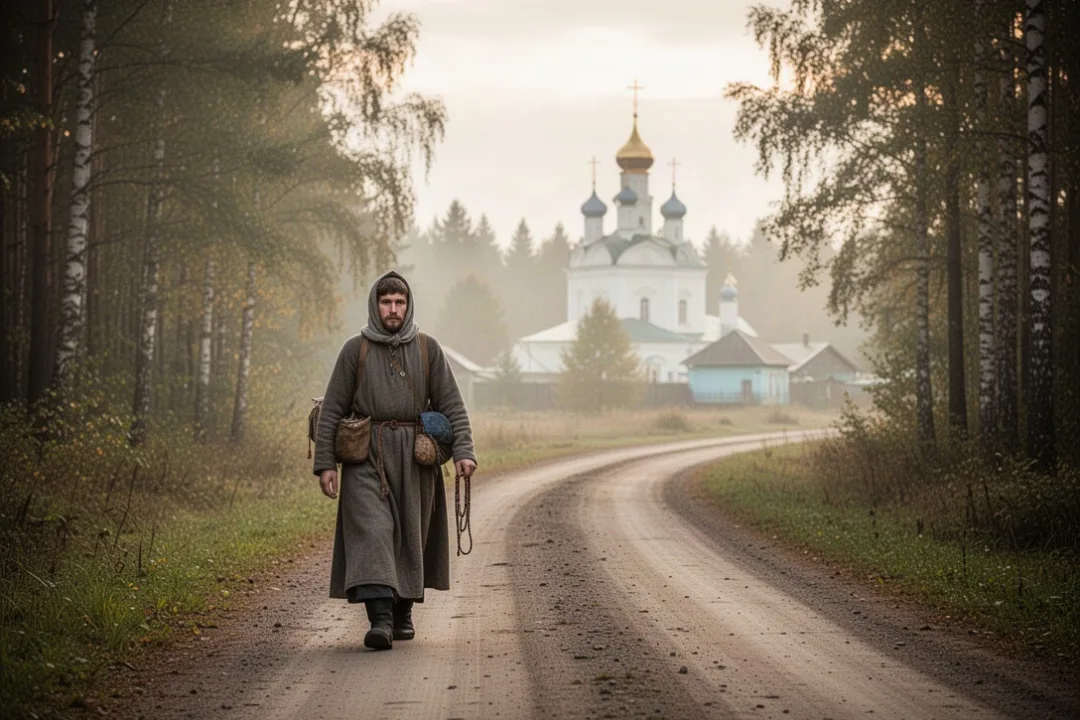
The work is often read as a simple travel story, but its deeper subject is how prayer moves from the lips toward the heart. The pilgrim walks through villages, forests, and towns while asking spiritual teachers how a person can remain turned toward God during daily activity. His physical movement gives the book its structure, while his repeated prayer gives it its center.
The narrator begins with a spiritual question that he cannot resolve on his own. He has heard the apostolic instruction to pray continually, yet he does not understand how anyone could fulfill it while working, traveling, eating, speaking, and sleeping. His search leads him to churches, monasteries, and experienced religious figures who offer different forms of guidance.
A meeting with a spiritual elder changes the direction of his search. The elder gives him a short prayer and teaches him to repeat it with attention: “Lord Jesus Christ, Son of God, have mercy on me, a sinner.” The wording is familiar within Eastern Christian prayer, but the book’s emphasis is not merely on reciting a formula. The pilgrim is instructed to develop steady, humble attention through repeated practice.
The prayer is commonly called the Jesus Prayer or the Prayer of the Heart. It contains several movements at once:
Address: The person prays directly to Jesus Christ.
Confession: The title “Son of God” expresses faith in Christ’s identity.
Petition: The person asks for mercy rather than claiming spiritual achievement.
Humility: The words acknowledge personal sin and dependence on divine help.
As the story continues, the pilgrim learns to repeat the prayer during ordinary circumstances. He prays while walking, resting, working, and speaking with others. The repetition is intended to gather a scattered mind, not to create a trance or provide a mechanical guarantee of holiness.
The narrative also includes encounters with people whose lives reveal different attitudes toward faith. Some are generous and attentive; others are suspicious, careless, or spiritually confused. These episodes prevent the book from becoming an abstract manual. Prayer is tested in the presence of hunger, conflict, fatigue, loneliness, generosity, and temptation.
Central idea: The pilgrim’s goal is not to escape ordinary life but to carry an awareness of God into ordinary life through faithful, patient prayer.
How the Jesus Prayer works in the pilgrim’s practice
The Jesus Prayer is short enough to repeat without a book, but the book does not present it as a magic phrase. Its value comes from the relationship it expresses and from the steady attention required to say it sincerely. The pilgrim begins by repeating the words aloud or quietly, then gradually seeks to keep them present in his mind.
In Eastern Christian spirituality, this practice belongs to a wider tradition often associated with hesychasm, a term connected with stillness, watchfulness, and inner quiet. The tradition has roots in early Christian monastic practice and is represented in writings gathered in the Philokalia, an influential collection of Eastern Christian texts on prayer and spiritual life.
The pilgrim is introduced to the Philokalia as a guide to understanding continual prayer. The book describes reading it as a way of seeing how earlier spiritual teachers approached the mind, the passions, temptation, and attention. The narrator does not treat intellectual knowledge as enough. Reading must lead to practice, and practice must be joined to humility and moral change.
Repetition: The same words are returned to again and again, especially when the mind wanders.
Attention: The person tries to understand and mean the prayer rather than reciting it absentmindedly.
Continuity: The prayer may be carried into work, travel, and quiet moments.
Repentance: The request for mercy is meant to foster honesty rather than self-congratulation.
Patience: The practice develops over time and is not measured by unusual sensations.
The book uses language about the prayer moving from the mind into the heart. This does not simply refer to a physical organ or to emotional intensity. In the spiritual vocabulary of the tradition, the heart often means the center of the person: thought, desire, memory, will, and attention held together before God.
That language can be misunderstood if it is read as a promise of instant mystical experience. The pilgrim does experience changes in his awareness, but the narrative repeatedly points toward persistence rather than excitement. Distraction, weariness, fear, and discouragement remain part of the journey.
The practice also has a practical rhythm. A person may begin with a modest period of prayer, use a prayer rope to count repetitions, and return gently to the words after distraction. The purpose is not to force the mind into silence. It is to notice distraction and turn back without abandoning the prayer.
Readers should distinguish the book’s spiritual language from techniques designed to produce altered states. The Jesus Prayer is a Christian act of invocation, repentance, and trust in Christ. Its meaning depends on the person’s faith and intention, not on breathing patterns, counting alone, or a particular bodily sensation.
Why the pilgrim keeps traveling
The pilgrim’s wandering has both a literal and a symbolic purpose. He has no settled home for much of the story, so roads and shelters become the setting for his education. Each stop exposes him to a new circumstance in which prayer must be practiced, tested, or explained.
His movement also reflects the condition of someone who has begun spiritual seeking but has not yet reached stability. He is eager, sometimes naïve, and dependent on guidance. He wants a direct answer, yet the people he meets show him that spiritual maturity involves repeated practice, not only receiving correct information.
The road gives the book several important contrasts:
Solitude and community: The pilgrim spends time alone but depends on hospitality and instruction.
Reading and experience: He studies spiritual texts but learns through encounters and difficulties.
Freedom and discipline: His wandering appears open-ended, yet his prayer follows a steady rule.
External poverty and inner abundance: He owns little, but he discovers forms of attention, gratitude, and companionship.
Travel also makes the pilgrim vulnerable. He cannot control where he sleeps or whom he meets. He may be welcomed, ignored, deceived, or helped. These circumstances reveal whether his prayer is only an inward exercise or whether it changes the way he responds to other people.
The book’s landscape is therefore more than scenery. Woods, roads, churches, inns, and rural homes become places where the pilgrim encounters fear and kindness. His external lack of security makes his dependence on God visible, although the narrative does not portray every hardship as automatically beneficial.
Readers sometimes assume that the pilgrim’s way requires abandoning work, family, or society. The story does not establish a universal rule of that kind. The narrator is a particular religious seeker shaped by the Russian Orthodox world of his time. His wandering can inspire reflection, but it should not be copied without considering one’s responsibilities and circumstances.
For many readers, the most useful lesson is not literal wandering. It is the possibility of developing a portable practice of prayer: something that can accompany a person during a commute, a walk, a period of waiting, or a difficult conversation. The prayer travels because attention can be redirected anywhere.
What the book teaches about spiritual guidance and discernment
A central figure in the narrative is the starets, an experienced spiritual elder who offers instruction to the pilgrim. The word refers to a respected elder or spiritual guide within Eastern Christian tradition. The elder is not presented merely as a lecturer. His role includes listening, judging what the pilgrim can handle, and giving practical direction.
The pilgrim’s relationship with this guide shows why spiritual instruction matters in traditions that emphasize inner prayer. A person can easily confuse imagination with insight, intensity with holiness, or repetition with transformation. Guidance can help identify these errors and keep practice connected to humility and responsible conduct.
The elder gives the pilgrim a manageable form of prayer rather than an elaborate system. This detail matters. The narrative suggests that spiritual growth often begins with faithful attention to a simple rule, not with collecting increasingly advanced methods.
The book also presents the dangers of spiritual pride. If a person becomes proud of the number of prayers completed, the unusual sensations experienced, or the admiration received from others, the practice can turn inward. The request for mercy is meant to resist that tendency by keeping the person aware of dependence and limitation.
Discernment is especially relevant when the pilgrim reads spiritual writings. Not every sentence in a devotional book should be treated as a universal instruction. Some passages reflect the author’s religious setting, ascetic assumptions, or literary purpose. A thoughtful reader can learn from the book while asking how its practices relate to personal health, obligations, church tradition, and emotional condition.
Practical caution: If repeated prayer becomes distressing, compulsive, or disruptive to sleep and daily responsibilities, reduce the practice and speak with a trusted clergy member or qualified mental-health professional.
The book’s model of guidance is relational rather than purely technical. The pilgrim does not receive a checklist that guarantees spiritual results. He learns through conversation, correction, observation, and perseverance. That approach can be valuable for readers who want prayer to become part of a larger life of worship and ethical action.
For someone considering the practice today, a cautious starting point might include:
Choose a quiet time and say the prayer slowly for a few minutes.
Pay attention to the meaning of the words instead of trying to achieve a particular feeling.
When your mind wanders, return without scolding yourself.
Keep the practice modest enough that it does not displace sleep, work, family care, or other responsibilities.
Seek guidance from a minister, priest, or spiritual director familiar with the tradition.
These steps are not a replacement for the book’s religious setting, but they reflect its emphasis on steadiness, humility, and personal guidance. They also protect against treating the prayer as a self-improvement trick detached from compassion and repentance.
How to read The Way of a Pilgrim today
The book can be approached in several ways. A Christian reader may read it as devotional literature and use its prayer as part of personal practice. A reader interested in Russian religious culture may focus on its landscape, social encounters, and picture of nineteenth-century religious life. Others may approach it as a literary account of a person searching for a coherent way to live.
Because the author is anonymous, questions about the book’s composition and history remain part of its appeal. The text circulated in manuscript before being published, and its exact origins and relationship to different versions have been discussed by scholars and translators. Readers should be cautious about treating the narrator as a fully documented historical individual or assuming that every event can be independently verified.
Different English editions may vary in title, translation, notes, and arrangement. Some editions include only the principal narratives, while others provide introductions or related material. The title may appear as The Way of a Pilgrim or in a longer form connected with the pilgrim’s conversations with a spiritual father.
When choosing an edition, consider the following:
Translation: Compare the translator’s approach if the wording feels unusually archaic or modern.
Notes: Explanatory notes can clarify Orthodox terms, prayer traditions, and references to the Philokalia.
Completeness: Check whether the edition includes all of the narratives associated with the work.
Context: An introduction can help separate the literary narrator from established historical fact.
Religious background: Readers unfamiliar with Eastern Christianity may benefit from a guide to its vocabulary and practices.
The book is best read slowly. Its repeated descriptions of prayer can seem circular if approached as a plot-driven novel. That repetition is part of the design. The reader is being asked to notice small changes in attention and understanding, much as the pilgrim returns to the same prayer while moving through changing circumstances.
Several questions can guide a careful reading:
How does the pilgrim respond when his expectations are disappointed?
Which encounters make him more humble, and which tempt him toward pride?
Does his prayer affect how he treats strangers and vulnerable people?
What does the book assume about solitude, obedience, poverty, and religious authority?
Which teachings seem universal, and which belong specifically to its historical setting?
These questions keep the book from being reduced to a technique. The pilgrim is not simply counting prayers. He is learning how attention, belief, conduct, and dependence fit together.
Its continuing appeal comes from the tension between a very small prayer and a very large goal. The words are brief, yet the command to pray continually reaches into every part of life. The pilgrim’s achievement is not that he never becomes distracted or troubled. It is that he keeps returning.
For readers who are drawn to contemplative prayer, The Way of a Pilgrim offers a vivid entry point into the Jesus Prayer and the Eastern Christian tradition of inner prayer. For readers who are more cautious, it offers a portrait of religious longing and the risks of seeking certainty through a single method. In both cases, the book asks a lasting question: how can a person remember what matters while moving through an unpredictable world?
Frequently asked questions
Is The Way of a Pilgrim based on a true story?
The work is presented as the account of a wandering Christian, but the author is anonymous and the narrator’s historical identity has not been firmly established. It is best read as a spiritual narrative shaped by real religious traditions rather than as a modern documentary or verified autobiography. Details may also vary among versions and translations.
What is the main prayer in The Way of a Pilgrim?
The central prayer is the Jesus Prayer: “Lord Jesus Christ, Son of God, have mercy on me, a sinner.” It is repeated with attention and humility. The point is not simply to recite words many times, but to cultivate remembrance of Christ, repentance, and a steady orientation toward God during ordinary activities.
Do you have to be Orthodox to read The Way of a Pilgrim?
No. The book is rooted in Russian Orthodox spirituality, so some practices and terms are best understood in that setting. Readers from other Christian traditions can still appreciate its reflections on attention, humility, and continual prayer. Those who adopt the prayer as a practice should learn about its tradition and seek guidance suited to their beliefs.
Is the Jesus Prayer a form of meditation?
It can be described as a form of contemplative prayer, but its purpose and meaning are specifically Christian. It invokes Jesus Christ, asks for mercy, and expresses dependence on God. It should not be treated as a technique for producing unusual mental states. Gentle repetition, faith, and humility matter more than physical sensations or a target number of repetitions.













Leave a Reply