The Seven Sorrows of Mary remember the deepest sufferings Mary endured in union with her Son, Jesus.
Also called the Seven Dolors or Our Lady of Sorrows, this Catholic devotion follows seven moments of grief drawn from the Gospels and Christian tradition. It does not treat Mary’s suffering as separate from Jesus’ mission. Instead, it considers how a mother shared in the pain, uncertainty, and faith surrounding her Son’s life, death, and burial.
The devotion gives you a structured way to pray with sorrow without treating suffering as meaningless. Each sorrow invites reflection on compassion, faithfulness, and the hope that remains present even when circumstances seem unbearable.
The traditional list begins with Simeon’s prophecy at the presentation of Jesus and ends with Jesus’ burial. The first three sorrows concern events from Jesus’ childhood; the final four focus on his passion and death.
The prophecy of Simeon: Simeon tells Mary that sorrow will pierce her heart as Jesus’ mission unfolds.
The flight into Egypt: Mary and Joseph take the child Jesus away from danger after Herod seeks to kill him.
The loss of Jesus in the Temple: Mary and Joseph search for Jesus for three days before finding him among the teachers in Jerusalem.
Mary meets Jesus carrying the cross: Mary encounters Jesus on the way to his crucifixion, according to longstanding Christian tradition.
Mary stands beneath the cross: Mary remains near Jesus during his crucifixion and death.
Mary receives Jesus’ body: After Jesus dies, Mary is traditionally understood to have received his body before burial.
Mary witnesses Jesus’ burial: Jesus is placed in the tomb, and Mary experiences the grief of separation while awaiting God’s promise.
These events are not presented as seven unrelated tragedies. Together, they trace a movement from warning to loss, from maternal fear to steadfast presence, and from apparent defeat toward Christian hope.
A helpful distinction: Some sorrows are described directly in the New Testament, while others come from ancient Christian meditation on events that the Gospels mention only briefly or do not describe in detail.
The first sorrow: Simeon’s prophecy at the presentation of Jesus
Mary’s first sorrow occurs when she and Joseph bring Jesus to the Temple in Jerusalem. There, the elderly Simeon recognizes the child as part of God’s saving work. He blesses God, speaks of opposition to Jesus, and tells Mary that a sword will pierce her soul, as recorded in Luke 2:22-35.
The scene contains joy and pain at the same time. Mary has brought her newborn child to fulfill a religious obligation, yet she hears that his life will reveal people’s hidden motives and provoke resistance. The prophecy does not describe every future event, but it prepares Mary for a vocation marked by love exposed to suffering.
Mary’s sorrow begins before she understands all that will happen. That detail makes this mystery meaningful for people who carry anxiety about the future. You may love someone deeply while knowing that you cannot control the dangers, choices, or hardships that person will face.
Prayer on this sorrow can focus on the difference between fearful anticipation and faithful readiness. Mary does not receive a complete explanation. She receives a difficult word and continues to participate in God’s plan.
The second sorrow: the flight into Egypt
Matthew 2:13-15 describes Joseph being warned in a dream to take Mary and Jesus to Egypt because Herod intends to destroy the child. Joseph obeys, and the family leaves during the night. The Gospel presents a family forced to become refugees from political violence.
This sorrow includes danger, hurried travel, uncertainty, and the loss of familiar surroundings. Mary is not grieving a death at this point, but she is protecting a vulnerable child under frightening conditions. The family’s safety depends on leaving home and trusting guidance they cannot fully verify in advance.
The flight into Egypt gives the devotion a direct connection to people displaced by war, persecution, poverty, or violence. It can also speak to parents who must make difficult decisions with incomplete information. Mary’s sorrow is active as well as emotional: she travels, adapts, and helps preserve her child’s life.
When praying with this mystery, you might remember families who have crossed borders for safety. You can also ask for wisdom when protection requires sacrifice, relocation, or the surrender of a familiar way of living.
The third sorrow: losing Jesus in the Temple
Luke 2:41-50 tells how Mary and Joseph travel to Jerusalem for Passover when Jesus is twelve. On the return journey, they realize he is not with the group. After searching for three days, they find him in the Temple speaking with teachers.
For Mary, this is the sorrow of not knowing where her child is. The episode is especially distressing because Jesus is still young, and the search lasts long enough for fear to deepen. When Mary finds him, she expresses the pain caused by his absence. Jesus responds by pointing toward his relationship with the Father, though Mary and Joseph do not immediately understand his meaning.
This sorrow recognizes that even a faithful family can experience confusion. Mary is not portrayed as having every answer or as being emotionally untouched by uncertainty. Her relationship with Jesus includes love, bewilderment, searching, and trust.
The mystery can help you pray during seasons when God seems distant or when someone you love has taken a path you do not understand. It does not promise a quick explanation. Instead, it honors the act of continuing to search with care rather than giving in to despair.
The fourth sorrow: Mary meets Jesus carrying the cross
The meeting between Mary and Jesus on the road to Calvary is one of the best-known scenes in Christian art and prayer. The canonical Gospels describe Jesus carrying the cross and identify women near the crucifixion, but they do not explicitly narrate a conversation between Jesus and Mary during the journey.
For that reason, this sorrow belongs especially to Christian tradition and devotional meditation. It does not need a detailed Gospel account to express a recognizable human reality: a mother sees her son publicly humiliated, physically exhausted, and being led toward execution.
This meeting is painful because Mary cannot remove the cross from Jesus. She cannot make the authorities reverse their decision or take his place. Her presence is limited, but it is not worthless. She sees him, remains connected to him, and refuses to treat him as abandoned.
The sorrow can shape the way you accompany people in crisis. Sometimes presence is the faithful action available when solutions are beyond your control. Listening, witnessing, and refusing to look away can carry moral importance even when you cannot stop another person’s suffering.
The fifth sorrow: Mary stands beneath the cross
John 19:25-27 places Mary near the cross with other women and the beloved disciple. Jesus speaks to Mary and the disciple in a way that creates a new bond between them. The scene shows Mary remaining near Jesus at the moment of his public death.
This is often regarded as the central sorrow because Mary witnesses the execution of her Son. The crucifixion combines physical violence, public shame, helplessness, and bereavement. Mary cannot change what is happening, yet she does not flee from Jesus when his suffering is most visible.
Her presence under the cross has a particular spiritual meaning. Christian tradition sees Mary as sharing in Jesus’ suffering without being the source of his redemption. Jesus remains the Savior; Mary is the faithful mother who participates through compassionate presence and steadfast love.
For someone facing grief, this sorrow can provide language for staying present to pain without pretending that pain is good. It also challenges the temptation to abandon people because their suffering is uncomfortable, prolonged, or impossible to fix.
Mary’s strength at the cross is not the absence of grief; it is faithful love that remains present within grief.
The sixth sorrow: Mary receives the body of Jesus
The sixth sorrow is traditionally associated with the Pietà, the image of Mary holding Jesus after his body has been taken down from the cross. The Gospels report that Jesus’ body was removed and prepared for burial, but they do not explicitly describe Mary receiving it in her arms.
This scene became powerful in Christian art because it gives visible form to a private moment of mourning. Mary holds the child she once carried as an infant, now dead after torture and crucifixion. The contrast brings together birth, motherhood, loss, and reverence.
The devotion does not ask you to admire suffering for its own sake. Rather, it recognizes the dignity of caring for the dead and the tenderness that grief can contain. Mary’s sorrow includes the shock of physical separation from Jesus, but also the loving attention given to his body.
This mystery may be especially meaningful for people who have cared for a dying relative, identified with a body after death, or struggled with the physical reality of bereavement. It allows prayer to acknowledge that grief affects the whole person, including memory, touch, and the senses.
The seventh sorrow: Jesus is placed in the tomb
The seventh sorrow concerns Jesus’ burial. The Gospel accounts describe Joseph of Arimathea taking Jesus’ body, wrapping it, and placing it in a tomb, with variations among the accounts. Mary’s sorrow is traditionally understood as including the final separation of burial and the silence that follows.
Burial makes death unmistakably real. There is no longer an immediate task of resistance or rescue. The body has been placed in the tomb, the stone has been set, and those who loved Jesus must endure a period when God’s promise appears hidden.
This final sorrow points toward the silence of Holy Saturday. It is not the same as Christian despair, because faith still looks toward resurrection. Yet it does not skip over grief or pretend that hope erases the pain of absence.
When you pray with this sorrow, you can bring situations that feel closed, buried, or beyond repair. The mystery teaches patience with unresolved loss. It makes room for a faith that waits without demanding immediate evidence or emotional certainty.
Why the seven sorrows matter in Catholic spirituality
The Seven Sorrows of Mary connect Christian belief with the experience of suffering. They show a woman who is not protected from every hardship simply because she has a special role in salvation history. Her holiness appears through faithful response, not through a life untouched by danger or grief.
The devotion also emphasizes that suffering should be met with compassion. Mary’s sorrows draw attention to refugees, grieving parents, people facing violence, and those who feel abandoned. The goal is not to romanticize their pain but to pray with greater solidarity and tenderness.
For many Catholics, Mary’s role is comforting because she understands sorrow personally. Devotion to her does not replace prayer to God or faith in Christ. It asks Mary to accompany believers as a mother and to lead them toward Jesus’ suffering, death, and resurrection.
The seven sorrows can also correct shallow ideas about faith. Trust in God does not guarantee that every difficult event will be prevented. Mary’s story shows that belief can coexist with fear, questions, tears, and long periods of waiting.
How the devotion developed and is practiced
Meditation on Mary’s sorrows grew especially through medieval Christian devotion, and the Servite Order became closely associated with the Seven Sorrows. The devotion developed through prayer, preaching, artwork, confraternities, and forms of the rosary focused on Mary’s suffering.
The Catholic liturgical calendar celebrates the Memorial of Our Lady of Sorrows on September 15, the day after the Feast of the Exaltation of the Holy Cross. Churches and individuals may also observe the devotion at other times, especially during Lent and Holy Week.
A common prayer form is the Chaplet of the Seven Sorrows. Traditional versions usually include an opening prayer, an announcement of each sorrow, one Our Father, seven Hail Marys, and closing prayers. Specific wording varies by prayer book, parish, religious community, or personal practice.
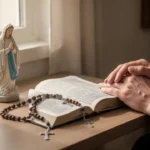
Some people pray one sorrow each day for a week. Others meditate on all seven at once, perhaps allowing several minutes for each scene. You do not need an elaborate setting. A quiet room, a candle, a Bible, or an image of Our Lady of Sorrows can help, but the essential practice is attentive prayer.
How to pray with the seven sorrows
A useful approach is to move slowly through each sorrow rather than reciting the names without reflection. The purpose is not to achieve a particular emotional reaction. You are making room to notice what the scene reveals about love under pressure and to bring related suffering before God.
Name the sorrow. Read the relevant Gospel passage when one is available, and identify whether the scene comes from Scripture, tradition, or both.
Picture the human reality. Consider the fear, uncertainty, physical pain, family bonds, or helplessness present in the scene.
Notice Mary’s response. Ask where she acts, waits, searches, remains present, or trusts without understanding everything.
Connect the mystery to real people. Pray for refugees, grieving families, victims of violence, caregivers, prisoners, or anyone facing a similar form of sorrow.
Bring your own pain honestly. Use plain words rather than forcing yourself to sound calm or certain.
End with hope that respects grief. Remember the resurrection without using it to dismiss the reality of suffering.
If you use the traditional chaplet, the repeated prayers can create a steady rhythm. If repetition distracts you, you may pray a decade slowly, read a passage from Luke, Matthew, or John, or sit quietly with one image. Attention matters more than speed.
Practical tips and common mistakes when praying the devotion
The Seven Sorrows can be prayed in many faithful ways, but a few habits make the practice more grounded and respectful. The devotion works best when it remains connected to the Gospel and to concrete love for suffering people.
Do distinguish the Seven Sorrows from the Sorrowful Mysteries. The Sorrowful Mysteries are five mysteries of the Rosary centered mainly on Jesus’ passion. The Seven Sorrows focus specifically on Mary’s sufferings.
Do read the biblical passages. Luke 2, Matthew 2, Luke 2 again, and John 19 provide important foundations. Treat traditional scenes as tradition rather than presenting them as direct quotations from Scripture.
Do not seek suffering as a spiritual achievement. The devotion teaches faithful love amid suffering; it does not require you to remain in abuse, neglect, or dangerous circumstances.
Do not assume Mary’s sorrow was emotional weakness. Grief, fear, and tears can exist alongside courage, wisdom, and trust.
Do pray for people beyond your own circle. Include displaced families, victims of war, the imprisoned, the terminally ill, and those grieving alone.
Do allow different emotions. You may feel sadness, anger, numbness, gratitude, or nothing noticeable. A prayer is not invalid because it does not produce a strong feeling.
Do seek pastoral help when grief becomes overwhelming. Prayer can support healing, but it does not replace medical care, counseling, safety planning, or practical assistance.
Safety matters: Never use Mary’s suffering to tell someone they must accept abuse, remain in danger, or refuse needed help. Christian compassion supports protection, justice, and appropriate care.
How the seven sorrows differ from the Rosary’s Sorrowful Mysteries
The names sound similar, so confusion is common. The Sorrowful Mysteries of the Rosary are the Agony in the Garden, the Scourging at the Pillar, the Crowning with Thorns, the Carrying of the Cross, and the Crucifixion. They follow major moments in Jesus’ passion.
The Seven Sorrows of Mary follow moments in Mary’s experience. They include events from Jesus’ childhood and traditions surrounding the road to Calvary, the Pietà, and the burial. Both devotions lead you toward the mystery of Christ’s suffering, but their focus and structure differ.
You can pray them together without treating them as identical. For example, the Sorrowful Mysteries may help you meditate on what Jesus endured, while the Seven Sorrows help you consider how Mary and other faithful witnesses endured the same events through relationship, compassion, and loss.
What the seven sorrows teach about hope
The final meaning of the devotion is not that sorrow has the last word. Christian prayer remembers Mary’s pain in light of the resurrection, but it does so without removing the darkness that came before Easter. Hope remains credible precisely because the tradition takes suffering seriously.
Mary’s seven sorrows also show that hope can be quiet. It may look like leaving danger to protect a child, searching when someone is lost, standing beside the dying, caring for the dead, or waiting through silence. These actions may not appear dramatic, yet they express enduring love.
When you pray the devotion, you are invited to become more attentive to people who suffer and less quick to explain their pain. The Seven Sorrows can deepen your compassion, strengthen your patience, and remind you that faithful presence has value even when no immediate rescue is visible.
Frequently asked questions
Are the seven sorrows of Mary found directly in the Bible?
Some are described directly in the New Testament, including Simeon’s prophecy, the flight into Egypt, the loss of Jesus in the Temple, Mary’s presence at the cross, and Jesus’ burial. Mary meeting Jesus on the road and receiving his body are longstanding Christian traditions and devotional scenes rather than detailed Gospel narratives.
When is the feast of Our Lady of Sorrows?
The Catholic Memorial of Our Lady of Sorrows is celebrated on September 15. It follows the Feast of the Exaltation of the Holy Cross. Individuals and parishes may also pray the devotion during Lent, Holy Week, or whenever they want to bring grief and compassion into prayer.
How many Hail Marys are prayed in the Seven Sorrows Chaplet?
A traditional form includes seven Hail Marys for each of the seven sorrows, usually with an Our Father connected to each sorrow. Versions vary, so a prayer book or parish may use different opening and closing prayers. The structure is less important than thoughtful meditation on each sorrow.
Can someone pray the Seven Sorrows devotion when grieving?
Yes. The devotion gives grief a prayerful structure and acknowledges fear, absence, helplessness, and waiting. It should not pressure you to hide emotions or accept unsafe conditions. If grief is severe, persistent, or affecting daily life, combine prayer with support from trusted people, a pastor, a counselor, or a health professional.












Leave a Reply