Teilhard de Chardin: his ideas, life, and influence
Teilhard de Chardin: his ideas, life, and influence
Pierre Teilhard de Chardin was a French Jesuit priest, paleontologist, and philosopher who tried to explain how Christian faith could engage seriously with evolution. His best-known ideas—the noosphere, the convergence of humanity, and the Omega Point—describe creation as a developing process moving toward greater complexity, consciousness, and unity.
Teilhard is remembered both for his scientific work and for the tensions his writings created within the Catholic Church. He did not treat evolution as a threat to belief in God. Instead, he argued that evolution could be understood as the way the universe gradually becomes more alive, aware, and capable of communion.
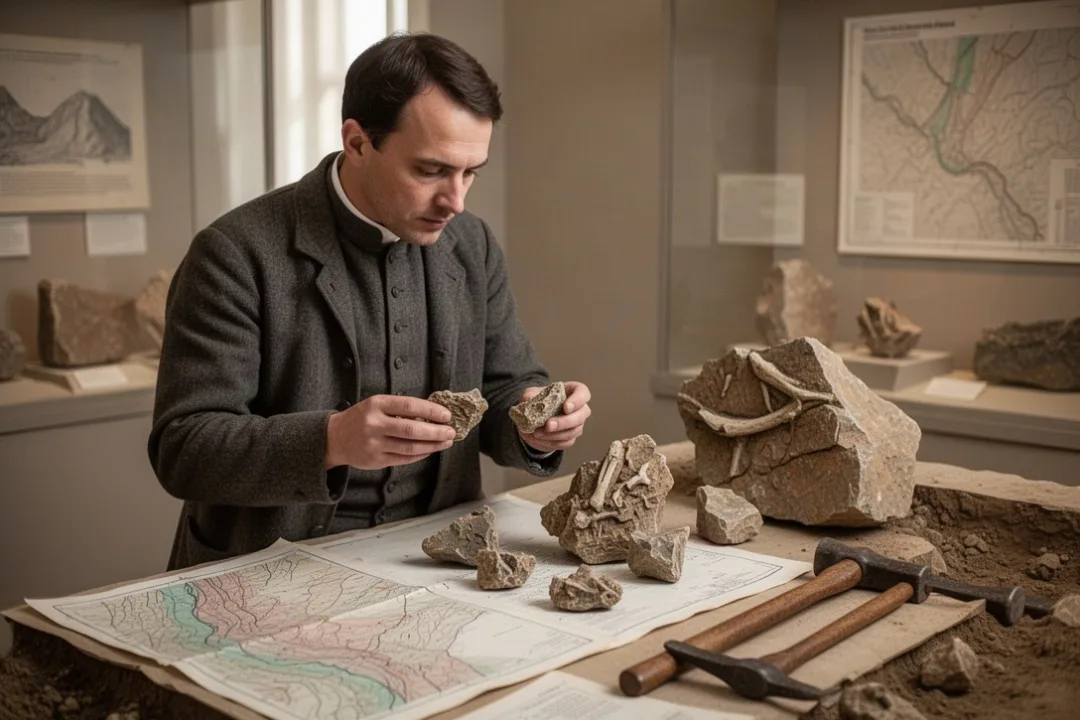
Teilhard de Chardin was born in France in 1881 and joined the Society of Jesus, commonly called the Jesuits. He became a Catholic priest while also pursuing scientific training in geology and paleontology. That combination shaped his lifelong effort to bring together matter and spirit, scientific inquiry and theology, and the history of the cosmos with the Christian story.
His work matters because he addressed a question that remains familiar: Can a person accept modern science without abandoning religious meaning? Teilhard believed the answer was yes, although his proposed synthesis was unconventional and has never represented official Catholic teaching in its entirety.
He spent much of his professional life studying fossils and geological evidence. His research took him to China, where he participated in scientific work associated with the excavation and study of early human remains at Zhoukoudian, the site linked with “Peking Man.” His scientific reputation rests on this fieldwork, along with his broader contributions to discussions about human origins and evolution.
At the same time, Teilhard wrote philosophical and spiritual reflections that were more speculative than his scientific research. His most influential works include The Divine Milieu and The Human Phenomenon, the latter published after his death. These books present a vision of the universe as a dynamic process rather than a static arrangement of separate things.
A useful distinction: Teilhard’s paleontological research and his theological interpretation of evolution should not be treated as the same kind of claim. His scientific work can be assessed through evidence and scholarly methods; his ideas about divine purpose and the Omega Point are philosophical and theological proposals.
How Teilhard understood evolution
For Teilhard, evolution was not merely a biological mechanism explaining how species change. It was the broad pattern of reality itself. He saw the universe developing from simpler forms of matter toward living organisms, nervous systems, consciousness, and increasingly complex forms of social and spiritual life.
He used complexity and consciousness as two linked ideas. As organisms become more complex, he argued, they also become capable of more interior awareness. A single-celled organism, an animal with a nervous system, and a reflective human being do not possess consciousness in the same way. Teilhard saw this growth in interiority as a major feature of cosmic development.
His position was not that every change automatically represents moral or spiritual progress. Evolution includes extinction, suffering, competition, and apparent setbacks. Rather, he believed that over long periods, reality displays a tendency toward higher organization and deeper forms of awareness.
Teilhard’s approach differs from a simple “survival of the strongest” interpretation. He focused on the way life forms increasingly cooperate, communicate, and organize themselves. Humanity, in his view, does not merely continue biological evolution; human beings introduce a new level in which thought, culture, language, technology, and shared purpose influence the future.
Evolution as a movement toward greater unity
Teilhard did not define unity as the destruction of individuality. He believed that persons become more fully themselves through meaningful relationships. A person isolated from every other person is not, in his view, the highest expression of individuality. Human freedom and identity develop through participation, love, and shared life.
This claim led him to describe evolution as a movement from many separate elements toward deeper forms of connection. Atoms form molecules, cells form organisms, and persons form communities. Each level does not erase the earlier one; it organizes it into a more complex whole.
He was especially interested in the way human beings create networks of thought. Language allows experience to be shared. Education preserves knowledge. Culture carries ideas across generations. Scientific research and social cooperation enable people to act together on a scale no individual could manage alone.
These developments help explain why Teilhard’s writings are sometimes discussed in connection with global communication and collective intelligence. He did not predict modern technology in its present form, and his vocabulary belongs to an earlier period. Still, his idea that humanity is becoming more closely linked through communication has encouraged later readers to apply his thought to globalization, media, and ecological interdependence.
What Teilhard de Chardin meant by the noosphere
The noosphere is one of Teilhard’s most recognized concepts. The word refers to a sphere or layer of thought surrounding the Earth, analogous in a broad sense to the atmosphere or biosphere. It names the domain created by human consciousness, language, culture, knowledge, and collective activity.
The noosphere is not simply a physical shell around the planet. It is a way of describing the growing presence of human reflection in the evolution of Earth. Human beings alter landscapes, preserve memories, build institutions, communicate ideas, and make deliberate choices about the future. Through those activities, thought becomes a force that affects the planet.
Teilhard saw the noosphere as both a gift and a responsibility. Greater connection does not automatically produce wisdom. A society can use intelligence to heal, cooperate, and discover, or it can use knowledge for domination and destruction. The noosphere therefore raises moral questions about how people should direct collective power.
His concept can be misunderstood as an early name for the internet. That comparison may be suggestive, but it is incomplete. The internet is a technological system, while the noosphere is a philosophical and spiritual account of human consciousness becoming increasingly interconnected. Digital networks may contribute to that interconnectedness, but they can also spread misinformation, intensify conflict, and encourage shallow attention.
Biological evolution concerns changes in living organisms and populations.
Cultural evolution concerns the transmission and transformation of ideas, practices, and institutions.
The noosphere describes the planetary sphere of human thought and shared consciousness.
Spiritual development concerns the direction and moral quality of human awareness, relationships, and action.
In this framework, human beings are not spectators standing outside nature. We are products of the Earth’s history and active participants in what happens next. That insight gives Teilhard’s work an ecological dimension, even though he did not use all the language associated with contemporary environmental ethics.
What the Omega Point means in Teilhard’s thought
The Omega Point is Teilhard’s name for the ultimate center and fulfillment of cosmic development. He associated Omega with the fullness of consciousness, unity, and personal existence. In his Christian interpretation, Omega is not an impersonal state or a merely mathematical endpoint; it is linked with Christ as the source and goal of creation.
Teilhard drew on the Christian belief that all things find their unity in Christ, especially themes associated with the Pauline letters. He did not quote these ideas as a rejection of traditional Christianity. Instead, he tried to understand Christ as more than a figure belonging only to the past. Christ, for Teilhard, is also the one toward whom the whole universe is moving.
The Omega Point should not be confused with a prediction that the universe will reach a measurable physical destination at a particular date. Teilhard was not offering a scientific forecast with a testable timetable. Omega functions primarily as a metaphysical horizon and a theological claim about the meaning and direction of creation.
Teilhard believed that authentic unity must preserve personal identity. A final state in which individuals disappear into an undifferentiated mass would not satisfy his vision. He imagined a form of communion in which persons become more personal through their relationship with God and one another.
Love therefore has a central place in his system. Teilhard regarded love not only as a private emotion but as a force capable of bringing persons into voluntary unity. In his account, love is the human and spiritual energy that corresponds to the universe’s movement toward greater coherence.
“The world is not finished.”
This short formulation captures a recurring feature of Teilhard’s thought: creation is not merely something completed in the distant past. The world remains in process, and human choices participate in its unfolding. The quotation is best understood as a summary of his perspective, not as a complete statement of his theology.
How Teilhard connected Christ with the cosmos
Teilhard’s Christianity was strongly cosmic. He believed that matter was not spiritually worthless or opposed to God. The physical world, including the human body and the processes of nature, belongs within the scope of redemption. This led him to emphasize the Incarnation—the Christian belief that God entered human history in Jesus—as a sign of matter’s capacity to bear divine presence.
He also developed a broad understanding of the “body of Christ.” In addition to its meaning for the Christian community, he saw it as pointing toward the whole creation gathered into unity through Christ. This interpretation connects his theology with Christian themes of creation, resurrection, communion, and the renewal of all things.
Teilhard’s vision differs from approaches that treat spirituality as escape from the world. He encouraged active engagement with work, science, culture, social responsibility, and the material conditions of life. Ordinary tasks could have spiritual significance when carried out as participation in the development of the world.
In The Divine Milieu, he describes a spiritual attitude in which people can encounter God through both action and suffering. Human work contributes to the building of the world, while unavoidable limitations and losses can be entrusted to God. This does not mean that suffering is good in itself or that injustice should be accepted passively.
Read his spirituality carefully: Teilhard’s claim that the world has a divine direction does not remove the need to oppose cruelty, repair harm, or make practical moral choices. His emphasis on cosmic hope should not be used to excuse suffering or dismiss present responsibilities.
Why Teilhard’s writings faced opposition
Teilhard’s writings became controversial because some church authorities believed his treatment of evolution, original sin, human destiny, and Christology could create confusion or depart from established Catholic formulations. The issue was not simply that he studied evolution. Catholic thinkers had already engaged with science in different ways, and the church’s position on evolution developed over time.
The sharper concern involved his attempt to reinterpret several doctrines within a cosmic evolutionary framework. Critics questioned whether his language gave enough weight to sin, redemption, the historical uniqueness of Jesus, and the distinction between natural development and supernatural grace.
During his lifetime, Teilhard was not free to publish many of his theological and philosophical manuscripts. He accepted restrictions connected with his Jesuit life and church responsibilities. Several major works appeared only after his death, largely through the efforts of editors and publishers working with his papers.
In 1962, the Holy Office issued a monitum, or warning, concerning his writings. The document stated that his works contained ambiguities and serious errors and advised that they be removed from seminaries and other Catholic institutions. The warning did not amount to a formal excommunication, and it did not provide a complete evaluation of every aspect of his thought.
Later Catholic readers and church leaders have referred to Teilhard with varying degrees of appreciation and caution. Some have praised his ability to connect faith with scientific questions, while others continue to regard parts of his theology as problematic. A careful reader should distinguish personal influence from official endorsement.
What Teilhard de Chardin wrote
Teilhard’s books differ in purpose and style. Some are spiritual meditations, some are philosophical interpretations of science, and others are collections of letters or essays. Reading them as if they were all technical scientific texts can lead to confusion.
The Divine Milieu presents a spirituality of action, suffering, and participation in the world’s development.
The Human Phenomenon interprets the history of the universe and humanity through the themes of complexity, consciousness, and convergence.
The Future of Man gathers essays addressing human development, social unity, and the future of civilization.
Letters from a Traveler provides personal and intellectual reflections from different periods of his life.
Christianity and Evolution brings together writings on the relationship between Christian belief and evolutionary thought.
The Human Phenomenon is often the best-known starting point for readers interested in the noosphere and Omega Point. It can also be difficult because Teilhard uses dense philosophical language and sometimes moves quickly between scientific description and theological interpretation.
The Divine Milieu is generally more accessible to readers seeking his spiritual vision. It shows how he understood work, creativity, suffering, and ordinary life as connected with the larger movement of creation.
Translations and editions vary. Readers should pay attention to the translator, editorial notes, and publication history, especially because some of Teilhard’s writings were published posthumously. Introductory material can clarify which passages present scientific observations, personal meditation, or speculative philosophy.
How Teilhard differs from a simple “science versus religion” debate
Teilhard is often placed in the middle of a conflict between science and religion, but that description is too narrow. He was a working scientist who accepted the importance of evidence and specialized research. His question was not whether science should be ignored, but whether scientific knowledge gives a complete account of reality by itself.
He distinguished, though not always with modern academic precision, between describing processes and interpreting their meaning. Paleontology can investigate fossils and the history of life. It cannot by itself establish whether the universe has a spiritual purpose. That second question belongs to philosophy and theology.
At the same time, Teilhard sometimes used scientific language in ways that contemporary scientists may regard as too broad or teleological. Modern evolutionary biology does not require the universe to move toward a predetermined spiritual goal. Natural selection, genetic variation, development, ecology, and historical contingency do not by themselves imply the Omega Point.
For this reason, Teilhard is most useful when read as a theological interpreter of evolution, not as a source of current scientific theory. His work can stimulate reflection on consciousness, cooperation, and planetary responsibility without functioning as a substitute for biology, geology, or physics.
Common mistakes when reading Teilhard de Chardin
His vocabulary invites shortcuts. The following distinctions help keep his ideas accurate and prevent claims that he did not make.
Do not call him a conventional creationist. Teilhard accepted the reality of evolutionary development and tried to interpret it within Christian belief.
Do not present Omega as a scientific prediction. It is a philosophical and theological concept, not a date, experiment, or confirmed cosmic location.
Do not equate the noosphere with the internet. Digital communication may illustrate increasing interconnection, but Teilhard’s concept is broader and concerns human consciousness and culture.
Do not treat every statement as official Catholic doctrine. His writings were influential but controversial, and significant restrictions surrounded their publication during his lifetime.
Do not reduce his message to inevitable progress. Teilhard recognized suffering and failure; greater power and connection can produce destructive results as well as cooperation.
Do not separate Christ from his theory of evolution. For Teilhard, the Omega Point was inseparable from his Christian understanding of Christ as the center and fulfillment of creation.
Do not assume that scientific credentials prove theological conclusions. His paleontological expertise gave him authority in a scientific field, not automatic proof for his metaphysical claims.
Practical ways to study Teilhard’s ideas
A focused reading strategy makes his work easier to assess. Begin with the question you want answered rather than trying to absorb his entire system at once.
Start with a reliable biography or introduction. Learn about his Jesuit formation, scientific career, travels, and publication restrictions before interpreting his major claims.
Choose one primary work. Read The Divine Milieu for spirituality or The Human Phenomenon for his account of cosmic development.
Mark the type of claim. Identify whether a passage is reporting scientific evidence, proposing philosophy, offering spiritual advice, or interpreting Christian doctrine.
Compare his language with current science. Ask which ideas remain suggestive and which depend on outdated scientific assumptions or broad analogies.
Read Catholic criticism alongside sympathetic interpretations. This reveals why his work attracted both admiration and concern.
Apply his concepts carefully. The noosphere can illuminate shared knowledge and planetary responsibility, but it should not be used to claim that all technological connection is morally beneficial.
It also helps to separate three questions that readers often blend together. First, is Teilhard’s description of evolutionary development scientifically sound? Second, does his philosophical interpretation provide a coherent account of consciousness and unity? Third, does his Christian understanding of Christ successfully explain the direction of creation?
Different readers may answer those questions differently. A person can value his spiritual insight while rejecting some scientific generalizations, or appreciate his account of human interdependence without accepting his theology. His work invites judgment, not uncritical agreement.
Teilhard’s continuing influence on theology and culture
Teilhard influenced later discussions of evolutionary theology, cosmic spirituality, ecological responsibility, and the relationship between science and religion. His language has appeared in conversations about globalization, collective intelligence, planetary consciousness, and the ethical meaning of human technological power.
His influence is strongest where people are trying to overcome a strict division between spirit and matter. He offers a picture of faith that values scientific discovery, human creativity, and the material world while still affirming divine purpose. That combination has appealed to theologians, scientists, educators, and religious readers who want a more dynamic account of creation.
His critics, however, raise serious questions. Does the idea of progress give enough attention to violence, inequality, ecological collapse, and historical tragedy? Can evolutionary language explain moral evil, or does it risk turning suffering into a necessary stage? Does the concept of convergence protect genuine difference, or could it be used to justify cultural uniformity?
These questions remain relevant because human beings now possess extraordinary powers to connect, alter, and damage the planet. Teilhard’s thought does not provide ready-made answers, but it offers a framework for considering whether intelligence should lead toward domination or toward responsible communion.
The most balanced assessment sees Teilhard as a bold and imperfect thinker. He was neither a scientific prophet whose conclusions have been proved nor a thinker whose work can be dismissed because it crosses disciplinary boundaries. He was a priest and scientist attempting to interpret an unfinished universe through both empirical knowledge and Christian hope.
What readers can take from Teilhard without accepting everything
Teilhard’s enduring contribution lies in the questions he joined together. He asked how a material universe could give rise to consciousness, how separate persons could become a genuine community, and how Christian faith might understand a world that changes through deep time.
His answer was that evolution can be understood as a movement toward greater complexity, consciousness, and unity, ultimately centered on Christ as Omega. That answer is theological rather than scientifically demonstrable, and it remains open to criticism. Still, it offers a coherent reason to regard scientific work, human relationships, and care for the Earth as spiritually significant.
Reading Teilhard well requires both openness and discipline. His vision can expand the imagination, but his claims should be tested according to the kind of claim each one makes. The result is a more accurate appreciation of a thinker who tried to hold together fossils and faith, cosmic history and personal prayer, and the unfinished future of humanity.
Frequently asked questions
Was Teilhard de Chardin accepted by the Catholic Church?
Teilhard remained a Jesuit priest, but church authorities restricted the publication of several theological writings during his lifetime. In 1962, the Holy Office issued a warning about his works, citing ambiguities and serious errors. His ideas have influenced Catholic and other Christian thinkers, but his complete theological system is not official Catholic doctrine.
Did Teilhard de Chardin believe in evolution?
Yes. Teilhard accepted evolutionary development and studied fossils as a paleontologist. He went further than describing biological change, interpreting evolution as a broader movement toward complexity, consciousness, and unity. That larger interpretation is philosophical and theological, so it should not be confused with the current scientific theory of evolution itself.
What is the noosphere in simple terms?
The noosphere is Teilhard’s term for the sphere of human thought surrounding and transforming the Earth. It includes language, culture, knowledge, communication, institutions, and collective consciousness. The internet can be one example of increasing human interconnection, but it is not identical to the noosphere, which is a wider philosophical and spiritual concept.
Is the Omega Point a scientific idea?
No. Teilhard used the Omega Point as a metaphysical and theological idea about the ultimate fulfillment of consciousness, unity, and creation. In his Christian interpretation, Omega is connected with Christ. It is not a measurable location, a scientific forecast, or a prediction that can be confirmed through a particular experiment.















Leave a Reply