Solomon in the Bible: His Wisdom, Temple, and Downfall
Solomon in the Bible: His Wisdom, Temple, and Downfall
Solomon in the Bible is the son of David and Bathsheba who became king of Israel, asked God for wisdom, built the temple in Jerusalem, and presided over a period of extraordinary wealth and influence. His story appears mainly in 1 Kings 1–11 and 2 Chronicles 1–9.
Solomon’s life carries a deliberate tension. He is remembered for wise judgment, Proverbs, the temple, and international renown, yet he also accumulated wives, wealth, horses, and political alliances in ways that pulled his heart toward other gods. His reign shows both the possibilities of faithful leadership and the danger of allowing success to replace devotion.
Solomon was born in Jerusalem after David’s relationship with Bathsheba. The biblical account connects his birth with David’s marriage to Bathsheba after the death of her husband, Uriah, and presents Solomon as a later child whom the Lord loved (2 Samuel 12:24–25). David also gave him the name Jedidiah through Nathan the prophet, a name associated with the Lord’s love.
Solomon was not David’s oldest son, so his succession was not automatic. Near the end of David’s life, David’s son Adonijah attempted to establish himself as king. Adonijah gathered supporters, including military and priestly figures, while Solomon’s supporters included Bathsheba, the prophet Nathan, the priest Zadok, and Benaiah.
Bathsheba and Nathan reminded David of his earlier promise that Solomon would succeed him. David then ordered Solomon to be anointed as king at Gihon. The people celebrated, and Adonijah’s supporters dispersed when they heard that David had publicly confirmed Solomon (1 Kings 1).
After David’s death, Solomon secured the throne through a series of political and judicial decisions. He dealt with Adonijah, Joab, Abiathar, and Shimei, each in a different way according to the circumstances described in 1 Kings 2. The biblical writer presents these actions as part of establishing the kingdom firmly, although modern readers may find the severity of the period difficult.
Important context: Solomon’s kingship began amid unresolved tensions from David’s household. His wisdom is not presented as abstract intelligence alone; it is tied to the demanding work of judging, governing, and preserving order in a fragile kingdom.
What Solomon asked God for at Gibeon
Early in his reign, Solomon went to Gibeon, an important worship site, and offered sacrifices. There, God appeared to him in a dream and invited him to ask for what he wanted. Solomon did not ask for long life, riches, or victory over his enemies. He asked for an understanding heart so he could govern God’s people and distinguish right from wrong (1 Kings 3:5–9).
God approved of Solomon’s request and promised him wisdom beyond that of any previous or future ruler. The account also says Solomon would receive riches and honor, and that long life would be connected with walking in God’s ways. The promise therefore combines gift and responsibility: wisdom was given for service, not merely for personal reputation.
The famous judgment involving two women and one living child immediately illustrates Solomon’s wisdom. Both women claimed the child, so Solomon ordered that the child be divided. One woman accepted the proposal, while the other pleaded that the child be given to her instead. Solomon recognized the true mother by her willingness to surrender the child to save his life (1 Kings 3:16–28).
This story is not praising cruelty or suggesting that a child should actually be harmed. It portrays a carefully designed test that exposed the difference between genuine love and a false claim. The people recognized that Solomon possessed divine wisdom for administering justice.
How Solomon organized and strengthened the kingdom
Solomon’s rule depended on extensive administration. 1 Kings 4 lists officials, district governors, provisions, and the scale of food required for the royal household. The list shows a centralized monarchy capable of collecting resources and coordinating labor across the territory.
The kingdom experienced security during much of Solomon’s reign. The biblical description uses images of people living safely and enjoying abundance. Solomon’s influence extended beyond Israel, and surrounding rulers sought access to his wisdom and court.
His government also relied on international trade and strategic relationships. Solomon formed an important partnership with Hiram, king of Tyre, who supplied cedar and skilled workers for the temple and other building projects. Israel provided goods in return, and the relationship connected Solomon’s kingdom with the commercial networks of the eastern Mediterranean.
Solomon’s economic achievements had a cost. The same administration that funded major construction required taxation and forced labor. 1 Kings 5 describes labor arrangements for the temple, while 1 Kings 9 describes additional building activity and labor policies. These demands help explain why northern tribes later complained that Solomon’s successor should reduce the burden.
His success was therefore mixed. The kingdom gained wealth, security, and international standing, but centralized power also created pressure. The biblical narrative does not treat visible prosperity as proof that every policy was wise or faithful.
Why Solomon built the temple in Jerusalem
Solomon’s most significant building project was the temple in Jerusalem. David had wanted to build a permanent house for the Lord, but the task was assigned to Solomon. The temple gave Israel a central place of worship and provided a permanent setting for priestly service, sacrifices, and national prayer.
The construction began in the fourth year of Solomon’s reign, according to 1 Kings 6:1, and the completed structure was dedicated after a lengthy building process. The temple included the Most Holy Place, where the ark of the covenant was brought. Its design reflected the holiness and ordered worship associated with Israel’s covenant with God.
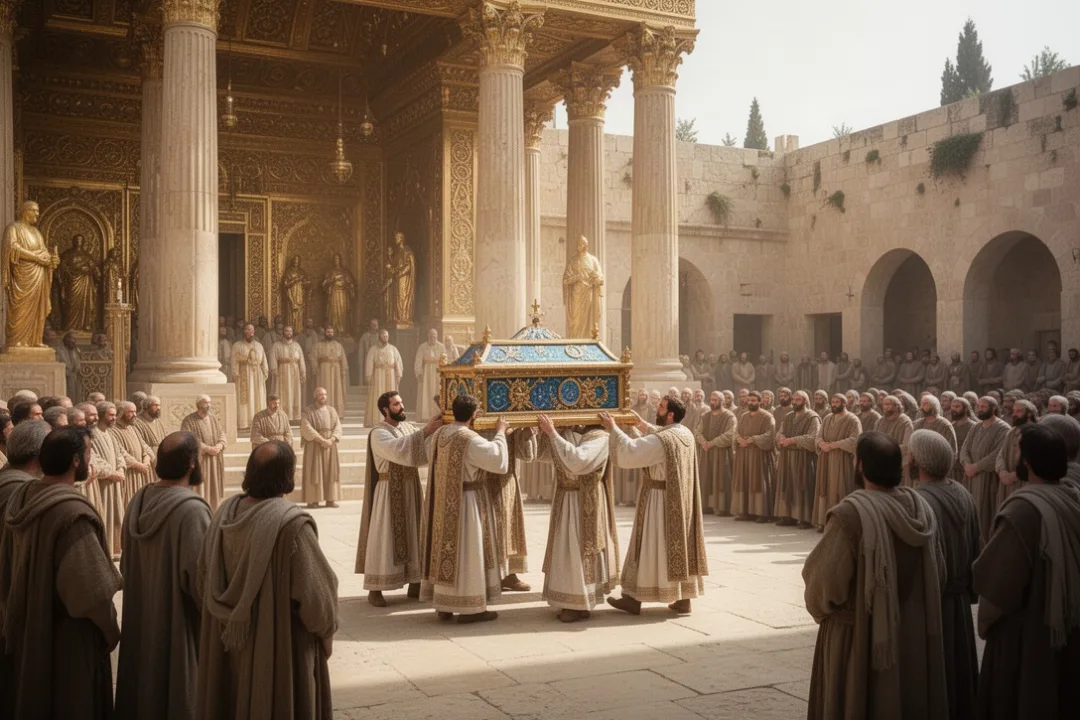
The dedication ceremony was one of the defining moments of Solomon’s reign. Priests brought the ark into the inner sanctuary, and the temple was filled with a visible manifestation of divine glory. Solomon then stood before the people and prayed, recognizing that even the highest heavens could not contain God, much less a human-built structure.
His prayer in 1 Kings 8 asks God to hear prayers connected with the temple. It includes requests for justice, forgiveness, restoration after defeat, help during drought, and welcome for foreigners who hear about the Lord’s name. The prayer also anticipates Israel’s future failure and exile, asking that repentance be met with mercy.
Solomon’s temple prayer presents the building as a place from which God hears, not a structure that limits where God can be.
The temple mattered because it represented God’s covenant presence among the people, not because stone and gold could control God. Solomon’s prayer preserves that distinction. The building was magnificent, but worship remained dependent on obedience, repentance, and God’s mercy.
What the queen of Sheba reveals about Solomon’s reputation
The queen of Sheba traveled to Jerusalem after hearing reports of Solomon’s wisdom and prosperity. She brought valuable gifts, asked difficult questions, and observed his court, servants, food, worship practices, and building projects. After seeing the evidence for herself, she acknowledged that the reports had not exaggerated his greatness (1 Kings 10:1–13).
The visit shows that Solomon’s reputation reached far beyond Israel. His wisdom attracted foreign rulers, and Jerusalem became a center of diplomatic and commercial attention. The queen’s response also connects Solomon’s achievement with the Lord, whom she credits with delighting in Israel and placing Solomon on the throne.
Yet the same chapter begins to emphasize the scale of Solomon’s wealth. Gold, luxury goods, royal equipment, and imported animals filled the account. The narrative’s admiration gradually takes on a warning tone because Israel’s king was accumulating the very things that the law cautioned a king not to multiply.
Deuteronomy 17:14–20 instructs Israel’s king not to multiply horses, wives, or silver and gold for himself. Solomon’s later behavior violates each area. His prosperity is not condemned simply because it is prosperity; the problem is that accumulation becomes connected with dependence, status, military power, and divided loyalty.
What Solomon’s writings are associated with
Solomon is traditionally associated with several biblical books and collections of wisdom. The opening chapters of Proverbs identify Solomon as a major contributor, and 1 Kings 4:32 describes him as speaking many proverbs and songs. These references support his reputation as a teacher of wisdom.
Proverbs emphasizes the fear of the Lord, disciplined character, truthful speech, diligence, justice, sexual faithfulness, and teachability. Its central idea is that wisdom is not merely cleverness. A wise person listens, accepts correction, practices self-control, and orders daily life according to reverence for God.
Ecclesiastes is traditionally connected with Solomon because its speaker is described as a son of David and a king in Jerusalem. The book’s precise authorship and historical setting are discussed by interpreters, so it is best to say that Solomon is traditionally associated with it rather than treating every detail as a direct autobiography.
Ecclesiastes examines pleasure, work, wealth, achievement, aging, injustice, and death. Its recurring claim that human effort is fleeting does not mean every activity is worthless. Instead, it challenges the belief that people can secure lasting meaning through possessions, accomplishments, or control. The book directs attention toward fearing God and living responsibly within human limits.
Song of Solomon, also called Song of Songs, is also traditionally associated with Solomon. It is poetic literature celebrating love, desire, beauty, and marital affection. Readers interpret it in different ways, including as love poetry, a celebration of marriage, or an allegorical text. Its imagery should be read as poetry rather than as a straightforward historical record of Solomon’s relationships.
How Solomon’s marriages led to spiritual compromise
Solomon’s greatest failure appears in the area where his political success and personal desire overlapped. He married many foreign women, including women from nations that Israel had been warned about. 1 Kings 11:1–8 says that these marriages turned his heart after other gods.
The issue was not ethnicity by itself. The biblical concern was religious allegiance and covenant faithfulness. Foreign alliances brought foreign worship into Solomon’s life and kingdom, and Solomon built worship sites for deities associated with his wives. He did not remain wholly devoted to the Lord.
This failure is especially serious because Solomon had received such clear wisdom and had experienced God’s presence and blessing. His story illustrates that knowledge does not automatically produce obedience. A person may understand what is right and still gradually make choices that weaken loyalty.
The wording of 1 Kings 11 suggests a gradual turning of the heart. Solomon’s decline was not described as one sudden decision. It developed through relationships, accommodations, public policy, and repeated tolerance of practices that displaced exclusive worship.
Central lesson: Solomon’s downfall did not come from a lack of ability. It came from allowing power, relationships, wealth, and religious compromise to reshape the loyalties that had once defined his reign.
What happened to the kingdom after Solomon died
Because of Solomon’s unfaithfulness, the biblical account says God raised adversaries against him, including Hadad the Edomite and Rezon of Aram. Jeroboam son of Nebat also became a major threat. Through the prophet Ahijah, Jeroboam was told that he would receive authority over most of the northern tribes after Solomon’s reign.
The kingdom was not torn apart during Solomon’s lifetime. The judgment was delayed for the sake of David, and Jerusalem remained the royal center. Even so, the conditions for division were already present: heavy labor, taxation, political resentment, and the spiritual failures of the king.
Solomon died after reigning for forty years, according to 1 Kings 11:42. His son Rehoboam succeeded him. When the northern tribes asked Rehoboam to lighten the burden imposed by Solomon, Rehoboam rejected the advice of older counselors and chose a harsher policy.
The tribes of Israel then broke away under Jeroboam. Judah and Benjamin remained connected with the house of David, while the northern kingdom took the name Israel. The division that followed Solomon’s death became one of the major turning points in biblical history.
The kingdom’s division shows why Solomon’s reign cannot be judged only by the temple, wealth, or international reputation. His achievements were real, but the burdens and compromises of his administration contributed to a fracture that shaped the generations after him.
Solomon’s story contains several layers, so a few common assumptions can lead to an incomplete reading. These points help keep the major themes in proportion:
“Solomon was perfect because he was wise.” The Bible praises his wisdom but also directly records his disobedience and divided worship.
“God’s blessing means every royal policy was approved.” Solomon’s prosperity coexisted with forced labor, heavy demands, and violations of the kingly restrictions in Deuteronomy.
“The temple made Israel spiritually secure.” Solomon’s dedication prayer emphasizes that God hears repentant people; the building itself could not replace covenant faithfulness.
“Solomon asked for wisdom in a general, abstract sense.” He asked for discernment to govern and judge people well, not merely for intellectual brilliance.
“His many wives are just a private family matter.” The biblical text connects Solomon’s marriages with national religious compromise and the worship of other gods.
“All wisdom books were certainly written entirely by Solomon.” Solomon is traditionally associated with Proverbs, Ecclesiastes, and Song of Songs, but the books have different forms, collections, and interpretive questions.
Practical lessons from Solomon’s wisdom and failure
Solomon’s life offers useful guidance for leadership, decision-making, and spiritual self-examination. The lessons are strongest when they hold his achievements and failures together rather than reducing him to either a model king or a warning alone.
Ask for wisdom that serves other people. Solomon’s request focused on judging the nation well. Good judgment is most valuable when it protects the vulnerable and helps a community flourish.
Treat success as a responsibility. Wealth, influence, education, and authority increase the need for accountability. They do not remove the need for correction.
Watch gradual compromises. Solomon’s heart turned over time. Small accommodations can become established practices when no one examines their direction.
Keep worship and public life connected. Solomon’s temple prayer joined justice, forgiveness, foreign visitors, national crisis, and everyday obedience. Faith was not meant to be isolated from governance.
Measure leadership by its effect on others. A successful project can still impose an unfair burden. Ask who pays, who benefits, and who has a voice.
Accept correction before authority hardens. Rehoboam’s response to the people’s request shows how quickly a successor can turn inherited strength into division.
These lessons do not require treating Solomon as either wholly admirable or wholly corrupt. Biblical wisdom often works through contrast. The same king who requested discernment later ignored the boundaries that discernment should have made clear.
How Solomon points beyond his own reign
Solomon’s reign is often remembered as Israel’s high point of unity, wisdom, wealth, and temple worship. Yet the biblical storyline also makes clear that he could not provide lasting faithfulness. His kingdom depended on a human ruler whose heart eventually wandered.
Later biblical writers continue to use Solomon’s legacy as a standard for comparison. The queen of Sheba’s visit is recalled in the teaching of Jesus, who says that she came from far away to hear Solomon’s wisdom and that something greater than Solomon is present in Jesus’ ministry (Matthew 12:42; Luke 11:31). The comparison emphasizes the responsibility of hearing greater revelation, not merely admiration for an ancient king.
Solomon also helps explain the Bible’s distinction between outward splendor and inward loyalty. A magnificent temple, a wealthy court, and international praise could not guarantee faithfulness. The deeper question remained whether the king and the people would love God, obey his commands, and practice justice.
For that reason, Solomon remains a complex and instructive figure. He was a gifted ruler, a builder, a poetically remembered teacher, and a man whose choices produced both great good and lasting damage. His story asks you to value wisdom not only as insight, but as faithful action sustained over time.
Where to read Solomon’s story in the Bible
The most direct account begins near the end of David’s reign and continues through the division of the kingdom. Reading the passages in sequence makes the movement from succession to wisdom, construction, prosperity, compromise, and judgment easier to see.
1 Kings 1–2: Solomon’s succession and the establishment of his rule.
1 Kings 3: His request for wisdom and the judgment between the two women.
1 Kings 4–5: Government, prosperity, and preparations for the temple.
1 Kings 6–8: Temple construction and Solomon’s dedication prayer.
1 Kings 9–10: God’s warning, building projects, wealth, and the queen of Sheba.
1 Kings 11: Solomon’s wives, idolatry, adversaries, death, and the coming division.
2 Chronicles 1–9: A parallel account emphasizing the temple, worship, wisdom, and wealth.
Proverbs 1–9: Wisdom teaching traditionally associated with Solomon.
Ecclesiastes and Song of Songs: Books traditionally connected with Solomon and interpreted in different ways.
Read together, these passages present a fuller picture than any single episode. Solomon’s wisdom was genuine, his accomplishments were substantial, and his failures were consequential. The lasting message is that faithful character must govern gifts, success, and authority.
Frequently asked questions
Was Solomon the wisest person in the Bible?
Solomon is described as receiving exceptional wisdom from God, especially for governing and judging Israel. The biblical text says his wisdom surpassed that of other people in his time. However, wisdom did not make him morally flawless. His later worship of other gods shows that intelligence and discernment must be joined with obedience, humility, and continued faithfulness.
Did Solomon write all of Proverbs, Ecclesiastes, and Song of Songs?
Solomon is traditionally associated with all three books, and Proverbs specifically identifies him as a major contributor. Biblical books can contain collections formed or preserved over time, so tradition does not necessarily mean Solomon personally wrote every line. Ecclesiastes and Song of Songs also raise questions of genre, authorship, and interpretation among readers.
Why did Solomon have so many wives?
Solomon’s marriages were connected to political alliances and royal relationships, but the Bible treats their religious consequences as the central problem. His wives turned his heart toward other gods, and he supported unauthorized worship. His relationships therefore illustrate how political strategy and personal choices can affect a nation’s spiritual direction.
What was Solomon’s greatest achievement?
The temple in Jerusalem was his most important public achievement because it became Israel’s central place of worship and symbolized God’s covenant presence. Solomon’s request for wisdom was also a defining moment. His greatest failure was allowing wealth, power, and relationships to weaken his exclusive devotion to the Lord.














Leave a Reply