1 Kings explained: Solomon, Elijah, and the divided kingdom
1 Kings explained: Solomon, Elijah, and the divided kingdom
1 Kings tells how Israel moved from the glory of Solomon’s reign to a divided kingdom marked by idolatry, injustice, and political instability. The book begins with Solomon becoming king, describes the building and dedication of the Jerusalem temple, and ends with the death of Ahab and the continuing reign of competing kings.
The book’s central question is not simply which ruler was powerful, but whether each king remained faithful to God. Its stories about Solomon, Jeroboam, Ahab, Elijah, and other rulers show how worship, leadership, justice, and national well-being are connected.
First Kings is the eleventh book of the Bible and the third book in the section commonly called the Former Prophets in the Hebrew Bible. It continues the history told in 2 Samuel and leads directly into 2 Kings. The narrative covers several generations, beginning near the end of David’s life and ending during the reigns of Ahab in Israel and Jehoshaphat in Judah.
The book is divided into two broad movements. Chapters 1–11 describe Solomon’s reign, including his rise to power, wisdom, wealth, building projects, and eventual spiritual failure. Chapters 12–22 describe the divided monarchy: the northern kingdom of Israel and the southern kingdom of Judah develop separate royal lines, political interests, and patterns of worship.
First Kings does not treat military success or economic prosperity as proof that a king pleased God. Instead, the repeated standard is faithfulness to the Lord, especially exclusive worship and obedience to the covenant. That perspective explains why a politically effective ruler can still receive a deeply negative assessment.
Central idea: 1 Kings presents kingship as a spiritual responsibility. A ruler’s decisions affect worship, justice, national unity, and the direction of future generations.
How to read 1 Kings step by step
A helpful way to follow the book is to track its major movements rather than read every royal notice as an isolated episode. The storyline develops through a series of decisions that gradually reshape the nation.
Watch the succession after David. Solomon becomes king after a struggle involving Adonijah and other members of David’s household.
Observe Solomon’s request for wisdom. His prayer for discernment initially presents him as a ruler who understands the weight of governing God’s people.
Follow the temple project. The temple becomes the symbolic center of Israel’s worship and a major sign of Solomon’s power and devotion.
Notice the cost of royal success. Forced labor, taxation, luxury, and political alliances create resentment beneath the surface of national prosperity.
Mark the division of the kingdom. Rehoboam’s harsh answer to the northern tribes helps produce the split between Israel and Judah.
Compare the two royal lines. The book repeatedly evaluates kings according to worship, covenant loyalty, and their influence on the people.
Follow the prophets’ challenges. Elijah and other prophetic figures confront kings when political authority conflicts with God’s commands.
Read the ending as unfinished history. Ahab dies, but the problems of idolatry, unstable leadership, and divided allegiance remain.
Solomon’s rise and his request for wisdom
First Kings opens with David old and near death. Adonijah, one of David’s sons, attempts to establish himself as the next king, gathering influential supporters around him. Bathsheba and the prophet Nathan remind David of his earlier promise that Solomon would succeed him. David then orders Solomon’s public anointing, and Solomon takes the throne.
Solomon’s early prayer at Gibeon is one of the most significant scenes in the book. Rather than asking primarily for long life, riches, or victory over enemies, he asks for an understanding heart so he can govern the people justly. God grants him exceptional wisdom and also gives him forms of prosperity he did not request.
The famous dispute between two women claiming the same child demonstrates Solomon’s ability to expose the truth through wise judgment. The story is not merely about cleverness. It presents wisdom as a gift intended to protect the vulnerable and establish justice.
At this stage, Solomon appears to embody the ideal of a discerning king. The narrative, however, gradually introduces details that complicate that picture. His growing administration, royal court, international relationships, and ambitious building program create both achievement and strain.
The temple in Jerusalem and what its dedication means
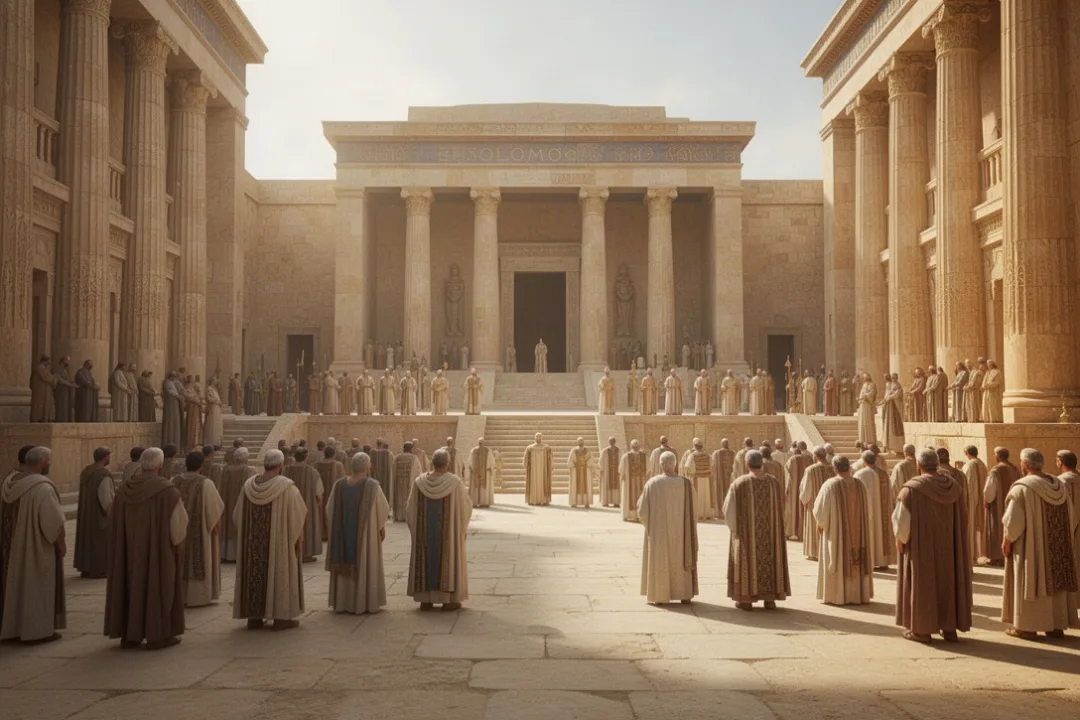
Solomon’s most important construction project is the temple in Jerusalem. First Kings describes its materials, design, furnishings, priestly service, and dedication in considerable detail. The temple represents a permanent place associated with the worship of Israel’s God, replacing the earlier tabernacle arrangement.
When the temple is dedicated, the ark of the covenant is brought into the inner sanctuary. The ceremony includes prayer, sacrifice, music, and public celebration. Solomon asks God to hear prayers directed toward this place, including prayers from people who have sinned, suffered defeat, experienced drought, or sought justice.
His dedication prayer also looks beyond Israel. Solomon asks that foreigners who turn toward God may be heard as well. That element gives the temple a purpose larger than national identity: it is connected with the recognition of God’s name among the nations.
Yet the temple itself is not treated as a guarantee of permanent security. Solomon’s prayer acknowledges that the people can fail and need forgiveness. The building is sacred, but obedience cannot be replaced by religious architecture or ceremony.
“The temple is meant to direct the people toward faithful worship, not to excuse unfaithful living.”
Solomon’s wealth, labor system, and spiritual decline
First Kings presents Solomon’s kingdom as prosperous and internationally respected. Visitors come to hear his wisdom, foreign rulers bring gifts, and Jerusalem becomes a center of trade and royal splendor. The visit of the queen of Sheba illustrates the reach of his reputation and the abundance associated with his court.
At the same time, the book includes evidence of serious costs. Solomon organizes labor, taxation, military defenses, and supply systems on a large scale. The building of the temple and palace complex requires substantial resources. The northern tribes later complain that the royal system has placed a heavy burden on them.
Solomon’s marriages and political alliances become a major spiritual problem. The narrative says that his foreign wives turn his heart toward other gods. The issue is not ethnicity alone; it is divided loyalty. Solomon allows worship practices that conflict with exclusive devotion to the Lord and builds high places connected with them.
This reversal is central to the book’s message. The king who once asked for wisdom becomes a ruler whose choices undermine the covenant. His success does not prevent judgment. God announces that the kingdom will be torn from Solomon’s house, although part of the kingdom will remain connected with David for the sake of the divine promise to David.
Jeroboam, an official from the tribe of Ephraim, becomes the human instrument through whom the northern revolt develops. The prophet Ahijah signals that Jeroboam will rule over the northern tribes. Solomon responds by trying to kill him, and Jeroboam flees to Egypt until Solomon dies.
Reading tip: Pay attention to the contrast between Solomon’s opening prayer and his later actions. First Kings shows that a wise beginning does not remove the need for continued obedience.
Why Israel divides after Solomon’s death
After Solomon dies, his son Rehoboam travels to Shechem, where the northern tribes ask him to reduce the burdens imposed by his father. Rehoboam consults two groups. Older advisers recommend a conciliatory response, while younger advisers urge him to assert greater authority.
Rehoboam rejects the older counsel and answers the people harshly. He promises an even heavier yoke instead of relief. The northern tribes respond by rejecting the house of David, and Jeroboam becomes their king. Judah and part of Benjamin remain under Rehoboam, forming the southern kingdom.
The division is both a political crisis and a theological judgment. First Kings connects it to Solomon’s idolatry, but it also shows how arrogance, poor listening, and exploitative leadership contribute to the immediate rupture.
The two kingdoms are usually identified by their dominant regions:
Israel: the northern kingdom, ruled from several capitals over time and often called Ephraim in prophetic language.
Judah: the southern kingdom, centered on Jerusalem and connected with the Davidic dynasty.
From this point forward, the book moves between the two kingdoms. The reader must keep track of which king is ruling in which territory and how their reigns overlap. The repeated royal formulas help establish chronology, but the spiritual evaluations remain the book’s main concern.
Jeroboam’s alternative worship and the northern kingdom
Jeroboam fears that regular pilgrimages to Jerusalem will weaken his political position. To prevent the people from returning to the southern kingdom, he establishes worship centers at Bethel and Dan. He places golden calves there and appoints priests outside the traditional Levitical arrangement.
These actions are described as a foundational sin of the northern kingdom. Later northern kings are often judged in relation to “the sin of Jeroboam,” meaning the worship system he created. Even when later rulers remove some other forms of evil, the book says they continue in Jeroboam’s pattern.
First Kings makes a distinction between political independence and spiritual faithfulness. Jeroboam may have a legitimate reason to protect the new kingdom, but he uses fear and convenience to redesign worship. The result is a state-supported religious system that competes with the worship God commanded.
A man of God from Judah confronts Jeroboam at Bethel and announces judgment against the altar. The king’s hand becomes rigid when he points toward the prophet, then is restored after the prophet prays. The episode emphasizes that royal authority cannot control God’s message.
Elijah’s drought, provision, and confrontation with Baal
Elijah enters the narrative suddenly during the reign of Ahab, one of Israel’s most infamous kings. He announces that there will be no rain for a period except by his word. The drought exposes Israel’s dependence on God rather than on agricultural fertility claims associated with Baal worship.
God directs Elijah to a secluded stream and provides food through ravens. When the stream dries up, Elijah goes to Zarephath, outside Israel’s territory, where a widow is preparing what she believes will be her final meal. Through Elijah’s word, her flour and oil do not run out during the drought. Later, her son becomes ill and dies, and Elijah prays for the child’s life to return.
These episodes show God caring for individuals during a national crisis. They also challenge assumptions about who may respond faithfully. A foreign widow trusts the prophetic word, while Israel’s king leads the nation toward competing worship.
After the long drought, Elijah confronts Ahab and arranges a public contest on Mount Carmel with the prophets of Baal. The issue is direct: the people must stop wavering between rival claims about who is truly God. The prophets of Baal call on their deity without receiving an answer. Elijah prays, and fire consumes the offering, stones, dust, and water around the altar.
The scene is not presented as entertainment or a test of religious technique. It is a decisive exposure of false worship and misplaced trust. Rain returns after Elijah prays, showing that the Lord—not Baal—controls the skies and the fertility of the land.
Elijah’s fear, despair, and encounter at Horeb
Immediately after Mount Carmel, Elijah faces a death threat from Jezebel, Ahab’s queen. Despite the public victory, he becomes afraid, travels into the wilderness, and asks to die. The narrative gives unusual attention to the prophet’s exhaustion and discouragement.
God provides Elijah with food and rest before sending him to Horeb, the mountain associated with Israel’s covenant history. There Elijah complains that the people have abandoned the covenant and that he alone remains faithful. God then passes by with powerful natural signs, but the divine message comes through a gentle sound rather than the wind, earthquake, or fire.
The passage does not suggest that God is never present in dramatic events. Instead, it corrects Elijah’s expectation that visible force alone will accomplish the work. God gives him further assignments, identifies other faithful people, and tells him to anoint Elisha as his successor.
Elijah’s experience offers a sober picture of prophetic service. Courage in one moment does not make a person immune to fear or exhaustion. The account also shows that God’s work is larger than one servant’s perspective.
Naboth’s vineyard and the abuse of royal power
First Kings 21 presents one of the clearest examples of injustice in the book. Ahab wants Naboth’s vineyard because it is near the palace. Naboth refuses to sell it, explaining that the land is part of his family inheritance. Ahab returns home angry and depressed rather than accepting the refusal.
Jezebel then uses the machinery of power against Naboth. She arranges false accusations, recruits witnesses, and has him executed. Once Naboth is dead, Ahab takes possession of the vineyard. The king may appear passive in the plot, but Elijah’s judgment makes clear that Ahab is responsible for accepting and benefiting from the crime.
Elijah confronts Ahab in the vineyard and announces severe consequences for the royal household. Ahab responds with visible humility, so the timing of some judgment is delayed, but the wrongdoing is not dismissed. The story shows that private desire can become public oppression when rulers treat their authority as a right to seize whatever they want.
Naboth’s story also connects land, family, and covenant identity. The vineyard is not simply a commercial asset. It represents an inheritance that Naboth believes he must preserve. Ahab’s appetite therefore violates both personal justice and Israel’s understanding of land received under God’s rule.
Ahab’s final battle and the ignored prophetic warning
The final chapter focuses on a proposed military campaign to recover Ramoth-gilead from Aram. Ahab asks Jehoshaphat of Judah to join him. Jehoshaphat wants to consult the Lord, so Ahab gathers many prophets, who predict success.
Jehoshaphat remains unconvinced and asks for a prophet of the Lord. Ahab reluctantly summons Micaiah, who first speaks ironically in agreement with the other prophets. When pressed, Micaiah predicts disaster and describes Israel as sheep without a shepherd. Ahab dislikes the message and orders that Micaiah be imprisoned.
Ahab attempts to avoid the danger by disguising himself, while Jehoshaphat wears royal clothing. The strategy fails. A random arrow strikes Ahab between pieces of his armor, and he dies at the end of the battle. His blood is washed from the chariot, fulfilling the prophetic word connected with Naboth’s vineyard.
The chapter emphasizes the danger of seeking confirmation rather than truth. A large group of agreeable voices cannot make a false message reliable. Faithful prophecy may be unwelcome precisely because it challenges the plans people want to pursue.
The major themes that shape 1 Kings
Faithfulness matters more than royal achievement
Solomon’s wealth, wisdom, buildings, and international reputation are real accomplishments, but they do not outweigh his failure to remain devoted to God. The same standard is applied to later kings. First Kings refuses to measure leadership only by prosperity, territory, or public image.
Idolatry changes public life
False worship is not portrayed as a private preference with no social consequences. It shapes national policy, alters institutions, influences family life, and gives rulers religious support for political goals. Jeroboam’s worship centers and Ahab’s promotion of Baal both show how theology can be used to reinforce power.
Prophets do more than predict future events. They interpret present decisions in light of God’s covenant. Nathan, Ahijah, Elijah, Micaiah, and the unnamed men of God confront kings who assume that status protects them from judgment.
God preserves a faithful witness
During Elijah’s despair, he believes he is alone, but God tells him that faithful people remain in Israel. The book repeatedly shows that public corruption does not mean every person has abandoned God. Faithfulness may be less visible than royal power, but it has not disappeared.
Political division has spiritual roots
The split after Solomon results from immediate political decisions, but the book traces it back to deeper failures: Solomon’s divided worship, burdensome administration, Rehoboam’s arrogance, and Jeroboam’s manipulation of religious practice. National fragmentation is not treated as an accident detached from moral choices.
How 1 Kings can be studied or taught
Readers often find the book easier to understand when they combine chronological reading with thematic questions. Keep a simple list of the kings and prophets, but do not let the names become the only focus. Ask what each ruler trusts, what each decision costs, and how the prophetic word responds.
Track the location: identify whether a scene takes place in Israel, Judah, Jerusalem, Samaria, Bethel, Carmel, or another region.
Mark the worship issue: notice references to high places, Baal, golden calves, the temple, sacrifice, and exclusive devotion to the Lord.
Compare words and actions: rulers may say they want guidance while rejecting the message they receive.
Look for vulnerable people: widows, children, landowners, and ordinary families reveal the human effects of royal decisions.
Read judgments in context: prophetic warnings usually explain how a ruler’s conduct violates covenant responsibilities.
Connect repeated phrases: descriptions such as doing evil or walking in the way of Jeroboam help the reader see recurring patterns.
For personal reflection, Solomon’s story raises questions about maintaining faithfulness after success. Rehoboam’s story highlights the consequences of refusing wise counsel. Elijah’s story addresses fear and exhaustion, while Naboth’s story challenges any use of authority that treats people or property as disposable.
How 1 Kings connects with the rest of the Bible
First Kings should be read as part of a larger history rather than as an isolated book. It follows David’s reign and prepares for the continued stories of Israel and Judah in 2 Kings. The division of the kingdom becomes a long-term reality, and later prophets interpret the failures described here.
The book also develops the promise made to David. Even though Solomon’s line is judged, Judah continues under Davidic rulers. That tension between judgment and promise becomes important in later biblical books, which look for a faithful king who will rule with justice and wholehearted devotion to God.
Elijah’s ministry echoes the work of Moses through covenant confrontation, wilderness experiences, and encounters with God at Horeb. The stories also anticipate later biblical teaching about hearing God’s word, caring for the vulnerable, resisting idolatry, and judging leaders who abuse power.
For Christian readers, 1 Kings is often read alongside the New Testament’s presentation of Jesus as the faithful king. That connection should not erase the original meaning of the book. First Kings first speaks about Israel’s kings, covenant obligations, prophetic authority, and the consequences of divided worship; later interpretation builds on those themes.
Questions to ask while reading each chapter
The following questions can keep the narrative focused and practical:
What decision drives this chapter? Identify the choice that changes the direction of the story.
Who benefits and who suffers? Pay attention to workers, families, the poor, landowners, soldiers, and religious communities.
What does the king believe about authority? Does he receive power as a responsibility or treat it as personal entitlement?
How does God respond? The response may come through a prophet, a judgment, provision, a delay, or a call to repentance.
What kind of worship is being promoted? Ask whether worship is shaped by covenant faithfulness or by political convenience.
What remains unresolved? First Kings often ends a scene without fixing the wider problem, preparing the way for 2 Kings.
Read in this way, 1 Kings becomes more than a record of royal succession. It is a study of how leaders use power, how communities respond to pressure, and how faithfulness is tested when prosperity, fear, ambition, and political survival compete for control.
Frequently asked questions
Is 1 Kings the same as the book called First Kings?
Yes. “1 Kings,” “First Kings,” and “I Kings” refer to the same biblical book. The number distinguishes it from 2 Kings. In some traditions, the two books were treated as one continuous history, while modern Bibles generally divide them into two books for easier reference.
What is the main message of 1 Kings?
The book teaches that Israel’s kings are accountable to God’s covenant, not merely to public success or military strength. It warns against divided worship, arrogance, injustice, and political manipulation while showing that God continues to speak through prophets and preserve faithful people.
Why is Elijah so important in 1 Kings?
Elijah represents prophetic opposition to royal idolatry, especially during Ahab’s reign. His confrontation with Baal on Mount Carmel, his experience of fear at Horeb, and his challenge to Ahab over Naboth’s vineyard show both the public courage and personal weakness of a prophet serving under pressure.
Should I read 1 Kings before 2 Kings?
Yes, reading 1 Kings first gives you the background needed for 2 Kings. It explains the division between Israel and Judah, establishes the pattern of evaluating kings, introduces Elijah and Elisha, and shows how Jeroboam’s worship system affects the northern kingdom for generations.














Leave a Reply