Elijah in the Bible: His story, message, and meaning
Elijah in the Bible: His story, message, and meaning
If you have ever wondered how a faithful person can stand up courageously one day and feel exhausted the next, Elijah’s story in the Bible offers a remarkably honest answer. Elijah appears during a spiritual and political crisis in Israel, confronts powerful leaders, witnesses dramatic miracles, and then runs for his life in fear. His life shows both the strength of trusting God and the reality of human weariness.
Elijah was a prophet from Tishbe in Gilead, active in the northern kingdom of Israel during the reign of King Ahab. His main mission was to call Israel away from the worship of Baal and back to the Lord. Most of his story is recorded in 1 Kings 17–19 and 21, followed by important events in 2 Kings 1–2.
Who Elijah was and why he confronted Israel’s kings
Elijah enters the biblical account suddenly. The text does not provide a long family history or describe his call in detail. He appears before King Ahab with a warning that there will be no rain for years except at his word, because Israel has turned from the Lord. The drought becomes both a judgment and a sign: the God of Israel, not Baal, controls the skies and gives life to the land.
Ahab ruled the northern kingdom of Israel, and the biblical narrative presents his reign as deeply influenced by Queen Jezebel. Jezebel promoted the worship of Baal and supported prophets connected with that religious system. Baal was associated with fertility, storms, and rain, so the drought directly challenged the belief that Baal controlled agricultural prosperity.
Elijah’s message was not simply a disagreement between two religious preferences. He was confronting covenant unfaithfulness. Israel’s relationship with the Lord included exclusive worship, justice, and obedience. By turning to other gods and allowing injustice to flourish, the nation had broken faith with the God who had delivered it.
After announcing the drought, Elijah followed God’s direction to hide near the Cherith Ravine, east of the Jordan River. There, ravens brought him food, and he drank from the stream until the drought caused it to dry up. The episode introduces a pattern that continues throughout his life: Elijah speaks publicly with great boldness, but he also depends on God for ordinary necessities such as food, water, safety, and direction.
When the stream dried up, God sent Elijah to Zarephath, a town in the region of Sidon. This detail matters because Zarephath was associated with the territory from which Jezebel came. Elijah was not merely sent to a safe place within Israel; he was sent into the homeland of the queen who wanted him dead.
At Zarephath, Elijah met a widow gathering sticks. She had only a small amount of flour and oil left and expected to prepare one final meal for herself and her son. Elijah asked her to make him a small portion first, promising that the flour and oil would not run out until rain returned to the land. According to 1 Kings 17, the supplies continued through the famine.
The widow’s son later became sick and died, or appeared to have died, according to the language of the passage. Elijah prayed intensely and pleaded with God. The child’s life was restored, and the widow recognized Elijah as a man of God whose message was trustworthy. This story places compassion alongside judgment: Elijah announces national drought, yet he also intercedes for a vulnerable family and receives help for a foreign widow.
A central pattern in Elijah’s story: God’s care often appears through ordinary means—food, water, shelter, a trusted person, or the next clear instruction—even when the larger crisis has not ended.
What happened on Mount Carmel
After three years of drought, God told Elijah to present himself to Ahab. The king blamed Elijah for bringing trouble on Israel, but Elijah answered that Ahab and his family were responsible because they had abandoned the Lord’s commands and followed Baal. Elijah then called for a public test on Mount Carmel.
The challenge involved the prophets of Baal and Elijah, the remaining prophet of the Lord. The people of Israel gathered as spectators. Elijah asked them how long they would keep wavering between two positions. His question exposed the deeper problem: they wanted the benefits of belonging to Israel while also accommodating the worship practices promoted by the royal court.
Two altars were prepared, and each side was to call on its god to send fire. The prophets of Baal prayed, shouted, and performed ritual actions for much of the day, but no response came. The biblical account describes Elijah mocking their claims in language that highlights the silence of Baal. The point is not that Elijah trusted in clever insults; it is that the entire public test revealed the inability of Baal to answer or act.
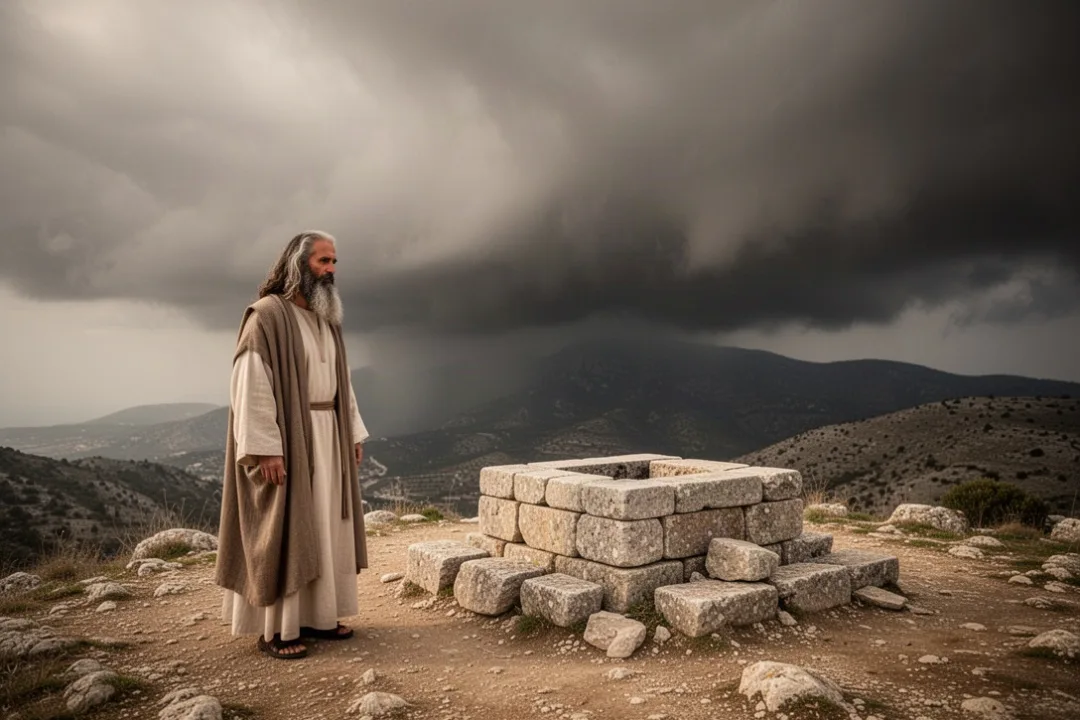
Elijah then repaired an altar associated with the Lord, using twelve stones to represent the twelve tribes of Israel. He arranged the sacrifice and had water poured over it repeatedly, making the situation humanly more difficult. His prayer was comparatively brief. He asked God to show that Israel belonged to the Lord and that Elijah acted according to divine instruction.
Fire fell and consumed the offering, the wood, the stones, the soil, and the water around the altar. The people responded by acknowledging the Lord as God. Elijah then ordered the prophets of Baal to be seized, and they were killed at the Kishon Valley. This is one of the most severe scenes in his story and must be read within the setting of ancient Israel’s covenant law, royal apostasy, and conflict over national worship rather than treated as a general command for religious violence.
After the confrontation, Elijah told Ahab to eat and drink because rain was coming. He climbed to the top of Mount Carmel and prayed. His servant looked toward the sea repeatedly before seeing a small cloud. Soon the sky darkened, wind rose, and heavy rain arrived. Elijah’s prayer and persistence marked the end of the drought, but the political danger had not disappeared.
The Mount Carmel account highlights several important themes:
God’s identity: The Lord is not one competing deity among many but the living God of Israel.
Undivided loyalty: Religious compromise can leave people spiritually unstable and confused.
Prayerful dependence: Elijah acts boldly, yet he still waits and prays for the promised rain.
Public witness: His confrontation addresses the whole nation, not merely a private dispute.
Restored worship: The goal is for the people to recognize and return to the Lord.
Mount Carmel was a decisive spiritual victory, but it did not immediately change the royal household. Ahab reported what happened to Jezebel, and she sent Elijah a threat promising his death. The prophet who had faced hundreds of opposing prophets now became afraid and fled into the wilderness.
Why Elijah became discouraged after his greatest victory
Elijah traveled south into Judah, left his servant behind, and went into the wilderness. There he sat beneath a broom tree and asked to die. His reaction may seem surprising after the fire on Mount Carmel, but the Bible does not present it as a contradiction to be explained away. A person can experience extraordinary courage and then collapse under fear, fatigue, isolation, and disappointment.
Elijah fell asleep. An angel woke him and provided bread and water, then allowed him to rest before waking him again. Strengthened by that food, Elijah traveled for forty days and nights to Mount Horeb, also called Mount Sinai. Horeb was a significant location in Israel’s history because it was associated with Moses, the covenant, and the revelation of God.
At Horeb, God asked Elijah what he was doing there. Elijah described his loyalty, Israel’s rejection of the covenant, the destruction of the Lord’s altars, the killing of the prophets, and the threat against his own life. His words reveal a prophet who felt alone, unsuccessful, and exposed. He had seen a national demonstration of God’s power, yet he believed the deeper crisis remained unchanged.
God then directed Elijah to stand on the mountain. A powerful wind tore at the mountain, followed by an earthquake and fire, but the text says the Lord was not revealed through those manifestations. Afterward came a quiet, gentle sound. The precise meaning of this phrase is debated because translations express it differently, but the scene clearly contrasts spectacular force with a quieter form of divine communication.
The lesson is not that God never works through fire, wind, or earthquake. Elijah had just witnessed fire from heaven. Rather, the Horeb encounter shows that God’s presence and guidance cannot be reduced to dramatic signs. The same God who acts publicly on Carmel also speaks personally and quietly to a frightened servant.
For readers facing exhaustion: Elijah’s recovery begins with sleep, food, water, honest prayer, and renewed direction. The biblical story does not treat physical and emotional limits as proof that faith has failed.
God gave Elijah several assignments at Horeb. He was to anoint or commission new rulers connected with future judgment, and he was to appoint Elisha as his successor. God also corrected Elijah’s belief that he was completely alone, telling him that a faithful remnant remained in Israel.
This response combines comfort and correction. God did not dismiss Elijah’s pain, but neither did he allow the prophet’s perception to define the whole situation. Elijah’s work had not been meaningless, even though the visible results were smaller than he expected. Other faithful people remained, and his prophetic ministry would continue through a successor.
How Elijah challenged injustice in Naboth’s vineyard
Elijah’s ministry was not limited to arguments about worship. In 1 Kings 21, he confronted Ahab over the theft of Naboth’s vineyard. Naboth owned a vineyard near Ahab’s palace and refused to sell it because it was part of his ancestral inheritance. Ahab became resentful, and Jezebel arranged a false accusation against Naboth. He was condemned and killed, allowing the king to take the vineyard.
When Elijah met Ahab, he delivered a severe judgment against the king and his household. The prophet named the wrongdoing directly: Ahab had murdered Naboth and taken his property. The story shows that biblical prophecy speaks to economic abuse and misuse of political power as well as to temple worship and personal morality.
Ahab was not merely an unhappy customer who acquired property through a questionable transaction. The royal household used authority, false testimony, and lethal punishment to remove a man who had defended his lawful inheritance. Elijah’s confrontation makes clear that devotion to God cannot be separated from the treatment of neighbors, especially those with less power.
Several features of the Naboth account remain relevant when reading Elijah:
Power does not erase responsibility: A king remains accountable for the harm carried out in his name.
Private desire can become public injustice: Ahab’s disappointment grew into a state-backed crime.
Prophetic speech protects truth: Elijah refuses to let royal status control the moral verdict.
Worship and justice belong together: Religious claims are contradicted when the vulnerable are exploited.
The account also gives a fuller picture of Elijah’s role. He is not only a miracle worker or a defender of exclusive worship. He is a messenger who stands between the powerful and those whom the powerful can silence. His message to Ahab is uncomfortable because it addresses the king’s conduct rather than merely his beliefs.
What happened to Elijah and how later Scripture remembers him
In 2 Kings 1, King Ahaziah, Ahab’s son, was injured after falling through a lattice. Instead of seeking guidance from the Lord, he sent messengers to ask Baal-Zebub, the god associated with Ekron, whether he would recover. Elijah intercepted the messengers and announced that the king would die because he had sought help from another god rather than the God of Israel.
Ahaziah sent military groups to seize Elijah. The first two commanders approached with authority and demanded that he come down from the hill. Fire came down from heaven and consumed them and their men. A third commander approached more humbly and pleaded for his life and the lives of his soldiers. An angel told Elijah to go with him, and Elijah repeated the judgment before the king.
This episode echoes Mount Carmel but has a different emotional tone. Elijah’s authority is again confirmed through fire, yet the narrative also shows the danger of approaching prophetic authority with arrogance. The third commander’s humility changes the immediate outcome for his group. The passage is not a simple model for how every disagreement should be handled; it belongs to a particular prophetic and royal setting.
Elijah’s final recorded journey begins when he and Elisha travel from Gilgal to Bethel, then to Jericho, and finally across the Jordan. At each stage, Elijah tells Elisha to remain behind, but Elisha refuses to leave him. Elisha asks for a double portion of Elijah’s spirit, expressing his desire to continue the prophetic calling as Elijah’s heir.
Elijah is then taken up into heaven by a whirlwind, with a fiery chariot and horses appearing between him and Elisha. Elisha takes up Elijah’s cloak, returns to the Jordan, and strikes the water with it. The water parts, confirming that Elijah’s prophetic ministry has passed to his successor.
Later biblical writings continue to remember Elijah. The prophet Malachi speaks of Elijah in connection with the coming “day of the Lord,” using imagery of reconciliation within families. In the New Testament, John the Baptist is described as coming in the spirit and power associated with Elijah, meaning that his ministry resembles Elijah’s work of calling people to repentance. John is not presented as Elijah returned in a literal sense.
Elijah also appears with Moses during Jesus’ transfiguration in the Synoptic Gospels. Their presence connects Jesus with the Law and the Prophets, while the scene directs attention to Jesus’ unique authority. James 5 refers to Elijah as a human being like other people who prayed earnestly, emphasizing that his effectiveness came from God rather than from superhuman nature.
How to read Elijah’s story for faith, prayer, and daily life
Elijah’s story is useful because it refuses to present faith as constant emotional confidence. He can confront a king, pray for a child, challenge false worship, collapse in the wilderness, hear God quietly, and continue serving. His life includes courage and fear, public success and private loneliness, judgment and compassion.
Prayer in Elijah’s life is active and honest. He prays for drought, asks for a child’s restoration, pleads for fire to reveal God’s identity, and repeatedly bows in prayer while waiting for rain. He does not hide distress when he is exhausted. Biblical prayer can include confidence, grief, protest, silence, and renewed obedience.
Faithfulness does not guarantee immediate visible results. Mount Carmel produced a dramatic response from the people, but Jezebel remained hostile and the national crisis did not vanish overnight. Elijah had to learn that a visible miracle was not the same as a completed transformation.
God’s care includes the body. When Elijah is depleted, the first response is not a lecture. He sleeps, eats, drinks, rests, and receives enough strength for the next part of the journey. That detail can shape a responsible reading of spiritual discouragement. Seeking rest, nourishment, trusted support, and professional help when needed is not a rejection of faith.
Spiritual courage should protect people from abuse. Elijah’s confrontation with Ahab over Naboth demonstrates that loyalty to God includes resistance to exploitation. A person who speaks passionately about worship while ignoring dishonesty, coercion, or injustice has missed a major part of Elijah’s witness.
God’s work continues beyond one person. Elijah needed Elisha, and Elisha needed to receive the work rather than simply admire the prophet who came before him. Healthy leadership includes preparation, succession, and the willingness to recognize that a mission does not depend entirely on one individual.
If you want to study Elijah’s story in a manageable order, read the passages in this sequence:
1 Kings 17: Elijah’s announcement of drought, his time at the Cherith Ravine, and the widow of Zarephath.
1 Kings 18: The meeting with Ahab, the contest on Mount Carmel, and the return of rain.
1 Kings 19: Elijah’s flight, his encounter with God at Horeb, and the call of Elisha.
1 Kings 21: Elijah’s condemnation of Ahab over Naboth’s vineyard.
2 Kings 1: Elijah’s message concerning Ahaziah and the encounters with the king’s commanders.
2 Kings 2: Elijah’s final journey and his departure from the earth.
Luke 4, Matthew 17, and James 5: Later reflections on Elijah’s ministry, identity, and prayer.
As you read, ask what each scene reveals about God’s character, human responsibility, and the cost of faithful speech. Also notice the changes in setting: palace, ravine, foreign town, mountain, wilderness, vineyard, and river. Elijah meets God and fulfills his calling in all of them, not only in dramatic public moments.
For many readers, the most enduring part of Elijah’s story is the movement from confrontation to renewal. The prophet who once stood alone before a crowd eventually learns that he is not abandoned, that quiet guidance matters, and that another servant will carry the work forward. His life remains a biblical picture of bold faith shaped by dependence, honesty, justice, and restoration.
Frequently asked questions
Was Elijah a prophet in the northern or southern kingdom of Israel?
Elijah primarily ministered in the northern kingdom of Israel during the reigns of Ahab and Ahaziah. He confronted the northern royal household, challenged Baal worship, and addressed national apostasy. Although he later traveled through Judah and the wilderness south of the kingdom, his main prophetic work involved Israel’s northern kings and people.
Did Elijah write a book of the Bible?
No biblical book is attributed to Elijah, and Scripture does not identify him as the author of a written prophetic book. His ministry is preserved through narrative accounts, especially in 1 Kings and 2 Kings. Later passages in Malachi, the Gospels, and James remember or interpret aspects of his life and ministry.
What does the name Elijah mean?
Elijah’s name is commonly understood to mean “My God is the Lord” or “The Lord is my God.” That meaning fits the central issue of his ministry: Israel had to decide whether it would worship the Lord or follow Baal. His name functions as a concise expression of the loyalty he proclaimed.
Why is Elijah associated with John the Baptist?
John the Baptist is associated with Elijah because his ministry had a similar purpose and character: calling people to repentance, confronting moral wrongdoing, and preparing people for the Lord’s work. The New Testament describes John as coming in Elijah’s spirit and power, not as Elijah literally returning from heaven.














Leave a Reply