Psalm 76: Meaning, themes, and a prayerful reading
Psalm 76: Meaning, themes, and a prayerful reading
Psalm 76 is a song about God’s overwhelming power over violence, war, and human pride. It presents the Lord as known in Judah and honored in Jerusalem, where he breaks the weapons of battle and brings hostile forces to a standstill. The psalm’s central message is that God’s judgment is stronger than human aggression, so his people can respond with awe, trust, and faithful action rather than fear.
The psalm is traditionally associated with Asaph and is connected with Zion, Salem, and Judah. Its language is vivid and sometimes severe, but its purpose is not to glorify destruction. It directs attention away from military strength and toward the holiness, justice, and authority of God.
Psalm 76 begins by declaring that God is known in Judah and that his name is great in Israel. The setting then narrows toward Salem and Zion, names associated with Jerusalem. This movement matters: the Lord is not described as a distant or abstract force. He is known among a particular people and worshiped in a particular place, yet his authority reaches far beyond that location.
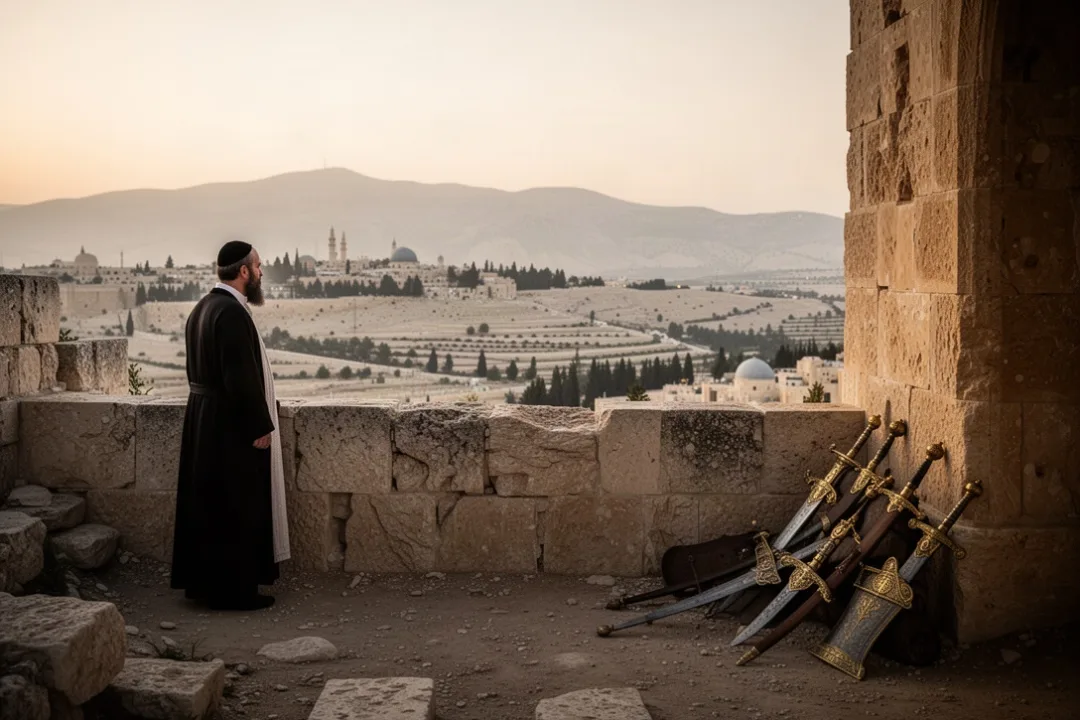
The psalm describes God’s dwelling as a place where he has shattered the weapons of war. The imagery includes bows, shields, swords, and the equipment of battle. These objects represent more than ancient military technology. They stand for organized violence, political domination, and confidence in human power.
The message is not that weapons are simply misplaced or outdated. Psalm 76 says that the Lord himself renders them ineffective. The strongest armies cannot preserve their power when God rises as judge. Human strength may appear impressive for a time, but it remains limited and accountable to the One who rules over creation and history.
Central idea: Psalm 76 does not ask you to place ultimate trust in force, status, or intimidation. It asks you to recognize that God’s authority can end what human power seems unable to stop.
The psalm also portrays God as more glorious than the mountains associated with prey or plunder. That image contrasts the Lord’s splendor with the spoils that warriors seek. Armies may collect riches and claim victories, but those gains do not compare with God’s lasting majesty.
How the psalm moves from battle imagery to divine judgment
Psalm 76 has a clear dramatic progression. It first identifies the place where God is known, then recalls his victory over weapons, then describes the effect of his judgment on warriors, and finally calls people to honor their vows. The movement is from God’s presence to God’s action and then to human response.
The middle portion imagines brave warriors being stripped of their strength. They are unable to use their weapons or defend themselves. Even the strongest among them lose their ability to act when confronted by the God of Jacob. The psalm uses sleep-like language to communicate complete helplessness: warriors who once seemed formidable become still and powerless.
This is a poetic description, not a military report. Its purpose is to show that human readiness cannot compete with divine authority. Armor, courage, planning, and experience all have limits. The psalm challenges the assumption that victory belongs automatically to whoever has the largest army or the most formidable weapons.
God’s rebuke is then described as causing both earth and heaven to tremble. The language expands the scene from a battlefield to the whole created order. God’s judgment is not a private preference or a local political opinion. It is presented as an event that reveals the true order of reality.
The psalm asks who can stand when God is angry. That question emphasizes accountability. The Lord is not indifferent to cruelty or oppression, and divine patience should not be mistaken for approval. God’s judgment exposes evil, limits its reach, and makes clear that no ruler or institution is beyond moral evaluation.
What Psalm 76 means by God’s wrath and praise
One of the most discussed ideas in Psalm 76 appears when the psalm says that even human wrath will praise God, while the remainder of wrath is restrained or turned to his honor. The wording can be understood in more than one closely related way, but the broad meaning is clear: God is able to overrule human rage and use the outcome to reveal his justice.
This does not mean that every angry action is good because God can bring good from it. Scripture repeatedly distinguishes between righteous judgment and sinful human anger. Psalm 76 does not excuse violence, revenge, or cruelty. Instead, it asserts that human hostility cannot finally escape God’s authority.
The second part of the idea is especially important. God does not merely redirect anger; he also limits it. The force that remains is contained, restrained, or made to serve a purpose beyond the intentions of the violent. For readers facing injustice, this can offer hope that evil does not have unlimited freedom.
For readers who are angry themselves, the passage offers a warning. Your anger may feel justified, but you are not entitled to become the final judge. God alone sees the whole situation, and his judgment is not driven by wounded pride or the desire to retaliate.
Psalm 76 presents divine judgment as the force that silences human boasting and establishes reverence.
Why Salem, Zion, Judah, and Israel matter
Several place names give Psalm 76 a strong biblical setting. Judah and Israel identify the covenant community among whom God is known. Salem is an ancient name associated with Jerusalem, while Zion refers to the hill and city that became central to Israel’s worship.
These names connect the psalm with a larger biblical story. Jerusalem is not praised because its buildings or defenses are inherently powerful. It is significant because God is present among his people. The city’s security depends on the Lord, not on walls, armies, or political influence.
Salem can also recall the priest-king Melchizedek in Genesis 14. That connection may deepen the psalm’s association with kingship, worship, and blessing, although the psalm itself does not explain the reference in detail. The safest reading is to see Salem as an ancient name for the place where God’s rule is acknowledged.
The geographic language also prevents a shallow interpretation. Psalm 76 is not simply saying that God helps any group that claims his name. The people of God are expected to respond with worship, humility, and obedience. Divine protection is never permission for human arrogance.
How Psalm 76 relates to other biblical songs
Psalm 76 belongs to a wider group of biblical passages that celebrate God as a divine warrior and righteous king. The imagery resembles other psalms in which God defeats enemies, stills disorder, and protects the vulnerable. It also echoes the biblical theme that the Lord cannot be compared with the military gods or political rulers trusted by surrounding nations.
Its closest emphasis is not personal success but God’s public victory over forces that threaten his people. That makes it different from a psalm focused mainly on private distress, illness, guilt, or individual guidance. The speaker is concerned with the Lord’s reputation among the nations and the collapse of arrogant power.
Psalm 76 also connects with the wisdom theme that reverence for God is the beginning of wisdom. When the Lord rises to judgment, people are called to fear him—not panic in the sense of hopeless terror, but recognize his holiness and authority. The appropriate response is humble attention rather than casual presumption.
In Christian reading, the psalm can be understood alongside the belief that God ultimately defeats evil through his saving work in Christ. Christians may see its victory imagery pointing toward the final establishment of God’s kingdom, while still respecting the psalm’s original setting in Israel’s worship.
That does not require forcing every line into a direct prediction. Psalm 76 first speaks as a hymn about God’s judgment and protection. Its continuing value comes from the truth it proclaims: evil is powerful but not ultimate, and God’s reign is not threatened by human violence.
What Psalm 76 teaches about fear, security, and trust
Many people read Psalm 76 during seasons of social conflict, political instability, or personal fear. Its strong language can remind you that security does not come from controlling every threat. The psalm does not promise that believers will never witness violence or loss. It declares that threatening powers remain under God’s authority.
That distinction matters. Trust in God is not the same as denial. You can acknowledge danger, grieve injustice, and take responsible precautions while still refusing to treat fear as the highest power in your life. Psalm 76 moves fear toward reverence: instead of being mastered by human threats, you remember who truly governs.
The psalm also challenges modern forms of confidence that are not military. People may rely on money, influence, credentials, technology, public approval, or institutional control. These resources can be useful, but none deserves absolute trust. Anything that becomes a substitute for God can become a source of false security.
At the same time, the psalm should not be used to discourage wise action. A person who trusts God can still seek help, protect others, oppose abuse, support just laws, and work for peace. Faith does not require passivity. It changes the foundation from self-reliance to dependence on God.
How to pray Psalm 76 without misusing its language
Psalm 76 can become a prayer for situations in which you feel surrounded by aggression or intimidation. You can bring the names of violent systems, destructive habits, and unjust circumstances before God. The aim is not to rehearse fantasies of revenge, but to ask God to expose evil and restrain its power.
A prayer shaped by this psalm might include several movements:
Recognition: Acknowledge God as the source of true authority and protection.
Honesty: Name the fear, anger, or injustice you are facing without pretending it is harmless.
Release: Place the desire for retaliation under God’s judgment rather than acting from impulse.
Responsibility: Ask for wisdom to protect the vulnerable and pursue what is right.
Reverence: End by remembering that God’s power is greater than the forces causing fear.
You might also pray through the psalm slowly, using each section as a prompt. The opening lines can lead you to praise God’s presence. The weapons imagery can help you surrender false sources of security. The judgment language can guide you in entrusting injustice to God. The closing call to fulfill vows can prompt a review of your own commitments.
Prayerful caution: When reading imprecatory or judgment-focused psalms, ask God to restrain evil and transform your heart. Do not treat the text as permission to curse enemies, excuse abuse, or pursue personal revenge.
Practical ways to read Psalm 76 in daily life
A useful reading does not stop with the question, “Who are the enemies?” It also asks, “Where am I tempted to trust force, image, control, or anger?” The psalm can speak to public injustice, but it can also uncover quieter forms of pride in your own decisions.
Use these practices when Psalm 76 feels difficult or distant:
Read it in four movements. Notice God’s presence, the breaking of weapons, the collapse of human strength, and the call to worshipful response.
Identify your false securities. Consider what you instinctively rely on when you feel threatened, such as money, influence, retaliation, or constant control.
Separate justice from revenge. Ask what would protect people and repair harm, rather than what would merely satisfy anger.
Pray for restraint. Include both the restraint of violent powers and the restraint of your own destructive impulses.
Keep your commitments. The final verses connect worship with fulfilling vows, so let prayer lead to honest and dependable conduct.
Seek wise support. If the psalm brings up experiences of abuse, war, or trauma, speak with a trusted pastor, counselor, or qualified professional.
Several common mistakes can make the psalm harder to understand:
Reading it as a guarantee of immediate rescue: The psalm praises God’s rule but does not promise that every crisis will end on your timetable.
Using it as a weapon against opponents: Its judgment belongs to God; it does not authorize personal condemnation or harassment.
Ignoring the worship setting: The text is a communal song, not merely a private statement of anger.
Equating faith with passivity: Trust in God can coexist with protection, truth-telling, peacemaking, and responsible action.
Assuming all power is evil: The psalm condemns arrogant violence and misplaced trust, not every form of leadership or strength.
What the final verses ask people to do
Psalm 76 ends by calling people to make and fulfill vows to the Lord and to bring gifts to the One who deserves reverence. The conclusion shifts attention from what God has done to what worshipers should do next. Recognition of divine power creates obligation.
A vow in the biblical world was a serious promise made before God. The psalm therefore rejects empty admiration. It calls for a response that can be seen in faithful conduct, generosity, worship, and integrity. If God has exposed the weakness of pride, people should not return to pride as soon as the danger passes.
The closing reference to rulers or kings receiving gifts reinforces the Lord’s supremacy. Human leaders may possess authority, but they remain accountable to God. The image can be read as a summons for nations and rulers to acknowledge the One above them rather than acting as though their power is unlimited.
For individual readers, the practical question is simple: What faithful response follows from what you have recognized about God? It may involve keeping a promise, ending a pattern of retaliation, defending someone vulnerable, making peace where possible, or returning to regular worship after a season of fear.
How Psalm 76 can shape a balanced Christian response to conflict
Psalm 76 gives Christians language for opposing evil without pretending to control the outcome. It affirms that God sees violence and can stop forces that appear invincible. That conviction can strengthen moral courage, especially when silence would protect the powerful rather than the vulnerable.
Yet the psalm also places limits on human anger. A Christian response to conflict should combine truth, justice, compassion, and self-control. Condemning oppression is not the same as dehumanizing every person involved. Seeking accountability is not the same as desiring revenge.
The New Testament’s calls to love enemies, pray for persecutors, and overcome evil with good do not erase the Old Testament’s concern for judgment. Together, these themes teach that evil must be confronted while personal vengeance is surrendered to God. Psalm 76 contributes the confidence that God’s justice is real even when human justice is incomplete.
This balance is especially important when the psalm is applied to current events. Avoid assigning every opponent the role of God’s enemy or treating every political victory as proof of divine approval. Instead, ask whether your interpretation produces humility, protection for the vulnerable, truthful speech, and a deeper dependence on God.
A concise way to remember Psalm 76
Psalm 76 can be remembered through four linked ideas: God is known, weapons are broken, pride is judged, and worshipers respond faithfully. These ideas capture the psalm’s movement without reducing it to a slogan.
God’s presence gives the psalm its setting. His victory over weapons shows that violence does not have the final word. His judgment exposes the limits of human arrogance. The call to fulfill vows shows that worship must shape the life that follows.
When you read Psalm 76 in fear, let it remind you that threats are not sovereign. When you read it in anger, let it call you away from revenge. When you read it after a victory, let it protect you from pride. Its enduring invitation is to stand in awe of God, trust his justice, and live as someone accountable to him.
Frequently asked questions
Who wrote Psalm 76?
Psalm 76 is traditionally connected with Asaph, a name associated with a family or guild of worship leaders in Israel. The psalm’s superscription also identifies it as a song intended for worship. Because the superscription is brief, it does not provide enough information to establish the exact historical event behind the composition.
What does “Salem” mean in Psalm 76?
Salem is generally understood as an ancient name connected with Jerusalem. In Psalm 76, it helps identify the place where God is known among his people. The name also recalls the biblical setting associated with Melchizedek, although the psalm’s main emphasis is God’s presence and authority rather than a detailed explanation of Salem’s history.
Is Psalm 76 about a specific war?
The psalm uses vivid battle imagery, but it does not identify one specific war in its verses. Some readers connect it with a historic deliverance of Jerusalem, while others read it as a general worship song celebrating God’s victory over hostile powers. Its message remains applicable beyond one event: human violence and pride are subject to divine judgment.
How can Psalm 76 help someone who feels angry?
It gives you words for acknowledging injustice while placing ultimate judgment in God’s hands. Read it slowly, name the harm honestly, and ask for protection, wisdom, and restraint. The psalm can help redirect anger toward faithful action, such as seeking safety, accountability, reconciliation where possible, and support from trustworthy people.














Leave a Reply