Psalm 87 presents Zion as the city God has chosen and as the spiritual home of people from many nations.
This short psalm, attributed to the Sons of Korah, is only a few verses long, but it raises large questions about worship, belonging, identity, and God’s purpose for the nations. Jerusalem is not praised merely as a political capital or an important ancient city. It is presented as the place God loves, establishes, and claims as his own.
The psalm’s most surprising idea appears near its center: people associated with places that were historically foreign or hostile to Israel are counted as having been born in Zion. The language is poetic, but the message is substantial. God’s people are defined not only by natural birthplace or ethnic origin. God can give outsiders a new standing among those who belong to him.
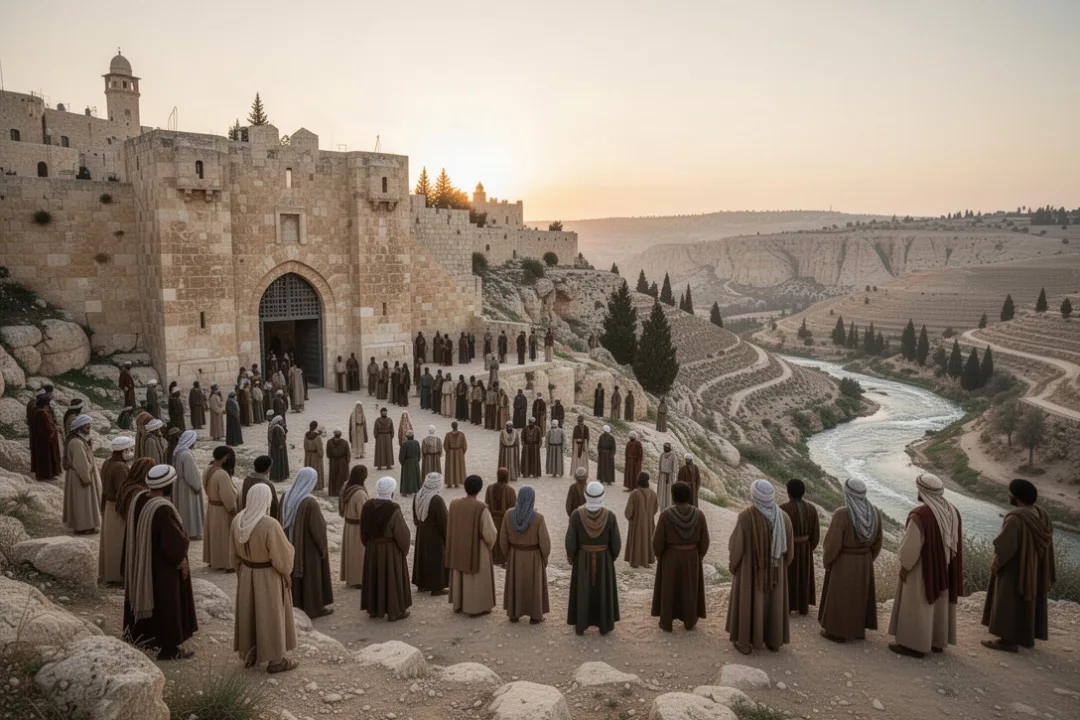
Psalm 87 opens by placing God’s foundation on the holy mountains. The wording can be understood as describing Zion’s secure establishment, with the Lord himself behind the city’s significance. Zion is not important because of its size, wealth, or military strength. Its importance comes from God’s presence and choice.
The psalm then declares that the Lord loves the gates of Zion more than all the dwelling places of Jacob. “Jacob” refers to Israel, so the comparison is striking: Zion is honored above the other places where Israel lives. The point is not that every Israelite town is worthless. Rather, Jerusalem holds a unique role in Israel’s worship because the Lord has set it apart.
In the Old Testament, Zion can refer specifically to the hill or stronghold associated with Jerusalem, and it can also refer more broadly to the city and its people. Psalm 87 uses Zion as both a real location and a theological symbol. It represents the place where God’s covenant presence is recognized and where people gather to worship him.
The psalm does not describe Zion as impressive by ordinary standards. Its glory is spoken by God. The Lord declares glorious things about the city, which means Zion’s true importance depends on divine testimony, not human advertising. What God says about the city determines how it should be understood.
Central idea: Psalm 87 does not teach that a physical city is valuable because of human achievement. It teaches that God’s choice can give a place—and the people associated with it—an identity grounded in his presence.
The opening also connects Psalm 87 with other biblical passages that describe Zion as a place of refuge, worship, kingship, and future hope. Psalm 48 celebrates Jerusalem as God’s city; Isaiah often portrays Zion as the center of God’s saving work; and the New Testament later uses Zion language in connection with the heavenly Jerusalem and the gathered people of God.
Those connections should be handled carefully. Psalm 87 first speaks in its own setting, to Israel and Jerusalem. Later biblical writers may apply Zion imagery in broader ways, but that does not erase the psalm’s original concern with God’s chosen city. Instead, the later uses build on the earlier picture of a place where God gathers and establishes his people.
Why Psalm 87 names foreign nations
After focusing on Zion, the psalm names several places: Rahab, Babylon, Philistia, Tyre, and Cush. These names represent a wide geographic and cultural range. Some were powerful enemies, some were wealthy trading centers, and some were distant lands associated with the southern regions beyond Egypt.
Rahab in this passage is generally understood as a poetic name for Egypt, not the woman named Rahab in the book of Joshua. In biblical poetry, Rahab can symbolize Egypt’s pride or power. Babylon was a major imperial rival and, in Israel’s history, the power responsible for the destruction of Jerusalem and the exile. Philistia was a neighboring people frequently involved in conflict with Israel.
Tyre was a prosperous Phoenician city on the Mediterranean coast. Cush likely refers to a region south of Egypt, often associated with Nubia or parts of northeastern Africa. By naming these places together, the psalm evokes nations that are geographically scattered and historically distinct from Israel.
The surprising statement is that one who knows Zion may be said to have been born there. The psalm does not simply say that foreigners visit Jerusalem or acknowledge Israel’s God from a distance. It uses the language of birth and citizenship. People whose natural origins lie elsewhere are recognized as belonging to Zion.
This poetic picture does not deny the history of conflict between Israel and these nations. It transforms the meaning of that history by imagining God’s city as a place where former outsiders can receive a new identity. The focus shifts from where a person came from to how God counts that person.
Rahab: a poetic reference commonly associated with Egypt and its power.
Babylon: an empire linked with conquest, exile, and opposition to Jerusalem.
Philistia: a neighboring rival often associated with conflict in Israel’s history.
Tyre: a wealthy coastal city known for trade and foreign influence.
Cush: a distant southern region that broadens the psalm’s geographic horizon.
The list matters because it prevents readers from treating Zion as a narrow symbol available only to one familiar group. The psalm places nations with difficult or foreign reputations directly into the story of God’s city. Belonging is widened, not guarded as a privilege for insiders alone.
What “born in Zion” means
The phrase “born in Zion” is the interpretive center of Psalm 87. It can refer to a person’s recognized membership in the city, even when that person’s literal birthplace is elsewhere. Ancient cities could record citizens and their families, so the language may echo a civic register. The psalm imagines God as the one who records and confirms this belonging.
Three times, the psalm repeats the idea that the Lord himself records people among those who were born in Zion. Repetition gives the statement weight. Their inclusion is not a casual compliment or a temporary invitation. It is written into the official record of God’s people.
The repetition also emphasizes God’s authority over identity. Human communities often sort people by ancestry, territory, language, class, or past allegiance. Psalm 87 imagines a higher declaration: the Lord knows who belongs to him, and his judgment can establish a person’s place among his people.
This does not mean the psalm offers a detailed procedure for conversion or citizenship. It is poetry, not a legal code. It gives a vision rather than a policy manual. The vision is that God can bring people from outside Israel’s usual boundaries into the recognized community of Zion.
That vision fits with other parts of the Old Testament. The story of Ruth shows a Moabite woman becoming part of Israel’s covenant community. The prophets frequently anticipate nations coming to Zion to learn the ways of the Lord. The Psalms also contain invitations for all peoples to praise God, even while Israel remains central to the covenant story.
Psalm 87 therefore holds two ideas together. First, Zion has a distinctive place because God chose it. Second, the blessing connected with Zion is not meant to remain closed to everyone else. God’s election becomes a channel of welcome rather than a reason for permanent exclusion.
Does the psalm erase national identity?
No. The nations named in Psalm 87 remain identifiable as nations. Their origins are not denied or hidden. What changes is their relationship to Zion. The psalm is not saying that every people must lose its history before approaching God. It is saying that God can grant a deeper belonging that reaches beyond natural origin.
This distinction is useful for modern readers. Christian and Jewish interpretation may differ on how Zion should be understood in later theology, but the basic poetic movement remains clear: God welcomes people without pretending their past does not exist. Their former identity becomes part of the testimony of grace rather than a permanent barrier.
The psalm also challenges the assumption that spiritual belonging is inherited automatically by those who are geographically or culturally closest to a sacred place. A person can be near Jerusalem and still fail to honor God; another person can come from a distant land and be counted among Zion’s children.
How Psalm 87 portrays God’s record and recognition
The repeated reference to the Lord’s register gives the psalm a courtroom and civic quality. God is portrayed as the one who keeps the definitive record. His register is more authoritative than the records maintained by human governments or communities.
In the ancient world, a register could establish a person’s family line, legal status, land rights, or membership in a city. To be absent from such a record could mean losing recognition and security. Psalm 87 uses that familiar idea to express a spiritual truth: God knows those who belong to him, and his recognition cannot be overturned by human prejudice.
The psalm’s wording places God at the center of every declaration. It does not say that the nations force their way into Zion, nor that they achieve citizenship through political influence. The Lord himself records them. Their status rests on God’s gracious decision.
That emphasis protects the passage from two opposite mistakes. One mistake is to read the nations’ inclusion as something humans can earn by cultural assimilation or personal status. The other is to assume that outsiders remain permanently unqualified. The psalm gives the decisive role to God, whose authority can both establish Zion and welcome people into it.
The idea of a divine register appears elsewhere in Scripture, sometimes as a record of the living and sometimes as a symbol of those who belong to God’s redeemed community. Those passages are not identical to Psalm 87, but they share an important concern: belonging before God is real, known, and significant.
For personal faith, this can speak to feelings of exclusion. People may carry family histories, national identities, past failures, or social labels that make them feel permanently outside. Psalm 87 does not offer a simplistic denial of those experiences. It does present a powerful alternative source of identity: the Lord can name and count people as his own.
How to read the psalm’s joyful ending
The final verse changes the mood from official declaration to celebration. The psalm pictures singers and dancers—or, depending on translation, musicians and those who celebrate—acknowledging that the fullness of life and blessing comes from Zion. The exact wording differs among translations, but the ending clearly turns toward joyful worship.
The joy is not separate from the earlier discussion of citizenship. The people from the nations are not merely listed in a register and then left without a voice. They join the celebration. Zion is pictured as a source from which worship, life, and gladness flow outward.
Some translations render the final expression in terms of springs, fountains, or sources. This image suggests that God is the origin of refreshment and vitality. The point is not that Jerusalem’s physical water supply solves every human need. The poetic language points to God as the source of the life celebrated by Zion’s people.
The movement of Psalm 87 can be traced in a few steps:
God establishes Zion as a holy city.
God declares Zion glorious because of his presence and purpose.
Nations associated with foreignness or hostility are named alongside the city.
God records outsiders as belonging to Zion.
The recognized community celebrates the life and joy that come from God.
This structure keeps the psalm from being read as a narrow statement about real estate. Zion is a place, but it also becomes a picture of God’s gathering work. The city’s glory is displayed most fully when people from many backgrounds are counted among its children.
For prayer: Ask where you have confused spiritual belonging with cultural familiarity. Psalm 87 invites you to trust God’s judgment about who belongs, while receiving people from different backgrounds as possible members of the same worshiping community.
The final celebration also corrects a common misunderstanding of inclusion. Psalm 87 does not present welcome as mere administrative acceptance. Those whom God records are drawn into praise. They become participants in the life of the community, not permanent guests standing at its edge.
What Psalm 87 means for readers today
Psalm 87 can shape Christian reflection on the church, worship, mission, and identity, although Christians should distinguish the ancient city of Zion from every modern institution that claims its symbolism. No church, denomination, nation, or congregation automatically embodies the whole promise of the psalm.
Still, the passage offers several clear principles. A community that belongs to God should not define membership only by ethnicity, nationality, social background, or family history. The psalm names outsiders as honored citizens, so it resists any form of pride that treats one group as naturally closer to God than another.
It also teaches that welcome begins with God’s initiative. Churches cannot manufacture spiritual belonging through slogans or public relations. They are called to recognize the breadth of God’s mercy, remove unjust barriers, and make room for people whose stories do not resemble the majority’s story.
At the same time, inclusion in Psalm 87 is not shallow. The nations are not added so that Zion can appear diverse while remaining unchanged. Their inclusion changes the community’s understanding of God’s glory. A city once associated with one people becomes a place where many peoples are recognized and celebrate together.
The psalm can also help people think about their own identity. You may feel secure because of your family, religious background, or cultural familiarity. Or you may feel disqualified because you lack those things. Psalm 87 places both assumptions under God’s authority. Neither inherited proximity nor perceived distance determines the final word about belonging.
Reject spiritual superiority: being close to religious tradition does not give a person grounds for contempt.
Receive outsiders seriously: people from unfamiliar backgrounds may be among those God is gathering.
Let God define belonging: human labels are limited and sometimes unjust.
Make worship genuinely shared: welcomed people should become participants, not symbolic guests.
Expect God’s work to cross boundaries: his purposes are wider than any one nation or culture.
Psalm 87 is especially meaningful for people who have crossed borders, joined a new community, or felt divided between identities. It does not require them to reject their birthplace. Instead, it offers the possibility of receiving a deeper home established by God.
For communities of faith, the psalm asks a demanding question: do your practices reflect the wide welcome that you claim to believe? It is easy to praise the inclusion of distant nations in a biblical poem while keeping actual newcomers at the margins. Psalm 87 joins theology to communal practice by imagining those once considered foreign as recognized, celebrated members.
The psalm remains brief because its central image is concentrated. God establishes Zion, names its glory, records people from the nations as its citizens, and gives the community a song of joy. Its message is both particular and expansive: God chooses a place, then uses that place to gather people far beyond its natural boundaries.
Read in that light, Psalm 87 is not merely a celebration of ancient Jerusalem. It is a testimony to God’s authority over identity and his freedom to create belonging where human beings would expect exclusion. Zion’s glory is seen not only in its holy status, but in the surprising range of people whom God counts as its own.
Frequently asked questions
Who wrote Psalm 87?
Psalm 87 is attributed to the Sons of Korah, a group associated with musical service and worship in ancient Israel. The psalm does not identify a specific individual author or provide a precise date. Its setting is centered on Zion, Jerusalem, and the Lord’s special relationship with the city.
What does “born in Zion” mean in Psalm 87?
“Born in Zion” is poetic language for being recognized as a true member of God’s city and people. The phrase does not necessarily describe literal physical birth. It emphasizes that God can grant outsiders an honored identity and count them among those who belong to Zion.
Why are Egypt, Babylon, and other nations mentioned?
The named nations represent distant peoples, powerful neighbors, and former rivals of Israel. Their inclusion makes the psalm’s message surprising: even people associated with foreign lands or hostility can be acknowledged as belonging to Zion. The list highlights the wide reach of God’s gathering purpose.
How should Psalm 87 be applied to Christian life?
Christians can read it as a challenge to treat belonging as God’s gift rather than as a reward for ancestry, culture, or social status. It encourages churches to welcome people from different backgrounds as genuine participants, not merely visitors, while remembering that the ancient psalm speaks first about Zion and Israel.












Leave a Reply