If you have read about money changers in the temple, you may wonder why they were there in the first place. Were they providing a useful service to Jewish pilgrims, or were they part of a corrupt religious marketplace? The answer is more specific than either extreme: currency exchange and animal sales served practical Temple needs, but Jesus condemned what the system had become and what it represented.
The Gospel accounts place Jesus’ action during his final visit to Jerusalem in Matthew, Mark, and Luke, while John records a similar Temple incident near the beginning of Jesus’ ministry. In each case, the scene raises questions about worship, religious authority, economic pressure, and the purpose of the Temple.
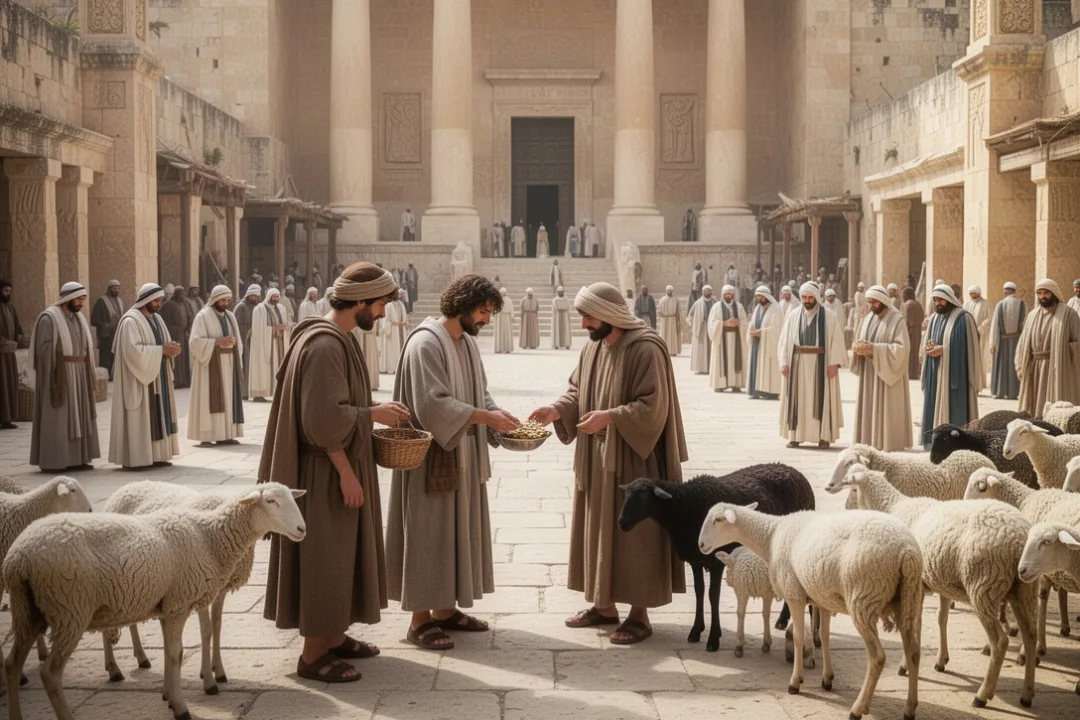
Jerusalem attracted Jewish worshipers from many regions, especially during major pilgrimage festivals such as Passover. These visitors arrived with different kinds of coins, but the Temple’s financial requirements were connected to particular forms of payment. Money changers exchanged foreign currency so pilgrims could use acceptable coins for Temple-related payments.
One relevant obligation appears in Exodus 30:11-16, which describes a half-shekel payment associated with the worshiping community. By the first century, Jewish men were expected to contribute a Temple tax, and money changers helped visitors convert their local currency into the coinage required for that payment.
Coins from across the Roman world could differ in weight, purity, and imagery. Some carried portraits or symbols connected with Roman rulers and pagan religion. That did not automatically make every foreign coin unusable, but it helps explain why a system of exchange existed near the Temple rather than relying on one universal currency.
The exchange was not necessarily comparable to a modern bank inside a sanctuary. The money changers likely operated in the broader Temple complex, where pilgrims could obtain accepted currency and purchase animals for sacrifice. The area is commonly associated with the outer court, often identified as the Court of the Gentiles, although the Gospel passages do not spell out every architectural detail.
Animal sellers served another practical need. Worshipers traveling long distances could not always bring a sheep, ox, or bird with them. Buying an animal in Jerusalem made pilgrimage possible for people who had come from distant places, including those with limited means.
Money changers exchanged foreign coins for currency suitable for Temple payments.
Animal sellers supplied animals used in the sacrificial system.
Pilgrims could avoid carrying animals over long distances.
Temple officials benefited from an organized system that supported offerings and dues.
For that reason, simply saying that the money changers were present because they were dishonest misses part of the historical setting. Their work met real needs. The central question is not whether every exchange was inherently wrong, but why Jesus treated the activity as a serious violation of the Temple’s purpose.
What the Gospel accounts say Jesus did
Matthew 21:12-17, Mark 11:15-19, and Luke 19:45-48 describe Jesus entering the Temple and driving out those who were buying and selling. The accounts also mention the money changers and the sellers of sacrificial animals. Jesus overturned tables associated with the exchanges and stopped people from using the Temple courts as a passageway for carrying goods.
Mark gives the fullest description of the action. It refers to Jesus preventing people from carrying merchandise through the Temple area. Matthew and Luke emphasize the removal of the sellers and buyers, while John 2:13-22 describes Jesus using a whip of cords and scattering animals and coins. John also includes sheep and oxen in the scene and connects the event with Jesus’ authority over the Temple.
The Gospel writers do not present the episode as a minor disagreement over market regulations. Jesus performs a prophetic sign, acting publicly in a place governed by powerful religious authorities. His action challenges the way the Temple was being used and forces observers to consider who truly had authority over it.
The Synoptic accounts connect the event with a sentence drawn from two prophetic passages. Isaiah 56:7 presents God’s house as a place of prayer for all peoples. Jeremiah 7:11 condemns a sanctuary that has become a refuge for people who commit injustice. Jesus brings these ideas together by saying, in paraphrase, that the Temple was intended for prayer but had become associated with a den of robbers.
Jesus’ protest joins the Temple’s purpose as a house of prayer with the prophets’ demand for justice.
The phrase about a den of robbers does not simply mean that every person selling an animal was a thief. In Jeremiah, a den is a safe place to which wrongdoers retreat after committing violence or injustice. Jesus’ language therefore points beyond individual transactions toward a religious system that could protect wrongdoing while continuing outward ceremonies.
Luke says the religious leaders began looking for a way to destroy Jesus after the incident, while the crowds listened to him. Mark similarly describes conflict with the chief priests and scribes. The action threatened both the Temple’s commercial arrangements and the authority of those responsible for maintaining them.
What “den of robbers” means in this setting
Many readers assume Jesus was condemning commerce in every form. That interpretation is too broad. The Bible contains no general rule that buying and selling are always sinful, and the Temple sacrificial system itself required animals, payments, and administrative arrangements. The sharper issue was commercial activity taking over sacred space and serving a system that had lost sight of mercy and justice.
The word “robbers” also matters. Jesus did not merely call the Temple a marketplace. His statement echoes Jeremiah’s warning to people who assumed that religious rituals would protect them from the consequences of oppression. The Temple could become a place where people felt secure while ignoring the needs of the poor, the foreigner, the widow, and the fatherless.
Jeremiah 7 places worship beside ethical obligations. The prophet criticizes people who mistreat vulnerable neighbors and then enter the Temple as though ritual alone makes them safe. Jesus’ use of that passage suggests that the money changers were part of a wider failure, not the only problem visible in Jerusalem.
Isaiah 56 adds another important dimension. Its vision includes foreigners who come to worship God. If commerce occupied the outer court in a way that crowded out prayer, noise and business could interfere with the worship of non-Jews. The location would therefore matter: activity in an outer court could affect people who had no other designated place within the Temple complex to pray.
The central criticism: Jesus was not merely objecting to the existence of currency exchange. He was confronting a Temple system in which religious activity, economic power, and exclusion could displace prayer and justice.
That does not prove that every money changer charged illegal rates or personally exploited every customer. The Gospel texts do not provide a price list, a description of exchange fees, or a record of individual abuses. Claims that the entire group was unquestionably running a scam go beyond what the passages directly say.
At the same time, the practical usefulness of the service does not make the system immune from criticism. A necessary arrangement can still be abused. Pilgrims who must pay a religious fee or purchase an approved offering may have little bargaining power, particularly when they have traveled far and have no convenient alternative.
The scene therefore combines economic vulnerability and spiritual authority. When people control access to worship, their financial decisions can carry religious consequences. Jesus’ protest exposes the danger of allowing a sacred institution to treat worshipers primarily as sources of revenue.
How the Temple incident differs across the Gospels
The accounts in Matthew, Mark, and Luke appear during Jesus’ final week in Jerusalem. Their placement makes the action part of the growing conflict that leads to Jesus’ arrest and crucifixion. John places a Temple cleansing near the start of Jesus’ ministry, after the wedding at Cana and before several early signs and conversations.
This difference has led to several interpretations. Some readers believe Jesus cleansed the Temple twice, once early and once near the end of his ministry. Others think the Gospel writers placed the same event differently for theological and literary reasons. The passages clearly share major elements, but they do not provide enough information to settle every question about chronology.
The Synoptic Gospel emphasis
In Matthew 21, Jesus enters Jerusalem, cleanses the Temple, heals blind and lame people, and receives praise from children. Matthew connects the action with the Temple’s role as a place of prayer and presents Jesus as one who restores its proper use.
Mark 11 gives the event a distinctive structure. Jesus approaches the Temple, acts against the buying and selling, and then the narrative returns to the subject after the account of the fig tree. Mark’s arrangement places the Temple action within a larger pattern of judgment, fruitlessness, and conflict with the authorities.
Luke 19 presents the scene with a strong emphasis on teaching. Jesus drives out the sellers and continues teaching daily in the Temple. The leaders want to destroy him, but they are constrained by the public response because the people are attentive to his words.
John’s Gospel emphasis
John 2 describes Jesus making a whip from cords, driving out the animals and sellers, and scattering the money changers’ coins. Jesus challenges those using his Father’s house as a place of trade. When questioned about his authority, he speaks in a way that connects the Temple with his own body, a statement the disciples understand more fully after his resurrection.
John’s version highlights Jesus’ identity and authority. The Temple action is not only a protest about conduct; it becomes a sign pointing toward Jesus’ death and resurrection. The physical sanctuary remains important, but the Gospel presents Jesus himself as the decisive meeting place between God and humanity.
The differences do not erase the shared message. Across the accounts, Jesus confronts the misuse of the Temple, invokes Scripture’s concern for prayer and justice, and acts with authority that challenges the established leadership.
Why the animal sellers mattered as much as the money changers
Discussions often focus on the coins because they make the story visually striking. Yet the Gospel accounts also identify people who sold oxen, sheep, and doves. Their presence shows that the dispute involved the entire sacrificial marketplace, not merely currency conversion.
Different offerings served different economic circumstances. A wealthy worshiper might offer a larger animal, while a person with fewer resources could bring birds. The Law of Moses made room for less expensive offerings in certain situations, including purification after childbirth as described in Leviticus 12.
That detail makes the sellers of doves especially significant. Poor worshipers depended on affordable offerings, and the religious system was supposed to provide a way for them to approach God. Any arrangement that made basic participation prohibitively expensive would undermine the stated purpose of the worship system.
The Gospel passages do not say that the dove sellers were charging a particular amount or that every price was unjust. They do show Jesus clearing out both the lower-cost offerings and the larger animals. His action addresses the use of the Temple space as a commercial operation, not only alleged fraud against one class of customer.
Animal sellers may also have been connected to the process of determining whether an offering was suitable. A worshiper who brought an animal from home could face questions about its fitness, while an animal purchased through the Temple system might be more readily accepted. That arrangement could be convenient, but it could also create dependence on sellers and inspectors connected to the institution.
The system made sacrifice possible for travelers.
It provided animals in several price ranges.
It linked commerce directly with religious access.
It could become vulnerable to pressure, inflated costs, or exclusion.
Jesus’ protest therefore has a social dimension. It asks whether a person who comes to worship is being welcomed as a worshiper or processed as a customer. The issue is not only the presence of animals and coins, but the priorities controlling the sacred space.
What “money changers in the temple” can mean for readers today
The episode is often applied to modern religious fundraising, church bookstores, ticketed events, or ministries that sell goods. Those comparisons can be useful, but they require care. The ancient Temple was the center of Israel’s sacrificial worship and had obligations that do not map perfectly onto a modern congregation.
A church selling books, meals, or educational materials is not automatically repeating the Temple incident. The relevant questions are more demanding than simply asking whether money changes hands. Consider who benefits, who bears the cost, and whether people can participate in worship without being pressured to spend.
A healthy ministry can involve money because buildings require maintenance, workers need support, and charitable work requires resources. Jesus’ action does not erase the practical costs of communal worship. It challenges situations in which financial activity controls access, exploits trust, or pushes prayer and care for people into the background.
These questions can help evaluate a religious organization:
Are donations presented as voluntary, or are people pressured through fear and shame?
Are essential spiritual services restricted to those who can pay?
Are financial practices explained clearly to the community?
Does the organization protect people with limited income?
Does fundraising support worship and service, or has it become the institution’s dominant purpose?
Are leaders accountable for the money they manage?
The passage also warns against using sacred language to protect unjust behavior. Jeremiah’s original criticism involved people who trusted the Temple while mistreating others. A religious institution can appear devoted on the outside while failing in mercy, honesty, and protection of the vulnerable.
For Christians, the account also raises a question about access. The Temple was meant to be a place where people sought God, and Isaiah’s vision includes people from the nations. Any religious practice that makes outsiders feel unwelcome or treats poor people as less worthy of attention conflicts with that larger biblical concern.
The strongest application is therefore not “never sell anything in a religious building.” It is “do not allow commercial interests, institutional power, or financial pressure to displace worship and justice.” That principle reaches beyond coins and animals to the way communities welcome, serve, and protect the people who depend on them.
What Jesus’ Temple action reveals about worship and authority
Jesus’ protest reveals that sacred spaces are judged by more than their rituals. The Temple had offerings, prayers, priests, Scripture, and crowds of worshipers. Yet the presence of religious activity did not guarantee that the institution was fulfilling its purpose. Worship without justice could become a shield for injustice.
The event also shows why the authorities treated Jesus as a serious threat. He did not merely criticize the Temple from a distance. He interrupted activity at its center and claimed the right to determine what belonged there. His action publicly questioned the leadership’s stewardship of the place where Israel met God.
The money changers were visible participants in that system, but the Gospel message reaches further. Jesus challenged a pattern in which institutional arrangements could be defended as necessary while their human effects were ignored. A system may have an official religious purpose and still become oppressive in practice.
Matthew, Mark, Luke, and John each present the Temple incident in their own way, but all direct attention to the meaning of God’s house. It was not meant to be a refuge for exploitation, a barrier against outsiders, or a marketplace that crowded out prayer. The money changers matter because they help make that conflict concrete: useful services had become part of a larger question about what worship was for.
Frequently asked questions
Were the money changers in the Temple automatically dishonest?
No. Their service met a practical need because pilgrims arrived with different currencies and needed acceptable payment for Temple obligations. The Gospel accounts condemn the way the Temple was being used, but they do not provide evidence that every money changer cheated customers. Jesus’ criticism is best understood as a challenge to exploitation, misplaced priorities, and a religious system that could burden worshipers.
Which Bible passages mention the money changers?
The main passages are Matthew 21:12-17, Mark 11:15-19, Luke 19:45-48, and John 2:13-22. Matthew, Mark, and Luke place the event during Jesus’ final visit to Jerusalem. John places a similar Temple incident near the beginning of Jesus’ ministry, leading readers to debate whether the Gospels describe one event from different perspectives or two separate incidents.
What does the Temple tax have to do with currency exchange?
Exodus 30:11-16 provides the biblical background for a half-shekel payment associated with the worshiping community. By Jesus’ time, pilgrims could arrive with coins from many regions, so exchange services helped them obtain currency used for Temple-related payments. The existence of that practical need explains why money changers were present, but it did not excuse abuse or the crowding out of prayer.
Does Jesus’ action forbid churches from selling goods?
The passage does not establish a simple ban on every sale connected with a religious community. Its warning concerns commercial activity that exploits people, controls access to worship, or displaces prayer and justice. Modern churches should examine transparency, voluntary giving, affordability, and accountability rather than assuming that either all religious commerce is wrong or that every fundraising practice is acceptable.












Leave a Reply