Litany of the Saints: Meaning, Text, and How to Pray It
Litany of the Saints: Meaning, Text, and How to Pray It
The Litany of the Saints is a traditional Christian prayer that asks God for mercy and asks the saints to pray for the Church and the world. It usually begins with appeals to the Holy Trinity, names groups of saints, and ends with petitions for protection, unity, and faithful living.
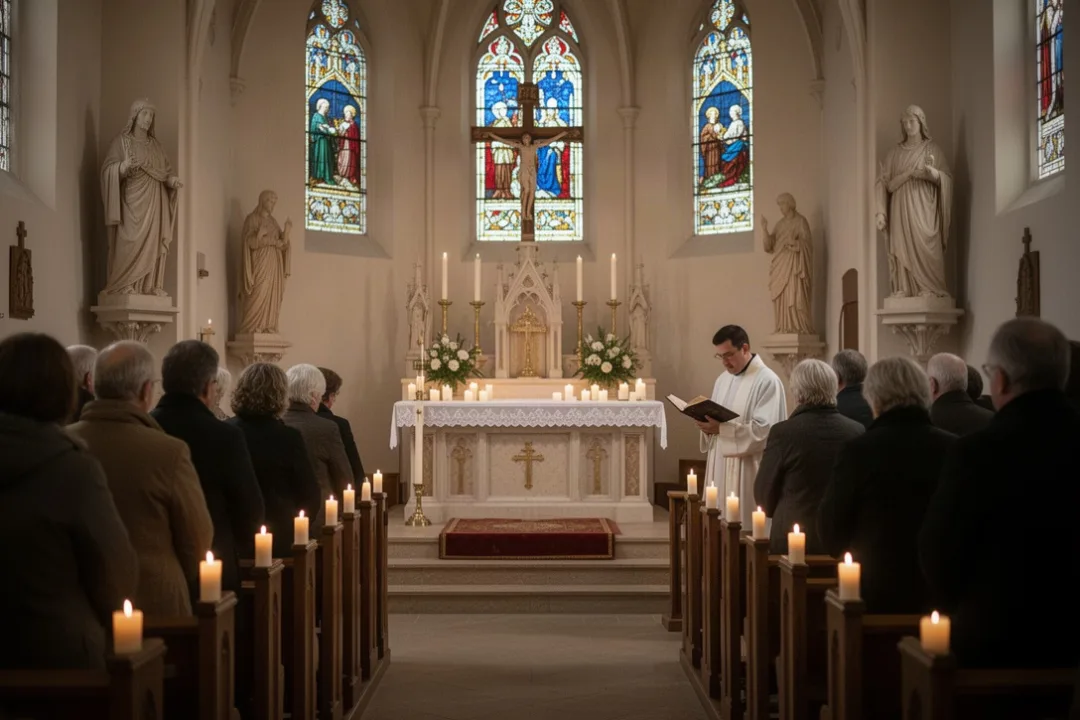
You can pray the litany alone, with a congregation, or as part of a Catholic liturgy. Its repeated responses make it suitable for processions and large gatherings, while its list of saints connects your prayer with Christians across many centuries and cultures.
The word litany refers to a series of short petitions, commonly led by one person and answered by the congregation. In the Litany of the Saints, the leader names God, Mary, angels, apostles, martyrs, teachers, and other saints. Those praying respond with brief appeals such as asking for mercy or asking a saint to pray for them.
The prayer is not worship of the saints. Worship belongs to God alone; asking a saint to pray is understood as requesting the intercession of a faithful member of the Christian community. The saints are honored because God’s grace was at work in their lives, and their example directs attention back to Christ.
This distinction matters because the litany holds together two forms of prayer. The opening and concluding petitions are addressed directly to God, while the invocations of individual saints ask those saints to join the Church’s prayer. The entire litany therefore has a Christ-centered purpose, even when many names appear in the middle.
The prayer also expresses the Christian belief that the Church is larger than the people gathered in one place. Those praying are united with believers who lived in different countries, spoke different languages, served in different vocations, and faced different forms of suffering. The litany gives that unity a spoken form.
Central idea: The Litany of the Saints is a prayer of intercession and solidarity. It asks God to save and guide the Church while inviting the saints to pray with the people on earth.
Many of the petitions use a repeated pattern because repetition helps the congregation pray together. It also slows the pace of the service. Rather than rushing from one request to another, the people hear each need and answer as a body.
The litany can feel solemn, especially when used during a funeral, ordination, or vigil. It can also be hopeful. The long list of saints reminds worshipers that holiness is possible in many settings: family life, religious life, public service, scholarship, missionary work, care for the sick, poverty, imprisonment, and ordinary work.
How the Litany of the Saints is organized
Although wording and the order of names can vary, the traditional form follows a recognizable movement. It starts with God, turns to the saints, asks for deliverance from sin and suffering, and finishes with petitions for the Church’s needs. Knowing this structure makes the prayer easier to follow when you hear it in church.
Invocations of the Holy Trinity
The first section addresses the Father, the Son, and the Holy Spirit. The people ask for mercy rather than presenting a list of personal achievements. This opening establishes the source of salvation: God’s mercy and power, not human strength.
The language often moves from a simple appeal for mercy to petitions connected with the life, death, and resurrection of Jesus. The purpose is not to retell the whole Gospel, but to place the prayer within the central Christian confession that Christ saves, heals, and reconciles.
Invocations of Mary and the angels
Mary is generally named first among the saints, often with titles that refer to her relationship to Jesus and her place within the Church. She may be invoked as the Mother of God, the Virgin, or the Queen of the saints. Different editions and traditions use different titles, but the emphasis remains on her faithful response to God.
The litany then commonly names angels and archangels. These invocations reflect biblical images of heavenly beings who serve God and participate in the divine purpose. The prayer is not attempting to provide a complete catalogue of the spiritual world; it is acknowledging that worship includes both the earthly and heavenly Church.
Groups of apostles, martyrs, and holy people
The next portion often proceeds through groups of saints. Apostles and evangelists represent the proclamation of the Gospel. Early martyrs represent steadfastness under persecution. Bishops, priests, deacons, religious men and women, and laypeople represent different ways of serving the Church.
The litany may also name saints known for particular virtues or missions. Some are associated with teaching, others with caring for the poor, defending the vulnerable, founding religious communities, evangelizing, or enduring illness and exile. The sequence helps worshipers recognize that holiness has many forms.
Names may be added for a particular celebration. An ordination may include the patron saints of the ordinand or the local church. A baptism may name a chosen patron. A religious profession may invoke saints connected with the community’s spiritual tradition. These additions should fit the approved form used by the church or denomination conducting the service.
Petitions for deliverance and the needs of the Church
After the saints have been invoked, the prayer usually returns to direct petitions to Christ. These ask for deliverance from sin, death, evil, and other dangers. The movement is significant: the saints intercede, but Christ is the one from whom salvation is requested.
The final petitions often mention the Church, the pope or other pastors, public authorities, the unity of Christians, the conversion of sinners, the suffering, and the needs of the local community. The litany can therefore move from the universal to the immediate. It remembers the whole world while making room for the people standing in the particular place where it is prayed.
Some versions include a closing prayer that gathers the petitions into one request. The leader may ask God to hear the Church, grant peace, strengthen the faithful, and guide them toward eternal life. The congregation’s repeated responses create a steady rhythm from beginning to end.
When the Litany of the Saints is prayed
The litany appears in several important Catholic rites and devotional settings. Its use is especially fitting when a person or community needs to be supported by the prayers of the whole Church. The exact form depends on the rite, local customs, and the approved liturgical book.
The Easter Vigil: The Church invokes the saints while preparing to celebrate Christ’s resurrection and welcome new members through baptism.
Baptism: The litany may be prayed for a child or adult who is entering the Christian community, asking for protection and faithfulness.
Ordination: Those being ordained lie prostrate or kneel while the Church asks the saints to pray for them and asks God to strengthen their ministry.
Religious profession: A person making vows may be supported by the intercession of saints connected with the religious vocation.
Dedication of a church or altar: The litany helps place a new sacred space under the care of God and recalls the communion of saints.
Funerals and vigils: The prayer asks for mercy for the deceased and comfort for those who mourn.
Processions and special days of prayer: A congregation may pray the litany during a procession, a pilgrimage, a time of crisis, or a feast connected with a local patron.
Its use at an ordination is one of the most recognizable examples. The person being ordained cannot carry the responsibility of ministry by personal ability alone. The posture of kneeling or lying prostrate communicates dependence on God, while the names of the saints place the person within the long history of Christian service.
At a baptism, the emphasis is different. The community asks that the newly baptized person be guarded in faith and joined to the Church. The prayer may be shortened or adapted for the setting, especially when children are involved, but its basic purpose remains intercession.
During a funeral, the litany can give mourners words when grief makes ordinary speech difficult. It does not remove sorrow or offer a simple explanation for death. Instead, it places the deceased and the living before God, surrounded by the memory and prayer of the saints.
Many churches also pray a litany outside formal rites. A parish may use it during a mission, a period of war, a natural disaster, or a community emergency. Individuals may pray a shorter form during illness, before a difficult decision, or when asking for courage to remain faithful.
Practical guidance: If the litany is being used within a formal service, follow the version appointed for that rite. Liturgical texts may differ in their names, responses, and rubrics, so a personal devotional version should not replace the required official text.
How to pray the Litany of the Saints by yourself or with others
The litany is easiest to pray when you understand who leads and who answers. In a communal setting, one person reads the invocations and petitions while everyone responds. In private prayer, you can read both parts, pause between sections, or use the responses as brief prayers of their own.
A simple method for praying it privately is:
Choose a quiet setting. Set aside enough time to pray slowly rather than treating the litany as a list to finish.
Begin with an intention. You might pray for a person who is ill, a family in conflict, a parish, a nation, the departed, or your own need for courage.
Read the opening invocations. Let the repeated appeals for mercy turn your attention toward God.
Pause at the names of the saints. Notice the different forms of faithful living represented by the list.
Pray the petitions for deliverance. Bring specific fears, habits, temptations, and dangers before God without needing to explain them at length.
Finish with the closing prayer. Remain quiet for a moment and entrust the people and concerns you named to God.
When praying with a group, decide beforehand who will lead and which response everyone will use. A printed copy or service booklet can help participants follow the sequence, especially if the litany includes unfamiliar names. The leader should allow a clear pause after each invocation so that the congregation can respond together.
Pronunciation does not need to become a source of anxiety. If you are leading, practice the names in advance and use a reliable liturgical edition. If a name is unfamiliar, pronounce it as carefully as you can. The value of the prayer lies in faithful attention, not in performing a flawless recitation.
You can also pray a thematic portion when time is limited, provided the setting allows it. For example, you might reflect on the martyrs when praying for courage, on teachers and pastors when praying for church leaders, or on saints known for compassion when praying for people who are poor or sick.
Still, a shortened personal practice should be identified honestly as a selection or adaptation, not presented as the complete litany. The full form has a deliberate shape, and omitting its opening or closing sections can change the balance between invoking the saints and asking God directly for mercy.
Music can support communal prayer, but it is not required. A spoken litany may be more appropriate in a small group, hospital room, or home. In a large church, a chant or simple melody can make the responses easier to hear and can help the congregation maintain a steady pace.
How to understand the saints named in the litany
The saints are not included merely to make the prayer long. Each name can open a small window into a particular form of discipleship. A martyr may remind you of courage, a missionary of generosity, a contemplative of attentive prayer, and a parent or layperson of holiness within ordinary responsibilities.
Some saints are known throughout the worldwide Church, while others belong especially to a country, diocese, parish, religious community, or family. Local names are valuable because they show that the communion of saints is not an abstract idea. It has a geography, a history, and a relationship to the people who are praying now.
The order of names is not a ranking of holiness. A saint listed near the beginning is not necessarily considered more important than a saint listed later. The arrangement usually follows categories inherited from liturgical tradition, such as Mary, angels, apostles, martyrs, pastors, virgins, and other holy men and women.
The list also prevents a narrow idea of Christian faithfulness. The people named may have lived in different centuries and cultures, but they share a response to God’s call. Their lives include public leadership and hidden service, scholarship and manual labor, solitude and community, suffering and joyful celebration.
For personal prayer, you can select one or two saints whose witness relates to your intention. Read a trustworthy account of their lives, then return to the litany and hear their names within the wider company of the Church. This keeps devotion from becoming isolated admiration; the saint points beyond personal qualities to God’s action and the needs of the community.
It is also acceptable not to know every saint in the list. The litany is a communal prayer, not an examination of religious history. Unfamiliar names can remind you that the Church’s memory is larger than your own experience and that many faithful lives were never widely recognized.
Differences between versions and traditions
There is not only one universal wording used in every Christian community. Catholic rites have official forms for particular celebrations, while Eastern Christian traditions and other churches use their own litanies or prayers of intercession. Even within Catholic practice, the list of saints and the order of petitions may change according to the rite or occasion.
Some versions are extensive and name many individual saints. Others use broader groups, such as all holy men and women or all saints of a particular region. A local church may add its patron, a recently canonized saint, or a figure especially connected with the celebration.
Translations can also differ. A response may be rendered with slightly different English wording while retaining the same meaning. When you are preparing for a formal service, use the translation supplied by the church or the approved liturgical resource rather than combining lines from several versions.
Names can differ because of language and pronunciation. A saint may be known by a Latin form, an English form, or a name commonly used in the saint’s own country. These differences do not necessarily indicate different people. They often reflect how names are adapted across languages.
The prayer’s setting influences how it should be heard. In a baptism, listen for the request that the newly baptized person be protected and strengthened. In an ordination, hear the petition as support for a particular ministry. At a funeral, attend to the movement from grief toward trust in God’s mercy.
For personal use, choose a complete and trustworthy version that matches your tradition. Avoid treating a random online list as authoritative, especially if you intend to use the prayer during a sacrament or public liturgy. A parish, diocese, denomination, or established prayer book can help you identify the appropriate form.
The most faithful way to pray the Litany of the Saints is with patience and attention. Let the repeated responses become an act of shared dependence on God. Let the names remind you that Christian holiness appears in many lives. Then bring the final petitions to the people and circumstances that need prayer now.
Frequently asked questions
Is the Litany of the Saints a prayer to the saints?
It includes direct requests for the saints to intercede, but its central petitions are addressed to God. In Christian practice, asking a saint to pray is understood as asking a member of the heavenly Church to join the prayer, not as giving the saint the worship owed to God. The litany’s beginning and ending make that focus especially clear.
Can I pray the Litany of the Saints without attending a church service?
Yes. You can pray it privately, with your household, or with a small prayer group. Read the leader’s lines and responses aloud, or read both parts yourself. For a formal sacrament or liturgy, use the version assigned by the relevant church. For personal devotion, you may pray for specific people and pause between sections.
Why are some saints included in one version but not another?
Litany forms are adapted to different rites, occasions, languages, and local churches. A baptismal version may include a patron connected with the child, while an ordination or funeral version may use a different selection. Local communities may also add regional saints. Differences in names or order do not necessarily mean that one version is incorrect.
What should I do if I do not recognize most of the names?
You can still pray the litany faithfully. The prayer is meant to unite you with the Church’s wider memory, not test your knowledge of saints. If you wish, look up one or two unfamiliar names after praying. Consider what each person’s life shows about courage, mercy, service, prayer, or perseverance, then return to the full communal prayer.












Leave a Reply