Litanies are repeated prayers of petition, usually led by one person while the congregation or individual responds with a short refrain.
The form is simple: a series of invocations names God, Christ, a mystery of faith, or a saint, and each invocation receives a repeated response such as “have mercy on us” or “pray for us.” That pattern allows prayer to become steady, communal, and attentive rather than dependent on finding new words each time.
The word litany comes from a Greek term associated with earnest prayer or supplication. Christians have used this kind of responsive prayer for centuries, especially in worship, processions, times of repentance, and moments of urgent need. Today, litanies appear in Catholic, Orthodox, Anglican, Lutheran, and other Christian traditions, as well as in personal prayer.
The central idea: A litany is not meant to impress God with many words. Its repeated structure helps you remain present while placing a series of needs, praises, or people before God.
Most litanies contain several recognizable parts. The leader begins with an invocation, the response names the community’s prayer, and the sequence continues through related petitions. A concluding prayer often gathers everything into one final request.
A typical litany may move through these elements:
An opening address: God, Jesus Christ, or the Holy Spirit is called upon directly.
A sequence of invocations: The prayer names divine attributes, Christian mysteries, saints, needs, or virtues.
A repeated response: The people answer with a phrase that remains the same or changes in a predictable pattern.
Requests for protection or mercy: The prayer may ask for deliverance from sin, suffering, danger, or spiritual confusion.
A concluding collect or prayer: The petitions are brought together and offered to God.
The response is not filler between more meaningful lines. It gives the people a shared voice and creates a rhythm that can carry prayer when you are tired, grieving, distracted, or unsure what to say. A short response such as “hear our prayer” can also remind you that every petition belongs to a larger act of trust.
Some litanies are highly formal and closely connected to a church’s official worship. Others are devotional prayers written for private use. Their length varies from a few lines to many petitions, but the defining feature remains the same: repeated responses organize a series of prayers.
Why Christians use repetition in litanies
Repetition can feel unfamiliar if you mainly associate prayer with spontaneous speech. Yet repeated prayer appears throughout Christian worship and devotional life. The repetition of a response does not mean that the words have lost their meaning; it gives the words time to settle more deeply.
A litany can help you pray when your attention is scattered. Instead of deciding what to say next, you listen to the petition, answer, and prepare for the next one. This makes the prayer accessible during illness, bereavement, anxiety, fasting, or communal intercession.
Repeated responses also create a sense of equality. The leader may read the invocations, but the congregation participates actively through its answer. In a group, the same response joins people of different ages, personalities, and levels of familiarity with prayer.
The structure can also broaden your prayer. You might begin by asking for personal help, but a litany may lead you to pray for families, leaders, the poor, the sick, enemies, the Church, creation, and people you do not know. Its ordered sequence keeps prayer from becoming limited to the concerns that happen to be most immediate.
Still, repetition is not automatically meaningful. If you rush through a litany, treat the response as a cue rather than a prayer, or use words that no longer communicate anything to you, the form can become mechanical. The remedy is not necessarily to abandon the litany. You can slow down, understand the petitions, and allow a brief pause before each response.
Where litanies appear in Christian worship
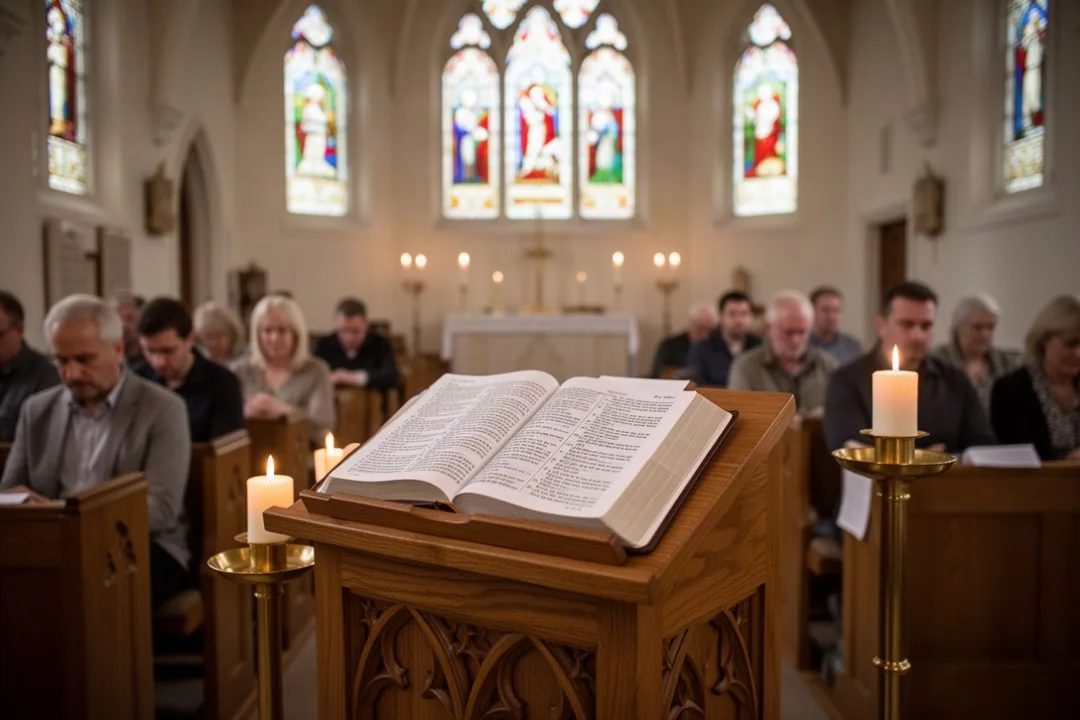
Litanies are used differently across Christian traditions, but the responsive pattern is widely recognizable. In many churches, a minister, priest, deacon, or cantor presents the petitions while the congregation answers together.
In Catholic worship, the Litany of the Saints has a prominent place in certain rites and processions. It invokes God, Christ, the angels, Mary, and saints, asking for their intercession and for help in living faithfully. The litany may be used during significant celebrations, in prayers connected with ordination, at the Easter Vigil, or in other settings according to the rite and local practice.
Other well-known Catholic devotions include the Litany of Loreto, which reflects on titles associated with Mary, and litanies devoted to the Sacred Heart of Jesus, Saint Joseph, the Holy Spirit, and other subjects. These prayers are often used privately, in parish devotions, or as part of novenas and seasonal observances.
Eastern Christian traditions use forms of liturgical petition often called ektenias. A deacon or priest offers a series of requests, and the congregation responds with a repeated prayer for mercy or divine help. Although the wording and setting differ from Western litanies, the shared pattern of leader, petition, and response is clear.
Anglican and other Protestant prayer books also include litanies. They may be used during regular worship, penitential seasons, national or community prayer, and services focused on healing or peace. Some contemporary churches write responsive prayers for particular circumstances while retaining the traditional rhythm.
These differences matter because a litany’s meaning is shaped by its tradition. A prayer addressed to saints, for example, expresses intercession within traditions that honor the saints in that way, while other Christians may prefer a litany addressed directly to God. You can choose a form that fits your convictions and worship community.
Common types of litanies and what they emphasize
Litanies are often identified by their central subject. Knowing the purpose of a litany can help you choose one that corresponds to your spiritual need instead of selecting a prayer only because its title is familiar.
The Litany of the Saints
This litany names saints from different periods and places, often beginning with biblical figures and continuing through martyrs, teachers, pastors, and other witnesses. The repeated request for their prayers expresses the Christian belief that the faithful are joined across time and that holy examples can encourage present believers.
Its petitions may also ask for deliverance from sin, death, division, or spiritual harm. The prayer is therefore both intercessory and penitential: it asks for help while acknowledging dependence on God’s mercy.
The Litany of Loreto
The Litany of Loreto is a Marian litany that uses a series of biblical and devotional titles for Mary. Each title presents a way of reflecting on her role in Christian faith, such as her relationship to Christ, her humility, her faithfulness, or her place among the Church’s people.
Because many titles are symbolic, it helps to pray this litany with an understanding of its imagery. You do not need to analyze every phrase during one session. You can choose one title that stands out and consider how it points beyond Mary to God’s work in salvation.
Litanies centered on Christ
Some litanies focus on Jesus under titles connected with his life, death, resurrection, compassion, or kingship. The Litany of the Holy Name of Jesus and the Litany of the Sacred Heart are examples of devotional forms in Catholic practice.
These prayers often invite contemplation of Christ’s character as well as petition. They can be especially appropriate when you want prayer to turn your attention away from fear or self-criticism and toward mercy, sacrifice, healing, and trust.
Litanies to the Holy Spirit
A litany to the Holy Spirit typically asks for wisdom, holiness, courage, guidance, and strength to serve others. It may be used before a major decision, during preparation for a sacrament, or at the beginning of a meeting or season of discernment.
The repeated form makes room for patience. Rather than demanding an immediate answer, you can ask for the qualities needed to recognize and follow what is good.
Many communities use litanies for peace, healing, the dead, the poor, families, vocations, or protection from danger. These prayers can be written for a parish, a retreat, a feast day, or a crisis affecting a whole community.
A useful litany does not promise a specific outcome. It places a need before God, recognizes the suffering involved, and calls the community to compassionate action. Prayer for peace, for example, should not replace practical efforts to protect vulnerable people and repair relationships.
How to pray a litany by yourself
You do not need a group to pray a litany. When praying alone, you can read the leader’s lines aloud and say the response aloud or silently. A printed prayer book, parish resource, or trusted devotional source can provide the text and indicate when to pause.
Choose a clear intention. Decide whether you are praying for healing, repentance, guidance, another person, a community, or simple attentiveness to God.
Set aside enough time. A longer litany should not be squeezed into the final seconds before an appointment. Even a short period without interruptions can make the prayer more deliberate.
Read the opening slowly. Notice whom you are addressing and what kind of prayer the litany invites.
Use the response consciously. Let each repetition become your own prayer rather than an automatic sound.
Pause when a petition touches a real concern. You may remain silent for several breaths before continuing.
End with the concluding prayer or a brief period of silence. Allow the petitions to remain with you instead of immediately moving to another task.
You can also divide a long litany across several days. For example, one day might focus on petitions for mercy, another on prayers for family and neighbors, and a third on requests for courage and service. This approach preserves the litany’s structure without making prayer feel hurried.
Practical tip: If a response feels distant or difficult, restate its meaning in your own words after the litany. You can keep the traditional form while making its purpose clearer to your mind and heart.
How to lead a litany with a group
A group litany works best when everyone knows the response and can hear the leader clearly. The leader should provide the text beforehand or announce the response at the beginning. If the prayer includes unfamiliar names, titles, or words from another language, pronunciation guidance can prevent avoidable distraction.
Keep the pace measured. A leader who reads too quickly can make the response feel like a routine interruption, while excessive pauses may make the congregation unsure whether the prayer has ended. A short silence after a group of related petitions can help people absorb what they have heard.
It is also helpful to explain the purpose without giving a long speech. A simple invitation such as “We will pray for those who are sick, for their families, and for those who care for them” gives the congregation a way to listen. The explanation should support the prayer, not become a second service before it.
Choose a response that everyone can hear and remember.
Arrange petitions in a meaningful order, such as praise, confession, intercession, and commitment.
Use names and situations with care, especially when praying for people facing illness, violence, or public scrutiny.
Allow the congregation to participate fully, rather than assigning every line to a solo reader.
Check the theology and wording against the tradition and setting in which the litany will be used.
Close with a definite prayer or silence so people recognize the transition to what follows.
Common mistakes that weaken a litany
The repetitive nature of a litany makes certain problems especially noticeable. These mistakes are easy to correct once you recognize them.
Reading without understanding: If you do not know what the petitions ask, the response can become empty. Read the prayer beforehand and look up unfamiliar terms.
Making every petition personal: A litany can include your concerns, but it should also widen your attention to other people and the larger community.
Using a form that conflicts with your beliefs: Select a prayer whose understanding of God, saints, salvation, and intercession fits your tradition.
Rushing because the prayer is familiar: Familiar words still need attention. Slow down at the petitions that involve suffering, repentance, or responsibility.
Adding too many petitions: A long list is not necessarily a deep prayer. Remove repetition that does not serve the purpose of the gathering.
Treating the litany as a magical formula: Its power does not come from saying a fixed number of responses or using a particular speed. It is an act of faith, attention, and dependence on God.
Ignoring the people affected by the prayer: If you pray for the hungry, grieving, or displaced, consider what concrete compassion your community can offer.
One of the most serious errors is using a litany to avoid responsibility. Prayer for someone in danger should be joined with appropriate help, advocacy, medical care, protection, or pastoral support. A responsive prayer can shape a community’s conscience, but it should not be used as a substitute for action.
How to understand saints and intercession in litanies
Some litanies ask saints to pray for the people using the prayer. In Catholic, Orthodox, and some Anglican settings, this reflects a belief that the Church includes the faithful who have died and that Christians can ask these holy witnesses to join their prayers. The request is directed ultimately toward God, who is understood as the source of grace and mercy.
Other Christians do not practice prayer addressed to saints and may prefer litanies directed only to God. That difference does not prevent Christians from appreciating the broader structure of a litany: praise, confession, intercession, and a repeated plea for help can be expressed without invoking saints.
When praying a saint-focused litany, learn enough about the figures named to understand why they appear. A martyr, missionary, contemplative, parent, teacher, or defender of the poor may represent a different aspect of faithful living. The names are not merely a long historical list; they can prompt you to consider courage, mercy, truth, patience, and service.
A litany can continue working in your mind after the final response. A petition for the lonely may make you notice a neighbor who needs a call. A request for forgiveness may lead you to repair a relationship. A prayer for wisdom may remind you to seek counsel instead of making a decision from fear.
To carry a litany into the day, choose one petition as a practical focus. If the prayer asks for compassion, identify one person you can listen to without rushing. If it asks for peace, consider one conflict where you can stop adding to hostility. The point is not to turn every prayer into a measurable task, but to let worship influence conduct.
Litanies are also useful during shared transitions. A family might pray a brief litany before a difficult medical appointment. A congregation might use one after a natural disaster or during a season of public tension. A person preparing for a major decision might repeat a short invocation for guidance over several days.
The form remains valuable because it holds together two movements that are easy to separate: remembering God’s presence and naming the real needs of the world. Its repeated response can be a small act of faithfulness when circumstances do not change quickly.
How to choose a litany for your situation
Start with the need rather than the popularity of the prayer. A litany centered on repentance may serve a different purpose from one focused on healing, and a prayer honoring saints may not be appropriate for every worship setting.
Ask yourself these questions:
Am I seeking mercy, guidance, healing, protection, thanksgiving, or intercession?
Will I pray alone, with a family, or in a formal congregation?
Does the litany fit my church tradition and beliefs?
Can I understand the language and explain its central petitions?
Does its length suit the time and attention available?
Will the prayer lead toward compassion and faithful action?
If no existing form fits your setting, you can write a simple litany. Begin with a clear address to God, group petitions around one purpose, use a response that expresses the central request, and finish with a prayer of trust. Avoid making promises on God’s behalf or suggesting that suffering is proof of personal failure.
A litany gives many needs one shared voice.
That shared voice may be spoken by a congregation, a household, or one person in a quiet room. Its strength lies in disciplined attention: the prayer names what matters, returns to a response, and teaches you to keep listening even when an answer is not immediate.
Frequently asked questions
Are litanies only used by Catholics?
No. Catholics use many well-known litanies, but responsive prayers also appear in Orthodox, Anglican, Lutheran, and other Christian traditions. The wording, subjects, and role of saints vary by church. Some communities create contemporary litanies for peace, healing, justice, or pastoral needs while keeping the same pattern of petitions followed by a repeated response.
Can I pray a litany without knowing the traditional response?
Yes. Read the prayer slowly and repeat the response printed in the text. If you are praying alone, you may say both the petition and response aloud, or read the leader’s words silently and speak only the response. Understanding the response matters more than memorizing it beforehand.
How long does it take to pray a litany?
It depends on the number of petitions and your pace. A short devotional litany may take only a few minutes, while the Litany of the Saints or a litany used in a service may take considerably longer. Pausing for reflection is appropriate, so there is no required speed.
May I write my own litany?
Yes, especially for a family prayer, church gathering, retreat, or community concern. Keep the purpose focused, arrange related petitions together, choose a response people can remember, and use language consistent with your tradition. Review the prayer for clarity and pastoral sensitivity before sharing it publicly.













Leave a Reply