If you have heard that the Bible says “fear not” 365 times, you may wonder whether that number is actually correct. It is an appealing idea—one reminder for every day of the year—but it does not match a consistent count of the biblical text.
The most accurate answer is that there is no single number for how many “fear nots” are in the Bible. In the King James Version, the exact phrase “fear not” is commonly counted at about 62 occurrences, depending on the concordance or search method. Other translations use different expressions, so their totals can be higher or lower.
The broader biblical message is much larger than one exact phrase. Scripture repeatedly tells people not to be afraid, not to panic, not to lose heart, and to trust God in danger. Those ideas appear in many forms across both the Old and New Testaments.
Short answer: The popular claim of 365 “fear not” verses is not a reliable literal count. A commonly cited King James Version count is 62 exact uses of “fear not,” but the number changes when related phrases and other translations are included.
Why the Bible does not have one fixed “fear not” count
A word-for-word count sounds simple until you decide what qualifies as a “fear not.” Are you counting only the two words fear not? Should “do not fear” count too? What about “do not be afraid,” “be not afraid,” “do not be anxious,” or “take courage”? Each choice produces a different result.
Translations also make different decisions about English grammar and vocabulary. One version may translate a Hebrew or Greek command as “fear not,” while another uses “do not be afraid.” Both may represent the same underlying biblical statement, but a computer search for the exact words will count only one of them.
Even within one translation, search results can vary because of punctuation, spelling, verse divisions, and the source database being used. A search for “fear not” may include the phrase when it appears as part of a longer expression, while another concordance may count verses, not every occurrence of the phrase.
For example, a verse might tell someone not to fear a human enemy, while another tells a person not to fear because God is present. Both belong to the Bible’s teaching about fear, but they may use different English words. A careful answer has to separate exact phrase counts from the wider theme.
Exact phrase count: Searches only for the words “fear not.”
Equivalent wording count: Includes phrases such as “do not be afraid” and “be not afraid.”
Thematic count: Includes passages about courage, anxiety, trust, peace, and confidence in God.
Translation count: Uses the wording of one particular Bible version, such as the KJV, NIV, ESV, or NLT.
These are all legitimate ways to study the subject, but they answer different questions. Saying that the Bible contains a certain number of “fear nots” without identifying the translation and definition can make a disputed estimate sound like a precise fact.
How many times “fear not” appears in the King James Version
The King James Version is usually the source behind online claims about the phrase. A commonly cited count finds 62 exact occurrences of “fear not” in the KJV. Some lists report a slightly different number because they use different databases, count repeated instances differently, or include closely related wording.
That count refers to the literal English phrase, not every passage where the Bible tells someone not to be afraid. It also does not mean the KJV contains only 62 teachings about fear. The same command may appear as “be not afraid,” “fear ye not,” “neither be afraid,” or another variation.
The KJV’s older English affects the count as well. Its wording often places the verb before the subject in commands, such as “fear ye not.” A search for only the modern-looking phrase “fear not” would miss those examples even though they communicate the same basic instruction.
Several KJV passages show how widely the command appears. In Genesis 15:1, God reassures Abram after a troubling encounter. In Genesis 46:3, Jacob is told not to fear going down to Egypt. In Exodus 14:13, Moses tells Israel not to be afraid as they face the Egyptian army.
The command also appears during military threats and national crises. Joshua receives reassurance before confronting enemies in Joshua 8:1 and Joshua 10:8. In 2 Chronicles 20:15, the people of Judah are told not to fear or be dismayed when a large opposing force approaches. These passages connect the command to God’s presence and promised help, not to a claim that danger is imaginary.
The New Testament uses the same language in moments of personal distress. Joseph is told not to fear taking Mary as his wife in Matthew 1:20. The disciples hear “fear not” or an equivalent reassurance when they are frightened by circumstances, including the storm on the Sea of Galilee and the events surrounding Jesus’ resurrection.
Jesus also distinguishes different kinds of fear in Matthew 10. He tells his disciples not to fear people who can harm the body, while directing their reverence toward God. The passage does not pretend that persecution is harmless. Instead, it places temporary human threats within a larger view of God’s authority and care.
How to state the number accurately: “The KJV contains about 62 exact occurrences of the phrase ‘fear not,’ according to commonly used counts.” That wording is more responsible than saying the Bible universally contains exactly 62 or exactly 365 “fear not” verses.
Where “fear not” appears in the Bible’s major sections
The phrase and its equivalents are spread across many kinds of biblical settings. They are not limited to one book, one writer, or one type of fear. God speaks reassurance to individuals, prophets, kings, families, disciples, and entire communities.
Reassurance in Genesis and the Pentateuch
In the opening books of the Bible, “do not fear” often appears when a person faces an uncertain future. Abram is reassured after a military victory and political danger. Hagar hears a similar message when her child is in distress. Isaac, Jacob, Moses, and the Israelites each encounter situations in which fear could shape their decisions.
These passages do not present faith as the absence of emotion. Jacob is dealing with a major relocation and the possibility of loss. Israel is trapped between an army and the sea. The command not to fear comes in the middle of a crisis, followed by a promise, instruction, or demonstration of divine help.
Deuteronomy uses the language in connection with justice, warfare, leadership, and the future. The Israelites are instructed not to be intimidated by powerful opponents. Moses also encourages Joshua not to fear as leadership passes to him. In this setting, courage means obeying God and acting rightly despite serious pressure.
Encouragement for leaders and threatened communities
Joshua repeatedly hears that he should not fear before battles. The message is tied to God’s promise to be with him and to give Israel victory according to the covenant promises. The text does not turn courage into self-confidence alone; it roots courage in God’s faithfulness and direction.
Later historical books use similar language during political instability. David encourages frightened people, prophets deliver reassurance to kings, and communities hear that they should not be paralyzed by hostile nations. In 2 Chronicles 32:7, Hezekiah urges the people of Jerusalem to be strong and courageous as the Assyrian threat approaches.
These passages should be read in their original setting. A statement given to Joshua before a particular battle is not automatically a promise that every modern plan will succeed. The enduring principle is that fear should not be allowed to control faithful obedience, especially when a person is facing opposition or responsibility.
Comfort in Isaiah and the prophetic books
Isaiah contains some of the Bible’s best-known “fear not” passages. God tells Israel not to fear because he has redeemed and called the nation. Other passages address people who feel weak, abandoned, or threatened by surrounding powers. The reassurance rests on God’s identity and relationship with his people.
Isaiah 41 includes several related statements about not fearing, receiving strength, and being helped. Isaiah 43 speaks to people passing through water and fire as images of overwhelming trouble. Isaiah 44 reassures God’s people that they should not be afraid because God has chosen and sustained them.
The prophetic context matters. These promises were spoken to particular people in particular historical situations, including judgment, exile, restoration, and national fear. They should not be reduced to slogans detached from their setting. At the same time, they reveal a consistent biblical pattern: God meets fear with his presence, promises, and care.
Fear and courage in the Gospels and Acts
In the Gospels, “fear not” often appears when someone encounters an angel, a miracle, or an event that reveals God’s power. Zechariah, Mary, Joseph, the shepherds, the disciples, and the women at the empty tomb all receive reassurance in situations that would naturally produce fear.
Jesus also tells his followers not to fear when they face opposition. In Luke 12, he addresses anxiety about persecution, bodily danger, possessions, and the future. His teaching moves the disciples away from constant worry and toward trust in God’s knowledge of their needs.
Acts shows that the early Christian mission also involved risk. Paul receives reassurance in Acts 18:9-10 when opposition is present in Corinth. During the dangerous voyage to Rome, he tells the people aboard the ship not to fear in Acts 27:24. In both cases, the command is connected to a specific word of guidance rather than a general promise that believers will never experience hardship.
What the Bible means when it says “fear not”
The biblical command usually does not mean that a person should deny danger, suppress every emotion, or refuse sensible precautions. Fear can alert you to a real threat. Scripture’s “fear not” passages often acknowledge the danger before calling people to respond with trust and obedience.
When Moses tells Israel not to fear the Egyptian army, the army is real. When Jesus tells his disciples not to fear human opposition, persecution is possible. When an angel tells Mary or the shepherds not to be afraid, they have encountered something overwhelming. The message is not “nothing frightening is happening.” It is closer to “do not let fear determine what you believe or do.”
The command commonly rests on one or more of these reasons:
God is present: The person is not facing the situation alone.
God has made a promise: A specific word of protection, guidance, purpose, or provision gives the person grounds for courage.
God is greater than the threat: Human power, political pressure, illness, and uncertainty do not have ultimate authority.
God knows and values his people: Several teachings connect freedom from anxiety with God’s knowledge of individual needs.
Faith requires action: The person is told to move forward, speak, lead, travel, obey, or endure rather than remain controlled by fear.
There is also a difference between fear of circumstances and the Bible’s use of “fear of the Lord.” In many passages, fear of the Lord means reverence, awe, and submission to God rather than panic. Proverbs connects that kind of fear with wisdom, while Jesus’ teaching in Matthew 10 distinguishes reverent concern for God from terror of human beings.
That distinction prevents a common misunderstanding. “Fear not” does not mean that every form of fear is morally identical. The Bible can condemn fearful unbelief, comfort anxious people, warn against destructive terror, and commend reverent awe toward God. The surrounding verses determine which meaning is intended.
Why the number 365 is a popular but inaccurate claim
The claim that the Bible says “fear not” 365 times probably became popular because it creates a memorable daily reminder. However, the number does not result from a standard count of the exact phrase in the Bible. No major English translation uses “fear not” exactly 365 times in a straightforward verse-by-verse search.
The claim may also come from combining many different commands and ideas: “fear not,” “do not be afraid,” “be strong,” “take courage,” “do not worry,” and “do not be anxious.” Once those categories are combined, the total depends on which verses a person includes. That may produce a large number, but it is no longer a count of one phrase.
Another issue is that the Bible itself is not arranged as a collection of one command for each calendar day. Some days may need more than one passage about fear, while other days may call for a different biblical theme. A memorable number can be useful devotionally, but it should not be presented as a verified textual statistic.
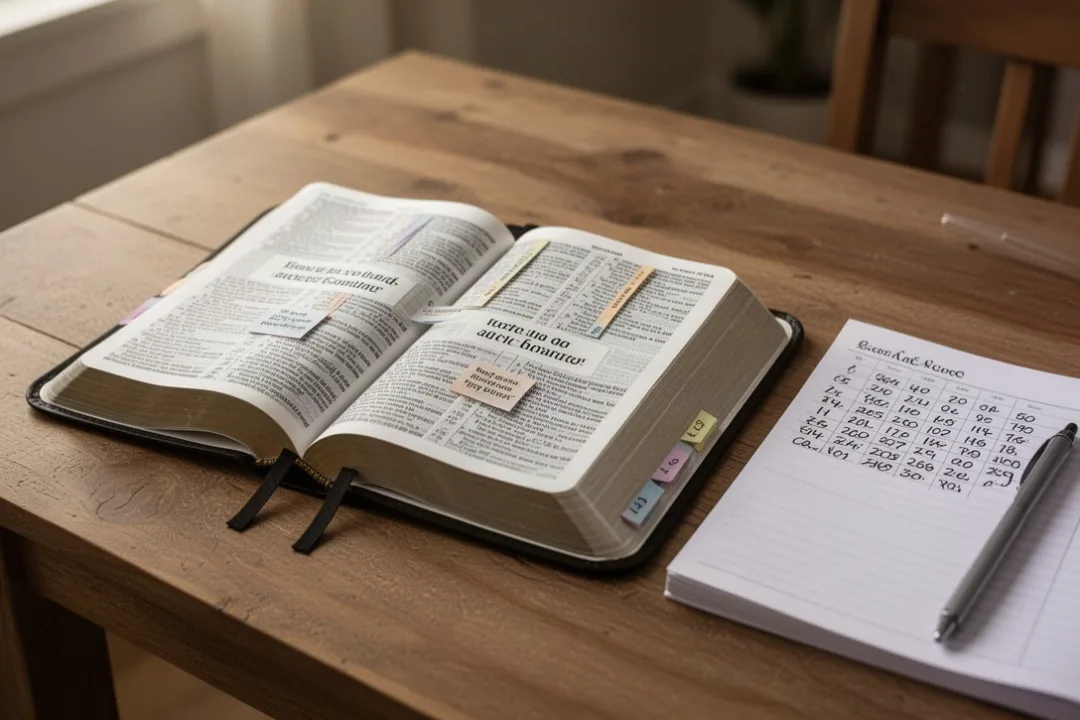
A more dependable way to study the subject is to choose one translation and define the search before counting. You can then compare exact wording with related commands.
Select a translation and use the same edition throughout the search.
Search the exact phrase “fear not” and record the number of verses and occurrences.
Search related expressions such as “do not fear,” “be not afraid,” “do not be afraid,” and “fear ye not.”
Read each result in context to determine whether the phrase is a command, a question, a quotation, or part of a longer statement.
Keep exact counts separate from thematic passages about worry, courage, peace, and trust.
This method gives you a result that can be explained and checked. It also shows why two sincere Bible readers may report different totals without either person deliberately miscounting.
How to use “fear not” passages responsibly
When you read one of these passages, begin by asking who is speaking, to whom, and why. The immediate setting may involve a battle, a family crisis, a journey, persecution, illness, judgment, or a divine message. Understanding that setting helps you apply the principle without claiming a promise the passage was not making.
Next, identify the reason given for courage. Is the person told that God is present? Is there a promise of protection? Is the person being instructed to act? Does the passage shift attention from human threats to God’s authority? The reason is often more important than the two-word command itself.
Finally, distinguish biblical comfort from denial. A “fear not” passage can encourage you to pray, seek wise help, prepare carefully, tell the truth, or endure faithfully. It does not require you to ignore danger, remain in an unsafe situation, reject medical care, or pretend that grief and anxiety are signs of spiritual failure.
For personal study, you might group passages into several themes:
Fear of the future: Genesis 46:3 and related promises about God’s guidance.
Fear of enemies: Deuteronomy 20:1-4 and Joshua 10:8.
Fear during overwhelming circumstances: Exodus 14:13 and Psalm passages about God’s protection.
Fear of people: Matthew 10:26-31 and Luke 12:4-7.
Fear connected with calling: Jeremiah 1:8 and Acts 18:9-10.
Fear in the presence of the holy: Luke 1:13, Luke 1:30, and Revelation 1:17.
Some of these references do not use the exact English words “fear not” in every translation. They are useful because they show the full biblical pattern, not because they inflate a phrase count. The central message is consistent: fear is real, but it does not have to rule the person who trusts God.
So, if someone asks how many “fear nots” are in the Bible, the clearest answer is: there is no universal total. About 62 exact uses are commonly attributed to the King James Version, while the often-repeated number 365 is a devotional saying rather than a dependable count. The Bible’s larger call to courage and trust appears far more broadly than any exact phrase search can measure.
Frequently asked questions
Is “fear not” really in the Bible 365 times?
No. The number 365 is a popular devotional claim, but it is not a reliable count of the exact phrase in standard English Bible translations. It likely combines several related expressions, including “do not be afraid,” “be strong,” and “do not worry.” The number can serve as a reminder, but it should not be presented as a literal biblical statistic.
Which Bible translation has the most “fear not” verses?
There is no universally accepted ranking because the result depends on the exact phrase being searched and the database used. Older translations may use “fear not” more often, while modern versions frequently choose “do not be afraid” or “do not fear.” Comparing translations requires counting both exact wording and equivalent expressions separately.
What is the difference between “fear not” and “fear the Lord”?
“Fear not” usually addresses panic, dread, intimidation, or anxiety about circumstances and people. “Fear of the Lord” generally describes reverence, awe, respect, and submission to God. The surrounding passage determines the meaning. Biblical writers can discourage terror while encouraging deep respect for God at the same time.
What should Christians do with Bible verses about not fearing?
Read each passage in its context and identify the reason given for courage. These verses encourage trust, prayer, wise action, and faithful endurance; they do not require you to deny danger or avoid practical help. A promise spoken to a particular biblical person should not automatically be treated as a guarantee that every modern situation will have the same outcome.















Leave a Reply