Fulton Sheen: His life, teachings, and sainthood cause
Fulton Sheen: His life, teachings, and sainthood cause
Fulton Sheen was an American Catholic bishop, theologian, author, and broadcaster whose clear preaching made Christian ideas accessible to millions. He is best known for the television program Life Is Worth Living, his many books, and his ability to connect Catholic teaching with everyday moral and spiritual questions.
Sheen died in 1979 and was declared Venerable by Pope Benedict XVI in 2012, recognizing that he lived the Christian virtues to an exceptional degree. That declaration does not make him a saint or a blessed person; his cause for canonization remains a separate process requiring further examination and an approved miracle.
Peter John Sheen was born on May 8, 1895, in El Paso, Illinois. He later became known publicly as Archbishop Fulton J. Sheen, although many people simply called him Bishop Sheen. He was ordained a priest for the Diocese of Peoria in 1919 and went on to study and teach philosophy and theology in the United States and Europe.
His academic background shaped his preaching. Sheen did not treat theology as a collection of abstract terms separated from ordinary life. He used reason, literature, history, psychology, and current events to show how Christian beliefs addressed questions about suffering, love, conscience, death, freedom, and human purpose.
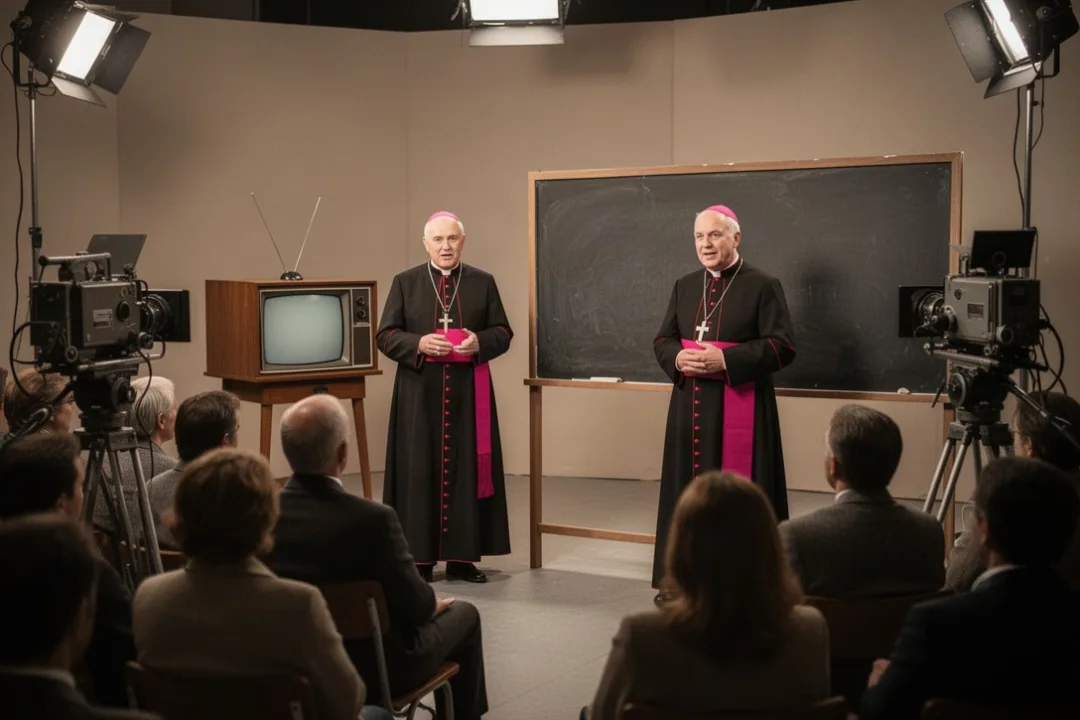
Sheen first became widely known through radio and later through television. His television program Life Is Worth Living began in the early 1950s and reached a large national audience. Standing before a blackboard, he spoke directly to viewers rather than relying on elaborate production. His style was polished but personal: he explained an idea, developed it through examples, and brought the discussion back to the spiritual life.
At a glance: Sheen was not famous only because he appeared on television. His influence came from combining Catholic doctrine, philosophical reasoning, storytelling, and a direct appeal to the viewer’s conscience.
Fulton Sheen’s life in chronological order
1895: Peter John Sheen was born in El Paso, Illinois, and grew up in a Catholic family.
1919: He was ordained a priest for the Diocese of Peoria.
1920s: He pursued advanced studies in philosophy and theology, including work in Europe, and began teaching.
1930s and 1940s: His radio preaching expanded his audience beyond the classroom and parish.
1951: He was ordained a bishop and appointed an auxiliary bishop of the Archdiocese of New York.
1952–1957: He hosted Life Is Worth Living, the television program that made him nationally recognized.
1966: He became Bishop of Rochester, New York.
1969: He resigned as Bishop of Rochester and later served in a role connected with the Archdiocese of New York.
1979: He died in New York City.
2012: Pope Benedict XVI recognized his heroic virtue, giving him the title Venerable.
These milestones show two sides of Sheen’s work. He was a churchman with formal responsibilities, but he was also a public teacher who used mass media to speak about faith to people who might never attend a theology lecture.
How Fulton Sheen used television and radio to teach Catholicism
Sheen’s broadcasting career developed during a period when radio and television were becoming central parts of American home life. Instead of assuming that his audience already understood Catholic vocabulary, he usually began with a recognizable human concern. A program might address loneliness, envy, guilt, marriage, war, ambition, or the fear of death before connecting the subject with Christian doctrine.
His method included several consistent elements:
Begin with ordinary experience: He explored emotions, relationships, decisions, and cultural pressures familiar to his audience.
Use reason as well as authority: He argued that faith was not an escape from thinking and that belief could engage serious philosophical questions.
Explain rather than merely assert: He often defined terms and built an argument in stages.
Return to the person of Jesus Christ: Moral instruction was connected to conversion, grace, prayer, and the life of Christ.
Speak directly to conscience: His goal was not simply to entertain viewers but to invite an honest examination of their lives.
Sheen’s television persona was distinctive. He wore clerical clothing, used expressive gestures, and often wrote or drew on a blackboard. The format was simple enough to keep attention on the argument. His delivery could be dramatic, but the deeper purpose was educational: to make religious ideas understandable without stripping them of seriousness.
His popularity also brought challenges. A national audience included Catholics, Protestants, members of other religions, and people with no religious commitment. Sheen therefore had to communicate the Catholic faith in a way that was particular enough to be honest but broad enough to address viewers who did not share all of its assumptions.
What Fulton Sheen taught about the human person
At the center of Sheen’s thought was the conviction that human beings are made for more than comfort, success, or social approval. He believed the human person has both a material and a spiritual dimension, and that a life organized entirely around possessions or status eventually becomes empty.
This did not mean that Sheen rejected work, beauty, ambition, or earthly responsibilities. His concern was disordered desire: treating a good thing as if it were the highest good. Money can support a family, but it cannot provide ultimate meaning. Recognition can affirm achievement, but it cannot settle the question of personal worth. Pleasure can be good, but it cannot by itself satisfy the deepest human longing.
He often examined the ways people avoid self-knowledge. Distraction, busyness, rationalization, and social conformity can keep a person from confronting guilt or the need for change. For Sheen, Christian conversion began with truthfulness: seeing oneself honestly before God rather than constructing a flattering public image.
His understanding of freedom was similarly demanding. Freedom was not merely the ability to choose whatever one wanted. It involved becoming capable of choosing what is true and good. In that sense, discipline and moral responsibility do not destroy freedom; they help a person become less controlled by impulse, fear, resentment, or addiction.
A useful lens for reading Sheen: Ask what human desire he is examining, what false substitute he identifies, and how he connects the answer to Christ, prayer, virtue, and self-giving love.
Fulton Sheen’s central spiritual themes
Christ as the answer to human longing
Sheen’s teaching was ultimately Christ-centered. Philosophy could clarify the human search for truth, and moral reasoning could explain the good life, but he believed neither could replace a personal relationship with Jesus Christ. The Christian life was not simply adherence to a code; it was participation in the life, death, and resurrection of Christ.
He presented Christ as the one who reveals both God and the true meaning of humanity. This explains why Sheen could move from a discussion of modern culture to prayer or the sacraments without treating those subjects as unrelated. In his view, the human problem was not only ignorance. It also involved sin, wounded desire, and a need for grace.
The cross and the meaning of suffering
Suffering was one of Sheen’s recurring subjects. He did not claim that every painful event could be easily explained or that Christians should pretend suffering does not hurt. Instead, he argued that suffering could be united with the cross of Christ and transformed into an act of love, perseverance, intercession, or service.
That teaching requires care. Sheen’s approach should not be used to dismiss another person’s grief, excuse abuse, or tell someone to remain in danger. Christian acceptance of suffering is not the same as approving injustice. A responsible reading distinguishes unavoidable suffering from harm that should be resisted or reported.
Prayer and interior life
Sheen repeatedly emphasized the need for silence, prayer, and examination of conscience. Public religion, good intentions, and outward activity were not enough. A person could appear successful while neglecting the inner life, so he encouraged habits that brought one’s motives before God.
Prayer, in this framework, is not limited to asking for favors. It includes adoration, repentance, gratitude, listening, and surrender. Sheen gave special attention to the Eucharist and to devotion to the Virgin Mary, both of which occupied an important place in his Catholic spirituality.
Love expressed through sacrifice
Sheen’s use of the word love generally involved more than affection or emotional intensity. Love meant willing the good of another and accepting the cost of serving that good. He connected this idea to marriage, parenting, friendship, priesthood, religious vocation, and social responsibility.
Because love involves self-giving, it can expose selfishness. A person may say that he or she loves others while refusing patience, forgiveness, truthfulness, or responsibility. Sheen’s moral teaching asked whether one’s actions actually served another person or merely protected one’s own comfort.
Fulton Sheen’s books and where to begin reading
Sheen wrote extensively, so readers do not need to begin with his most technical works. The best starting point depends on the question you want to explore. His books range from apologetics and philosophy to prayer, spirituality, morality, and reflections on Jesus Christ.
Life Is Worth Living: A useful entry point for readers who want the broad themes associated with his television preaching, including purpose, virtue, suffering, and the search for happiness.
Life of Christ: A substantial meditation on the life and mission of Jesus, suitable for readers looking for a Christ-centered work rather than a general introduction to Sheen.
Peace of Soul: An exploration of anxiety, guilt, inner conflict, and the spiritual sources of peace.
Three to Get Married: A Catholic treatment of marriage that presents the relationship between husband, wife, and God as central to Christian marriage.
The World’s First Love: A work about Mary and Catholic devotion, especially appropriate for readers interested in Sheen’s Marian spirituality.
Treasure in Clay: His autobiography, offering a personal account of his life, ministry, public work, and weaknesses.
Older books may use expressions that reflect the vocabulary and cultural assumptions of the twentieth century. Read them with attention to the central argument, while recognizing that examples, social references, and pastoral language may not always translate directly to current circumstances.
Sheen’s books are also different from his broadcasts. Television talks often compress an argument into a memorable structure, while a book can develop distinctions more carefully. A reader who finds one format too formal may understand him better through recorded sermons or broadcasts, provided the recording is complete and accurately identified.
How to read Fulton Sheen critically and fairly
Admiration for Sheen does not require treating every sentence attributed to him online as authentic. His name is frequently attached to short sayings, edited passages, and modern paraphrases. Some may express an idea consistent with his thought without being an exact quotation from a known work or broadcast.
Use these checks when evaluating a quotation or claim:
Look for a primary source: Check the book, broadcast transcript, sermon, or recorded program where the words supposedly appeared.
Separate quotation from paraphrase: A website may summarize Sheen’s argument and present it in quotation marks.
Check the historical setting: References to technology, politics, or social habits can reveal whether a passage is being misdated.
Read the surrounding material: A short sentence may sound different when placed within the larger argument.
Compare reliable editions: Reputable publishers, archives, diocesan resources, and scholarly biographies are more dependable than unattributed image posts.
Critical reading also means recognizing that Sheen’s public style was shaped by his period. His insights into conscience, distraction, pride, and moral responsibility can remain useful, while some illustrations may need historical context. The goal is neither to dismiss him because he belonged to another era nor to assume that every application he made fits every present situation.
Fulton Sheen’s role in the Catholic Church
Sheen was more than a media personality. He was a priest, professor, bishop, and pastor with responsibilities inside the Catholic Church. His public influence grew from that ecclesial identity, even when his programs addressed a general audience.
As a bishop, he participated in the life and governance of the Church and represented Catholic teaching publicly. He also worked with the Catholic University of America earlier in his career, where he taught philosophy. His academic formation helped explain the structure of his arguments, but his ministry was not limited to universities or highly educated audiences.
He was also associated with the missionary work of the Church through his leadership of the Society for the Propagation of the Faith. That work emphasized support for Catholic missions and helped connect American Catholics with the needs of the worldwide Church. His understanding of evangelization included both clear teaching and practical concern for people beyond one’s immediate community.
His relationship with media should therefore be understood as a form of evangelization. He used communication tools to explain Catholic belief, challenge cultural assumptions, and invite people toward conversion. The approach remains relevant for anyone considering how religious teaching can be communicated publicly without becoming either inaccessible or merely promotional.
What “Venerable” means in Fulton Sheen’s sainthood cause
The Catholic Church investigates a candidate for sainthood through a formal process. A diocesan inquiry gathers writings, testimony, and other evidence about the person’s life, virtues, reputation for holiness, and possible miracles. The material is then examined by the Church’s competent authorities.
When the Church recognizes that a person practiced the theological and cardinal virtues, along with related virtues, to an extraordinary degree, the pope may authorize a decree of heroic virtue. The person is then called Venerable. This title means the Church has recognized a significant level of holiness, but it does not permit public veneration as a blessed or canonized saint.
For Fulton Sheen, Pope Benedict XVI authorized the decree recognizing his heroic virtue in 2012. That was a major step, but it was not the final stage. Beatification normally requires the recognition of a miracle attributed to the candidate’s intercession, unless the person is being beatified as a martyr under the applicable process. Canonization requires another approved miracle after beatification in the ordinary path.
Reports about a possible miracle connected with Sheen have received attention, but the Church’s investigation and approval process must be distinguished from private claims or local enthusiasm. The status of a cause can change as documentation is reviewed, so current information should be checked through official Church sources rather than social media summaries.
Why Fulton Sheen still attracts readers and viewers
Sheen continues to attract attention because he addressed questions that have not disappeared: What makes life meaningful? Why do people feel guilty? Can suffering have a purpose? What is freedom? How should love shape a person’s choices? His answers are explicitly Christian and Catholic, but the questions themselves are widely human.
His communication style is another reason for his continued appeal. He combined an orderly argument with vivid examples and a strong sense of audience. He did not assume that a person had already solved the problem under discussion. Instead, he tried to lead the listener from a familiar experience toward a larger explanation.
Many readers also appreciate that Sheen treated faith and intellect as allies. He did not reduce religion to private feeling, but he also did not present philosophy as an exercise detached from personal transformation. His work repeatedly asks what a belief does to a person’s character, decisions, relationships, and habits of prayer.
At the same time, his work is best approached with discernment. Sheen’s authority came from his office and learning, but no individual writer replaces Scripture, the teaching authority of the Church, sound pastoral judgment, or professional help in matters such as mental health and abuse. His reflections can encourage examination of conscience, yet they should not be used as a substitute for medical, psychological, legal, or safeguarding advice.
Ways to explore Fulton Sheen’s work today
A thoughtful reading plan can prevent Sheen’s ideas from being reduced to isolated quotations. Begin with one accessible book or a complete broadcast, then compare what you hear with the broader themes of his ministry.
Choose a work focused on your question, such as prayer, marriage, suffering, or the life of Christ.
Read in short sections and identify the human problem Sheen is addressing.
Write down the distinction he makes between a genuine good and a false substitute.
Check unfamiliar theological terms in a reliable Catholic reference.
Compare older cultural examples with the underlying moral principle.
End with a practical question about truthfulness, charity, prayer, or responsibility.
Readers who are especially interested in his public career can study the history of Life Is Worth Living, listen to archived programs, and examine how his television method differs from his written work. Those interested in canonization can follow official announcements from the relevant diocesan and Vatican authorities rather than relying on unverified claims.
Fulton Sheen’s lasting significance rests on the connection he made between clear thinking and transformed living. He presented Catholic Christianity as an account of reality that addressed both the mind and the conscience. Whether a reader agrees with every application or historical example, his work continues to invite serious questions about truth, desire, suffering, love, and the purpose of human life.
Frequently asked questions
Was Fulton Sheen a saint?
No. Fulton Sheen was declared Venerable in 2012, which means the Catholic Church recognized his heroic virtue. He has not been canonized, and he is not officially called a blessed person. Beatification and canonization require additional steps, including the Church’s recognition of miracles attributed to his intercession under the applicable process.
What was Fulton Sheen’s most famous television show?
His best-known television program was Life Is Worth Living, which brought Catholic teaching and broader reflections on morality, purpose, and human behavior to a national audience. He typically spoke from a simple set and used a blackboard, relying on explanation and direct address rather than elaborate production.
Did Fulton Sheen write books?
Yes. He wrote numerous books on Christ, prayer, philosophy, marriage, morality, suffering, and the spiritual life. Common starting points include Life of Christ, Peace of Soul, Three to Get Married, The World’s First Love, and his autobiography, Treasure in Clay.
Where can I find authentic Fulton Sheen quotations?
Start with published editions of his books, verified broadcast transcripts, recordings, and reputable archival or Catholic sources. Many quotations circulating online are shortened, paraphrased, or wrongly attributed. Checking the original work and surrounding context is the safest way to determine whether a saying is genuinely Sheen’s.















Leave a Reply