In the Bible, “circumcised” usually means that the foreskin of a male’s penis has been removed as a physical sign of belonging to God’s covenant. The practice began with Abraham and his household in Genesis 17. As Scripture develops, circumcision also becomes a spiritual image for a heart turned toward God, willing obedience, and the removal of stubbornness or sin.
The meaning depends on the passage. A reference may describe an actual physical practice, identify someone as Jewish, mark participation in the covenant with Abraham, or use “circumcision” symbolically. Reading the surrounding verses helps you determine which meaning is intended.
What circumcision meant in its original biblical context
Circumcision was a permanent bodily sign associated with the covenant God made with Abraham. In Genesis 17, God instructed Abraham to circumcise himself, his household, and male descendants. Future male children were to receive the sign at eight days old. The practice therefore connected family identity, faith, and covenant membership.
For ancient Israelites, circumcision was not merely a private health practice or a general cultural custom. It identified a person with the people descended from Abraham through the covenant line. An uncircumcised male within that community was described as having broken or rejected the covenant, according to the terms given in Genesis 17.
The sign also appeared in important stories about Israel’s relationship with God. For example, Exodus 4 describes an unusual incident involving Moses’ household and circumcision. Joshua 5 describes Israelite men being circumcised after entering the land. These passages show that circumcision could carry consequences for covenant identity and participation in the community.
Plain meaning: In an Old Testament historical passage, “circumcised” generally refers to the literal physical removal of the foreskin as a sign of membership in the covenant community.
How to identify the meaning of “circumcised” in a Bible passage
A reliable reading method is to ask what kind of language the writer is using. Some verses describe a literal event, while others compare spiritual obedience to circumcision. The same word can therefore refer to the body in one passage and the heart in another.
Check the immediate context. Look at the people, events, and commands surrounding the reference. A birth, military gathering, family ritual, or temple-related setting usually points to literal circumcision.
Identify the covenant being discussed. If the passage refers to Abraham, Israel, Moses, or Jewish identity, circumcision may be functioning as the sign of the Abrahamic covenant.
Look for contrast with the heart. Words such as heart, ears, lips, or spirit may signal a figurative meaning involving inner obedience or receptiveness to God.
Notice who is speaking and to whom. Prophets addressed Israel differently from Paul addressing Gentile Christians. The audience affects the force of the term.
Read the argument beyond one verse. Especially in Romans and Galatians, Paul develops his point across several paragraphs. A single sentence can be misunderstood when separated from the larger argument.
These questions help distinguish the main uses of the word:
Literal circumcision: a physical act performed on a male.
Covenant circumcision: the sign given to Abraham and carried through Israel’s identity.
Ethnic or social circumcision: a way of referring to Jews in contrast with uncircumcised Gentiles.
Spiritual circumcision: an image of inward change, faithfulness, repentance, or belonging to God.
What the covenant with Abraham required
Genesis 17 presents circumcision as an enduring covenant sign. Abraham was told to circumcise himself, the males in his household, and later male children at eight days old. The command applied not only to biological descendants but also to males connected with Abraham’s household, including those acquired or born within it.
The sign carried a serious boundary. Genesis 17 describes an uncircumcised male as being removed from the covenant community because he had violated the covenant. That language shows how strongly the biblical text connected the outward sign with communal identity.
At the same time, circumcision did not automatically prove that a person trusted God or lived faithfully. The prophets repeatedly criticized Israelites who possessed the covenant sign while practicing injustice, idolatry, violence, or oppression. The physical mark was meaningful, but it could not substitute for loyalty to God.
This distinction matters throughout the Bible: a ritual sign can identify a person outwardly without producing inward faithfulness. Circumcision was commanded and significant, yet the people were still called to love God, obey his commands, seek justice, and turn away from sin.
What “circumcise your hearts” means
The Old Testament uses circumcision as a metaphor for inner responsiveness to God. Deuteronomy 10 calls Israel to circumcise the heart and stop being stubborn. The image describes the removal of resistance so that a person can love God and live faithfully.
Deuteronomy 30 uses similar language while describing Israel’s future restoration. The emphasis is not on a new physical operation but on God changing the people inwardly so they can love him wholeheartedly. A circumcised heart is therefore humble, receptive, and willing to obey.
Jeremiah also challenges the people to circumcise themselves to the Lord and remove the hardness of their hearts. Later, the prophet speaks of the uncircumcised heart of Judah and Israel. In this setting, “uncircumcised” describes people who are outwardly part of the covenant community but inwardly resistant to God.
An uncircumcised heart resists correction, trusts in outward status, and refuses faithful obedience.
A circumcised heart receives God’s instruction, turns from stubbornness, and seeks to love God sincerely.
The outward sign without inward change is inadequate because covenant identity is meant to shape a person’s life.
This figurative use does not make the physical command meaningless. Instead, it shows that the physical sign pointed beyond itself. The body carried a covenant mark, but God also required the inner reality that the mark was meant to represent.
How circumcision functions as an identity marker in the Old Testament
Many Old Testament passages use circumcision to distinguish Israelites from surrounding peoples. The term “uncircumcised” can therefore function as a social or ethnic description, not merely as a medical observation. It identifies someone as outside Israel’s covenant sign and often outside its religious community.
In the stories of Saul, David, and the Philistine warrior Goliath, “uncircumcised” is used as a contemptuous label for Israel’s enemies. The point is not simply that those individuals had not undergone the ritual. The term marks them as outsiders who do not belong to Israel’s covenant relationship with God.
Some passages also describe the dead or defeated nations as “uncircumcised” in prophetic poetry. Ezekiel 32, for example, uses the language in a vision of the grave. There the word participates in a broader picture of foreign rulers brought low, rather than offering a detailed statement about their physical condition.
Because of this, readers should avoid assuming that every appearance of “uncircumcised” gives the same kind of information. It may describe physical status, national identity, covenant distance, or poetic disgrace, depending on the passage.
What circumcision means in the Gospels
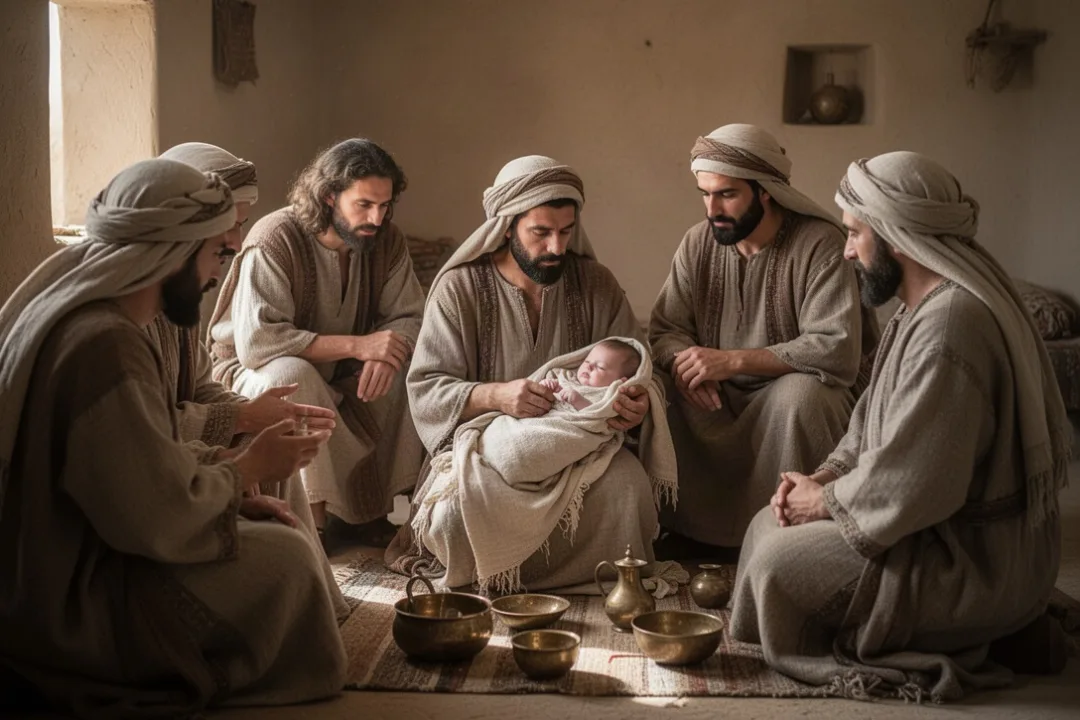
Jesus was circumcised as a Jewish male, as Luke 2 records. This places him within the covenant and religious life of Israel. The Gospel accounts present him as born into the Jewish people, participating in its Scriptures and traditions, and fulfilling the story associated with Abraham, Moses, and David.
John the Baptist was also circumcised, and the Gospel of Luke mentions the event when describing his birth and naming. These references are straightforward historical descriptions. They show that circumcision remained a normal covenant practice for Jewish boys in the first century.
Jesus did not teach that the ritual itself had no historical meaning. However, his disputes with religious leaders repeatedly focused on the difference between outward observance and inward faithfulness. His teaching placed love for God, love for neighbor, mercy, truth, and repentance at the center of obedience.
John 7 refers to circumcision in a discussion about whether healing on the Sabbath was lawful. Jesus points to the way people apply the law concerning circumcision and argues that an act of healing should not be condemned when it serves the good of a whole person. The passage is not a rejection of circumcision; it is part of an argument about how to understand God’s commands rightly.
Why Paul discusses circumcision so often
Paul’s letters address a major question in the early Christian movement: Must Gentile believers be circumcised and observe Jewish identity markers to belong fully to God’s people? Paul’s answer is no. He argues that people are accepted by God through faith in Christ, not through circumcision or other works that mark Jewish covenant identity.
In Romans, Paul asks whether circumcision has value. His answer is qualified: it has value when a person keeps the law, but the physical sign by itself cannot protect someone who disobeys God. Paul then argues that a Gentile who obeys God can expose the disobedience of a circumcised person. His concern is the difference between external status and genuine righteousness.
Paul also explains that Abraham received the sign of circumcision after being counted righteous by faith. In Romans 4, this timing allows Paul to describe Abraham as the father of both circumcised believers and uncircumcised believers who share his faith. The argument makes faith, rather than the physical mark, central to belonging to Abraham’s spiritual family.
In Galatians, Paul strongly opposes requiring Gentile Christians to be circumcised as a condition of full acceptance. He warns that adopting circumcision for that purpose would mean accepting an entire covenant obligation rather than trusting in Christ. His concern is not that circumcision is sinful in every circumstance; it is that people were treating it as necessary for salvation or membership in Christ.
Paul’s central point: Circumcision cannot earn salvation, complete faith, or create a higher class of Christian. In his argument, trust in Christ and the work of the Spirit—not a physical identity marker—define belonging to God’s people.
How “circumcision of the heart” is used in the New Testament
Paul develops the Old Testament image of inner circumcision in Romans 2. He says that true Jewish identity is not merely external and that circumcision has value when it is joined with obedience. He describes circumcision of the heart as a work associated with the Spirit rather than merely with written regulations.
In Philippians 3, Paul uses “circumcision” to describe believers who worship by the Spirit of God, boast in Christ, and do not rely on physical credentials. He is not claiming that every physical reference is irrelevant. He is rejecting confidence in ancestry, ritual, and personal religious achievement as the basis for righteousness.
Colossians 2 speaks of believers having received a circumcision not performed by human hands. The language points to a spiritual transformation connected with Christ’s death and resurrection. The passage presents believers as having their old sinful identity put off and as being raised to new life through faith.
These texts use different wording and arguments, but they share a theme: God seeks a transformed person, not merely an external sign. Spiritual circumcision refers to a decisive change in allegiance, identity, and conduct that God accomplishes through faith and the Spirit.
How circumcision relates to Jewish and Gentile believers
In the New Testament, “the circumcision” often means Jewish people, while “the uncircumcision” means Gentiles. This shorthand reflects the major cultural and religious boundary of the first-century world. It does not always function as an insult; often it simply identifies two groups with different covenant histories.
The early church had to decide how Gentiles should be welcomed. Acts 15 describes a council in Jerusalem where church leaders considered whether Gentile believers needed circumcision and full observance of the law of Moses. The decision did not require Gentile converts to be circumcised as a condition of belonging to the church.
Paul later explains that this decision does not erase every distinction in cultural background. Jewish believers and Gentile believers could still have different customs and histories. The key change is that neither group can claim superior standing before God because of circumcision.
First Corinthians 7 advises believers not to make circumcision or uncircumcision the center of their calling. Paul’s practical instruction is that a person does not need to change physical status to follow Christ. Conversely, a person should not treat physical status as a spiritual advantage.
Does the Bible say circumcision is required for Christians?
For Christian faith and salvation, the New Testament does not require Gentile believers to be circumcised. Acts 15, Romans, Galatians, and other passages consistently oppose making circumcision a requirement for acceptance by God or full inclusion among Christ’s people.
That answer should be stated carefully. The Bible records circumcision as a command given to Abraham’s covenant household and as a continuing Jewish practice during the time of Jesus and the apostles. It also records Jewish Christians who continued their cultural practices. The issue for the church was whether the practice should be imposed on Gentiles as a religious requirement.
Paul’s letters answer that question by placing the emphasis on faith working through love, a phrase associated with Galatians 5, rather than on physical circumcision. A person’s relationship with God is not improved by relying on a ritual as a badge of spiritual worth.
Some Christian families choose circumcision for medical, cultural, or family reasons. That is a separate question from whether the New Testament makes circumcision a requirement for salvation. The biblical debate concerns covenant status, religious obligation, and confidence before God.
What “circumcised” means in specific biblical phrases
“The circumcised”
This phrase commonly refers to Jews as a people or to Jewish believers in a particular discussion. The surrounding context determines whether the focus is ethnicity, religious practice, covenant history, or a group within the Christian community.
“The uncircumcised”
This usually refers to Gentiles, especially when Paul contrasts Jewish and non-Jewish believers. In Old Testament narratives, it can also describe foreign enemies or people outside Israel’s covenant community.
“Uncircumcised lips”
In Exodus 6, Moses describes himself as having uncircumcised lips. The phrase is a metaphor for feeling unable or unfit to speak effectively. It likely conveys inadequacy or impeded speech rather than making a statement about Moses’ physical circumcision.
“Uncircumcised ears”
Jeremiah 6 and 9 use the language of uncircumcised ears for people who refuse to hear God’s message. The ears are described figuratively as blocked or unreceptive. The expression carries the same basic idea as an uncircumcised heart: resistance to God’s correction.
“Circumcision made without hands”
Colossians 2 uses this phrase for a spiritual work rather than a human physical procedure. It describes a change associated with Christ that involves putting away the old sinful self and receiving new life through faith.
What the Bible’s symbolism teaches about outward religion
Circumcision is one example of a broader biblical pattern. God gives visible signs and practices, yet he also judges whether the people connected with those signs are living faithfully. The sign matters, but it must not become a substitute for repentance, justice, love, and trust.
The prophets make this point forcefully when they condemn religious people who exploit the poor, worship idols, or ignore God’s commands. Their criticism does not mean that worship or covenant practices are worthless. It means that outward religion separated from faithfulness contradicts its own purpose.
The New Testament applies the same principle to Christian identity. Baptism, church membership, religious language, and participation in worship do not function as automatic proof of a transformed heart. The biblical language of circumcision calls attention to the need for an inward response to God.
For Christian readers, the practical question is not whether a physical mark can create righteousness. It is whether a person’s life shows humble trust in God and a growing willingness to obey him. The symbolic language directs attention from external status to the condition of the heart.
How to read a difficult passage about circumcision
When a verse seems to say different things about circumcision than another verse, compare the purposes of the passages rather than treating them as simple contradictions. Genesis 17 establishes the covenant sign for Abraham’s household. The prophets emphasize the heart. Acts addresses Gentile inclusion. Paul explains why the sign cannot be used to earn righteousness.
Use these practical checks when studying the passage:
Ask whether the reference is describing an event, a command, a group, or a metaphor.
Determine whether the audience is Israel, Jewish Christians, Gentile Christians, or opponents of the biblical message.
Separate the question of physical practice from the question of salvation and acceptance by God.
Read the entire argument in Romans, Galatians, Philippians, or Colossians rather than relying on one isolated phrase.
Look for the inward qualities associated with spiritual circumcision: faith, repentance, love, humility, and obedience.
The result is a balanced understanding. Circumcision is genuinely a physical covenant sign in the Bible, especially in the story of Abraham and Israel. It also becomes a powerful picture of inner transformation and wholehearted devotion, and the New Testament rejects using the physical sign as a requirement for Gentile salvation.
What “circumcised” means for biblical interpretation today
When you encounter the word in a Bible study, begin with its most ordinary meaning: a physical act involving a male body. Then test that reading against the passage. If the writer speaks of hearts, ears, lips, or spiritual transformation, the term is probably functioning symbolically.
Remember that “circumcised” can identify more than anatomy. It can point to covenant belonging, Jewish identity, separation from Gentiles, or inward openness to God. The word’s force comes from the biblical covenant story, not from a single universal definition that fits every verse.
The central movement of the biblical teaching is from sign to substance. A physical sign marked Abraham’s covenant family, while the prophets and apostles insisted that God also wanted faithful hearts. In the New Testament, those who trust in Christ are not required to receive circumcision to belong to God’s people.
Frequently asked questions
Was Jesus circumcised according to the Bible?
Yes. Luke 2 records that Jesus was circumcised as an infant, in keeping with Jewish covenant practice. This places him within the people of Israel and the covenant history connected with Abraham and Moses. The Gospel reference is a literal historical statement, not a metaphor about spiritual transformation.
Does “uncircumcised” always mean someone was a Gentile?
No. It often refers to Gentiles because Jews and Gentiles were commonly distinguished by circumcision, but context matters. In some passages, “uncircumcised” describes Israelite disobedience, spiritual resistance, enemy identity, or poetic disgrace. It may be a physical, ethnic, symbolic, or rhetorical description.
What is spiritual circumcision?
Spiritual circumcision is biblical imagery for inward change that makes a person receptive and faithful toward God. It involves removing stubbornness, turning away from sin, and trusting God rather than relying on outward religious status. Romans 2, Philippians 3, and Colossians 2 develop this idea in different ways.
Should Christian parents circumcise their sons for religious reasons?
The New Testament does not require circumcision for Gentile Christians or present it as necessary for salvation. Families may make the decision for medical, cultural, or personal reasons, but it should not be treated as a measure of spiritual worth. The early church rejected requiring Gentile believers to undergo circumcision to belong fully.















Leave a Reply