Catholic missionaries: What they do and how to serve
Catholic missionaries: What they do and how to serve
When you hear “Catholic missionaries,” you may picture priests preaching in a distant country. That is one form of missionary work, but it is only part of the picture. Catholic missionaries include priests, religious brothers and sisters, consecrated women and men, and laypeople who serve across cultures and communities.
Their work may involve parish ministry, Bible education, schools, health care, disaster response, farming programs, or human-rights advocacy. Some serve overseas for decades; others spend a year in a mission parish or volunteer close to home. Their common purpose is to share the Catholic faith through respectful relationships and practical service, while supporting the local church rather than treating local people as passive recipients.
What Catholic missionaries do in local communities
A missionary’s daily work depends on the needs of the community, the person’s training, and the local diocese or religious congregation. A missionary priest may celebrate Mass, prepare people for the sacraments, visit families, train catechists, and travel between remote communities. A lay missionary may teach, manage a clean-water project, provide counseling, or help a parish improve its administrative systems.
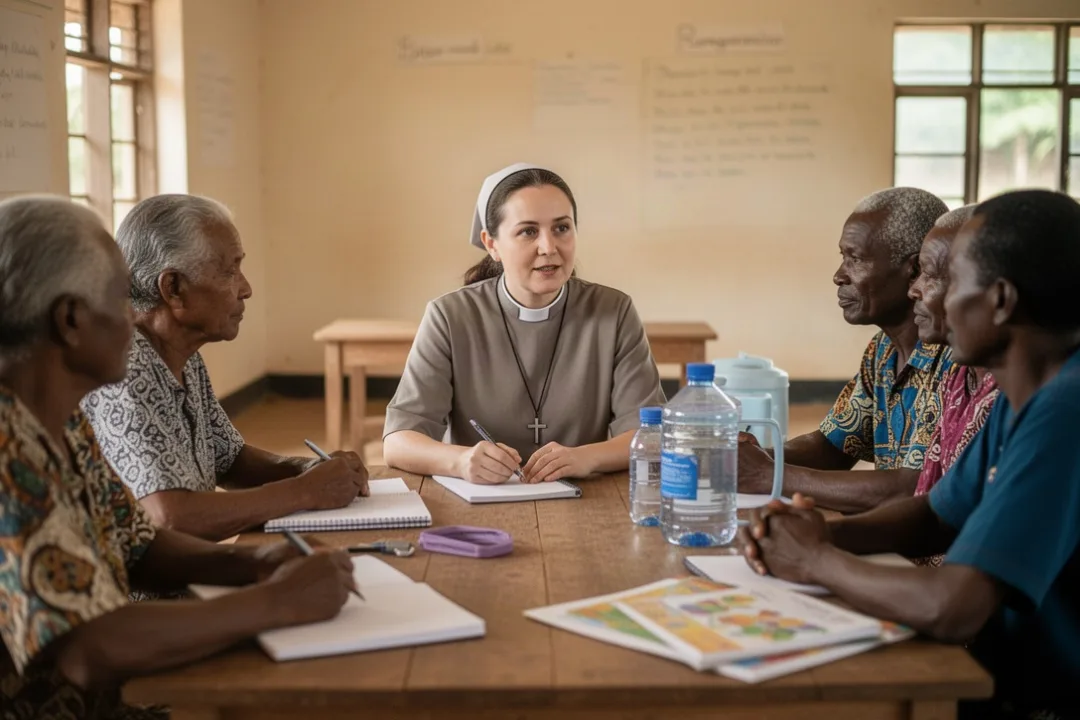
Evangelization is central to Catholic missionary life, but it is not limited to public preaching. Missionaries often begin by listening. They learn the community’s language, customs, history, concerns, and religious traditions. Conversations, home visits, youth groups, small Christian communities, and adult faith classes can all become settings for sharing the Gospel.
Many missionaries also support the wider conditions that allow families and parishes to flourish. Depending on local priorities, their responsibilities may include:
Preparing children and adults for baptism, confirmation, Eucharist, and marriage.
Training local catechists, pastoral leaders, musicians, and youth ministers.
Teaching in elementary schools, high schools, seminaries, or adult education programs.
Providing nursing, public-health education, disability services, or maternal care.
Helping farmers, small businesses, and families develop sustainable livelihoods.
Supporting migrants, refugees, prisoners, people experiencing homelessness, and victims of conflict.
Documenting human-rights concerns and advocating for people whose voices are overlooked.
The goal is not to make a community dependent on foreign workers. Healthy missionary service strengthens local leadership and long-term capacity. A missionary who trains a local teacher, helps establish a parish council, or supports a community health worker may have a less visible role than someone distributing supplies, but the results can last much longer.
Core principle: Catholic missionary service joins faith with human dignity. Evangelization should never be separated from compassion, justice, honest listening, and respect for a community’s freedom.
Why Catholic missionaries serve outside their home communities
Catholic teaching describes the church as missionary because it is called to share the message of Jesus Christ with all peoples. Mission is not reserved for a small group of adventurous specialists. Every baptized Catholic has a responsibility to witness through prayer, conduct, service, and care for neighbors, while some receive a specific vocation to cross cultural or geographic boundaries.
For religious missionaries, this calling is often expressed through a community’s charism. A charism is a particular spiritual gift or mission emphasized by a religious congregation. One community may focus on education, another on care for people with leprosy or disabilities, another on parish ministry, contemplative prayer, social justice, or service among migrants.
Missionaries may serve in places where priests are scarce, where a Catholic population is small, or where poverty and conflict have limited access to education and health care. They may also work in countries with large Catholic populations, helping dioceses reach isolated villages, crowded urban neighborhoods, prisons, or immigrant communities.
Missionary service is not based on the idea that one culture has all the answers. The Catholic Church is present in many cultures, and missionaries are expected to recognize the gifts already present in local communities. The work often becomes a partnership in which local Catholics provide knowledge, leadership, and spiritual insight while missionaries contribute training, resources, or a willingness to serve where help is needed.
How Catholic missionary work has changed over time
Christian missionary activity began with the earliest disciples and spread through different regions over many centuries. Missionaries traveled with the early church, established Christian communities, translated religious texts, founded schools, and served the poor. Religious orders such as the Franciscans, Dominicans, Jesuits, and Benedictines developed distinctive approaches to preaching, education, scholarship, and community life.
The history is not simple or uniformly positive. Some missionary activity became connected to colonial expansion, political power, or pressure on Indigenous cultures. In certain settings, Christian institutions contributed to the suppression of languages, customs, and spiritual practices. The damage caused by forced assimilation and abuse must be acknowledged rather than hidden behind accounts of schools, hospitals, or conversions.
Modern Catholic missionary practice places greater emphasis on inculturation, consent, local leadership, and human rights. Inculturation means expressing Catholic faith through forms that genuinely engage a local culture without treating that culture as inferior. It may involve local music, art, language, community structures, and forms of prayer, provided these are integrated thoughtfully with Catholic teaching.
Mission organizations also face serious responsibilities concerning safeguarding, financial transparency, professional standards, and the protection of children and vulnerable adults. A trustworthy organization should have clear conduct policies, reporting procedures, background checks where appropriate, and systems for handling complaints independently and safely.
Which people become Catholic missionaries
There is no single personality type or career path. Some missionaries feel drawn to service during childhood; others discover the vocation through parish work, college, professional experience, or a period of volunteering. A person may enter religious life, become a diocesan priest, or serve as a lay missionary without taking religious vows.
Priests and seminarians in missionary ministry
Missionary priests may belong to a religious congregation or be sent by a diocese. Their ministry can include sacramental preparation, preaching, pastoral counseling, spiritual direction, formation of lay leaders, and oversight of several chapels or mission stations. In remote areas, travel can require long drives, boats, small aircraft, or difficult walks.
Diocesan priests usually serve within a particular diocese, but some dioceses establish partnerships that send priests to areas with fewer clergy. Religious institutes may have an international missionary focus from the beginning. In either case, preparation should include language study, cultural training, pastoral supervision, and education about local history.
Religious sisters, brothers, and members of missionary communities
Religious sisters and brothers often work in schools, clinics, parishes, shelters, retreat centers, and social-service programs. Their communities may take vows of poverty, chastity, and obedience, although the exact form of commitment depends on the institute. Some religious communities are active in public service; others devote more of their life to prayer and support for mission.
Missionary communities may accept members from many countries. A new member usually goes through stages of formation that can include a period of inquiry, postulancy, novitiate, and temporary vows before any permanent commitment. The names and timelines vary, so anyone discerning religious life should speak directly with several communities rather than rely on general assumptions.
Lay Catholic missionaries
Lay missionaries bring professional skills that may be essential to a project. Teachers, nurses, engineers, social workers, accountants, farmers, translators, lawyers, and communications specialists can all contribute. Some serve under a formal lay mission program; others work through a Catholic relief agency, university, parish partnership, or diocesan exchange.
Lay missionaries do not need to be ordained to share faith. Their witness may come through dependable work, hospitality, prayer, ethical conduct, and solidarity with neighbors. They must also understand the limits of their training. A short-term volunteer should not provide medical care, counseling, construction, or legal advice without appropriate qualifications and supervision.
Where Catholic missionaries serve
Missionary work takes place in more settings than overseas villages. Some missionaries serve in urban neighborhoods where poverty, migration, addiction, or housing insecurity create urgent pastoral needs. Others work in rural areas, Indigenous communities, refugee camps, prisons, schools, hospitals, or parishes that lack regular access to clergy.
International missionaries may be sent through a religious congregation, a diocese, a Catholic university, or a nonprofit organization. The work can occur in Africa, Asia, Latin America, the Pacific, Europe, the Middle East, or North America. Geographic labels alone tell you very little about the assignment. A missionary might serve in a capital city, a coastal fishing community, a remote mountain region, or a neighborhood populated by immigrants from many countries.
Missionaries also serve within the United States. Catholic organizations support rural parishes, Native communities, migrant farmworkers, border communities, new immigrant populations, and areas affected by natural disasters. A Catholic mission may refer to a small worshiping community that depends on a nearby parish or to an outreach project serving people who have limited access to church life.
How Catholic missionaries support development without creating dependence
Good mission programs begin with local priorities rather than an outside group’s preferred project. Before building a clinic or sending volunteers, responsible organizations ask who will operate the service, how supplies will be obtained, what local authorities and community leaders recommend, and how the project will continue after foreign staff leave.
Capacity building is often more valuable than short-term visibility. A program might train local health workers, provide scholarships for community members, improve a parish’s financial controls, or help a cooperative reach stable markets. Missionaries can provide technical support, but local people should have meaningful decision-making power.
Development work also requires humility. A volunteer may arrive with a useful skill but little understanding of local conditions. A solution that works in the United States may be too expensive, difficult to maintain, or culturally inappropriate elsewhere. Listening, testing a small approach, accepting criticism, and changing plans are signs of responsible service.
Donations should be handled with the same care. Before giving money, look for a clear description of the program, realistic claims, responsible oversight, and information about how funds are used. Be cautious when an organization relies heavily on dramatic images of suffering or promises that a small gift will solve a complicated problem immediately.
Practical ways to prepare for Catholic missionary service
Missionary work requires more than good intentions. Preparation helps you serve safely and avoid placing extra burdens on the community. Start by identifying the type of service you are considering: a parish assignment, religious vocation, professional placement, short-term volunteer trip, or financial partnership.
Clarify your motivation. Ask whether you want to serve the community or mainly seek adventure, recognition, or a dramatic personal experience. Mixed motives are normal, but they should be examined honestly.
Assess your skills. List your professional qualifications, language abilities, physical limitations, and experience working with people from different backgrounds.
Research the organization. Review its leadership, safeguarding rules, project goals, financial practices, training, emergency procedures, and relationship with the local church.
Ask who leads the work. Find out whether local staff and community members make decisions, supervise volunteers, and control the project’s long-term direction.
Complete appropriate preparation. Study language, culture, religion, political history, health guidance, personal safety, and Catholic teaching related to mission.
Set realistic expectations. You may spend more time listening, traveling, organizing supplies, or learning procedures than performing the task you first imagined.
Plan for accountability. Know whom to contact if you see unsafe conduct, financial problems, discrimination, exploitation, or a safeguarding concern.
Reflect after serving. Evaluate what the community requested, what changed, what did not work, and how you can continue supporting local leadership.
Safety warning: Never arrange informal access to children or vulnerable adults through a mission trip. Responsible programs use screening, supervision, boundaries, and clear reporting procedures, even when volunteers are serving for only a few days.
Common mistakes to avoid when serving as a missionary
Well-meaning people can still cause harm if they assume that enthusiasm replaces preparation. The most respectful approach treats local people as partners with knowledge, agency, and the right to disagree.
Assuming poverty means helplessness: Communities have skills, history, leadership, and existing solutions that outsiders may not see.
Doing work locals can do: Painting a building or distributing supplies may feel useful, but a project can undermine local employment if volunteers replace trained workers.
Arriving without language preparation: Even basic greetings and key phrases show respect and reduce dependence on interpreters.
Using people’s suffering as publicity: Photos and personal stories require consent and should protect dignity, privacy, and safety.
Promising results too quickly: Trust, education, health improvements, and parish development usually require sustained local effort.
Confusing cultural difference with wrongdoing: Ask questions before judging practices that are unfamiliar, while still responding clearly to abuse or exploitation.
Ignoring religious freedom: Faith should be shared without coercion, manipulation, threats, or linking basic aid to conversion.
Leaving without a handoff plan: A local person or institution should understand the project, budget, responsibilities, and next steps.
How to discern a Catholic missionary vocation
If you are considering missionary life, begin with regular prayer and honest conversation rather than making a quick commitment. Talk with a parish priest, vocation director, experienced missionary, and people who have served in the same region. Listening to different perspectives can reveal both the rewards and the difficult realities of the work.
Pay attention to how you respond to ordinary service. Missionary life includes routine tasks, conflict resolution, administration, homesickness, cultural misunderstandings, and periods when visible results are limited. A strong vocation is not measured only by excitement about travel. It often includes a growing willingness to remain faithful, learn from others, and serve without control or recognition.
You may want to ask a religious community or mission agency:
What training and formation do you provide before departure?
How are assignments selected, and can a missionary decline an unsafe placement?
What health insurance, evacuation, counseling, and emergency support are available?
How do local Catholics participate in leadership and evaluation?
What are the rules for contact with children and vulnerable adults?
How does the organization respond to complaints or allegations of abuse?
What financial contribution is expected from the missionary?
What happens when the assignment ends?
A person who feels called to religious missionary life may need several years of formation before making permanent vows or receiving a long-term assignment. A lay missionary may have a shorter application process, but serious agencies still assess maturity, health, skills, references, and the ability to work under supervision.
How Catholics can support missionaries without traveling
Mission depends on more than the people who cross borders. You can support local and international mission through prayer, responsible giving, advocacy, and practical parish partnerships. Some parishes sponsor scholarships, health projects, seminarian formation, or disaster relief. Others build relationships with a mission diocese and exchange information, music, and pastoral resources.
Financial support is most useful when it is consistent and flexible enough to meet local priorities. Ask whether the organization funds operating costs, trains local staff, measures outcomes, and publishes clear reports. Unrestricted support can help a trusted organization respond to changing needs, while a designated gift may fund a particular program.
You can also serve your own community as a missionary disciple. Welcome a newly arrived family, help with English classes, visit someone who is isolated, volunteer at a Catholic food pantry, or support a parish ministry among migrants. Mission begins wherever people need friendship, truth, practical help, and a credible witness to the Gospel.
Questions to ask before joining a mission trip
Short-term trips can strengthen relationships when they are designed around local requests. They become less helpful when visitors arrive with a prepackaged project, limited training, and no plan for continuity. Ask specific questions before paying a deposit or raising funds.
Find out what the local partner requested, what volunteers will actually do, and how the work fits into a longer program. Ask whether the trip includes cultural orientation, translation, medical preparation, insurance, safe housing, and supervision. You should also know how the organization handles transportation, political unrest, illness, harassment, and evacuation.
Most of all, ask what success looks like after the visitors leave. If the answer focuses only on how many volunteers traveled or how many photos were taken, the program may be designed around the visitor’s experience rather than the community’s needs. A responsible trip has clear local ownership and a realistic explanation of its limits.
Frequently asked questions
Do Catholic missionaries have to be priests or religious sisters?
No. Catholic missionaries may be priests, deacons, religious brothers or sisters, or laypeople. Lay missionaries often serve as teachers, nurses, social workers, administrators, engineers, pastoral ministers, and development specialists. Some commit to a formal mission program, while others serve through a diocese, parish, university, or Catholic nonprofit for a limited period.
Can a Catholic missionary work in the United States?
Yes. Missionary service takes place throughout the United States, including rural communities, Native communities, border regions, migrant neighborhoods, prisons, and areas with limited access to clergy or social services. Missionaries may also serve immigrant communities in cities, where language skills and cultural familiarity are valuable for parish and community programs.
How long do Catholic missionaries usually serve?
The length varies widely. A volunteer placement may last several weeks or months, while a lay missionary contract can last a year or more. Priests and religious members may receive assignments lasting several years or spend most of their working lives in mission service. The organization, country, role, training, and visa requirements all affect the schedule.
How can you tell if a Catholic mission organization is trustworthy?
Look for transparent leadership, clear project descriptions, safeguarding policies, trained supervisors, responsible financial reporting, and strong local participation. The organization should explain how it handles complaints, emergencies, and volunteer boundaries. Be cautious if it makes exaggerated promises, pressures you for immediate payment, discourages questions, or presents local people only as helpless beneficiaries.














Leave a Reply