The Canticle of the Sun is a prayer of praise by St. Francis of Assisi that honors God through the sun, moon, water, fire, earth, and every creature.
Also called the Canticle of the Creatures or, in its original form, Laudes Creaturarum, it is one of the best-known Christian poems from the Middle Ages. Francis does not praise nature as a separate divine power. Instead, he sees the created world as a sign of God’s goodness and invites every person to respond with humility, gratitude, and care.
What the Canticle of the Sun says about God and creation
Francis begins with God, whom he addresses as the Most High, the source of every good thing. He then uses the language of family to speak about creation: the sun is “brother,” the moon is “sister,” and the earth is “mother.” These relationships are poetic rather than literal. They express a sense of belonging within a created world that humans do not own by themselves.
The poem repeatedly gives creatures a role in praising God. The sun reflects brightness and beauty; the moon and stars display radiance; wind and weather sustain life; water is clean and useful; fire gives warmth and light; and earth produces food. Each image points beyond itself to the Creator. Creation is not worshiped, but it becomes a way to recognize and praise God.
The canticle also includes human beings, especially those who forgive and endure suffering with patience. This placement matters. Francis does not treat praise as a feeling reserved for pleasant experiences. The poem connects forgiveness, endurance, and peace with the same spiritual vision that celebrates sunlight and fertile ground.
Central idea: Francis praises God through creation, not instead of God. The natural world is presented as a gift and a sign that directs attention toward its Creator.
When St. Francis wrote the Canticle of the Sun
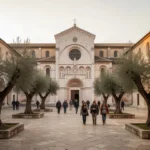
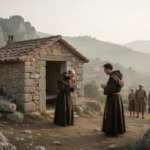
The canticle is generally associated with the final years of Francis’s life, when he was physically weak and seriously ill. Tradition places its composition at or near San Damiano, the small church outside Assisi where Clare and the early Poor Clares lived. Francis had experienced pain, illness, and difficulty with his eyes, yet the poem speaks with gratitude rather than resentment.
The exact process of composition is not completely certain. Accounts of Francis’s life suggest that the work may have developed in stages. The main section praising creation is connected with the early 1220s, while later lines about peace and death appear to have been added in response to circumstances near the end of his life.
The peace section is traditionally linked with conflict between the bishop of Assisi and the city’s mayor. Francis is said to have encouraged reconciliation by adding a stanza that honors those who forgive and make peace. The final reference to death is associated with his approaching death. These stories help explain why the canticle moves from cosmic praise to the difficult realities of human relationships and mortality.
Francis composed the poem in the vernacular associated with central Italy rather than in the Latin commonly used for formal church texts. That choice made the words more accessible to ordinary people and gave the canticle a direct, songlike quality. It is often recognized as one of the earliest major works of Italian literature, although its primary purpose was prayer rather than literary prestige.
Why the title “Canticle of the Sun” can be misleading
The popular title comes from the poem’s striking description of the sun, but the sun is only one part of the prayer. Its fuller traditional title, Canticle of the Creatures, better represents the whole work. Francis praises the heavens, the elements, the earth, human conduct, and the mystery of death.
The word canticle means a sacred song or hymn of praise. It connects the poem with biblical songs such as those associated with Mary, Zechariah, and the three young men in the Book of Daniel. Like those biblical canticles, Francis’s poem uses repeated praise to place ordinary life within a larger relationship with God.
“Canticle of the Sun” can also sound as if the poem is directed mainly toward the sun. Francis’s wording has a different focus. He addresses God first and calls the sun a brotherly creature that reflects divine splendor. The title is memorable, but the prayer’s subject is broader: God’s goodness revealed through the created order.
What each part of the canticle means
The opening praise of the Most High
The opening acknowledges that human language cannot fully contain God. Francis uses a humble posture, recognizing that God is beyond complete description. This humility protects the rest of the poem from becoming a celebration of the speaker’s own insight. The world is beautiful, but its beauty does not make the human observer the center of everything.
That beginning also gives the canticle a clear theological direction. Francis is not merely listing pleasant features of the landscape. He is saying that every good quality in creation has its ultimate source in God. Brightness, usefulness, strength, purity, and fruitfulness become ways of speaking about divine generosity.
Brother Sun and Sister Moon
The sun receives special attention because it is bright, powerful, and visible to everyone. Francis associates it with splendor and with the likeness of God’s radiance. Calling it “brother” places the sun within a family of creatures rather than above God or above humanity.
The moon and stars are described as beautiful and precious. Their changing light can suggest order, mystery, and wonder. Francis’s language does not require a scientific explanation of the heavens. It shows how a person of faith might look at the sky and respond with reverence rather than possession.
Brother Wind and the elements
Wind represents movement and power. It can be gentle or fierce, refreshing or destructive. Francis gathers wind with weather and the elements, recognizing that forces beyond human control help sustain life while also reminding people of their limitations.
Water is praised for its usefulness, humility, and purity. These qualities have both physical and spiritual associations. Water supports bodies and crops, yet its value is not limited to what humans can measure or sell. Francis’s description encourages gratitude for a resource that people often take for granted.
Fire is honored for its beauty, energy, and ability to illuminate the night. Fire can warm a home and help prepare food, but it also requires care and respect. The poem’s language captures both the gift and the power of the element without reducing it to a human tool.
Mother Earth and the gifts of the land
Earth is the most intimate image in the poem because it supports human life directly. Francis calls attention to the earth’s ability to sustain people through food, plants, and harvests. He also recognizes the earth’s capacity to produce flowers and varied beauty.
The word “mother” suggests dependence and relationship. People do not create the soil, rain, seasons, or biological processes that make food possible. They receive these gifts and participate in them through work. In this sense, the canticle encourages gratitude joined with responsibility.
Francis’s vision is not sentimental. The earth provides through processes that include labor, uncertainty, decay, and limits. A harvest can fail, a storm can destroy, and a human body eventually returns to the earth. The canticle holds these realities together without denying the goodness of creation.
Those who forgive and make peace
After praising the natural world, Francis turns to people who forgive for the sake of God and remain patient in trials. This section prevents readers from treating the canticle as a simple celebration of scenery. Francis presents moral action as part of creation’s praise.
Peace is not described as the absence of disagreement. It involves the difficult work of forgiveness, reconciliation, and restraint. The canticle’s inclusion of peacemakers shows that the way people treat one another belongs within their worship. A person cannot praise creation while ignoring cruelty, resentment, or injustice.
Patience in suffering does not mean that pain is good or that people should remain in dangerous situations. It points to a form of faithfulness that does not allow hardship to erase compassion. In practical terms, the stanza asks how gratitude can shape conduct when life is uncomfortable or unfair.
Sister Bodily Death
The final section speaks of death as a sister. This language does not make death harmless or deny grief. Francis acknowledges that death is unavoidable, while distinguishing between those who live in faith and those who turn away from God.
Calling death a sister places mortality within the same family imagery used for the sun, moon, and earth. Human life is not outside creation; it shares the limits of every living thing. The poem therefore ends not with human control, but with humility before the mystery of life and death.
Francis’s treatment of death is especially striking because it follows praise rather than replacing it. The canticle does not say that suffering and mortality cancel the goodness of the world. Instead, it presents gratitude as a way of facing the whole of existence, including its limits.
How the canticle reflects Franciscan spirituality
The prayer expresses several central themes associated with Francis and the Franciscan tradition. First is poverty of spirit: the recognition that life is received rather than possessed. Francis sees dependence on God not as humiliation, but as the foundation of freedom and gratitude.
Second is fraternity and kinship. Francis calls creatures brother and sister, a vocabulary that discourages domination. The created world is not merely raw material for human use. It is a community of gifts in which human beings have responsibilities.
Third is simplicity. The canticle names things that are immediately available to ordinary experience: sunlight, water, wind, fire, soil, plants, and human relationships. Francis does not need elaborate abstractions to express wonder. Attention to familiar things becomes a form of prayer.
Fourth is reconciliation. The addition about peace connects care for creation with the way people handle conflict. Franciscan spirituality does not divide spiritual life into private devotion and public behavior. Worship should influence how people use resources, speak to neighbors, forgive injuries, and respond to vulnerable communities.
What the Canticle of the Sun means for environmental care
The canticle is not a modern environmental policy document, and Francis did not use contemporary scientific language about ecosystems or climate. Still, its vision offers a strong spiritual foundation for ecological responsibility. If creation is received as a gift, careless destruction becomes a moral concern rather than merely a technical problem.
Francis’s family language can change the way people think about consumption. Water is not only a commodity; it is a life-giving gift. Soil is not only a surface for development; it supports food and living communities. Animals, plants, and habitats are not valuable only when they produce a direct benefit for people.
This perspective does not require romanticizing nature. Floods, fires, disease, and predation are part of the natural world, and human communities must still build homes, grow food, and use energy. The canticle encourages discernment: use what is needed, avoid waste, and remember that human convenience is not the sole measure of value.
Many churches, schools, and environmental groups use the canticle in services or educational programs because it connects spiritual gratitude with practical action. Its language can support conservation, care for local habitats, and ethical discussions about how resources affect neighbors and future generations.
A balanced reading: The canticle does not teach that every natural event is pleasant or that humans should stop using the world’s resources. It teaches gratitude, restraint, kinship, and responsibility within creation.
How to pray with the Canticle of the Sun
You do not need to understand every historical detail before using the canticle in prayer. Read one section slowly and allow a particular image to remain in your attention. The goal is not to rush through a list, but to notice how a created thing can lead you toward gratitude and care.
Begin with praise of God. Acknowledge that the gifts you are considering come from beyond your own effort and control.
Choose one creature or element. Spend a few minutes with sunlight, water, wind, fire, soil, a plant, or the night sky.
Name its gift. Consider what it provides, reveals, or makes possible in your life and in the lives of others.
Examine your response. Ask whether your habits show gratitude or waste, care or indifference.
Pray for peace. Bring to mind a relationship that needs patience, forgiveness, honesty, or reconciliation.
Remember human limits. Let awareness of mortality deepen gratitude for the time and responsibilities you have now.
A short practice can be as simple as standing near a window in the morning and giving thanks for light. Another approach is to pray outdoors while walking, paying attention to one sense at a time. You might notice the temperature of the air, the sound of birds, the texture of bark, or the smell of damp soil.
The canticle can also guide a group prayer. One person may read a line or paraphrase an image, while others respond with a phrase such as “Praise be to you.” Groups can then discuss one concrete way to reduce waste, protect a local place, or repair a strained relationship.
Common mistakes when interpreting or using the canticle
The poem is straightforward enough to read quickly, but several misunderstandings can flatten its meaning. The following points help preserve its religious, literary, and practical dimensions.
Do not treat it as sun worship. Francis praises God through the sun; he does not place the sun above God or treat it as a deity.
Do not reduce it to nature appreciation. Enjoying beautiful scenery is part of the response, but the prayer also addresses humility, forgiveness, peace, suffering, and death.
Do not assume every stanza was written at exactly the same time. Historical accounts suggest that the text may have developed in stages.
Do not read “mother earth” as a complete theology by itself. The image works within Francis’s broader belief in God as Creator and source of all goodness.
Do not use the poem to dismiss grief. Its treatment of death recognizes mortality; it does not command people to pretend that loss is easy.
Do not separate environmental care from human relationships. The canticle places peacemaking alongside praise of the elements and the earth.
Do not rely on one translation without checking its purpose. English versions vary in rhythm, word choice, and line arrangement, especially because the original was written in an Italian vernacular.
How the canticle has influenced worship and culture
The Canticle of the Sun has been translated into many languages and adapted for hymns, choral works, prayer services, and educational settings. Its short images make it suitable for congregational use, while its theological depth gives musicians and poets room to interpret it in different styles.
Its influence extends beyond church music. The poem has become part of conversations about humanity’s relationship with the natural world, especially in communities that connect faith with conservation and social responsibility. Its language is often used to encourage care for water, land, animals, and vulnerable people affected by environmental damage.
The canticle also shaped the public image of St. Francis as a patron of ecology and a friend of animals. That image can be meaningful, but Francis was more than a gentle observer of nature. He was a religious reformer whose vision included poverty, service, repentance, reconciliation, and closeness to Christ.
Reading the poem in that wider context keeps it from becoming a decorative nature hymn. The sun, water, earth, and fire matter because they belong to a world received from God. They call people toward a way of living marked by reverence, simplicity, mercy, and peace.
Ways to bring its themes into everyday life
The canticle becomes most useful when its praise changes attention and behavior. A person might begin by keeping a small record of water or energy use, not as an exercise in guilt but as a way to see dependence more clearly. Gratitude can lead to practical limits.
Care for creation can also take a local form. Planting native species, protecting a stream, sharing food, repairing usable items, and supporting responsible farming all express the conviction that material goods should serve life rather than endless accumulation.
Interpersonal choices matter just as much. A timely apology, a patient conversation, or a refusal to spread resentment can reflect the canticle’s connection between praise and peace. Francis’s vision is broad enough to include both the condition of a river and the condition of a friendship.
When the poem is read during illness, bereavement, or personal uncertainty, its treatment of death can offer honest companionship. It does not promise that loss will feel simple. It invites you to receive each day as a gift while placing your limits within a larger hope in God.
The enduring strength of the Canticle of the Sun lies in this complete vision. The world is beautiful but not divine, useful but not disposable, and fragile but not meaningless. Human beings are dependent creatures who are called to praise God by the way they receive gifts, treat neighbors, forgive injuries, and care for the common home.
Frequently asked questions
Is the Canticle of the Sun the same as the Canticle of the Creatures?
Yes. “Canticle of the Sun” is the popular title, while “Canticle of the Creatures” more fully describes the poem. It praises God through the sun, moon, stars, wind, water, fire, earth, human peacemakers, and death. Different translations and musical adaptations may use either title or slightly different wording.
Did St. Francis write the canticle in Latin?
No. Francis wrote it in the Italian vernacular of his region rather than in formal church Latin. This helped the prayer reach ordinary people and contributed to its importance in the history of Italian literature. Modern English versions are translations, so their rhythms and word choices can differ considerably.
Why does St. Francis call death a sister?
The phrase places death within the family of creation and acknowledges that mortality is part of human existence. It does not suggest that death is painless or that grief should be ignored. Francis presents a faithful approach to death that combines honesty about human limits with trust in God.
Can the canticle be used in environmental worship today?
Yes. Churches and other groups often use it to connect praise of God with responsible care for water, land, animals, and communities. It works especially well alongside practical commitments, such as reducing waste, protecting a local habitat, supporting vulnerable neighbors, or seeking reconciliation in personal relationships.















Leave a Reply