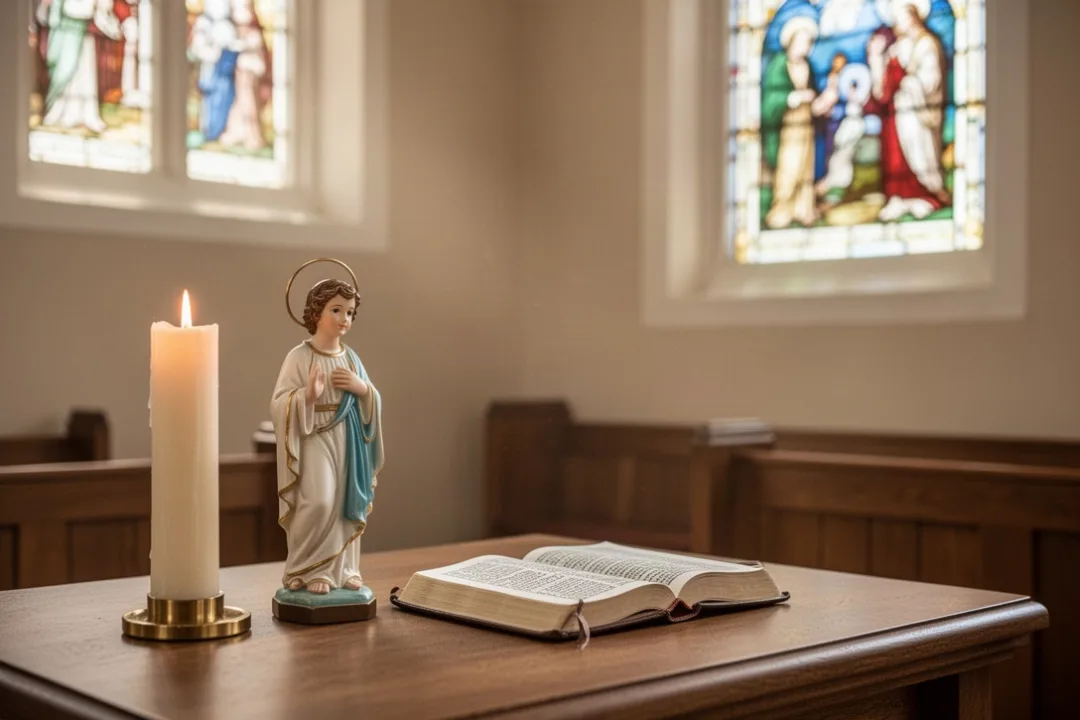
When anxiety keeps your thoughts racing, you may find yourself asking, “Is there a patron saint I can pray to?” The saint most commonly associated with anxiety is St. Dymphna, who is widely honored as the patron saint of mental illness, emotional distress, depression, and related struggles.
People turn to St. Dymphna for comfort when fear, panic, obsessive thoughts, grief, or emotional exhaustion feel difficult to carry. Her story connects her with people facing serious psychological suffering, abuse, and situations in which they need protection. Prayer to her does not replace therapy, medication, medical care, or emergency support. Instead, it can give spiritual meaning and companionship while you seek the help your mind and body need.
The short answer: St. Dymphna is the saint most often invoked for anxiety and mental health concerns. You can ask for her intercession in simple words, while also reaching out to a qualified mental health professional when anxiety interferes with daily life.
Why St. Dymphna is associated with anxiety and mental illness
St. Dymphna is traditionally remembered as a young woman from Ireland who lived during the seventh century. According to the long-standing account of her life, she fled to what is now Belgium after her father attempted to force her into an abusive relationship. She sought safety and religious refuge, but he eventually found her and killed her when she refused to return with him.
Because her story involves fear, trauma, coercion, persecution, and the need for protection, Christians gradually began invoking her for people experiencing mental and emotional suffering. Her association became especially strong in Geel, Belgium, where devotion to her developed around care for people with mental illness.
The traditional story uses older language and reflects the culture in which it was preserved. It should not be treated as a modern clinical account of anxiety or mental illness. Its continuing significance lies in the way it remembers a vulnerable person who faced danger and in the way her devotion became connected with compassionate care for people who suffer psychologically.
St. Dymphna is therefore not considered the patron saint of anxiety because she offers a medical explanation for anxious feelings. She is honored because her story speaks to people who feel frightened, overwhelmed, unsafe, misunderstood, or burdened by distress that others cannot easily see.
What “patron saint of anxiety” means in Catholic devotion
A patron saint is a saint whom a person, community, profession, place, or group asks to intercede with God. The saint is not worshiped as a god and is not believed to control events independently. Catholics ask the saint to pray with them and for them.
Patronage can develop in several ways. A saint may have a connection with a particular place or occupation, be remembered for a specific kind of suffering, or become associated with people who ask for help in similar circumstances. Some patronages are widely recognized across the Catholic Church, while others are especially strong in a country, parish, religious community, or popular tradition.
That means the phrase “patron saint of anxiety” is useful devotional language, but it does not mean that every Christian tradition has issued a formal, universal designation for anxiety as a modern diagnosis. St. Dymphna is the most common answer, particularly in Catholic settings, because her patronage is broadly connected with mental illness and emotional distress.
Her intercession may be especially meaningful if your anxiety includes:
Persistent fear or dread without an obvious immediate danger
Panic attacks or physical symptoms such as a racing heart and trembling
Intrusive thoughts, excessive worry, or difficulty quieting your mind
Emotional distress related to trauma, grief, abuse, or major life changes
Fear of being judged or misunderstood because of a mental health condition
Concern for a family member or friend who is experiencing serious anxiety
Prayer can acknowledge the spiritual dimension of suffering without pretending that anxiety is caused by weak faith. A faithful person may still need counseling, psychiatric treatment, rest, practical support, and protection from an unsafe environment.
How St. Dymphna’s story can speak to an anxious person
Anxiety often creates the impression that you are alone with your fear. Even when other people care about you, anxious thoughts can make your situation feel private, shameful, or impossible to explain. St. Dymphna’s story can offer a reminder that your suffering deserves compassion, not ridicule or blame.
Her story also has a strong connection with safety. If your anxiety is related to abuse, intimidation, stalking, violence, or an unsafe home, spiritual support should be paired with concrete protection. A trusted person, domestic violence advocate, emergency service, doctor, or counselor can help you plan the next safe step.
For people living with mental illness, the tradition surrounding St. Dymphna can also challenge the idea that psychological suffering should be hidden. Her name has been connected with hospitals, care communities, and charitable work for people with mental health needs. That association points toward care, dignity, patience, and community rather than shame.
You do not need to feel a particular emotion while praying. Anxiety may make prayer difficult. You might feel distracted, numb, angry, doubtful, or unable to form a complete sentence. A short request such as “St. Dymphna, pray for me in this fear” is enough for a devotional practice.
Ways to pray to St. Dymphna when anxiety feels intense
There is no single required prayer formula. You can use a traditional prayer, speak in your own words, or sit quietly with the saint’s name. The purpose is not to perform perfectly. It is to turn toward support and ask for grace, steadiness, wisdom, and help.
A simple prayer might be:
St. Dymphna, please pray for me as I face this anxiety. Ask God to give me calm, courage, wise support, and the strength to take the next safe step. Help me remember that I am not alone. Amen.
You can also pray for another person:
St. Dymphna, pray for someone I love who is suffering with fear and distress. May they receive compassionate care, protection, and the help they need. Guide the people supporting them. Amen.
If spoken prayer feels too difficult, try a quiet, repeatable practice:
Place both feet on the floor and take a slow breath without forcing it.
Say the name “St. Dymphna” once or several times.
Name the specific concern in plain language, such as fear of a medical appointment or panic at night.
Ask for one immediate grace, such as calm enough to make a phone call or tell someone what is happening.
Choose one practical action that supports your safety or treatment.
This combination matters because anxiety can make large solutions feel unreachable. Prayer may help you pause, while a small action moves you toward care. That action could be texting a trusted friend, scheduling an appointment, taking prescribed medicine as directed, eating something, or stepping away from a threatening situation.
Other saints people invoke for fear, worry, and emotional distress
St. Dymphna is the clearest answer to the question, but she is not the only saint people turn to when facing anxiety. Different saints may resonate with different experiences, and you can ask for the intercession of more than one.
St. Teresa of Ávila: Many people seek her intercession when they need inner steadiness, patience, and trust during periods of turmoil. Her writings describe prayer as a relationship that can continue through distraction and difficulty.
St. Francis de Sales: He is often associated with gentleness, spiritual direction, and a patient response to discouragement. His example can be meaningful when anxiety is accompanied by harsh self-criticism.
St. Thérèse of Lisieux: People may turn to her when they feel small, uncertain, or unable to manage a situation through their own strength. Her spirituality emphasizes simple acts of trust.
St. Padre Pio: Some people ask for his prayers during illness, fear, and prolonged hardship. His devotion may appeal to those seeking endurance while receiving treatment.
St. Joseph: He is frequently invoked for protection, family concerns, work-related worries, and difficult decisions. His quiet example can be comforting when anxiety centers on responsibility or uncertainty.
St. Michael the Archangel: Some Christians pray for protection when fear feels threatening or spiritually overwhelming. This devotional practice should support, not replace, practical safety measures and mental health care.
Choosing another saint does not mean you are rejecting St. Dymphna. Devotion is personal, and the saint who helps you pray honestly may be the right companion for a particular season. You may also ask your parish priest, spiritual director, or trusted faith leader for guidance.
Practical ways to combine prayer with anxiety care
Prayer is most helpful when it works alongside responsible care for your whole life. Anxiety affects thoughts, sleep, concentration, muscles, breathing, appetite, and relationships. A complete response may include spiritual practices, professional treatment, healthy routines, and support from people who understand what you are experiencing.
Consider these steps:
Describe the symptoms clearly: Write down what you feel, how often it happens, what triggers it, and how it affects sleep, work, school, relationships, or daily tasks.
Contact a qualified professional: A primary care clinician, licensed therapist, psychologist, or psychiatrist can help identify appropriate treatment.
Use prayer as a pause: Pray before making a difficult call, entering an appointment, or telling someone that you need help.
Build a support list: Keep the names of trusted people, healthcare providers, crisis resources, and local services in one place.
Reduce avoidable strain: Regular meals, adequate sleep, movement, and careful use of caffeine or alcohol can affect anxiety symptoms.
Follow treatment instructions: Take medication only as prescribed and speak with your prescriber before changing or stopping it.
Review what helps: Notice whether prayer, breathing exercises, therapy skills, time outdoors, or conversation makes the next hour more manageable.
Seek urgent help: If anxiety includes thoughts of suicide, self-harm, harming another person, or an inability to stay safe, contact emergency services or call or text 988 in the United States and Canada’s 988 service where available. Do not remain alone with immediate danger.
Spiritual care can also be part of treatment planning. If your faith matters to you, tell your therapist or doctor. A good professional can respect your beliefs while helping you examine symptoms and choose evidence-based care.
Common mistakes when using devotion for anxiety
Devotion to St. Dymphna can be a source of hope, but certain assumptions may increase guilt or delay needed support. Watch for these common mistakes:
Assuming anxiety proves weak faith: Anxiety is a real mental and physical experience. It is not reliable evidence that you have prayed badly or disappointed God.
Waiting for a miracle before seeking treatment: Prayer and professional care are not opposites. Asking for help can be an expression of wisdom rather than a lack of trust.
Stopping medication suddenly: Some medicines require careful tapering or medical supervision. Discuss changes with the prescribing clinician.
Using prayer to stay in danger: St. Dymphna’s story does not require you to tolerate abuse, threats, or coercion. Safety planning and outside assistance are appropriate.
Promising a guaranteed result: Intercession is not a transaction. A prayer should not imply that a person will be cured by a particular date or that continued symptoms represent spiritual failure.
Giving religious advice instead of listening: If a loved one is anxious, compassionate presence and practical help may be more useful than repeated instructions to pray.
Confusing spiritual distress with a medical emergency: Panic, severe depression, substance use, psychosis, or thoughts of self-harm require appropriate professional attention.
A balanced devotional practice can be both reverent and realistic. You can ask St. Dymphna to intercede while acknowledging that recovery may involve time, setbacks, therapy, medication, supportive relationships, and changes in circumstances.
How to honor St. Dymphna beyond personal prayer
Honoring St. Dymphna does not have to mean reciting a long prayer every day. You might learn about her traditional story, attend Mass on her feast day, light a candle where permitted, or ask your parish to pray for people living with mental illness. You could also support a mental health organization or accompany someone to an appointment.
Her patronage is especially meaningful when it leads to compassionate action. Check in with someone who has withdrawn. Offer to help with transportation, meals, childcare, or scheduling. Avoid treating the person as a problem to solve; ask what kind of support would actually help.
Families may also use her name as a reminder to speak about mental health without shame. A person who is anxious may need reassurance that seeking a therapist is not a betrayal of faith. They may need help finding a clinician who respects religious values, or simply someone willing to listen without judgment.
Parishes and religious communities can honor St. Dymphna by making care more accessible. That may include training pastoral ministers to recognize warning signs, sharing crisis resources, creating welcoming spaces, and referring people to licensed professionals rather than attempting to provide treatment beyond their expertise.
Occasional worry is part of ordinary life, but anxiety deserves professional attention when it is persistent, severe, or disruptive. Consider contacting a healthcare provider if fear makes it difficult to sleep, work, study, eat, leave home, maintain relationships, or manage ordinary responsibilities.
You should seek prompt help for new or extreme symptoms, especially if they include confusion, hallucinations, severe agitation, substance misuse, chest pain, fainting, or thoughts of death or self-harm. Some physical conditions can resemble anxiety, so a medical evaluation may be appropriate.
In the United States, calling or texting 988 connects you with the Suicide and Crisis Lifeline. If you are in immediate danger or have a life-threatening medical emergency, call 911 or go to the nearest emergency department. If you are outside the United States, use your local emergency number or crisis service.
St. Dymphna can be a spiritual companion while you take those steps. Her place in Christian devotion does not ask you to deny symptoms or carry them silently. It can point you toward courage, protection, honest conversation, and care for the person who is suffering.
A simple daily practice with St. Dymphna
A brief routine may be easier to maintain than an elaborate devotional plan. In the morning, name one concern and ask for the wisdom to respond to it. During an anxious moment, repeat a short invocation and focus on the next safe action. At night, note one form of support you received or one task you completed despite fear.
You might use this short invocation: “St. Dymphna, pray for me and help me receive the care I need.” It keeps prayer connected to a practical intention. You are not asking yourself to eliminate every anxious thought before moving forward; you are asking for help to respond with patience and sound judgment.
The patron saint of anxiety is most commonly understood to be St. Dymphna. Turning to her can help you feel accompanied, but the fullest response to anxiety includes both spiritual support and appropriate mental health care. Reaching out is not a failure of faith. It is often one of the wisest and most courageous steps available.
Frequently asked questions
Is St. Dymphna officially the patron saint of anxiety?
St. Dymphna is widely recognized in Catholic devotion as the patron saint of mental illness, emotional distress, and related conditions, including anxiety. Anxiety is a modern clinical term, so the wording may vary among sources and traditions. Her patronage is broadly accepted through longstanding devotion rather than a single universal title specifically defining every form of anxiety.
What is a short prayer to St. Dymphna for anxiety?
You can pray in your own words: “St. Dymphna, please pray for me in this anxiety. Ask God to give me calm, courage, wise support, and the strength to take the next safe step. Help me remember that I am not alone.” A short, honest prayer is sufficient; you do not need a special formula.
Can I pray to St. Dymphna instead of seeing a therapist?
Prayer can provide comfort and spiritual support, but it should not replace therapy, medical care, prescribed treatment, or emergency assistance. If anxiety affects your sleep, work, relationships, safety, or ability to function, contact a qualified healthcare professional. Faith and treatment can work together, and many people find both valuable.
What feast day is associated with St. Dymphna?
St. Dymphna’s feast day is commonly observed on May 15. Customs vary by parish and country, but people may attend Mass, pray for those living with mental illness, or support compassionate mental health care. The date can also serve as a personal reminder to check on someone who is struggling.













Leave a Reply