A parable in the Bible is a short story, comparison, or picture drawn from ordinary life that communicates a deeper spiritual truth. Parables often use familiar scenes—farmers planting seeds, shepherds searching for sheep, travelers on a road, or workers receiving wages—to make listeners think about God, human behavior, faith, and the kingdom of God.
Jesus is especially known for teaching through parables, although the Bible contains examples before the Gospels as well. A parable is not usually meant to be read as a literal historical report. Instead, its characters, actions, and outcome work together to confront the listener with a truth or decision.
The word parable comes from a term meaning something like “putting beside.” A parable places a familiar image beside an unfamiliar or deeper idea. The everyday image becomes a window through which the listener can see something about God’s character, the human heart, or faithful living.
For example, a farmer scattering seed provides a concrete picture for thinking about how people respond to God’s message. A shepherd looking for one missing sheep illustrates the value of the lost and the joy of restoration. A father welcoming a returning child portrays mercy, forgiveness, and the tension between grace and resentment.
Parables are usually brief, but brevity does not make them simple. A good parable can be understood at several levels. A child may recognize the basic story, while an adult may notice questions about justice, pride, responsibility, repentance, or the nature of God’s kingdom.
Many parables contain a surprising reversal. The person expected to behave well does not. The outsider acts more faithfully than the religious insider. The worker who arrives late receives unexpected generosity. The person who appears successful turns out to be spiritually unprepared. These reversals disrupt ordinary assumptions and make the main point difficult to ignore.
Core idea: A parable is not merely a story with a hidden code. It is a teaching story that invites you to see familiar life differently and respond to the truth it presents.
Parables also depend on their setting. The same story can carry a different emphasis when Jesus tells it to a crowd, a critic, a disciple, or a person asking a particular question. The surrounding conversation, the audience’s expectations, and the story’s conclusion all help identify its meaning.
Why Jesus taught so often through parables
Jesus used parables as one of his most distinctive teaching methods. The Gospels describe him speaking about the kingdom of God, forgiveness, prayer, wealth, mercy, judgment, readiness, and discipleship through stories that ordinary people could remember.
Parables made profound truths concrete. Instead of offering only an abstract statement about loving a neighbor, Jesus told the story commonly called the Good Samaritan in Luke 10:25–37. Instead of giving a general lesson about God’s concern for sinners, he told stories about a lost sheep, a lost coin, and a lost son in Luke 15.
His stories also exposed the attitudes of listeners. A person could agree with the events in a story before realizing that the story was challenging their own behavior. In the Good Samaritan, for example, the central question becomes not simply, “Who qualifies as my neighbor?” but “Will I act as a neighbor to someone in need?”
Jesus’ parables served several related purposes:
They revealed truth to people willing to listen and consider its implications.
They challenged pride by questioning social, religious, and moral assumptions.
They made teaching memorable through images drawn from work, family, farming, money, and community life.
They invited a response rather than allowing listeners to remain detached observers.
They exposed resistance when people heard the story but refused to accept its message.
Matthew 13 connects Jesus’ use of parables with both revelation and concealment. The point is not that Jesus wanted to make spiritual truth arbitrary or inaccessible. Rather, parables could open the meaning to people who listened humbly while leaving resistant hearers with only the surface story.
The Gospels sometimes record Jesus explaining a parable privately to his disciples. The Parable of the Sower in Matthew 13, Mark 4, and Luke 8 is one example. Its explanation shows that the different soils represent different responses to the message about God’s kingdom.
That explanation does not mean every parable should be treated as a puzzle with a separate meaning for every detail. It shows that Jesus sometimes gave a central interpretation when his disciples needed further instruction. In other cases, the story’s point becomes clear through its question, conflict, or final reversal.
Important examples of parables in the Bible
The Bible contains many stories that readers call parables, but they do not all work in exactly the same way. Some teach about God’s mercy, some address human responsibility, and others describe the surprising growth or value of God’s kingdom.
Parables about God’s kingdom
In Matthew 13, Mark 4, and Luke 13, Jesus compares the kingdom of God with images such as seed, yeast, a mustard seed, and a treasure. These comparisons emphasize different features of the kingdom: its apparently small beginning, its powerful growth, its hidden influence, and its extraordinary value.
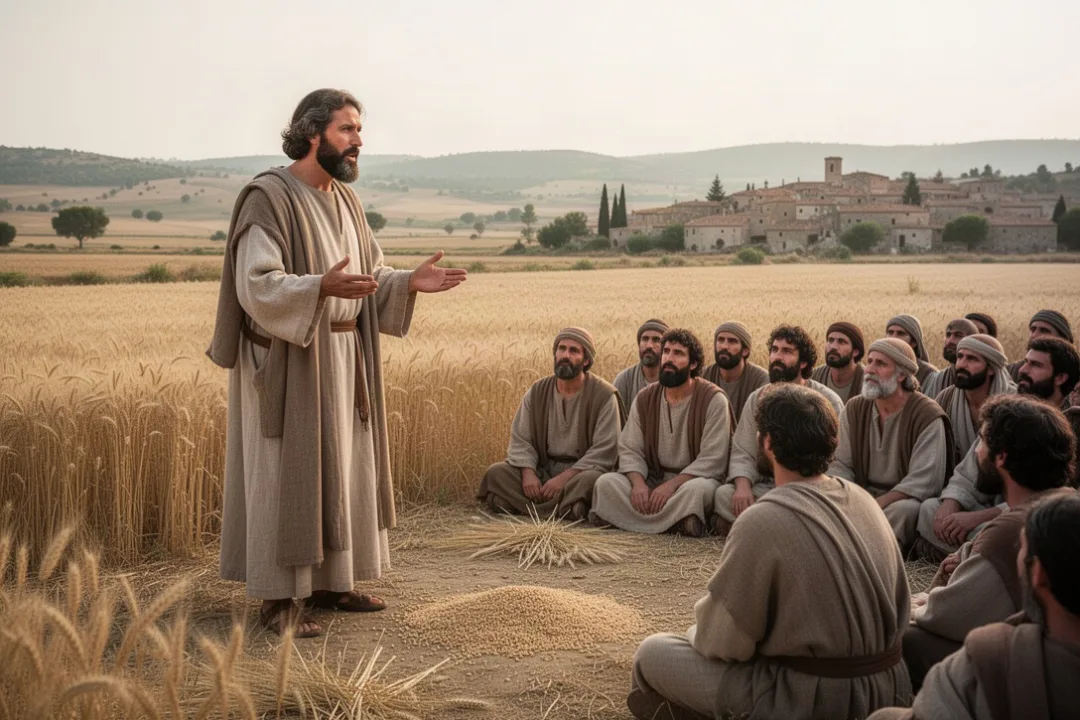
The Parable of the Sower focuses on how people receive the message of the kingdom. The seed is scattered broadly, but the results differ according to the soil. The image suggests that hearing alone is not the same as understanding, endurance, or fruitful obedience.
The Parables of the Hidden Treasure and the Valuable Pearl in Matthew 13 portray a person who recognizes exceptional worth and responds decisively. Their emphasis is not a formula for buying spiritual favor. They picture the kind of wholehearted response that follows when someone recognizes the surpassing value of God’s kingdom.
The Parable of the Weeds among the Wheat in Matthew 13 addresses the coexistence of good and evil and points toward a future separation. It cautions against assuming that human beings can perfectly judge every person’s spiritual condition in the present.
Parables about mercy and restoration
Luke 15 presents three connected stories: a shepherd searches for one lost sheep, a woman searches for one lost coin, and a father receives a son who has returned home. Together, they emphasize God’s joy over restoration and challenge the resentment of people who believe some sinners are beyond mercy.
The story often called the Prodigal Son could also be called the Parable of the Two Sons or the Loving Father. The younger son’s return is central, but the older son’s anger is also significant. The story asks whether a person can remain physically close to the household while being inwardly distant from the father’s generosity.
The Parable of the Unforgiving Servant in Matthew 18:21–35 begins with a servant whose enormous debt is forgiven. When that same servant refuses mercy to another person, the contrast exposes the contradiction between receiving forgiveness and refusing to extend it.
Parables about neighbor love and compassion
The Good Samaritan in Luke 10:25–37 responds to a question about eternal life and the meaning of neighbor love. A wounded traveler is ignored by two respected religious figures but helped by a Samaritan, a person many Jewish listeners would have viewed through a lens of hostility or suspicion.
Jesus makes compassion the decisive issue. The story does not reduce love of neighbor to a feeling or a narrow category of people. It portrays mercy as practical action that accepts inconvenience, risk, and cost for the sake of someone in need.
Parables about prayer, wealth, and readiness
The Persistent Widow in Luke 18:1–8 encourages continued prayer through the contrast between a vulnerable widow and an unjust judge. The judge does not act from compassion, yet he eventually responds to her persistence. Jesus uses the contrast to encourage trust in God’s justice rather than to suggest that God is reluctant to hear his people.
The Rich Fool in Luke 12:13–21 portrays a prosperous man who plans to store more wealth and enjoy security for himself. He fails to account for the limits of life and his relationship with God. The story warns against treating possessions as the foundation of identity or safety.
The Ten Bridesmaids in Matthew 25:1–13 and the Talents in Matthew 25:14–30 both address readiness and responsibility, although they do so in different ways. The first emphasizes being prepared for the bridegroom’s arrival. The second challenges servants to use what has been entrusted to them rather than hiding it through fear.
Parables in the Old Testament and beyond Jesus’ teaching
Jesus did not invent the use of story and comparison to teach spiritual truth. The Old Testament includes memorable examples of prophetic storytelling and symbolic narratives that confront people with their own conduct.
In 2 Samuel 12, the prophet Nathan tells King David a story about a rich man who takes a poor man’s beloved sheep. David condemns the rich man’s behavior before Nathan reveals that the story reflects David’s own actions involving Uriah and Bathsheba. The story leads David to recognize his guilt before he can defend himself.
Judges 9:7–15 records Jotham’s fable about trees seeking a king. The trees choose a thornbush, and the tale criticizes the violent ambition of Abimelech and the people who supported him. Its talking trees make the political warning vivid without presenting the story as a literal event in nature.
Ezekiel 17 uses an extended comparison involving great eagles and a vine to address political choices and covenant faithfulness. Isaiah 5:1–7 presents a song about a carefully tended vineyard that produces poor fruit. The explanation identifies the vineyard with God’s people and connects the failed harvest with injustice.
These passages show that biblical parables can take different forms. Some are short narratives, some are fables, some are extended metaphors, and some are symbolic visions. They share a method: a concrete image carries a moral or theological claim.
The Bible also includes wisdom comparisons that are not always labeled parables. Proverbs uses images from ants, paths, houses, harvests, and marketplaces to teach wisdom. These sayings are usually shorter than narrative parables, but they similarly connect ordinary observations with principles for living.
Reading tip: Identify the passage’s biblical setting before drawing a broad lesson. A parable told to expose hypocrisy may not be teaching the same emphasis as a parable told to encourage perseverance.
How to interpret a biblical parable responsibly
Start by reading the entire passage, not only the familiar portion. Notice what happens before and after the story. A question, dispute, command, or explanation may reveal why Jesus or another biblical teacher told it.
Then identify the main tension. What problem drives the story? Is someone lost, unprepared, proud, afraid, indebted, impatient, or unwilling to forgive? The conflict often points toward the central lesson more reliably than any single object or character.
Use these steps when studying a parable:
Read the surrounding verses. Look for the question, audience, or controversy that prompted the story.
Describe the plot in a few sentences. Identify the main characters, conflict, turning point, and ending.
Notice the surprise. Ask which action or result would have challenged the original audience’s expectations.
Find the stated emphasis. Some passages explain their point directly; others make it clear through a concluding question or command.
Consider the audience. A story spoken to hostile critics may expose hypocrisy, while one spoken to disciples may train them for faithful service.
Compare related passages. Parallel accounts in Matthew, Mark, and Luke may include different details that clarify the emphasis.
Apply the principle carefully. Ask how the story addresses your relationship with God, other people, possessions, suffering, or responsibility.
Parables generally have a main point or dominant emphasis, even when they contain several meaningful details. The Parable of the Good Samaritan centers on merciful neighbor love. It would be risky to assign a separate spiritual meaning to the road, the inn, the animal, and every coin unless the passage itself supports those connections.
Some interpreters use an allegorical approach, treating many details as symbols of separate realities. Allegory can be appropriate when the biblical text clearly guides readers that way. Jesus’ explanation of the Sower assigns meaning to several elements, and some Old Testament passages do the same.
Still, forcing every detail into a symbolic system can obscure the story’s actual force. Ask first what the story would have communicated as a whole to its original listeners. Only then should you consider whether particular details carry additional significance.
Historical and cultural context also matters. A modern reader may miss the shock of a Samaritan acting as the merciful neighbor, the social vulnerability of a widow, or the economic danger represented by debt. Learning about farming, household customs, weddings, servants, land ownership, and religious expectations can make the story’s conflict clearer.
Common mistakes when reading Bible parables
One common mistake is assuming that every parable is a literal account. Some biblical narratives describe historical events, while parables use imagined or representative situations to teach. The fact that a story contains realistic details does not by itself establish that it happened exactly as told.
A second mistake is treating every parable as a prediction of the future. Some do address judgment, readiness, or the coming kingdom, but others focus on mercy, prayer, humility, stewardship, or the treatment of neighbors.
Another mistake is reducing a parable to a vague slogan. Saying that the Good Samaritan means “be nice” misses the story’s challenge to social boundaries, costly compassion, and the temptation to define away one’s responsibility.
Watch for these interpretive problems:
Ignoring the context: A familiar story may be detached from the question or conflict that gave it meaning.
Making every detail symbolic: Minor features may support the story without representing separate doctrines.
Reading modern assumptions into the text: Ancient farming, family, legal, and social practices may differ sharply from current experience.
Using one verse as the whole message: The plot and ending should shape interpretation, not an isolated phrase.
Turning grace into a reward system: Some parables use wages, debts, or payment to make a point without teaching that salvation can be purchased.
Overlooking the emotional response: Anger, shame, relief, envy, fear, and joy often reveal where the story is pressing the listener.
It is also wise to distinguish between what a parable clearly teaches and what you infer from it. A passage may strongly support mercy while leaving room for careful discussion about the timing of judgment or the details of a future event.
Parables are meant to do more than provide information. They often place the reader inside a decision. You may find yourself identifying with the generous character, the resentful observer, the distracted hearer, the anxious servant, or the person who needs forgiveness. That recognition is part of the teaching method.
Read parables slowly and return to them over time. Their familiar images often raise new questions as your circumstances change. The central truth remains anchored in the text, while its personal challenge may become clearer in different seasons of life.
A biblical parable, then, is a carefully shaped story that uses ordinary experience to reveal spiritual reality. It may comfort, warn, expose, encourage, or call for action. Its meaning becomes clearest when you read the whole passage, listen for its central tension, respect its historical setting, and allow its challenge to address the way you live.
Frequently asked questions
Are all the stories Jesus told considered parables?
No. The Gospels include parables, sayings, illustrations, historical accounts, prophetic actions, and references to real events. A parable normally uses a compact, representative story to communicate a spiritual or moral truth. Some passages are clearly identified by their context, while others are classified as parables because of how they function as teaching stories.
What is the difference between a parable and an allegory?
A parable usually communicates one main lesson through a story, while an allegory may assign symbolic meaning to many or nearly all of its details. Biblical passages can sometimes combine both methods. The safest approach is to follow the interpretation supplied by the passage rather than assuming every character, object, or number represents something separate.
Why did Jesus sometimes explain parables to his disciples?
Jesus’ private explanations helped his disciples understand the spiritual significance of certain stories and prepared them to teach others. They also show that hearing a parable and grasping its meaning are not always the same. The disciples were being taught to listen carefully, recognize the kingdom’s message, and respond with faithful action.
Can a parable have more than one valid application?
Yes, a parable can address different situations while retaining a central meaning. For example, a story about forgiveness may speak to personal resentment, community relationships, and one’s understanding of God’s mercy. Applications should remain connected to the story’s context, main conflict, and emphasis rather than becoming unrelated lessons.














Leave a Reply