The scripture of the prodigal son: Meaning and message
The scripture of the prodigal son: Meaning and message
Have you ever wondered whether someone who has made serious mistakes can really come home to God? The scripture of the prodigal son answers that question through one of Jesus’ best-known parables, found in Luke 15:11–32. It tells of a younger son who leaves his family, wastes his inheritance, returns in humility, and is welcomed by his father.
The story is often called the parable of the prodigal son, but the father’s response is just as important as the son’s failure. Jesus presents a father who watches for his child, receives him with compassion, and restores him before the son can earn his way back. The older brother adds another dimension, showing how resentment and self-righteousness can separate a person from the joy of grace.
Where the scripture of the prodigal son appears in the Bible
The complete passage is Luke 15:11–32. It comes after religious leaders criticize Jesus for welcoming sinners and eating with them. Jesus responds with three connected stories: a lost sheep, a lost coin, and a lost son. Each parable focuses on something lost, something found, and the joy that follows recovery.
Luke 15:11–32 is the longest of the three stories and the only one involving family members who respond differently to restoration. The younger son is physically lost in a distant country, while the older son is near the father but spiritually distant through anger and pride. The father goes out to meet both sons, although he speaks to each one in a different situation.
The passage is sometimes described as the parable of the lost son or the parable of the loving father. “Prodigal” means recklessly wasteful, especially with money or resources. The word describes the younger son’s behavior, but it does not appear as a title in the original Gospel text. The father’s generous welcome is also extravagant, though his generosity is directed toward mercy rather than waste.
Scripture reference: Read Luke 15:11–32 for the full parable. The central movement is from rebellion to repentance, from alienation to welcome, and from resentment to an invitation to share in joy.
The story begins when the younger son asks for his share of the family property. In that culture, such a request would have been deeply insulting because it treated the father’s living presence as less valuable than the inheritance. The son wants the benefits of the household without remaining in relationship with the person who gave him those benefits.
After receiving the property, the younger son leaves for a distant region and spends everything in reckless living. When a severe famine arrives, he has no resources left. He takes a humiliating job feeding pigs, a detail that would have emphasized his uncleanness and disgrace to many of Jesus’ Jewish listeners.
What the younger son’s departure and return mean
The younger son’s departure represents more than poor financial choices. It shows a deliberate attempt to define life apart from the father. He seeks freedom, pleasure, and independence, but his choices eventually lead to poverty, isolation, and shame. The story does not suggest that every hardship is caused by personal sin, but it does show the consequences of this particular son’s decisions.
His turning point comes when he recognizes the seriousness of his condition. Luke describes him as coming to his senses, meaning that he begins to see both his circumstances and his relationship with his father clearly. He remembers that even the hired workers in his father’s household have enough food, while he is starving far away.
Repentance in the parable includes several connected movements:
Recognition: The son admits that his choices have brought him to a place of ruin.
Humility: He stops defending his behavior and accepts responsibility for what he has done.
Decision: He chooses to leave the distant country and return to his father.
Confession: He acknowledges that he has sinned against both heaven and his father.
Return: He takes concrete action instead of treating regret as sufficient.
The son prepares a speech in which he plans to confess his wrongdoing and ask to be treated as a hired worker. He no longer assumes that he deserves a place in the family. His planned words show genuine humility, but they also reveal that he does not yet understand the depth of his father’s love.
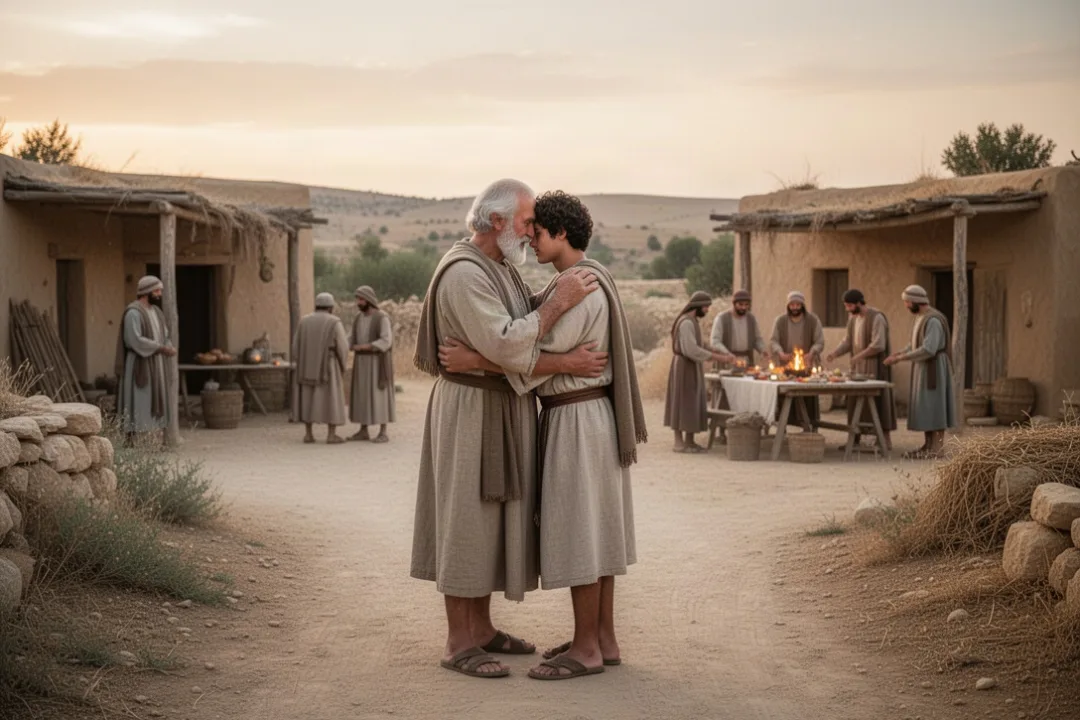
As he approaches home, the father sees him while he is still far away. The father runs to him, embraces him, and welcomes him before the son can complete his prepared request for employment. Jesus emphasizes the father’s initiative: the son returns, but the father responds with immediate compassion.
The father’s actions communicate acceptance, restoration, and celebration. He orders servants to bring the best robe, a ring, and sandals. These gifts are not wages for completed work. They are signs that the son is being received as a member of the household rather than kept at a humiliating distance.
The father also orders a feast because his child was dead and is alive again, and because he was lost and has been found. This language presents reconciliation as a restoration of relationship, not merely the cancellation of a debt. The son is not simply allowed to stand at the edge of the family; he is brought back into its shared life.
The father’s welcome shows that repentance does not persuade God to become merciful; it brings a returning person into the mercy God is already ready to give.
The younger son’s return does not erase the fact that he caused pain or wasted property. Grace does not call wrongdoing harmless. Instead, the parable shows that a person’s worst failure does not have to be the final definition of that person’s relationship with God.
How the father reveals God’s mercy
The father is the emotional center of the scripture of the prodigal son. He allows the younger son to leave, but he does not stop loving him. When the son returns, the father does not demand a period of probation, a financial repayment plan, or a public performance of regret before offering welcome.
This does not mean that every earthly relationship should ignore wisdom, accountability, or safety. The parable addresses the father’s response to a repentant child, not every circumstance involving abuse, manipulation, addiction, or ongoing danger. In practical life, forgiveness can exist alongside boundaries and responsible rebuilding of trust.
The father’s compassion appears in several ways:
He allows the son to make a genuine choice, even though that choice brings sorrow.
He remains attentive to the possibility of the son’s return.
He moves toward the son instead of waiting for a perfect apology.
He restores the son’s identity within the household.
He celebrates reconciliation rather than using the past as a weapon.
Many readers focus on the son’s confession, but the father’s response explains the heart of the parable. Jesus portrays God as eager to receive those who turn back. The father does not love the son because the son has become impressive. He welcomes him because he is his child and because restoration gives him joy.
The father’s mercy is also personal. He does not treat the returning son as a case, a liability, or a public embarrassment. He sees a wounded and repentant person. His compassion preserves the son’s dignity while still acknowledging that the son had been lost.
Jesus’ audience would have recognized that the father’s behavior was startling. A dignified patriarch was not expected to run publicly toward a disgraced child. Yet the father accepts humiliation in order to restore the relationship. This surprising action helps communicate the startling generosity of divine mercy.
A helpful distinction: The father welcomes the son before the son can prove himself, but the son still has to turn around and come home. Grace is freely offered; repentance is the honest response that receives it.
The parable also corrects the idea that God is reluctant to forgive. The father is not dragged into compassion by pressure from others. He is already watching, already moved, and already prepared to restore. Luke 15 places this story alongside the joy over one lost sheep and one lost coin to show that recovery matters deeply to God.
Why the older brother matters to the parable
The story does not end when the younger son returns. The older brother is working in the field when he hears music and dancing. After learning that his brother has come home and that the father has prepared a feast, he becomes angry and refuses to go inside.
His anger is understandable at one level. He has stayed, worked, and obeyed, while his younger brother left with family property and returned to a celebration. The older brother believes the father has failed to recognize his loyalty. His complaint exposes a view of family life based on performance, fairness, and earned reward.
The father goes outside and pleads with him. This detail matters because the father seeks both sons. He goes out to the younger son on the road and to the older son outside the celebration. One son is lost through rebellion; the other is lost through resentment and self-righteousness.
The older brother describes himself as someone who has served faithfully and never disobeyed. He complains that the father has never given him a young goat for a celebration with his friends, while the returning brother receives a feast. His words suggest that he sees himself more as a servant earning benefits than as a beloved son sharing the father’s life.
The father answers that everything he has belongs to the older son. He also explains that celebration is appropriate because the younger brother was dead and is alive again, and because he was lost and has been found. The father does not deny the older son’s place. Instead, he invites him to join the joy of restoration.
The older brother’s final response is not recorded. Jesus leaves the ending open, forcing listeners to decide whether they will remain outside or enter the celebration. The religious leaders who prompted the parable would have had to consider whether their objection to Jesus welcoming sinners resembled the older brother’s refusal to rejoice.
The older brother warns against several spiritual attitudes:
Comparing your obedience with another person’s failure.
Treating God’s favor as payment for good behavior.
Believing that someone else’s restoration diminishes your own place.
Using moral faithfulness to justify contempt for people who repent.
Remaining close to religious activity while becoming distant from compassion.
The parable does not say that faithfulness is worthless. The father does not condemn the older son for working or remaining home. The problem is that the older son cannot accept mercy for his brother. His obedience has become a reason to withhold love rather than a response to the father’s love.
What the prodigal son teaches about repentance and forgiveness
The scripture of the prodigal son gives a balanced picture of repentance. Repentance is not merely feeling bad after consequences arrive, although sorrow may be part of it. It is a change of direction that acknowledges the truth, turns toward God, and accepts the possibility of restored relationship.
The younger son does not blame the famine, his friends, his father, or the culture around him. He does not claim that his intentions were misunderstood. He says, in substance, that he has sinned and is no longer worthy to be treated as he once was. His confession is direct rather than defensive.
At the same time, Jesus does not present forgiveness as a reward that the son earns through the quality of his speech. The father interrupts the planned negotiation. The son imagines a reduced position, but the father gives him a restored identity. Forgiveness is grounded in the father’s compassion rather than in the son’s ability to compensate for the past.
For someone who feels far from God, the parable offers a clear path:
Face the truth about what has happened without minimizing it.
Turn toward God rather than remaining trapped in shame.
Confess honestly to God and, when appropriate, to people who were harmed.
Accept mercy instead of insisting that punishment is the only proof of sincerity.
Take responsible steps to repair harm and rebuild trust.
Live as someone restored, not as someone permanently defined by former failure.
The parable also speaks to people who have been hurt by another person’s choices. The father’s welcome does not require the older brother to pretend that the younger son’s departure never happened. It does invite him to see that restoration is a reason for joy, not a threat to justice or belonging.
Christian readers commonly connect this passage with the wider biblical message of God’s forgiveness, but the passage itself should be allowed to speak in its own setting. Jesus is answering criticism of his welcome toward sinners. His point is that heaven rejoices when the lost are found and that God’s people should share that joy.
The story also guards against two opposite errors. A person may believe that failure makes return impossible, or a person may believe that religious performance makes mercy unnecessary. The younger and older sons take different paths, but both need the father’s invitation into restored relationship.
How to read Luke 15:11–32 in prayer and daily life
Reading the prodigal son passage slowly can help you notice which character resembles your present situation. You may identify with the younger son because of regret, addiction, distance from faith, or a relationship damaged by your decisions. You may identify with the older son because someone else’s forgiveness feels unfair. At another time, you may need to reflect on the father’s compassion toward someone who has returned.
Consider these questions as you read Luke 15:11–32:
What did the younger son believe would make him free?
What helped him recognize that he needed to return?
Why might the father’s welcome have surprised the son?
What does the older brother believe he has earned?
Where do you see yourself resisting mercy?
How could repentance involve both confession and practical change?
A simple prayer based on the passage might ask God for honesty about sin, courage to return, humility to receive forgiveness, and compassion toward people who are being restored. The goal is not to repeat the parable as a formula. The goal is to allow its movement—from distance to home and from resentment to joy—to shape your response.
The passage can also guide conversations about reconciliation. If you have caused harm, begin with a clear acknowledgment rather than an explanation designed to protect your image. If someone has harmed you and is genuinely changing, forgiveness may be a process that includes wisdom, boundaries, and time. The father’s compassion is generous, but it is never shallow or indifferent to the truth.
For churches and families, the parable offers a test of welcome. Do people who return after failure encounter only suspicion and shame, or do they find a community that combines truth with mercy? Do long-term members feel valued, or are they expected to suppress every concern? Jesus’ story calls everyone into a household where restoration is celebrated without treating faithful service as invisible.
The scripture of the prodigal son ultimately centers on the character of the father. The younger son shows the misery of rejecting relationship, and the older son shows the misery of refusing mercy. The father shows a love that seeks the lost, receives the repentant, and invites the resentful into joy. Luke 15:11–32 remains a powerful account of how God welcomes people home.
Frequently asked questions
What is the exact scripture reference for the prodigal son?
The parable of the prodigal son is recorded in Luke 15:11–32. It appears after Jesus tells the shorter parables of the lost sheep and the lost coin. Together, these stories respond to criticism that Jesus welcomed sinners and shared meals with them.
What does “prodigal” mean in the Bible story?
“Prodigal” means recklessly wasteful. It describes the younger son because he wastes his inheritance through irresponsible living. The word does not mean simply “lost” or “rebellious,” and it can also draw attention to the father’s lavish generosity when he welcomes his child home.
Is the prodigal son a true historical event?
Luke presents it as one of Jesus’ parables, a teaching story that communicates spiritual truth through familiar human situations. The passage is not introduced as a report about named historical individuals. Its central message concerns repentance, mercy, restoration, and the danger of refusing to celebrate another person’s return.
Why does the story include the older brother?
The older brother shows that someone can remain physically close to the family while being emotionally and spiritually distant. His resentment reflects the attitude of people who believe mercy should be earned. Including him helps Jesus address both obvious rebellion and self-righteousness, inviting both sons to receive the father’s love.

















Leave a Reply