The scourging at the pillar: meaning and meditation
The scourging at the pillar: meaning and meditation
The scourging at the pillar is the second Sorrowful Mystery of the Rosary, recalling Jesus’ brutal whipping before his crucifixion. Catholics meditate on this scene not to glorify violence, but to remember Christ’s willing endurance, his solidarity with human suffering, and the love expressed through his sacrifice.
The scene appears most directly in John 19:1, where Pilate has Jesus scourged before presenting him to the crowd. The other Gospel accounts describe Jesus’ condemnation and crucifixion without giving the same brief, explicit description of the scourging. Together, the accounts place the punishment within the final hours of Jesus’ earthly life.
The familiar phrase the scourging at the pillar comes from Christian tradition and devotional language. It reflects the common image of Jesus being restrained or bound to a column while Roman soldiers beat him. The Gospels do not identify the pillar, give its location, or provide a detailed account of the instrument used, so those details should not be treated as certain historical facts.
Roman scourging was a severe form of punishment. It could cause extensive injury and blood loss, and it was sometimes administered before crucifixion to weaken the condemned person. The Gospel accounts do not state how many blows Jesus received. The traditional number of 39 lashes comes from later associations with Jewish disciplinary practice, not from a biblical description of Jesus’ scourging.
Keep the focus clear: The central point is not to reconstruct every physical detail. It is to contemplate Jesus’ innocent suffering, his dignity under abuse, and the self-giving love Christians believe he showed for humanity.
Where this mystery fits in the Rosary
The Sorrowful Mysteries traditionally include five events from the Passion of Christ: the Agony in the Garden, the scourging at the pillar, the crowning with thorns, the carrying of the cross, and the crucifixion. The scourging is therefore prayed after Jesus’ anguish in Gethsemane and before the mockery and humiliation represented by the crown of thorns.
In the usual Rosary sequence, the mystery is announced before the decade begins. The person praying then reflects on the event while reciting the Our Father, ten Hail Marys, and the Glory Be. The words of the prayers provide a steady rhythm, while the mind returns to the mystery’s spiritual meaning.
The Sorrowful Mysteries are traditionally prayed on Tuesday and Friday, as well as during Lent and at other times of devotion. The Rosary is a flexible prayer, however, and people may meditate on this mystery whenever they need to bring suffering, injustice, repentance, or compassion before God.
Tuesday: a traditional day for the Sorrowful Mysteries.
Friday: a day associated with Christ’s Passion and death.
Lent: a season when many Christians give special attention to repentance and the cross.
Any day of need: a person may pray this decade when facing pain, fear, abuse, grief, or concern for someone who is suffering.
What the Gospel accounts show about Jesus’ suffering
The scourging takes place within a wider pattern of rejection and abuse. Jesus is arrested, questioned, handed over to Roman authority, mocked by soldiers, and eventually led to crucifixion. The physical violence is joined by false accusation, public humiliation, abandonment, and the denial of his innocence.
John’s Gospel presents Pilate as repeatedly finding no clear basis for condemning Jesus, yet still permitting the punishment and later surrendering him to be crucified. This tension makes the scene especially troubling: a person recognized as not deserving death is nevertheless treated as an object of political convenience and public pressure.
The Gospel of Matthew and the Gospel of Mark describe soldiers mocking Jesus as a king, placing a robe on him, and striking him. Luke emphasizes the role of Herod’s soldiers in mocking him. These accounts do not simply describe pain; they show the deliberate stripping away of dignity through ridicule, exposure, and abuse of power.
When praying this mystery, you can hold together several realities:
Jesus suffers physically through a brutal punishment.
He suffers emotionally through rejection and humiliation.
He suffers socially as authorities and crowds participate in his condemnation.
He suffers spiritually while remaining faithful to the mission he has received from the Father.
The Church’s meditation does not require you to imagine details that Scripture does not provide. Returning to the Gospel’s clear elements can make prayer more grounded: Jesus is innocent, he is abused, he does not abandon his identity, and his suffering leads toward the cross.
Why Catholics meditate on the scourging
The mystery offers a way to contemplate Christ’s solidarity with suffering humanity. Jesus is not presented as distant from pain. He experiences bodily injury, fear, shame, and injustice. For someone who feels overlooked or misunderstood, this can make prayer more personal: the Christian faith speaks of a Savior who knows suffering from within human life.
The scene also reveals the seriousness of sin and violence. Sin is not merely an abstract failure to meet a standard. It can damage bodies, relationships, communities, and the vulnerable. The scourging confronts the consequences of cruelty, cowardice, resentment, and the misuse of authority without suggesting that every person’s suffering is a direct punishment for personal sin.
Christians also see in the mystery the obedience and self-offering of Jesus. This does not mean that abuse is good, or that victims should quietly accept mistreatment. Jesus’ suffering is connected to his free fidelity to God’s saving purpose; it is not a command for abused people to remain in danger or for perpetrators to avoid accountability.
A necessary distinction: Meditating on Jesus’ endurance must never be used to excuse domestic violence, sexual abuse, bullying, exploitation, or any other harm. Seeking safety, reporting abuse, and accepting help are consistent with human dignity and Christian responsibility.
The mystery can also lead to gratitude. Christians believe that Jesus does not save humanity from a safe distance. He gives himself through the whole Passion, including the humiliation and physical suffering that precede the cross. Gratitude, however, should remain joined to compassion for real people who suffer today.
How the scourging connects to Christian teaching about human dignity
Jesus’ treatment at the pillar shows what happens when a human being is reduced to a problem, a threat, or a means of satisfying a crowd. The soldiers do not see the person before them with reverence. They use their power to injure and humiliate him. Meditating on the mystery can therefore sharpen a Christian commitment to defend the dignity of every person.
That commitment includes people whose pain is hidden: prisoners, refugees, victims of trafficking, patients with chronic illness, people experiencing homelessness, and those facing violence at home. The mystery calls prayer out of the church building and into concrete concern for neighbors who are being treated as disposable.
There is also a personal examination of conscience. You may ask how you respond when someone has less power than you do. Do you join in ridicule? Ignore suffering because speaking up is uncomfortable? Use authority for service, or for control? These questions can make the decade more than a mental picture of a past event.
At the same time, the mystery should not lead to self-hatred. Christian repentance identifies real wrongdoing and turns toward repair. If you have harmed someone, prayer should support honest confession, changed behavior, restitution where possible, and acceptance of appropriate consequences.
Begin by settling on one simple image: Jesus standing wounded and humiliated after the scourging, yet still known by God and still faithful. You do not need to force intense emotion. A quiet recognition of what happened can be a sincere prayer.
Then bring the mystery into the decade. Each Hail Mary can become an opportunity to return to one aspect of the scene: Christ’s innocence, the abuse of power, his patience, the pain of the body, or the hope that suffering and death will not have the final word.
Name the mystery: Say, “The second Sorrowful Mystery, the scourging at the pillar.”
Read a brief reference: Use John 19:1, or compare the Passion narratives without trying to merge every detail.
Choose one focus: Consider Christ’s dignity, compassion for victims, repentance, courage, or trust in God.
Pray the decade slowly: Let the words remain audible to your mind instead of racing to finish.
Make a concrete response: Ask what act of mercy, protection, apology, or service should follow the prayer.
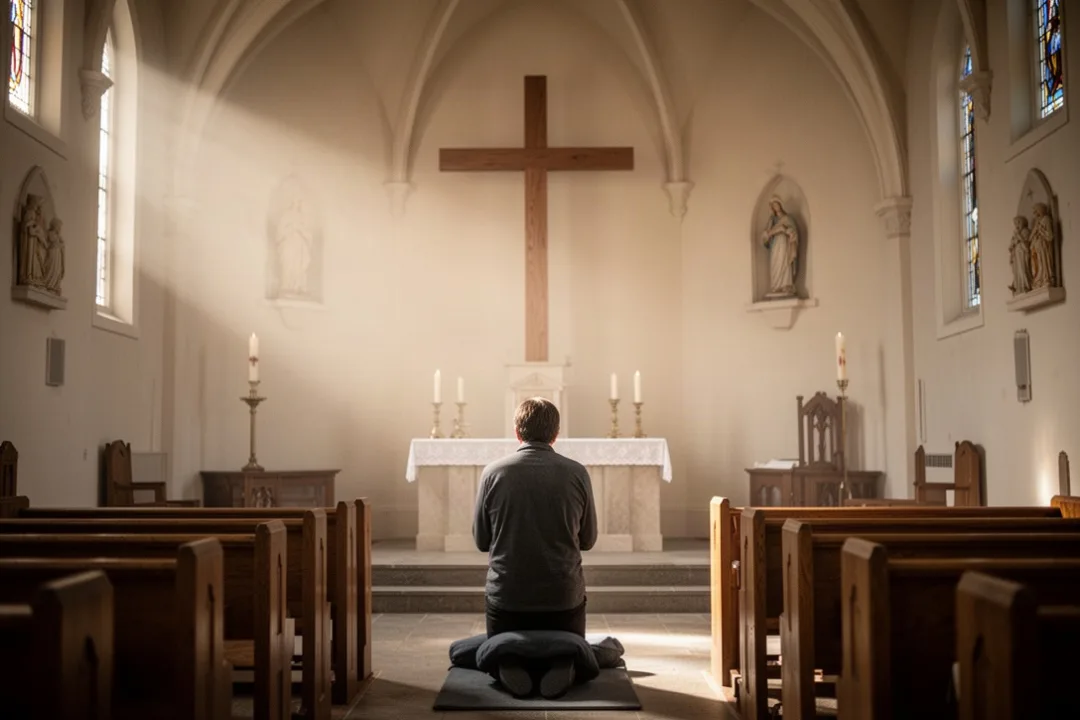
Some people find it helpful to use an icon, crucifix, or traditional artwork. Others prefer to avoid graphic images, especially if they have experienced violence or trauma. A plain cross, a quiet room, or the words “Jesus, stay with those who suffer” can be enough.
Practical tips and common mistakes when meditating
A fruitful meditation does not depend on producing a strong emotional reaction. It depends on honest attention and a willingness to let the mystery shape how you see God, yourself, and other people.
Do not confuse vivid detail with deeper faith. Graphic images may distract from prayer or distress people who have experienced abuse.
Do not invent certainty. Scripture does not identify a specific pillar, the exact number of blows, or every feature shown in religious art.
Do not treat suffering as automatically virtuous. Enduring preventable abuse is not the same as faithfully carrying a cross.
Do not make the mystery only about your own pain. Bring your experience to Christ, but also remember victims, caregivers, and people whose suffering is ignored.
Do not rush past the human reality. Jesus’ body, emotions, and dignity matter; the Passion is not an abstract theological diagram.
Do not stop at sadness. Ask how compassion, justice, forgiveness, and hope should affect your actions.
Do not force a prayer style that harms you. If the imagery triggers traumatic memories, choose a gentler focus or speak with a trusted pastor or counselor.
One practical method is to use a different focus for each Hail Mary. For example, the first may consider Jesus’ innocence, the second the suffering of abused people, and the third the temptation to stay silent in the face of injustice. The remaining prayers can turn toward courage, healing, repentance, protection, and hope.
How the mystery speaks to people who are suffering
Someone in pain may wonder whether God understands what is happening. The scourging presents a Christian answer centered on the wounded Christ: God is not indifferent to bodily vulnerability or human cruelty. Jesus enters the experience of being overpowered, exposed, and harmed.
That answer should be offered with care. A grieving or traumatized person may not need an explanation of why suffering occurred. They may need protection, medical care, a safe place, practical assistance, and someone who will listen without minimizing what happened. Prayer can accompany those forms of love, but it should not replace them.
The mystery can also support people who care for the sick or injured. Nurses, family members, chaplains, social workers, and friends often witness pain they cannot remove. Praying with the scourging can express their desire to remain present without pretending that suffering is easy or that every wound has an immediate answer.
For victims of abuse, the Passion must be handled especially carefully. Jesus’ suffering does not mean that abuse is acceptable, required, or spiritually beneficial in itself. The wounded Christ stands with those who need safety and justice; he does not ask them to protect an abuser’s reputation or remain in a dangerous situation.
How the mystery leads beyond violence
The scourging is not the end of the Christian story. It leads to the cross, but the cross leads toward the Resurrection. This movement does not erase the reality of pain or turn tragedy into something harmless. It expresses the Christian hope that violence, sin, and death will not ultimately define Jesus or those joined to him.
That hope can change the way the Rosary is prayed. You may begin with grief over what was done to Jesus, move toward solidarity with those who suffer, and end the decade asking for the grace to resist cruelty. The prayer becomes both remembrance and commitment.
Forgiveness may also arise, but it should not be confused with denying harm. Christian forgiveness can involve releasing revenge while still pursuing truth, boundaries, protection, and justice. In serious cases, reconciliation is not possible without genuine repentance and changed conduct, and personal safety remains essential.
The mystery therefore has a practical moral direction. It asks you to notice suffering, refuse dehumanizing speech, protect vulnerable people, and use whatever authority you have responsibly. The prayer is complete not when you have imagined the scene perfectly, but when love becomes more concrete in your choices.
Questions to bring into prayer
A few focused questions can keep your meditation from becoming vague. You might choose one before the decade and let it remain with you rather than trying to answer all of them at once.
Where do I see people being treated as objects instead of persons?
When have I remained silent because speaking for someone vulnerable felt costly?
Do I need to ask forgiveness for causing harm or for refusing to repair it?
Whose suffering am I tempted to overlook because I cannot solve it?
Where do I need courage to seek safety, tell the truth, or set a boundary?
How can I show Christ’s compassion through one specific action today?
After the decade, sit quietly for a moment. You might pray for a person who is being abused, for an injured patient, for those responsible for violence, or for your own healing. A short prayer such as “Jesus, help me recognize your wounded presence and respond with mercy and courage” can gather the meditation into a clear intention.
The scourging at the pillar remains a difficult mystery because it holds together innocence and violence, humiliation and dignity, suffering and hope. Prayed with honesty, it does not make cruelty less serious. It teaches you to see the wounded Christ in those who suffer, to reject the abuse of power, and to trust that faithful love is stronger than the forces that seek to destroy it.
Frequently asked questions
Is the scourging at the pillar mentioned in all four Gospels?
No. John 19:1 explicitly states that Pilate had Jesus scourged. Matthew, Mark, and Luke describe the Passion and crucifixion but do not provide the same direct sentence about the scourging. Christian tradition combines the Gospel accounts with historical knowledge of Roman punishment when presenting this event as a Rosary mystery.
Why is the scourging called a mystery if it is a painful historical event?
In the Rosary, “mystery” means a saving event contemplated through faith, not something imaginary or unknowable. The scourging is considered a mystery because prayer reflects on what Jesus’ suffering means: his solidarity with humanity, his fidelity to God, and the call to respond to suffering with compassion and justice.
Should children pray or view images of this mystery?
Children can learn about the mystery in an age-appropriate way, but graphic images are not necessary. Adults can emphasize that Jesus was treated unjustly and that every person deserves protection and dignity. If a child has experienced violence, choose gentle language and provide reassurance, support, and access to trusted professional help when needed.
Can I pray this mystery if I am angry with God about suffering?
Yes. Honest anger and grief can be brought into prayer. You do not have to pretend that the scourging makes sense or that pain is easy to accept. You can simply remain with Jesus’ suffering, ask for help, or pray for someone else. If the imagery becomes overwhelming, use a less graphic focus or seek pastoral and professional support.

















Leave a Reply