You may have heard the name Saint Josemaria Escriva connected with Opus Dei and wondered why he remains influential. Was he mainly a Spanish priest, a spiritual writer, or the founder of a Catholic organization? The short answer is that he was all three, but his central message was simple: ordinary Christian life can become a path to holiness.
Escriva taught that people do not need to leave their families, professions, neighborhoods, or daily responsibilities to seek God. Instead, they can pursue holiness through prayer, honest work, family life, friendship, and service. His ideas attracted followers around the world, while Opus Dei also became the subject of criticism and misunderstanding. Understanding both his message and his historical context gives a clearer picture of his legacy.
Who Saint Josemaria Escriva was and why he became known
Saint Josemaria Escriva was born in Barbastro, Spain, in 1902, and was ordained a Catholic priest in 1925. His early life included family hardship and a growing sense that God was calling him to a particular mission. According to his own account, he recognized more clearly in 1928 that he was being asked to found a work dedicated to helping Christians seek holiness in ordinary circumstances.
That work became Opus Dei, a name that means “Work of God.” Escriva founded it in Madrid on October 2, 1928. The organization eventually developed as a personal prelature of the Catholic Church, with priests and lay members who seek to live the Christian faith through their everyday duties. Women and men participate, and members come from many professional, cultural, and national backgrounds.
His work developed during a turbulent period in Spanish history. The Spanish Civil War, which began in 1936, created severe political and religious conflict. Escriva spent part of that period moving between hiding places and eventually leaving Spain. Afterward, he continued developing Opus Dei and serving as a priest, writer, and spiritual director.
Escriva moved to Rome in 1946, where he worked to obtain formal approval for Opus Dei and to guide its international growth. He also encouraged the establishment of schools, universities, student residences, and other educational initiatives. He died in Rome on June 26, 1975, after suffering a heart attack shortly after returning to his workplace and chapel.
The Catholic Church beatified him in 1992 and canonized him on October 6, 2002. His liturgical memorial is observed on June 26. The canonization recognized his life, teaching, and example of Christian virtue, while also drawing renewed public attention to Opus Dei and its place in the Church.
At the center of his message: holiness is not reserved for clergy, religious communities, or unusually heroic people. Escriva believed that people can meet God through faithful attention to the responsibilities already present in their lives.
What Saint Josemaria Escriva taught about ordinary life
Escriva’s most distinctive teaching is often described as the sanctification of ordinary life. “Sanctification” means making something holy or allowing it to become a setting for love of God. In his view, ordinary responsibilities are not obstacles that must be escaped before spiritual life can begin. They can be the very material through which a person grows in virtue.
For a parent, that may include caring for children patiently, keeping promises, and creating a home marked by generosity. For a nurse, teacher, mechanic, office worker, or business owner, it may involve competence, fairness, attention to others, and a refusal to separate professional conduct from moral responsibility. The task itself does not automatically become holy; the person’s intention, character, and love matter.
This teaching does not mean that every job is automatically good or that work should consume a person’s entire identity. Escriva regarded work as a way to serve others and cooperate with God, but he also emphasized prayer, family obligations, rest, friendship, and concern for people in need. Work loses its spiritual value when it becomes an excuse for vanity, greed, dishonesty, or neglect.
He also gave attention to small duties. Preparing a meal, studying carefully, answering correspondence, maintaining a household, or listening to someone who is struggling may seem insignificant when compared with public acts of charity. Yet these moments can reveal patience, humility, reliability, and love. For Escriva, faithfulness in small things helped form the habits needed for more demanding acts of service.
His approach makes spiritual growth practical. Rather than waiting for ideal conditions, a person can begin with the responsibilities of the present day. That may mean offering the day to God in prayer, working with care, correcting a harsh habit, apologizing promptly, or treating a difficult colleague with respect.
How his teaching applies to work
Escriva did not present work merely as a way to earn money or gain status. He saw it as a human activity that can develop personal abilities and contribute to the common good. A person’s profession can become a place where truthfulness, justice, craftsmanship, and service are practiced repeatedly.
That perspective includes both paid employment and unpaid responsibilities. Domestic work, caregiving, education, volunteering, and community service can all involve serious effort and genuine social value. The spiritual question is not only, “What work do I do?” but also, “How do I do it, whom does it serve, and what kind of person am I becoming through it?”
His teaching also leaves room for professional excellence. Doing work well can be an act of respect toward the people who depend on it. At the same time, Christian responsibility requires limits. A career pursued through exploitation or constant neglect of family and health cannot be justified simply because it is performed with energy.
How his teaching applies to family and friendship
Family life was central to Escriva’s understanding of Christian vocation. He encouraged married people to see marriage not as a lesser spiritual state but as a genuine path to holiness. Spousal love, parenting, forgiveness, and daily sacrifice can form a person in self-giving love.
He also emphasized friendship as a way to share faith naturally. A Christian does not need to treat every conversation as a formal religious discussion. Being trustworthy, welcoming, honest, and attentive can create relationships in which spiritual questions arise without pressure. This emphasis helped make his spirituality accessible to laypeople living ordinary social and professional lives.
How prayer and spiritual discipline fit his approach
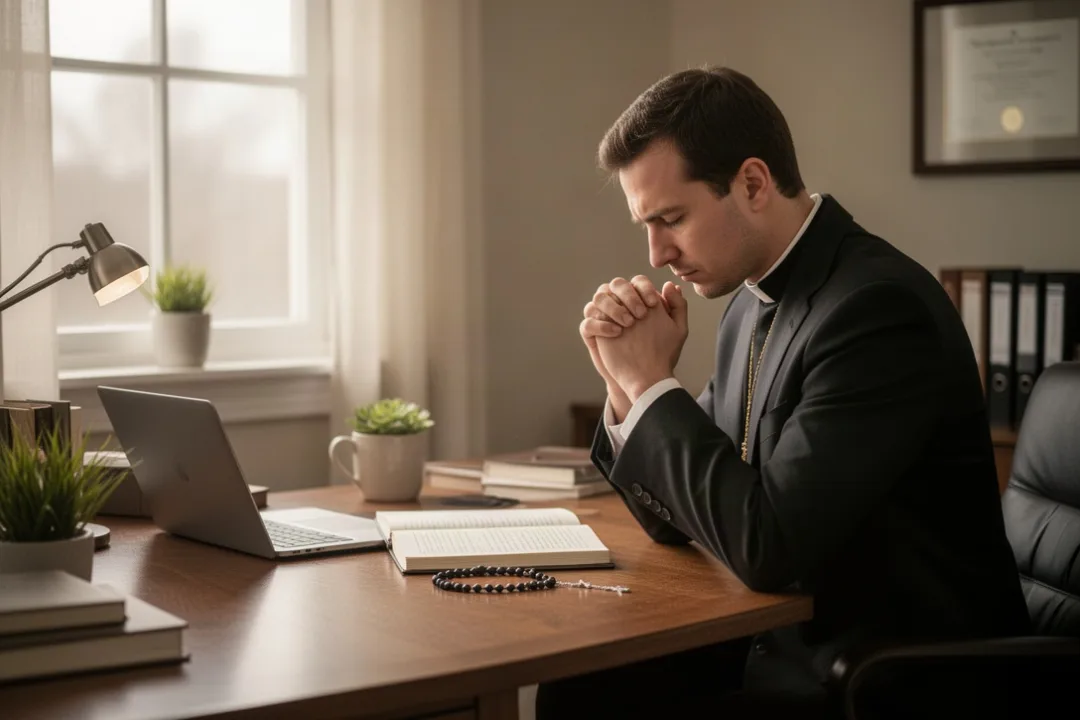
Ordinary life, in Escriva’s understanding, cannot be separated from a life of prayer. Daily responsibilities may provide the setting for holiness, but prayer keeps a person from reducing faith to productivity or good intentions. He encouraged Catholics to develop regular habits such as mental prayer, participation in Mass, confession, spiritual reading, and examination of conscience.
Mental prayer means spending time speaking with God and listening inwardly rather than simply reciting words. It may include reflection on the life of Jesus, gratitude, repentance, petition, or quiet attention. Escriva frequently encouraged people to bring their real circumstances into prayer instead of pretending that spiritual life takes place apart from work, family tension, fatigue, or personal weakness.
The Mass occupied an important place in his spirituality. He taught that participation in the Eucharist should shape the entire day, not remain an isolated religious obligation. Prayer before and after Mass, thanksgiving, and practical charity can help connect worship with daily conduct.
He also promoted frequent confession as a means of conversion and spiritual direction. In Catholic practice, confession involves acknowledging sins to a priest, receiving absolution, and making a sincere effort to change. Escriva presented it as a meeting with God’s mercy rather than merely a legal procedure. The practice, however, should never be used to manipulate or humiliate someone; healthy spiritual guidance respects freedom and conscience.
His practical advice often involved creating a stable rhythm rather than relying on emotion. A person might set aside a regular time for prayer, attend Mass according to Catholic obligations and personal circumstances, read a short passage from the Gospels, and review the day before sleep. Consistency matters because spiritual maturity usually develops gradually.
Begin the day intentionally: offer your plans to God and identify the responsibilities that require patience or courage.
Work attentively: avoid deliberate carelessness, dishonesty, and unnecessary distraction.
Practice brief prayer: use short moments during travel, waiting, or transitions to turn your attention toward God.
Examine the day: recognize gratitude, acknowledge failures, and decide on one concrete improvement.
Stay connected to other people: spiritual discipline should produce greater charity, not isolation or self-absorption.
These habits are not meant to turn every minute into a religious exercise or create anxiety about performing perfectly. Escriva’s approach assumes that people will fail and begin again. The purpose of discipline is to support freedom and love, not to create a private scorecard of spiritual achievements.
Opus Dei is a Catholic institution founded by Escriva to promote the universal call to holiness, especially among laypeople. Its members generally remain in their own professions and communities rather than living in monasteries or convents. They receive formation in Catholic teaching and spiritual practices while pursuing their responsibilities in the world.
Most members are lay Catholics. Some live celibacy as part of their commitment, while others are married or single and organize their lives around family and professional duties. Opus Dei also includes priests of the Priestly Society of the Holy Cross, which is associated with the organization’s spiritual mission but is open to diocesan priests.
Escriva established the Priestly Society of the Holy Cross in 1943. Later, Opus Dei received different forms of canonical recognition as its membership spread internationally. In 1982, Pope John Paul II established it as a personal prelature, a structure in Church law intended to support particular pastoral work across diocesan boundaries. The prelature is not a diocese and does not replace a local bishop’s authority over ordinary parish life.
Opus Dei operates centers, student residences, schools, and educational projects in various countries. The exact activities differ by place, and many initiatives associated with members are not formally owned or governed by Opus Dei. This distinction matters when evaluating claims about the organization.
People who appreciate Opus Dei often point to its clear spiritual formation, strong emphasis on lay responsibility, and practical encouragement to integrate faith with professional life. They may find Escriva’s writings direct and useful for building habits of prayer and service.
Critics have raised questions about organizational transparency, recruitment methods, internal authority, and the experiences of former members. Some former members and observers describe aspects of formation or community life as overly demanding. Opus Dei has rejected some allegations and has made changes over time, including greater attention to safeguarding, communication, and institutional accountability.
A balanced distinction helps: Saint Josemaria Escriva’s personal spirituality, the formal structure of Opus Dei, and the experiences of individual members are related but not identical. Claims about one should not automatically be treated as proof about all three.
Why Saint Josemaria Escriva remains influential and debated
Escriva’s influence rests partly on the accessibility of his central idea. Many Christians struggle with the feeling that religious commitment belongs mainly to priests, nuns, missionaries, or people with unusual gifts. His teaching insists that a person can seek holiness while working in an office, raising children, studying at college, managing a household, or serving in public life.
His books have been translated into many languages and are widely read by Catholics. The Way, a collection of short reflections first published in 1934, is his best-known work. Christ Is Passing By contains homilies and reflections on the Christian life, while Friends of God focuses on holiness in ordinary circumstances. The books are written in a direct, sometimes demanding style, and readers may respond differently to their aphorisms and spiritual challenges.
He also had a strong view of personal freedom. Escriva taught that Christians should make responsible decisions in matters where the Church does not impose a specific choice. Professional work, political preferences, and many practical arrangements belong to the proper judgment of laypeople, provided they respect moral principles. This emphasis was significant for a Church increasingly focused on the role of lay Catholics in public and social life.
At the same time, his legacy cannot be separated from the questions surrounding Opus Dei. Public discussions have sometimes portrayed the organization in highly simplified terms, either as a powerful secret network or as an entirely misunderstood spiritual community. Both portrayals can obscure the more complex reality of a worldwide Catholic institution containing varied people, practices, and local experiences.
The canonization process also generated debate. Supporters viewed it as confirmation of Escriva’s sanctity and pastoral importance. Critics questioned the speed and presentation of aspects of the process, as well as the influence Opus Dei may have had in promoting his cause. The Church proceeded with beatification and canonization after its established investigations and approvals, but canonization does not require every historical question about an organization or founder to disappear.
A thoughtful assessment can hold several points together:
Escriva offered a distinctive and influential account of holiness in ordinary work and family life.
He helped create an international Catholic institution with a significant lay membership.
His writings continue to assist some readers while challenging others because of their demanding tone.
Opus Dei has supporters and critics, and responsible discussion should consider evidence rather than relying on stereotypes.
Respect for a saint’s spiritual legacy does not prevent honest questions about institutions, leadership, or individual experiences.
For someone reading Escriva today, the most useful approach may be to begin with a specific question rather than a general reputation. How should you handle repetitive work? How can prayer fit into a crowded schedule? What does forgiveness require in family life? How can professional ambition remain consistent with justice and service? His writings are most relevant when they are tested against concrete choices.
How to explore Saint Josemaria Escriva’s message responsibly
If you want to learn more, start with a reliable biography or an official Catholic resource, then read one of Escriva’s works in small sections. His short reflections can sound absolute when taken out of context, so it helps to consider the surrounding chapter and the broader Catholic teaching he assumes.
You can also compare descriptions from different perspectives. Opus Dei’s own publications explain its mission and structure, while independent historians, journalists, former members, and Catholic scholars may raise questions that official sources do not emphasize. Looking at more than one type of source makes it easier to separate documented facts, interpretation, testimony, and rumor.
When applying his spirituality, choose practices that lead to greater love and responsibility rather than scrupulosity. A useful test is practical: Does the habit help you become more truthful, patient, generous, and attentive to other people? If a practice produces fear, secrecy, contempt, or pressure to ignore legitimate boundaries, it deserves careful reconsideration and perhaps discussion with a trusted priest or qualified counselor.
For Catholics, a parish priest or spiritual director can help place Escriva’s ideas within the wider life of the Church. For readers from other Christian traditions or from no religious background, his work can still be examined as a distinctive account of vocation, discipline, character, and the meaning of everyday work.
Saint Josemaria Escriva’s enduring contribution is not the claim that every ordinary task is automatically sacred. It is the more demanding suggestion that love, integrity, and prayer can transform the way a person performs ordinary tasks. His life and legacy remain best understood by holding that spiritual vision alongside the real history of Opus Dei and the questions raised about it.
Frequently asked questions
What is Saint Josemaria Escriva best known for?
He is best known for founding Opus Dei and teaching that all Christians are called to holiness, including through ordinary work, family responsibilities, friendship, and civic life. His spirituality emphasizes prayer, professional excellence, personal freedom, and service. He also wrote several influential books, including The Way, Christ Is Passing By, and Friends of God.
When is Saint Josemaria Escriva’s feast day?
Saint Josemaria Escriva’s liturgical memorial is celebrated on June 26, the anniversary of his death in 1975. He was beatified by Pope John Paul II in 1992 and canonized by the same pope on October 6, 2002. Catholics who observe his feast may attend Mass, pray through his intercession, or reflect on his teaching about holiness in daily life.
Is Opus Dei the same thing as the Catholic Church?
No. Opus Dei is a Catholic institution within the Church, not a separate church or denomination. It includes laypeople and priests who seek to promote holiness through ordinary circumstances. Since 1982, it has had the canonical status of a personal prelature. Its members remain connected to local dioceses and parishes, while the prelature provides its particular pastoral formation.
Did Saint Josemaria Escriva write about ordinary work?
Yes. Ordinary work is one of the central themes of his spirituality. He taught that professional duties, domestic responsibilities, study, and service can become occasions for developing virtues and serving others. He did not mean that every job or workplace practice is automatically good. Rather, he stressed that honest work carried out with competence, justice, and love can become part of a person’s Christian vocation.










Leave a Reply