If you are checking the church calendar before making plans, the short answer is no: Ash Wednesday is not a day of holy obligation for Catholics in the United States. Catholics are not required to attend Mass under the Church’s Sunday and holy day obligation simply because ashes are distributed.
That does not make Ash Wednesday unimportant. It marks the beginning of Lent, the 40-day season of prayer, fasting, and almsgiving that prepares Christians for Easter. The Church strongly encourages Catholics to attend Mass or another service, receive ashes, and use the day to begin a more deliberate return to God.
Short answer: You do not commit a sin merely by missing Ash Wednesday Mass, but Catholics in the United States are generally expected to observe the day’s rules on fasting and abstinence if they are within the required age range and able to do so.
A holy day of obligation is a day when Catholics are required to participate in Mass, in addition to every Sunday. The obligation comes from Church law and applies to particular solemnities designated by the Church. Ash Wednesday is not included in that list, even though it is one of the most widely observed days on the Catholic calendar.
The day’s importance comes from its role as the opening of Lent, not from a requirement to attend Mass. Ash Wednesday is a day of penitence and conversion. Its central practices point toward a change of heart: Christians acknowledge their need for God, accept a season of self-denial, and prepare to celebrate Christ’s death and resurrection.
Many Catholics attend because the liturgy provides a meaningful beginning to Lent. The distribution of ashes is a visible reminder of human mortality and the need to repent. But the ashes themselves do not create a Mass obligation, and a person does not need ashes in order to observe Lent faithfully.
What Catholics are required to do on Ash Wednesday
For Catholics who are bound by the Church’s discipline and able to follow it, Ash Wednesday is a day of fasting and abstinence. These are separate practices. Fasting concerns the amount of food you eat, while abstinence concerns the kind of meat you avoid.
Fasting: You generally eat one full meal and may have two smaller meals that together do not equal another full meal.
Abstinence: You refrain from meat on Ash Wednesday.
Age requirements: In the United States, the obligation to abstain from meat generally begins at age 14, while the obligation to fast applies to adults from age 18 through the beginning of their 60th year.
Health and circumstances: People whose health, work, pregnancy, medical needs, or other serious circumstances make fasting unsafe or unreasonable are not expected to harm themselves.
These rules are intended as a form of penance, not as a test of endurance. The purpose is to create space for prayer and to remind you that spiritual life cannot be reduced to comfort, consumption, or routine. Someone who must modify the fast can still observe Ash Wednesday seriously through prayer, generosity, or another appropriate sacrifice.
Abstinence from meat usually means avoiding the flesh of land animals such as beef, pork, and chicken. Fish, shellfish, eggs, and animal products such as milk are generally permitted under the Catholic practice of abstinence, although local customs may shape what people eat. A simple meatless meal is enough; expensive seafood is not required.
Who is excused from Ash Wednesday fasting and abstinence
The Church does not expect people to follow a fast that would endanger their health. Children who have not reached the required age, older adults outside the fasting age range, and people with medical conditions are not bound in the same way as healthy adults within the stated ages.
People with diabetes, eating disorders, chronic illness, demanding physical jobs, or other health concerns should use prudent judgment and seek medical advice when necessary. Pregnant or nursing women may need additional nutrition and should not treat the fasting rule as a reason to neglect their health or the health of their child.
Those who are unsure about a serious situation can ask a priest or parish pastoral minister for guidance. A dispensation or substitution may sometimes be appropriate. The point of Catholic fasting is obedience directed toward love of God and neighbor, not rigid behavior that causes harm.
People who are traveling or living outside the United States may encounter local rules or customs that differ in practical details. The basic observance of Ash Wednesday remains widely recognized, but the discipline of fasting and abstinence can be regulated by the local bishops. When in doubt, follow the guidance of the diocese where you are observing the day.
Why Catholics receive ashes if Mass is not required
Ashes are a sacramental, not one of the seven sacraments. They are a religious sign used by the Church to express repentance, mortality, and a desire to live differently during Lent. Receiving them can be spiritually helpful, but ashes do not forgive sins and are not necessary for a person to be reconciled with God.
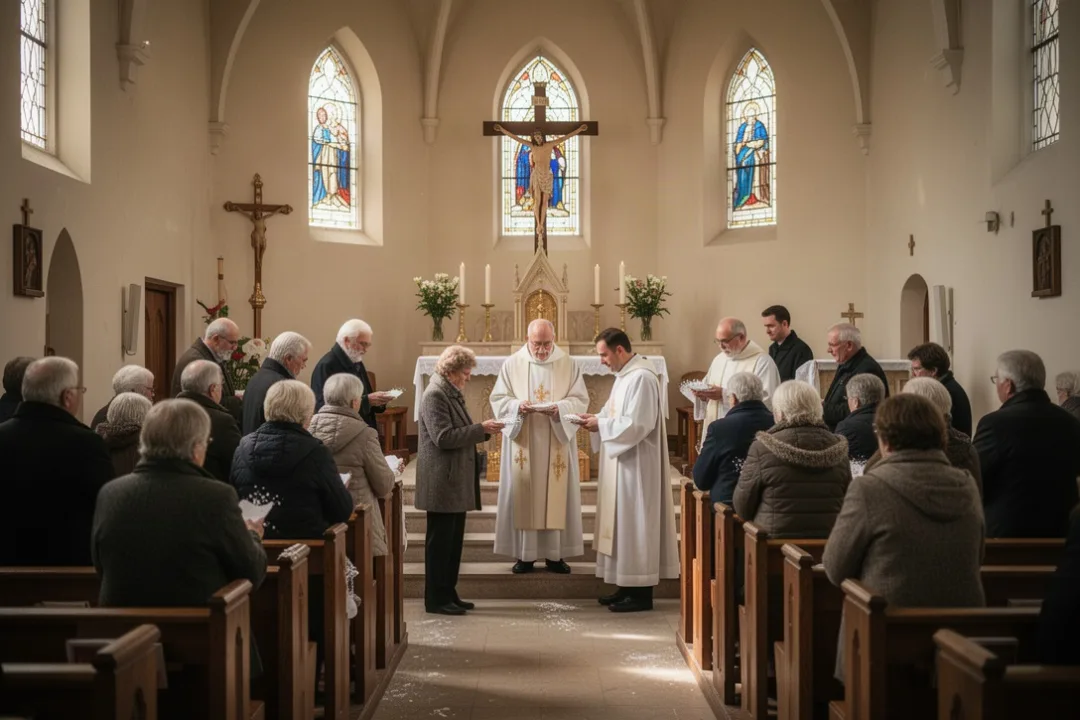
The minister may place ashes on your forehead or sprinkle them on your head, depending on local practice. The words spoken during the rite direct attention to repentance and human mortality. They are meant to remain with you beyond the church service as a reminder that Lent calls for an interior change, not only an outward mark.
You do not have to be Catholic to attend an Ash Wednesday service in many parishes, and visitors may choose whether to receive ashes. A person who is not prepared to receive Communion may still attend the liturgy and receive ashes, since the two practices have different meanings.
If you cannot attend a scheduled service, you can still begin Lent through prayer, Scripture, charitable giving, or a deliberate act of repentance. Some parishes distribute ashes outside Mass, but the ashes should be received in a reverent setting rather than treated as a requirement that must be obtained at any cost.
How Ash Wednesday differs from Sundays and holy days
Sunday Mass attendance is a separate obligation for Catholics who are bound by Church law. The fact that Ash Wednesday begins Lent does not replace or add to the Sunday obligation. If Ash Wednesday falls near a weekend, attending an Ash Wednesday service does not fulfill Sunday Mass attendance, and Sunday Mass does not fulfill the observance of Ash Wednesday.
Holy days of obligation are also distinct from days of fasting and abstinence. A day can carry one discipline without carrying the other. Ash Wednesday requires fasting and abstinence for those who are bound by those rules, but it does not require attendance at Mass. Conversely, a holy day of obligation requires participation in Mass but is not automatically a day of fasting.
For example, a Catholic may attend Ash Wednesday Mass because the liturgy helps mark Lent, then attend Sunday Mass because Sunday has its own obligation. Missing Ash Wednesday Mass is not the same as missing Sunday Mass. It may be a missed opportunity for worship, but it is not a violation of the holy day obligation.
What to do if you cannot attend an Ash Wednesday service
Work schedules, illness, transportation problems, caregiving, travel, and family responsibilities can make attendance difficult. Since Ash Wednesday Mass is not obligatory, you do not need to create a crisis to attend or feel that your Lent has failed if you cannot receive ashes.
You can observe the day at home or wherever you are by setting aside a quiet period for prayer. Read the day’s Scripture readings, examine your habits, and ask what kind of conversion Lent might require. A short, sincere prayer can be more spiritually fruitful than attending only because of social pressure.
Set aside time for personal prayer, even if it is brief.
Choose a realistic Lenten practice involving prayer, self-denial, or service.
Make a donation or provide practical help to someone in need.
Refrain from meat and follow the fasting discipline if you are required and able to do so.
Contact a nearby parish if you want ashes and need a service time that fits your schedule.
Plan to attend Sunday Mass, which remains a separate responsibility.
Do not try to imitate the fasting practices of another person without considering your own circumstances. A student, construction worker, parent of a newborn, and office employee may need different approaches. The discipline should be honest and meaningful while remaining consistent with Church guidance and good health.
Common Ash Wednesday mistakes to avoid
Several misunderstandings can make Ash Wednesday seem more complicated than it is. The most common involve confusing attendance at Mass with the rules about fasting, or treating ashes as if they were a sacrament that must be received for Lent to count.
Assuming Ash Wednesday is a holy day of obligation. It is not, although attendance is strongly encouraged.
Thinking ashes are required for salvation or forgiveness. They are a public sign of repentance, not a sacrament and not a substitute for confession.
Forgetting that fasting and abstinence are different. You may need to limit the quantity of food and avoid meat, depending on your age and circumstances.
Eating an unusually large “small meal.” The two smaller meals are not intended to combine into a second full meal.
Assuming fish means an elaborate feast. Meatless food can be simple, inexpensive, and consistent with the penitential purpose of the day.
Forcing a fast that harms your health. Serious medical and physical needs should be respected, and an alternative penance may be appropriate.
Believing Ash Wednesday fulfills Sunday Mass attendance. The two observances are separate.
Reducing Lent to one food rule. Prayer, charity, repentance, and reconciliation are central parts of the season.
Practical reminder: If you are planning a workday around Ash Wednesday, schedule the church visit if you want the ashes, but plan your meals around the fasting and abstinence rules separately. Missing the service does not remove the penitential discipline, and attending the service does not replace it.
How fasting, abstinence, and almsgiving work together
Ash Wednesday begins Lent with three connected practices: prayer, fasting, and almsgiving. Fasting helps loosen the hold of unnecessary consumption. Prayer turns your attention toward God. Almsgiving directs what you save or sacrifice toward the needs of other people.
These practices are not meant to operate as unrelated religious tasks. If you give up an expensive daily purchase, for example, the money can be donated rather than simply kept. If you spend less time on entertainment, that time can be used for prayer, visiting someone who is lonely, or serving your family with greater patience.
The fasting requirement on Ash Wednesday is the minimum discipline set by the Church for those who are bound by it. Many people also choose a personal Lenten practice, but a private resolution should be realistic. A practice that lasts for several weeks and produces greater charity is usually more useful than a severe promise abandoned after a few days.
Fasting also should not become a way to judge other people. You may not know another person’s medical condition, age, work demands, or spiritual circumstances. The discipline is intended to form your own heart, not to provide a standard for criticizing someone else’s plate.
What Ash Wednesday points toward during Lent
The ashes look back to the biblical image of repentance expressed through dust and ashes, while also pointing toward the death and resurrection of Jesus. Catholics begin Lent by acknowledging that human life is limited and that conversion cannot be postponed indefinitely.
The season then continues through prayer, fasting, and acts of mercy toward Holy Week and Easter. Ash Wednesday is not an isolated observance. It begins a period in which Christians are invited to confront sin honestly, repair relationships, seek forgiveness, and grow in love.
For Catholics who have been away from the Church, the day can provide a gentle opportunity to return. For regular churchgoers, it can prevent Lent from becoming routine. The absence of a Mass obligation does not reduce the day’s spiritual invitation: you are still being asked to begin again with sincerity.
If you attend Mass, receive ashes respectfully and listen to the prayers as a call to conversion. If you do not attend, mark the day in a way that reflects its meaning. In either case, the most significant question is not whether ashes remain visible on your forehead, but whether the season leads you toward deeper faith, repentance, and charity.
How to decide what Ash Wednesday means for your schedule
Start by separating the three questions people often combine: Must I attend Mass? No, not because Ash Wednesday is a holy day of obligation. Should I observe fasting and abstinence? Generally yes, if you are within the required age range and able to do so. Can I receive ashes? Yes, if you attend a suitable service and wish to receive them, but they are not required.
Then consider your circumstances. Check your parish schedule if you want to attend, make a simple plan for meals, and choose one additional practice that expresses the purpose of Lent. If illness, work, caregiving, or another serious responsibility prevents one part of the observance, focus on what you can do faithfully rather than treating the day as all or nothing.
Ash Wednesday is therefore best understood as a major penitential day, not a holy day of obligation. Catholics are encouraged to participate in its worship and to begin Lent deliberately, while the formal requirement to attend Mass remains different from the obligation to fast and abstain.
Frequently asked questions
Is it a sin to miss Mass on Ash Wednesday?
No. Because Ash Wednesday is not a holy day of obligation, missing Mass that day is not automatically sinful in the way deliberately missing Sunday Mass or a designated holy day can be. You may still choose to observe Ash Wednesday through prayer, fasting, abstinence, charitable action, or another meaningful Lenten practice.
Do I have to receive ashes to be Catholic?
No. Receiving ashes is a traditional sacramental practice, not a requirement for being Catholic and not a sacrament. Ashes symbolize repentance and mortality, but they do not forgive sins. If you cannot attend a service or choose not to receive ashes, you can still observe Lent faithfully.
Can I eat meat if I am not Catholic?
The Catholic rules for Ash Wednesday fasting and abstinence apply to Catholics who are bound by them, not to everyone who happens to attend a service. Non-Catholics may voluntarily abstain from meat as a spiritual practice, but they are not required to follow Catholic penitential law simply because they visit a Catholic church.
Does attending Ash Wednesday Mass fulfill my Sunday obligation?
No. Ash Wednesday and Sunday have separate observances. Ash Wednesday is a penitential day that includes fasting and abstinence for those who are bound by those rules, but it is not a holy day of obligation. Attending an Ash Wednesday service does not replace the need to participate in Sunday Mass.













Leave a Reply