The Book of Job is a biblical wisdom book about a righteous man who suffers extreme loss and struggles to understand why. Its central question is not simply, “Why do bad things happen?” but whether a person can remain faithful when obedience brings no visible reward.
Job loses his wealth, children, health, and social standing, yet the book resists giving a simple explanation for his pain. Through poetry, debate, and divine speeches, it challenges the belief that suffering always proves personal guilt. The book ultimately points toward humility before God, honest lament, and a faith that is deeper than a bargain for blessing.
The book begins with a scene in heaven and then follows Job’s suffering on earth. Job is introduced as a man of exceptional integrity who reveres God and avoids evil. He has a large household, substantial possessions, and a respected place in his community.
In the opening chapters, a heavenly accuser questions whether Job’s devotion is genuine. The accusation is that Job honors God only because his life is prosperous. God permits Job to be tested, within limits, and a series of disasters destroys his property, servants, and children. Job responds with grief, but he does not curse God.
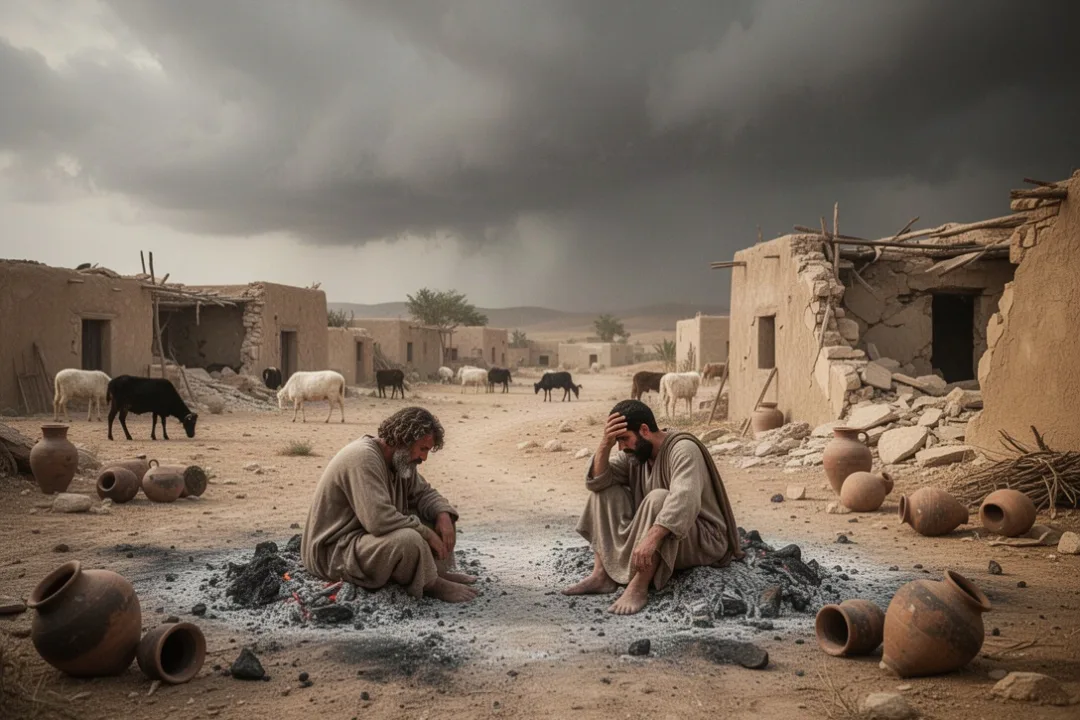
A second trial brings painful illness. Job sits in ashes and scratches his sores, while his wife urges him to abandon his faith. Job refuses to treat God as a source of blessings only, although his later words reveal deep anguish and confusion. The opening prose establishes the problem that drives the rest of the book: Job suffers without any known wrongdoing.
Three friends—Eliphaz, Bildad, and Zophar—come to comfort him. At first, their silence is compassionate. They sit with Job for seven days without speaking because his distress is so great. Their approach changes when Job begins to lament, and they start insisting that suffering must be connected to sin.
The central portion consists mainly of poetic speeches. Job protests his innocence and asks for an opportunity to present his case before God. His friends defend a traditional view of moral order: God is just, the wicked are punished, and therefore Job must have done something to deserve his condition.
After the friends finish, a younger speaker named Elihu offers additional speeches. He criticizes both Job and the older friends, suggesting that suffering may serve as warning, discipline, or instruction rather than functioning only as punishment. Then God speaks from a storm, and the book moves toward its resolution.
God does not reveal the heavenly conversation that readers saw at the beginning. Instead, God questions Job about the creation and governance of the world. Job recognizes the limits of his understanding, and the final prose section describes restoration, including renewed prosperity and a new family life. The ending does not erase the earlier grief, but it shows that Job’s friends were wrong to claim that his suffering proved hidden wickedness.
Read the structure carefully: the opening and closing prose frames give information that Job himself never receives. That difference helps explain why the book is less interested in supplying a neat cause for suffering than in examining how people respond to mystery.
How the Book of Job is organized
The Book of Job combines several literary forms. The beginning and ending are written as narrative prose, while most of the middle uses elevated Hebrew poetry. The shift in style signals a shift from events and description to argument, prayer, lament, and reflection.
The major movements can be read in this order:
Job 1–2: Job’s character is presented, and a series of disasters tests his integrity.
Job 3: Job breaks his silence and curses the day of his birth, not God himself.
Job 4–31: Job debates Eliphaz, Bildad, and Zophar through repeated cycles of accusation and response.
Job 32–37: Elihu speaks about suffering, divine correction, and God’s greatness.
Job 38–41: God answers Job with questions about creation, animals, and the ordering of the world.
Job 42: Job responds to God, the friends are corrected, and Job’s fortunes are restored.
Job 3 is especially significant because it shows the emotional cost of his suffering. He wishes he had never been born and asks why life is given to people in misery. These words are not presented as a polished theological argument. They are the speech of a grieving person who can no longer maintain a calm religious posture.
The debate sections use repetition and escalation. Job’s friends return to similar claims, while Job becomes more direct in demanding an audience with God. The speeches sometimes sound contradictory because the speakers are arguing from different experiences: the friends trust a familiar system of retribution, while Job’s life has disproved that system in his own case.
The final chapters also require careful reading. God’s speeches are not a direct answer to the question of what caused Job’s suffering. They widen the frame, drawing attention to animals, weather, wilderness, and forces beyond human control. The reader is shown a universe more complex than human calculations of guilt and reward.
Why Job suffers and what the book says about justice
The most direct answer to the book’s central mystery appears in the opening chapters: Job’s suffering is connected to a heavenly test, not to a specific sin that he committed. Yet that explanation belongs to the reader, not to Job. Throughout the poetic debate, Job does not know why disaster has overtaken him.
This distinction matters because Job’s friends repeatedly accuse him of wrongdoing. Eliphaz implies that people reap what they sow. Bildad argues that God’s justice cannot be perverted. Zophar goes further, suggesting that Job deserves even more punishment than he has received. Their statements express a common belief that the world operates according to a visible moral equation.
The friends are not wrong to say that God is just. Their error is turning a general theological principle into a complete explanation for one person’s suffering. They assume that because God judges evil, every sufferer must have committed a serious offense. The book rejects that conclusion.
Job does not claim to be morally flawless in every possible sense. He insists that he has not committed the hidden evil his friends imagine, and he refuses to confess to crimes he did not commit simply to make their theology work. His protest is a demand for truthful speech before God.
That honesty makes Job’s prayers unusually powerful. He complains, questions, pleads, and sometimes speaks with startling boldness. He asks why God appears to treat him as an enemy and requests a hearing before the divine judge. These words are uncomfortable, but the book preserves them as part of faithful engagement rather than dismissing them as unacceptable unbelief.
The contrast between Job and his friends becomes explicit at the end. God says that the friends have not spoken rightly about God as Job has. This does not mean every statement Job makes is a complete or systematic description of divine reality. It means Job’s direct struggle is more honest than the friends’ confident accusations.
The book therefore challenges retributive theology when it is used as a universal formula. Retributive theology, in this context, is the belief that righteous people prosper and wicked people suffer in ways that can be clearly identified. Job shows that life often cannot be interpreted through such a simple pattern.
This does not make justice irrelevant. It means that divine justice is not always visible in a person’s immediate circumstances. The wicked may prosper for a time, and the innocent may suffer terribly. Job 21 gives particular attention to this problem as Job observes that some wrongdoers appear secure and successful.
The book also refuses to treat a suffering person as a theological puzzle. Job needs companionship and truth, but his friends make his pain worse by insisting that he explain himself. Their behavior offers a practical warning: do not accuse people in crisis merely because their suffering makes you uncomfortable or challenges your assumptions.
What Job’s friends, wife, and Elihu contribute
The supporting characters show several ways people respond to suffering. Job’s wife appears briefly, but her words reveal the intensity of the household’s collapse. She sees the loss, illness, and humiliation firsthand. The book does not develop her perspective at length, so readers should be cautious about reducing her to a simple villain. Her response comes from overwhelming grief and despair.
Eliphaz, Bildad, and Zophar represent different versions of conventional wisdom. They believe that God governs the world morally, which is a sound starting point. They go wrong when they defend that belief by attacking Job’s character.
Eliphaz often appeals to personal experience and visions, presenting suffering as correction or evidence of human weakness.
Bildad emphasizes the permanence of divine justice and argues that the fate of Job’s children proves the family’s guilt, making his counsel particularly harsh.
Zophar speaks with the greatest bluntness, claiming that Job deserves more correction than he has received.
All three friends share an unwillingness to accept mystery. They would rather preserve their explanation than admit that Job’s circumstances do not fit it. Their speeches are a portrait of religious certainty without compassion.
Elihu enters after the main cycles of debate. Because his speeches appear later and use language that overlaps with other parts of the book, readers and scholars have discussed his role in the composition. Within the finished book, however, Elihu serves as another voice attempting to explain suffering without simply repeating the friends’ accusations.
Elihu argues that God may use suffering to warn, teach, or turn a person away from danger. He also emphasizes that human beings cannot place God on trial as if God were an equal defendant. Some of these themes prepare the way for God’s speeches, especially the emphasis on human limitation.
Even so, Elihu does not solve Job’s problem. He offers a possible purpose for suffering, but Job still lacks a personal explanation. The book allows readers to hear multiple interpretations without treating every speech as equally reliable. A character’s words must be judged within the dialogue and against the book’s final evaluation.
The friends’ presence also raises questions about good pastoral care. Their initial silence is arguably their best response. Once they begin explaining Job’s pain, they stop accompanying him and start defending a system. The narrative suggests that presence can be wiser than speculation when someone is suffering.
What God’s speeches mean in Job 38–41
When God answers Job, the response begins with a challenge about knowledge. God asks whether Job was present when the earth was founded and whether he can explain the origins of light, weather, stars, and the sea. These are not ordinary requests for information; they expose the vast distance between human understanding and the scope of creation.
The speeches then turn to animals and their behavior. Mountain goats, wild donkeys, wild oxen, ostriches, horses, hawks, and eagles appear as examples of life that cannot be reduced to human usefulness. Some are powerful, strange, dangerous, or apparently independent of human purposes.
God’s point is not that Job is worthless or that questions about suffering do not matter. Rather, Job’s knowledge is partial. He has judged the moral order from one painful location within creation, while God’s perspective encompasses the whole world and its interconnections.
Chapters 40 and 41 describe Behemoth and Leviathan in vivid, poetic language. Interpretations differ: some readers understand them as poetic representations of powerful animals, while others see symbols of untamable chaos. The passage emphasizes forces that human beings cannot control and that God alone can master.
God never says, “You suffered because of this specific sin,” because that accusation would contradict the book’s opening. Nor does God explain the heavenly test. Instead, the divine response directs Job away from the assumption that a limited human perspective can account for every event.
For that reason, the speeches should not be used to silence people who ask difficult questions. “God is powerful, so do not ask why” is a much narrower response than the book itself. Job has already asked why at length, and God engages him rather than rejecting him for speaking.
Job’s response in chapter 42 is often translated with language about repentance, but the exact nuance is debated. He acknowledges that he spoke about matters beyond his understanding and responds with humility before God. He does not confess to the hidden sins alleged by his friends.
God’s answer is not a cause-and-effect explanation: the book’s resolution centers on encounter, perspective, and restored relationship rather than revealing a secret moral reason for Job’s losses.
Major themes for reading the Book of Job today
Faith beyond a transaction
The opening challenge assumes that Job worships God only because worship is profitable. If blessings disappear, the accuser argues, Job’s devotion will disappear too. The book tests whether faith can remain meaningful when it is separated from guaranteed success.
This does not require pretending that suffering is good. Job mourns real losses and wants his life restored. The point is that faith is not a contract promising immunity from grief. A person may trust God while also feeling abandoned, angry, or confused.
Lament as honest prayer
Job’s lament includes grief, protest, accusation, and longing for justice. The book gives him room to speak in language that polite religious conversation often avoids. His example suggests that prayer can include the full truth of a person’s experience rather than only calm or reassuring words.
Lament is not identical to despair, although the two may overlap. Lament addresses God and keeps the relationship open, even when the speaker feels unable to understand or accept what has happened. Job’s repeated demand for an answer shows that silence and distance matter to him precisely because he still seeks God.
The danger of blaming victims
Job’s friends turn uncertainty into accusation. Their logic may sound orderly, but it causes harm because it places the burden of explanation on the person already suffering. The book firmly undercuts their approach when God rejects their claims.
This theme applies to illness, poverty, bereavement, disaster, and other forms of hardship. A person’s suffering is not proof of personal moral failure. Careful support begins with listening, practical help, and respect for the limits of what anyone can know.
Job wants to judge the world from the evidence available to him. The divine speeches show that the world contains dimensions he cannot see. This does not make moral reasoning pointless, but it does call for humility about conclusions.
Human limits are not an excuse for ignoring injustice. Job himself protests injustice, and the book honors that protest. Humility means recognizing that no person has complete knowledge, especially when interpreting another person’s pain.
Restoration without erasure
The final chapter describes Job receiving renewed prosperity and becoming the father of another family. Some readers find this ending comforting; others find it difficult because new blessings cannot replace the children who died. Both reactions can be taken seriously.
The restoration does not make the earlier suffering unimportant or prove that every tragedy will be reversed in this life. It belongs to the book’s narrative resolution, while the emotional wound remains part of the story. The ending also gives Job renewed social standing and confirms that his friends’ accusations were unjust.
How to read the Book of Job responsibly
Read the book as a conversation rather than a collection of isolated sayings. Not every statement by Job’s friends expresses the book’s final teaching, and not every line spoken by Job is meant to function as a universal doctrine. Context, speaker, genre, and the final narrative judgment all matter.
It can help to read the prose frame first, then move slowly through the poetic debates. Poetry often uses exaggeration, imagery, repetition, and emotional intensity. A line spoken during Job’s anguish should not be treated as though it were a detached definition of God or human nature.
Keep these reading practices in mind:
Separate what the reader knows from what Job knows. The opening heavenly scene gives the audience information that remains hidden from Job.
Distinguish lament from theological conclusion. Job’s cries express real distress, but they are not always settled claims about how reality works.
Compare the speeches with the ending. God’s judgment on the friends shows that their confident explanations are not trustworthy.
Notice the literary movement. The book moves from prosperity to loss, from argument to divine encounter, and from isolation toward restored relationship.
Allow unresolved questions to remain. The book does not promise that every instance of suffering can be explained from a human point of view.
Readers can also approach Job alongside other biblical wisdom books. Proverbs often emphasizes the connection between wise living and flourishing. Ecclesiastes questions whether effort and righteousness reliably produce visible rewards. Job presses the same tension through personal catastrophe, showing that the world cannot always be interpreted by immediate outcomes.
For someone who is grieving, the Book of Job may be best read in small portions. Its speeches are intense, and its restoration should not be used to pressure a suffering person into quick acceptance. The book gives permission to mourn, question, and seek honest companionship while refusing simplistic answers.
The enduring force of the Book of Job lies in its refusal to choose between reverence and truthfulness. It does not require Job to deny his pain, and it does not endorse his friends’ attempts to explain it away. Instead, it presents a person who brings his questions to God, discovers the limits of his own perspective, and remains within a relationship transformed by honest encounter.
Frequently asked questions
Is Job a historical person or a fictional character?
The book does not provide enough information to establish Job’s historical identity. It presents him as a figure from the land of Uz and uses a carefully shaped combination of narrative and poetry. Some readers understand the story as historical, while others read it as wisdom literature built around a representative sufferer. The text’s central purpose is theological and literary rather than biographical.
Did Job lose his children twice?
The opening narrative says that Job’s first children die in the disasters that strike his household. At the end, he has another family, including sons and daughters. The new children do not replace the ones who died, which is why many readers find the restoration both hopeful and emotionally complicated. The ending restores Job’s future without pretending that earlier losses never occurred.
What is the main message of Job?
Job teaches that suffering cannot always be explained as punishment for personal sin. It also presents lament as an honest form of faith and warns against blaming people for their pain. God’s speeches emphasize the limits of human knowledge, while the ending confirms that Job’s friends were wrong to accuse him. The book offers humility and truthful relationship rather than a simple explanation.
Why does God allow Job to be tested?
The opening chapters frame Job’s suffering as a test of whether devotion depends entirely on prosperity. The story does not present this as a general formula explaining every tragedy, nor does Job ever learn the heavenly reason. Its purpose is to challenge the assumption that people worship God only for rewards and to expose the limits of human attempts to explain suffering.

















Leave a Reply