Aquila and Priscilla: Their story and example in the Bible
Aquila and Priscilla: Their story and example in the Bible
Aquila and Priscilla were a married Jewish couple who became important coworkers of the apostle Paul. They worked as tentmakers, helped teach the gifted preacher Apollos, welcomed Christians into their home, and supported the early church in several cities. Their story appears mainly in Acts 18, Romans 16, 1 Corinthians 16, and 2 Timothy 4.
The Bible presents them as a united team whose ministry included hospitality, practical work, personal instruction, and courage under pressure. Priscilla is also called Prisca, the shorter and more formal form of her name, so references to Prisca and Priscilla describe the same woman.
Who Aquila and Priscilla were in the New Testament
Aquila and Priscilla were Jewish believers who had lived in Rome before arriving in Corinth. Acts 18:2 explains that Aquila had come from Pontus, a region along the southern coast of the Black Sea, and that the couple had recently left Italy because the Roman emperor Claudius ordered Jews to leave Rome. The passage does not give the exact circumstances of their departure or describe their conversion in detail.
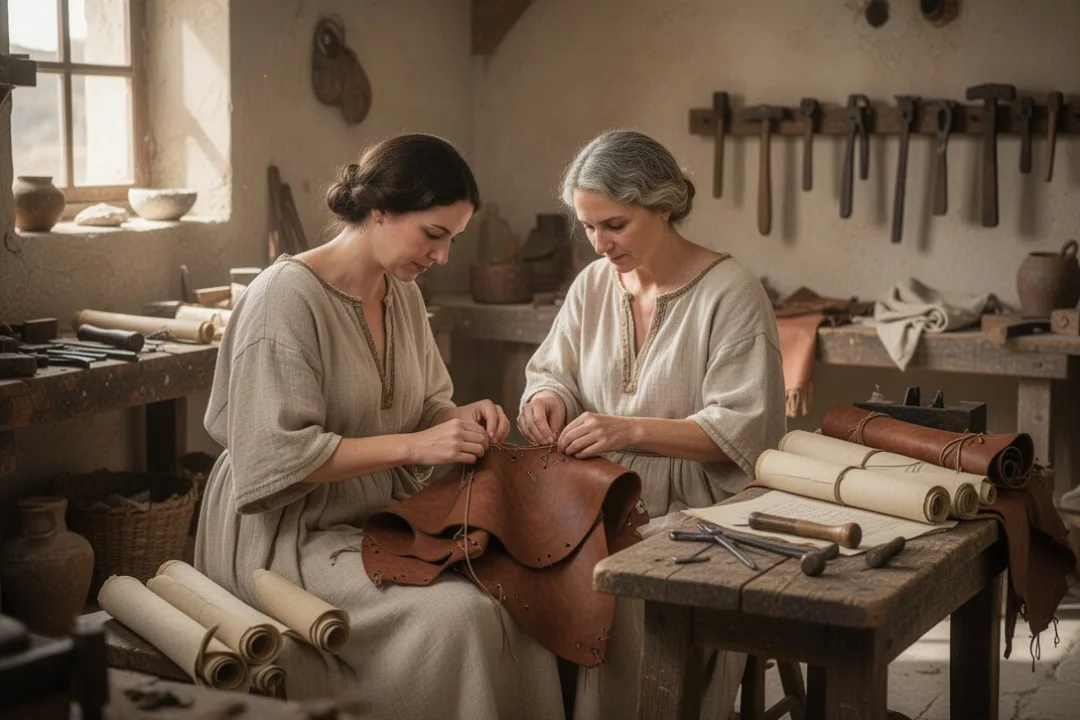
When Paul arrived in Corinth, he met the couple and stayed and worked with them because they shared the same trade. Acts identifies that trade as tentmaking. The term may have included making or repairing tents and other products from leather or woven material. Their work gave them a practical way to support themselves while participating in Christian ministry.
The couple’s names are often written “Aquila and Priscilla,” but the biblical text sometimes places Priscilla’s name first. This happens in Acts 18:18 and 18:26, Romans 16:3, and 2 Timothy 4:19, while Aquila appears first in other passages. The order does not prove a particular role or rank, but it does show that the New Testament consistently presents both people as recognizable and active members of the Christian community.
They were not described merely as Paul’s landlords, business contacts, or occasional acquaintances. Paul later called them his coworkers in Christ Jesus in Romans 16:3. He also said they had risked their lives for him, while adding that Gentile churches were grateful to them. That brief description gives their relationship with Paul unusual depth: they shared both ordinary labor and serious danger.
Names to recognize: Priscilla and Prisca are two forms of the same biblical name. “Priscilla” is the familiar form in Acts, while “Prisca” appears in several of Paul’s letters.
How Aquila and Priscilla met Paul in Corinth
After leaving Rome, Aquila and Priscilla settled in Corinth. Paul came there after spending time in Athens, and Acts 18 says he joined the couple because of their shared occupation. This arrangement placed Paul in a household where work, friendship, and Christian service were closely connected.
Corinth was a major commercial city with a busy port and a mixed population. Jews, Greeks, Romans, and people from other parts of the empire lived and worked there. The city’s location made it an effective place for communication and trade, but it also meant that the Christian message encountered many religious traditions and competing ideas.
Paul first reasoned in the synagogue on the Sabbath, seeking to persuade both Jews and Greeks. When opposition developed, he continued ministering among Gentiles. Aquila and Priscilla were present during this period, and their home and working relationship with Paul would have placed them near the center of the developing Christian community.
Acts 18 describes a prolonged stay in Corinth. Paul eventually left the city with Aquila and Priscilla and traveled to Ephesus. At Ephesus, Paul separated from the couple after entering the synagogue and discussing the message with the people there. He promised to return if God permitted, then continued his travels.
The passage does not give a full account of Priscilla and Aquila’s daily work in Corinth or Ephesus. Still, several details are clear:
They opened their lives to Paul by working and staying with him.
They moved between important cities as circumstances and ministry opportunities changed.
They were familiar with synagogue discussion and the Jewish Scriptures.
They remained connected to Paul after he left Corinth and continued serving elsewhere.
Their partnership with Paul also shows that the earliest Christian movement depended on more than public preaching. Travel, housing, food, skilled labor, introductions, correspondence, and protection all mattered. Aquila and Priscilla contributed through several of these forms of service, not through one narrowly defined activity.
The best-known account of Aquila and Priscilla occurs in Acts 18:24-26. A Jewish man named Apollos arrived in Ephesus. He was described as eloquent, knowledgeable about the Scriptures, fervent in spirit, and active in teaching about Jesus. However, his understanding was incomplete: he knew only part of the Christian message associated with John’s baptism.
Apollos spoke boldly in the synagogue. Aquila and Priscilla heard him and took him aside, where they explained the way of God more accurately. The text does not provide the content of their private conversation, so readers should avoid claiming more detail than the passage gives. The central point is that they recognized Apollos’s gifts and helped correct and complete his understanding.
The setting matters. They did not publicly embarrass him or treat his incomplete knowledge as proof that he was useless. Instead, they used a private conversation to offer instruction. Their response combined truth, respect, and discernment.
Apollos went on to serve in Achaia, where he made a strong contribution by publicly demonstrating from the Scriptures that Jesus was the Messiah. Acts does not say that Aquila and Priscilla took credit for his later work. They helped prepare him, then allowed him to continue serving with his own abilities and calling.
Lessons from their conversation with Apollos
Aquila and Priscilla’s interaction with Apollos offers a model for handling a capable person whose knowledge needs refinement. Their approach was neither passive nor combative. They listened first, identified what was missing, and then supplied the needed explanation.
Strong communication skills do not guarantee complete understanding. Apollos was gifted and persuasive, yet he still needed further teaching.
Correction can be personal rather than performative. A private setting protected his dignity and encouraged honest conversation.
Instruction should lead to service. The goal was not simply to win an argument but to help Apollos teach more accurately.
Experienced believers can learn from one another. Aquila and Priscilla were able to teach Apollos, while his gifts strengthened the wider church.
The passage also gives a careful picture of Christian authority. Aquila and Priscilla were not portrayed as replacing Apollos or controlling his future ministry. They supplied sound instruction, and Apollos then continued his public work. Their contribution was significant precisely because it helped someone else become more effective.
Practical principle: When someone is sincere and gifted but missing important information, private, respectful instruction may serve the person and the wider community better than public criticism.
Where the New Testament places them after Corinth
Aquila and Priscilla appear in several locations, which suggests a mobile life shaped by work, relationships, and Christian service. Their movements should not be turned into a complete biography, because the New Testament offers only brief references. Even so, the passages create a consistent picture of a couple whose ministry continued across the Roman world.
Rome: a household connected to the church
In Romans 16:3-5, Paul sends greetings to Prisca and Aquila and calls them his coworkers in Christ Jesus. He also refers to the church in their house. This indicates that their home served as a gathering place for Christians in Rome.
House churches were practical centers for worship, teaching, fellowship, prayer, and shared meals. The reference does not tell us how large their group was, how often it met, or whether the couple owned the home. It does show that their household was closely associated with the local Christian community.
Paul’s greeting also mentions the couple’s willingness to risk themselves for him. The wording indicates serious danger, but the passage does not identify the specific event. It would be inaccurate to attach their courage to a particular arrest, riot, or persecution unless the text makes that connection. What can be said with confidence is that Paul remembered them as people who had acted bravely on his behalf.
Corinth: greetings from a house church
Paul’s first letter to the Corinthians was written to believers in Corinth, where he had previously lived and worked. Near the end of the letter, he sends greetings from the churches of Asia and from Aquila and Prisca, along with the church in their house.
This reference is significant because it places them in a Christian household community connected with the wider network of churches. Their home was not simply private lodging for traveling workers. It was part of the practical infrastructure through which believers gathered and maintained relationships across cities.
The phrase also shows that Christian communities in the first century could meet in ordinary homes. Worship did not depend on purpose-built church buildings. A household with enough space, willingness, and hospitality could become a place where believers learned, prayed, shared meals, and encouraged one another.
Ephesus: a bridge between Christian teachers
The Acts account places Aquila and Priscilla in Ephesus when they met Apollos. Paul’s greeting in 1 Corinthians comes from the churches of Asia, a phrase that likely includes the province where Ephesus was located. Their presence there helps explain how they could encounter Apollos and contribute to his preparation for ministry.
Ephesus was a major city and an important center for the spread of Christian teaching. Aquila and Priscilla’s role there illustrates how believers who moved for work could become valuable links between different congregations and teachers. Their relationships with Paul and Apollos connected people, instruction, and opportunities for service.
Paul’s final reference to them
In 2 Timothy 4:19, Paul sends greetings to Prisca and Aquila. The letter does not specify where they were living at that moment, and the greeting alone should not be used to reconstruct their exact location. It does, however, show that Paul still remembered them and that their relationship remained part of his network near the end of his recorded ministry.
Taken together, these references show a couple who were active in at least Rome, Corinth, and Ephesus. They did not serve in only one setting or through only one kind of contribution. Their work included teaching, hospitality, travel, partnership, and personal loyalty.
What their marriage and ministry reveal
The New Testament does not describe every aspect of Aquila and Priscilla’s marriage. It does not tell us when they married, whether they had children, how they divided their trade, or how they made household decisions. It is better to respect those limits than to fill the gaps with assumptions.
What the text does show is a shared life of service. They appear together in every biblical reference that mentions them as a couple. They worked alongside Paul, traveled together, instructed Apollos together, hosted a church together, and received greetings together.
That pattern makes their partnership especially meaningful. Christian service did not separate them into unrelated personal projects. Their marriage became a setting in which practical work and spiritual responsibility could support one another.
Priscilla’s repeated appearance by name also deserves careful attention. Some readers conclude from the order of the names that she held greater social status or took primary responsibility for teaching. The biblical passages do not explicitly explain why the order changes. The safest observation is that the New Testament gives clear visibility to both spouses and does not reduce Priscilla to an unnamed assistant.
The account of Apollos shows that Priscilla participated in serious theological instruction with Aquila. Acts uses a plural subject for the couple’s action, so the passage presents them as working together. It does not establish a universal rule about every teaching setting, nor does it require readers to ignore the cultural and congregational context of other New Testament passages.
Their example is strongest when kept specific:
Marriage can support shared service without requiring identical personalities or abilities.
Hospitality can become ministry when a home is used to strengthen a local church.
Vocational skill can serve Christian work by providing income, relationships, and opportunities for trust.
Teaching can be collaborative, with spouses contributing together rather than one person receiving all recognition.
Courage may be remembered quietly, even when the original danger is no longer described.
The couple also challenges a narrow definition of ministry. They were not known only for public speeches. Their influence came through conversations, labor, travel, protection, and the welcome they extended to other believers. These forms of service often remain unseen, yet they can shape a community’s stability and growth.
Aquila and Priscilla can inspire practical reflection, but their story should not be used to make claims the biblical record does not support. Their lives give principles rather than a complete ministry blueprint. You can learn from their actions while recognizing the limited information available about their personal circumstances.
For couples, their example points toward shared purpose rather than identical tasks. A husband and wife may work in the same profession, host people together, teach as a team, or support one another in different areas. The essential feature is not copying the couple’s exact activities but treating the relationship as a place where service, wisdom, and hospitality can grow.
For churches, their example highlights the importance of recognizing contributions beyond the platform. A congregation depends on people who welcome newcomers, provide meeting space, explain difficult ideas, support traveling workers, and build durable relationships. These responsibilities deserve thoughtful preparation and genuine appreciation.
For teachers and mentors, their conversation with Apollos gives a useful pattern. Before correcting someone, listen carefully to what the person actually understands. Then address the specific gap, preserve the person’s dignity, and encourage continued growth rather than making the correction the center of attention.
For people whose work requires relocation, Aquila and Priscilla show how a move can involve more than employment. Their travels brought them into new Christian communities and relationships. You do not need a public title to become useful in a new place; showing up faithfully, learning the local context, and offering your skills can create meaningful opportunities to serve.
Their story also supports a balanced view of risk. Paul’s description indicates that they endangered themselves for him, but it does not provide enough information to define exactly what happened. Christian courage should be serious and purposeful, not confused with carelessness or a desire to appear heroic.
Finally, their example encourages a form of faithfulness that lasts across seasons. They are mentioned in different cities and at different points in Paul’s ministry. Their circumstances changed, but their commitment to Christian relationships remained visible. The biblical record remembers them not for one isolated achievement, but for a pattern of dependable partnership.
Frequently asked questions
Were Aquila and Priscilla married?
Yes. The New Testament consistently presents Aquila and Priscilla as a married couple. They worked together, traveled together, taught Apollos together, and hosted a church in their home. Scripture does not provide details about when they married, whether they had children, or how their household was organized, so those parts of their story remain unknown.
Did Priscilla teach Apollos by herself?
Acts 18:26 describes Aquila and Priscilla together as taking Apollos aside and explaining the way of God more accurately. The passage presents their instruction as a joint effort rather than assigning the conversation exclusively to one spouse. It also shows that Priscilla participated in serious Christian teaching, without providing a full account of her individual responsibilities.
Why did Aquila and Priscilla leave Rome?
Acts 18:2 says that Aquila and Priscilla left Italy because Claudius ordered Jews to depart from Rome. The passage does not explain the precise enforcement, duration, or personal circumstances of that order. After leaving, they settled in Corinth, where they met Paul and worked with him as tentmakers.
What does “the church in their house” mean?
The phrase means that a Christian congregation gathered in Aquila and Priscilla’s household. Early believers commonly met in homes for worship, teaching, prayer, fellowship, and shared meals. The wording does not tell us the size of the group or whether the couple owned the home, but it clearly connects their household with organized Christian community life.
















Leave a Reply