5 finger prayer: A simple guide to praying with your hand
5 finger prayer: A simple guide to praying with your hand
Do you ever sit down to pray and realize that your mind is already moving through errands, messages, work, and family concerns? The 5 finger prayer gives you a simple way to focus. You use each finger to remember a different group of people, moving from those closest to you toward your own needs.
This prayer method is not a fixed liturgy or a required religious practice. It is a memory aid for intentional prayer, often associated with a popular prayer outline attributed to Pope Francis. The exact wording can vary, but the basic pattern remains useful: pray for the people closest to you, those who guide and help others, people carrying heavy burdens, and yourself.
At a glance: The thumb represents people closest to you, the index finger represents teachers and helpers, the middle finger represents leaders, the ring finger represents people who are weak or suffering, and the pinky represents your own needs.
The hand provides a natural sequence that is easy to remember. You can hold up one finger at a time, touch it, or simply picture your hand while praying. The goal is not to find perfect words; it is to bring specific people and concerns before God with attention and care.
Thumb: pray for the people closest to you
Your thumb is the finger nearest to you, so it begins the prayer with the people who are physically or emotionally closest. This may include your spouse, children, parents, siblings, close friends, roommates, or members of your household. You can also include someone who is not nearby but has a central place in your life.
Pray for their health, wisdom, protection, relationships, work, faith, and daily needs. Instead of naming only broad concerns, you might remember a friend preparing for an important appointment or a family member facing a difficult decision. Specific prayer often helps you pay closer attention to what people are actually experiencing.
You can also use this finger to express gratitude. Thank God for the people who have encouraged you, supported you, corrected you, or stayed present during a difficult season. Prayer for loved ones does not need to focus only on problems.
Index finger: pray for teachers, guides, and helpers
The index finger points and is often used to direct or instruct. It can represent people who teach, guide, serve, or help you understand what to do next. Consider teachers, mentors, pastors, counselors, doctors, nurses, coaches, caregivers, and others whose work supports the well-being of other people.
Pray that these people will have patience, knowledge, strength, and compassion. Many helpers carry responsibilities that are not visible to everyone around them. A teacher may be supporting a struggling student, a medical worker may be under pressure, and a counselor may be listening to painful stories every day.
This finger can also remind you to pray for people who have influenced your character. You might remember someone who taught you a practical skill, encouraged your education, or helped you make a wiser choice. If you are currently learning something difficult, ask for humility, perseverance, and a willingness to receive good guidance.
Middle finger: pray for leaders and people in authority
The middle finger is usually the tallest, which makes it a reminder to pray for people who hold responsibility or authority. This includes elected officials, community leaders, judges, military leaders, business owners, school administrators, and religious leaders. You may also pray for people who make decisions within your workplace, neighborhood, or family.
Praying for leaders does not require you to agree with every decision they make. You can ask for wisdom, honesty, justice, restraint, and concern for vulnerable people. You can also pray for accountability and for leaders to recognize the human effects of their choices.
This part of the prayer can be especially helpful when public events leave you angry, afraid, or divided from other people. Rather than ignoring those feelings, bring them honestly to God and ask for the ability to respond with truth and integrity. Prayer for leaders can include a desire for correction when authority is misused.
Ring finger: pray for people who are weak, sick, or struggling
The ring finger is often considered the weakest finger, so it represents people who are vulnerable or carrying burdens. Pray for those who are sick, grieving, lonely, unemployed, imprisoned, displaced, abused, addicted, or overwhelmed. Include people experiencing poverty, discrimination, conflict, or uncertainty about where they will sleep or how they will eat.
You can name people you know personally as well as groups of people whose suffering you may never see directly. Pray for comfort, healing, protection, practical assistance, and trustworthy support. If someone has asked you to pray for them, this is a natural place to remember that request.
Prayer should not replace practical help. When appropriate, let this finger prompt an action: call someone who is isolated, bring food to a neighbor, donate responsibly, volunteer, listen without judgment, or help a person find professional support. Compassion becomes more complete when prayer and action work together.
Pinky: pray for yourself
The pinky is the smallest finger, and it comes last as a reminder to place your own needs in perspective. This does not mean your concerns are unimportant or that you must feel guilty for praying about them. You also need wisdom, strength, forgiveness, rest, courage, and help with ordinary responsibilities.
After praying for others, you may have a clearer sense of what you need and why. Ask for guidance in your decisions, patience in relationships, healing from your own wounds, and faithfulness in your responsibilities. You can be direct about fear, temptation, disappointment, anger, or uncertainty.
Ending with yourself can also create a quiet transition into the rest of your day. Consider asking how you can become a more attentive friend, responsible neighbor, honest worker, or compassionate family member. The purpose is not self-neglect; it is to bring your own life into the same caring awareness you have extended to others.
How to practice the five-finger prayer step by step
You can complete the prayer in a few minutes or spend much longer with each finger. A short version may be useful during a commute, before a meeting, or while waiting for an appointment. A longer version can become part of a morning routine, evening reflection, or weekly prayer time.
Become still. Sit, stand, or walk at a comfortable pace. Take a few slow breaths and set aside the need to produce impressive words.
Begin with the thumb. Name the people closest to you and pray for their current needs, well-being, and growth.
Move to the index finger. Remember teachers, caregivers, mentors, medical workers, and others who guide or serve.
Raise the middle finger. Pray for leaders and decision-makers, asking for wisdom, justice, courage, and humility.
Hold the ring finger. Bring to mind people who are sick, grieving, poor, lonely, oppressed, or otherwise vulnerable.
Finish with the pinky. Present your own needs honestly and ask how you can respond faithfully to the people and situations around you.
You do not have to use the same words every time. For one person, a prayer may be as brief as “Give her strength today.” For another, it may include gratitude, confession, a request for guidance, and a commitment to provide practical support. Attention matters more than length.
If your thoughts wander, gently return to the finger you are holding. You can repeat a short phrase such as “Bring peace,” “Give wisdom,” or “Help me serve.” Repetition is not a failure; it can give your mind a steady place to return.
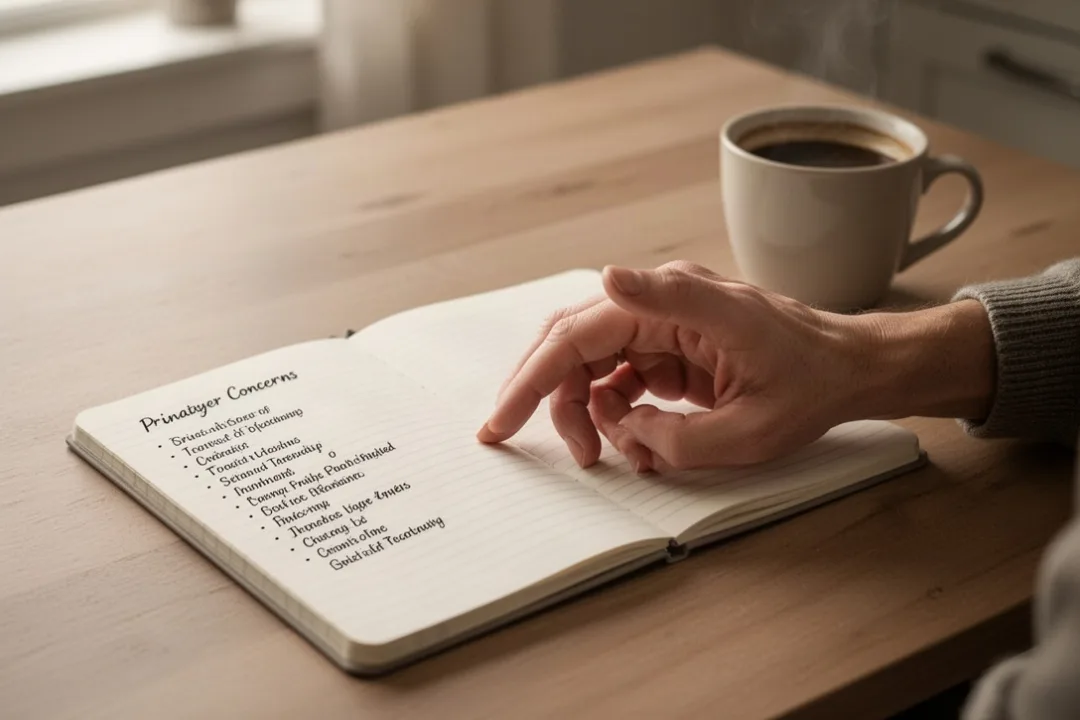
Simple practice: Write one name or concern beside each finger in a notebook. Review the list once a week and update it as circumstances change, while protecting other people’s privacy.
Ways to adapt the 5 finger prayer to your life
The basic pattern works across many schedules and prayer traditions. You can pray silently, aloud, with another person, or as part of a family routine. Some people use an open hand, while others touch each finger to the palm as they pray.
In the morning, move through the five fingers before beginning your main responsibilities. Keep each section to one or two sentences. Ask for protection and wisdom for loved ones, strength for people who serve, integrity among leaders, care for those who suffer, and guidance for your own choices.
This approach can help you begin the day with a wider perspective. You are not only thinking about your schedule; you are remembering that other people have needs, responsibilities, and fears as real as your own.
Use it during stressful moments
When anxiety becomes intense, the hand pattern can give you a grounding action. Feel your feet on the floor, slow your breathing, and move through one finger at a time. You may not solve the situation immediately, but you can separate your concerns into manageable categories and choose one faithful response.
If your stress is connected to a specific person, start with the finger that best fits the situation. Someone may be both a close friend and a person who is suffering. The categories are flexible prompts, not strict rules.
Use it with children or teenagers
Children often understand the method quickly because it connects an abstract practice with something they can see and touch. Invite them to name one person for each finger. Avoid pressuring them to disclose private information, and let them use simple language such as “help my teacher” or “be with people who are sick.”
Teenagers may prefer adapting the categories to school, friendships, sports, online communities, or future plans. You can ask open questions rather than correcting their wording. The purpose is to help them develop compassionate attention and a regular prayer habit.
Use it in a group setting
A small group can pray through one finger at a time, leaving a short period of silence after each category. Participants may offer names aloud, write private requests, or simply pray silently. A leader should make clear that no one is required to share personal information.
Groups can also assign one finger to each person and then close with a shared prayer. Keep the focus on prayer rather than turning the gathering into a discussion of politics, personal advice, or speculation about other people’s lives.
At home: Pray together before a meal or at bedtime.
At work: Use the index finger to remember colleagues, clients, teachers, and service workers.
At church: Include the five categories in a prayer meeting or pastoral-care routine.
During travel: Pray silently for the people and communities you pass.
In a journal: Record one gratitude and one request for each finger.
What the five finger prayer can teach about prayer
The structure encourages you to pray beyond your immediate concerns. It begins with relationships, moves toward people who serve and lead, gives attention to suffering, and only then turns directly to your own needs. That sequence can cultivate gratitude, empathy, humility, and responsibility.
It also shows that prayer can be concrete. Instead of saying only “help everyone,” you can name an exhausted caregiver, a school principal facing a difficult decision, a neighbor recovering from surgery, or a family member who needs courage. Specificity does not limit prayer; it helps you notice where care is needed.
The method can also expose the limits of your attention. You may remember public leaders but forget the workers who keep your community functioning. You may pray for people in crisis but overlook someone who is quietly lonely. The five categories offer a balanced prompt that can broaden your awareness.
At the same time, the pattern should not become a way to judge your prayer performance. Missing a day does not mean you have failed. Reaching only one finger during a busy moment can still be meaningful. A repeatable practice is more useful than an elaborate practice you cannot sustain.
Some people use prayer to seek changes in circumstances, while others also seek a change in their own response. Both can fit within this method. You may ask for healing for a sick person and for patience as you support them. You may ask for justice from leaders and for courage to participate responsibly in your community.
“Pray for one another” is the central idea behind the method: bring other people’s needs to God with care, honesty, and compassion.
Common questions about using the 5 finger prayer
The five finger prayer is simple enough to adapt, but a few questions often arise when people first try it. The answers depend partly on your faith tradition and partly on the needs of the people you are remembering.
Is the 5 finger prayer an official prayer?
It is best understood as a prayer guide or teaching tool rather than a required formula. Different churches, families, and teachers may assign slightly different meanings to the fingers. You can follow the common pattern, use wording from your own tradition, or create categories that fit your community.
Do I have to pray in the exact finger order?
No. The usual order provides an easy path from close relationships to wider concerns and then to yourself, but it is not a rule. If an urgent need comes to mind, pray for it immediately. The hand is there to support attention, not restrict it.
Can I pray for myself before praying for others?
Yes. Your needs are valid, and there may be moments when you need to ask for help first. The pinky comes last in the common version as a reminder to include others, not as a command to ignore yourself. You can also return to your own needs at any point.
A useful prayer habit should make you more honest and compassionate, not more anxious about doing everything correctly. Hold the hand pattern lightly, use words that feel sincere, and allow the practice to grow with your circumstances.
Frequently asked questions
Where did the 5 finger prayer come from?
The five finger prayer is commonly associated with a prayer outline attributed to Pope Francis, although similar hand-based prayer practices may appear in different Christian settings. It is not a single universally prescribed prayer. The familiar version uses the fingers as reminders to pray for loved ones, helpers, leaders, people who are suffering, and yourself.
What should I say during a five finger prayer?
Use natural words rather than memorizing a required script. For each finger, name people or groups and ask for relevant help, such as wisdom for leaders, strength for caregivers, comfort for people who are grieving, or guidance for yourself. You can also include gratitude, confession, or a request for practical ways to serve.
How long should a 5 finger prayer take?
It can take less than five minutes if you offer one short prayer for each finger. You can also spend several minutes on a single person or concern. The length is less significant than your attention and sincerity. A brief, consistent practice often works better than waiting for a long uninterrupted period.
Can people from other faith traditions use this prayer method?
The structure can be adapted by anyone whose spiritual practice includes intercession or intentional reflection. The traditional version uses Christian language and categories, but the hand sequence can be modified for another tradition. You might use it for gratitude, compassion, community concerns, vulnerable people, and personal guidance.















Leave a Reply