A scribe was a trained professional who wrote, copied, preserved, and interpreted important documents. In the ancient world, where reading and writing were specialized skills, scribes could serve kings, governments, temples, businesses, and religious communities.
The word can describe several related roles rather than one identical job. A scribe might record a tax payment, draft a royal letter, copy a biblical manuscript, explain religious law, or act as an administrator. In the New Testament, “the scribes” often refers to Jewish teachers and legal experts, especially those who debated how the law should be understood and practiced.
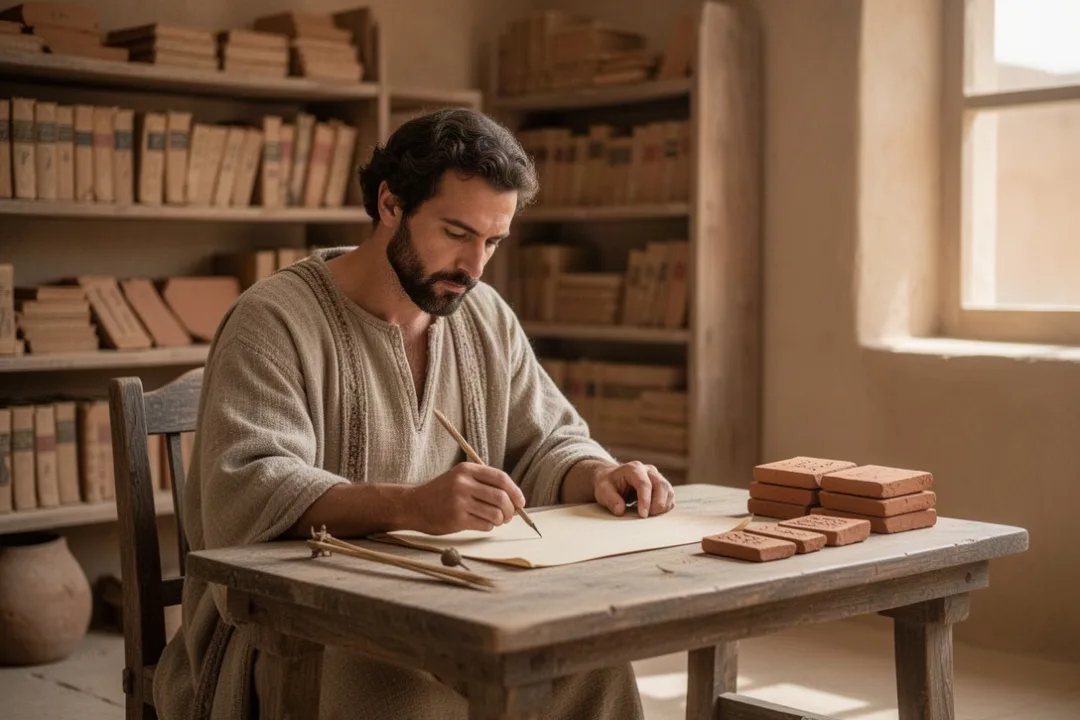
Most ancient societies depended on written records, but relatively few people could produce them. Writing required training, practice, and access to materials such as clay tablets, papyrus, parchment, ink, and reed pens. A scribe therefore held a skill that had practical value and often carried social status.
Written documents helped institutions manage property, taxes, trade, laws, military affairs, and worship. Without scribes, governments would have struggled to track supplies, preserve official decisions, or communicate across long distances. Religious communities also depended on trained writers to copy sacred traditions and maintain accurate records.
Scribes were not always wealthy or powerful in the same way. Some worked close to a royal court, while others served local officials, merchants, priests, or village communities. Their status depended on their employer, education, and responsibilities.
What a scribe did, step by step
The daily work of a scribe varied, but the main responsibilities can be broken down into several connected tasks:
Learning writing systems: A scribe had to master the script or scripts used by the community. In some regions, this meant learning more than one language or writing system.
Preparing writing materials: The scribe selected a suitable surface and tool, such as a clay tablet, papyrus sheet, parchment, or ink pen.
Recording information: The scribe wrote contracts, lists, letters, accounts, laws, genealogies, prayers, or official reports.
Copying existing texts: Religious, literary, legal, and administrative documents were reproduced by hand so they could be preserved and used elsewhere.
Checking and correcting writing: Skilled scribes compared copies, repaired errors, and sometimes added notes or explanations.
Interpreting documents: Some scribes explained legal or religious texts and applied their meaning to particular situations.
Maintaining archives: Scribes organized records so that officials, priests, or other authorized people could retrieve them later.
This combination of technical skill and institutional responsibility made scribes more than simple copyists. They were part of the machinery through which ancient societies governed themselves and preserved knowledge.
Key distinction: A scribe was not automatically a religious leader. Some scribes served religious institutions, but others worked in government, business, law, or private administration.
What the word “scribe” means in the Bible
In the Bible, the meaning of scribe changes somewhat according to the period and setting. In the Hebrew Bible and related Jewish traditions, scribes can appear as officials, secretaries, record keepers, or people devoted to studying and preserving the law.
In the New Testament, the Greek term commonly translated “scribe” is grammateus, a word connected with writing. It can refer broadly to a secretary or official, but in many Gospel passages it identifies a Jewish legal and religious expert. These scribes were associated with the careful study of the Torah and with discussions about how its commandments applied to everyday life.
Several biblical passages show scribes working in official settings. A scribe could serve a king, prepare documents, manage correspondence, or record decisions. Other passages present scribes alongside priests and elders as influential figures who understood and taught religious law.
The title therefore should not be reduced to one modern job description. Depending on the passage, “scribe” may mean government secretary, trained copyist, legal scholar, or religious teacher.
How scribes were trained
Scribal training required sustained practice. Students learned to form signs or letters accurately, memorize vocabulary, copy model texts, and follow established conventions. In societies using complex writing systems, education could take many years because students had to learn hundreds of signs and the language used in formal documents.
Training often took place in a palace, temple, school, or household connected with a professional scribe. Students copied lines repeatedly and practiced standard formulas for letters, contracts, lists, and legal documents. Mistakes mattered because a poorly written name, number, or boundary description could change the meaning of a record.
In Jewish settings, a student preparing to become a legal or religious expert needed more than handwriting ability. The student studied the Torah, inherited interpretations, legal reasoning, and methods of applying commandments. Learning could involve memorization, debate, discussion with teachers, and careful comparison of accepted traditions.
Not every scribe had the same level of education. A person who recorded a business transaction might have had a narrower specialization than a scholar who interpreted religious law. The term covered a range of expertise.
The materials and tools scribes used
Ancient scribes wrote on whatever durable material was available for the purpose. The material influenced the appearance, cost, and survival of a document.
Clay tablets: In Mesopotamia, scribes pressed a shaped reed into wet clay to make wedge-shaped marks. The tablet could be dried in the sun or fired for greater durability.
Papyrus: Sheets made from the papyrus plant were widely used in Egypt and other parts of the ancient Mediterranean world. Papyrus was useful for letters, accounts, literary works, and official documents.
Parchment: Prepared animal skin provided a durable writing surface and became especially important for manuscripts that needed to last.
Ink and reed pens: Scribes used ink made from mineral, plant, or soot-based materials, applying it with a sharpened reed or similar writing tool.
Wax tablets: A coated tablet could serve for temporary notes. The writing could be erased and the surface reused.
Some documents were designed for long-term preservation, while others were temporary working records. A quick note, draft, or calculation did not require the same materials or care as a legal deed or sacred manuscript.
Scribes as government officials
Ancient governments relied heavily on scribes. They recorded agricultural production, collected taxes, tracked labor, prepared military lists, copied orders, and managed correspondence. A royal scribe might write on behalf of a ruler who could not or did not personally draft every document.
Administrative writing also helped rulers control distant territories. Officials could send reports about supplies, disputes, population movements, or military conditions. The written record gave a government a way to preserve instructions and review transactions after the people involved had changed.
In biblical narratives, scribes sometimes appear in connection with royal administration. The Hebrew Bible refers to royal or court officials whose duties included writing and record keeping. These figures should be distinguished from the later religious scribes who appear in debates about Jewish law.
A government scribe did not necessarily hold independent political power. The scribe usually worked for a king, governor, military commander, temple, or other institution. Still, access to information and official documents could give the position considerable influence.
Scribes and religious texts
Religious communities needed scribes to preserve texts, maintain liturgical materials, and transmit teachings. Copying a sacred text required attention to wording, order, spelling, and format. A manuscript could be used in public reading, private study, teaching, or worship.
In Jewish tradition, scribes played an important role in preserving and studying the written law. The biblical book of Ezra presents Ezra as a priest and a skilled student and teacher of the law of Moses. His role illustrates how writing, religious learning, teaching, and public authority could overlap.
Copying was not always a mechanical process. A scribe had to understand the document’s structure and recognize likely mistakes. Later scribes and scholars developed methods for comparing copies and identifying differences. The survival of ancient religious literature depended on generations of such work.
Christian communities also relied on scribes to copy letters, Gospel accounts, Hebrew Scriptures, and other writings. These copyists worked in different settings and with varying degrees of training. Their manuscripts are part of the evidence scholars use when studying how ancient texts were transmitted.
What the Jewish scribes did in the New Testament
The scribes mentioned in the Gospels were often connected with the interpretation of Jewish law. They appear alongside Pharisees, chief priests, elders, and other leaders, although these groups were not identical. A scribe could be associated with a particular religious movement, but the title itself primarily described expertise in the law and its interpretation.
They asked Jesus questions about commandments, purity, marriage, the Sabbath, authority, and the meaning of particular passages. These questions were part of a wider culture of legal discussion. Jewish teachers examined how broad principles should guide specific behavior, especially when different commandments or circumstances appeared to create tension.
Some Gospel passages criticize scribes for placing burdens on others, seeking public honor, or focusing on external behavior while neglecting justice and compassion. Other passages portray individual scribes as thoughtful or receptive. One scribe is shown asking about the greatest commandment and receiving an answer centered on love for God and neighbor, as described in Mark 12.
These varied portraits matter. The New Testament does not present every scribe as identical, and the criticism is directed at particular attitudes and practices rather than at literacy itself. The concern is often about hypocrisy, misuse of authority, and failure to practice the values being taught.
How scribes differed from Pharisees and priests
These terms are sometimes treated as interchangeable, but they described different roles.
Scribes: Experts in writing, legal interpretation, and the preservation or administration of texts. In the New Testament, many were religious legal scholars.
Pharisees: Members of a Jewish movement known for careful observance of the law and traditions of interpretation. A person could be both a Pharisee and a scribe, but the terms described different aspects of identity.
Priests: Members of the priestly class responsible for duties connected with the Jerusalem Temple and sacrificial worship. A priest might also be educated in the law, but priesthood was inherited through a particular family line.
Elders: Respected community leaders or members of governing councils. Their authority could be social, judicial, religious, or political.
The same person might hold more than one kind of status, and ancient institutions did not always divide responsibilities as sharply as modern professions do. Even so, separating the terms helps you read biblical passages more accurately.
Why Jesus criticized some scribes
Jesus’ criticisms of scribes in the Gospels focus on the relationship between religious knowledge and conduct. A person could know the law, explain it to others, and still fail to show mercy, humility, or justice. The criticism therefore challenges the use of religious expertise as a source of prestige rather than service.
In Matthew 23, Jesus condemns leaders who burden others while not carrying those burdens themselves and who seek public recognition. The passage uses strong prophetic language to expose a gap between outward piety and inward character. It should be read as a critique of particular behavior within a Jewish religious setting, not as a rejection of Jewish learning or all scribes.
Other passages present debates in a more constructive way. Questions about the Sabbath, ritual practice, forgiveness, and commandments reflect serious disagreements over interpretation. The existence of debate does not mean that scribes were foolish or dishonest; it shows that their work involved complex judgments about how sacred law applied to real circumstances.
Read the context carefully: When a Gospel passage criticizes “the scribes,” ask whether it concerns legal interpretation, public status, financial behavior, or a particular group of leaders. The title alone does not explain the person’s motives.
How scribes preserved texts accurately
Hand copying always created the possibility of mistakes. A scribe might skip a line, repeat a phrase, confuse similar letters, alter spelling, or make a correction based on what seemed grammatically or theologically expected. Copies could also accumulate differences over time as texts moved between communities and regions.
That does not mean ancient scribes copied carelessly. Many worked within strong traditions of accuracy and used checking procedures. Some manuscripts contain corrections, marginal notes, or marks showing that a copy was reviewed. Professional scribes understood that their reputation depended on producing reliable documents.
Modern scholars compare surviving manuscripts to study how a text was transmitted. They consider differences in wording, spelling, order, and additions or omissions. The work of ancient scribes is central to this process because the manuscripts they produced preserve evidence of earlier forms of writing.
Accuracy also depended on the purpose of the document. A legal contract required clear identification of people and property. A sacred manuscript demanded careful attention to established wording. A private letter might allow more flexibility in style and spelling.
The role developed as societies, languages, and writing systems changed. In early kingdoms, scribes were often closely connected with palaces and temples. As commerce and local administration expanded, more scribes served merchants, courts, military offices, and private households.
In the Jewish world of the Second Temple period and the time of Jesus, the term increasingly carried associations with legal and religious scholarship. Scribes were part of a larger network of teachers, priests, elders, and communal authorities. Their influence came from their command of texts and traditions rather than from one universal office.
Later Jewish scholars continued the work of interpreting and transmitting religious law, though the titles and institutions changed. In Christian settings, manuscript copying was carried out by various kinds of trained writers, including clerks, secretaries, and monastic copyists in later centuries. The basic need remained the same: preserve information accurately enough for others to use.
What “scribe” means in modern language
Today, scribe can still mean a person who writes down information for someone else. Medical scribes, for example, document a clinician’s observations and actions in a health care setting. Legal, court, and administrative assistants may perform related recording functions, although their training and responsibilities differ from those of ancient scribes.
The word can also describe a copyist or someone who produces a handwritten document. In religious studies, “scribe” usually refers to the ancient professionals and scholars who copied texts, kept records, or interpreted law. The correct meaning depends on the historical and literary context.
The most useful definition is therefore broad but precise: a scribe was a trained specialist in writing and written knowledge. Some were secretaries, some administrators, some copyists, and some legal teachers. Their common feature was the ability to create, preserve, manage, or explain written records in a world where that ability was uncommon.
How to identify a scribe in a biblical passage
When you encounter the word in the Bible, examine the surrounding details before deciding what role it describes. The passage may tell you whether the person is connected with a king, a temple, a legal dispute, a religious debate, or the copying of a document.
Look for references to writing, letters, records, or official orders. These clues may indicate an administrative scribe.
Look for discussions of commandments, traditions, or disputed practices. These often point to a legal or religious scholar.
Notice whether the scribe is grouped with priests, elders, Pharisees, or government officials.
Separate the person’s title from the narrator’s evaluation of that person’s behavior.
Check whether the passage is describing a specific individual or making a broader criticism of a group.
This approach prevents two common errors: assuming every scribe was a priest or religious leader, and assuming every biblical criticism applies equally to all people who held the title.
Frequently asked questions
Were all scribes religious teachers?
No. Some scribes served as religious scholars, but others worked as government officials, secretaries, accountants, legal record keepers, or professional copyists. In biblical passages, the surrounding context determines the role. A scribe connected with a royal court may have handled administration, while a scribe debating commandments was more likely a legal or religious expert.
Could women become scribes in the ancient world?
The surviving evidence gives much more information about male scribes, especially in official and religious institutions, but that does not prove that every woman was excluded from literacy or writing. Women could participate in economic and household affairs, and some may have received education. The evidence is too limited to make a universal claim about women and scribal work.
Did scribes write the Bible?
Scribes copied and preserved many biblical texts, but “the scribes” were not one group that wrote the entire Bible at one time. Biblical books emerged through different authors, communities, editors, and periods. Later copyists transmitted these writings by hand, making scribal work essential to their preservation.
Why did scribes have so much influence?
Literacy was specialized, and written records controlled access to law, administration, property, taxation, and religious teaching. A skilled scribe could read documents that others could not, prepare official records, and explain authoritative texts. This combination of technical knowledge and institutional access gave some scribes significant social influence, although their status varied widely.















Leave a Reply