Revelation 4 explained: God’s throne and heavenly worship
Revelation 4 explained: God’s throne and heavenly worship
Revelation 4 describes John’s vision of heaven’s throne room, where God reigns at the center of creation. The chapter shows a throne, radiant colors, lightning and thunder, twenty-four elders, four living creatures, and unceasing worship directed toward the Creator.
The main message is clear: God remains sovereign even when events on earth appear frightening or chaotic. Revelation 4 shifts the reader’s attention from the churches’ struggles in chapters 2 and 3 to the heavenly reality that stands behind history. Before the coming judgments and visions unfold, John is shown who sits on the throne.
Revelation 4 begins after John has received messages for seven churches in Asia Minor. Those messages address faithfulness, compromise, suffering, spiritual weakness, and endurance. Chapter 4 then opens a new scene: John is invited to see what is taking place in heaven.
This change in location matters. The churches live in a world shaped by political power, economic pressure, persecution, and false worship. Yet the vision reveals that earthly rulers are not ultimate. The highest authority belongs to God, represented by the throne at the center of the scene.
The chapter does not yet focus on the opening of the scroll or the judgments that follow. Instead, it establishes the setting for those events. Revelation 4 answers a foundational question: Who controls the story? The answer is not the Roman emperor, human institutions, violence, or chance. God is enthroned, surrounded by worship, and acknowledged as the source of all creation.
Central idea: Revelation 4 is primarily a throne-room vision, not a timeline of future events. Its symbols emphasize God’s holiness, authority, and worthiness to receive worship.
John’s invitation to look into heaven
John sees an open door in heaven and hears a voice like a trumpet calling him to come up and see what must take place afterward. The wording connects the scene with the prophetic visions of the Old Testament, where God reveals heavenly realities to chosen messengers.
The invitation does not necessarily describe a physical trip through space. It presents a prophetic vision in which John is given access to a reality normally hidden from human sight. He is enabled to see the spiritual dimension of history and to report what he sees to the churches.
John says he is immediately “in the Spirit,” meaning that the vision comes through divine revelation rather than ordinary observation. His experience should not be treated as a detailed architectural description of heaven. Revelation uses symbolic images to communicate theological truth.
The phrase “what must take place afterward” introduces the visions that follow, but it should not be separated from the throne room itself. Future events are shown from the perspective of heaven. That perspective keeps the reader from interpreting suffering and judgment as evidence that God has lost control.
The throne at the center of Revelation 4
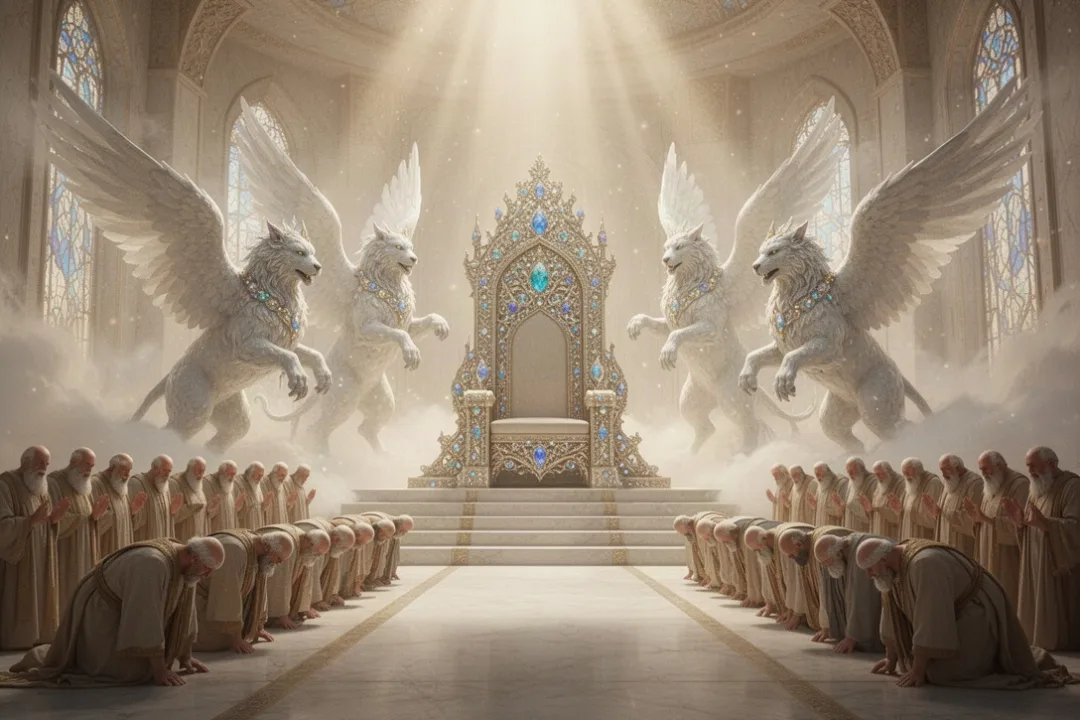
The dominant image in the chapter is the throne. John mentions it repeatedly, making its central position unmistakable. Someone is seated on it, but John does not give a human portrait of God. Instead, he describes the one on the throne through the appearance of precious stones and radiant light.
John compares the appearance to jasper and carnelian, while a rainbow resembling an emerald surrounds the throne. The precise identification of these ancient stones is uncertain, so readers should be cautious about assigning a fixed meaning to every mineral. The overall effect is one of brilliance, majesty, and overwhelming beauty.
The throne also communicates authority. In the ancient world, a throne represented a ruler’s right to govern and judge. In Revelation 4, the throne is not empty or contested. God’s rule is presented as established and unquestionable.
John’s description is deliberately indirect. He does not reduce God to a visible human figure or claim to capture God’s full nature in physical terms. Light, color, sound, and surrounding beings point beyond themselves to divine glory.
What the precious stones and rainbow suggest
The jewels and rainbow should be read as part of the vision’s symbolic atmosphere rather than as a code with one universally agreed interpretation. The stones evoke radiance and royal splendor. The rainbow may suggest beauty, completeness, or covenant faithfulness, especially because rainbows are associated with God’s covenant after the flood in Genesis.
At the same time, Revelation does not explicitly explain every detail. A responsible reading distinguishes between what the chapter clearly states and what interpreters infer. The text clearly presents a glorious throne surrounded by color and light; it does not provide a full dictionary for each stone.
From the throne come flashes of lightning, rumblings, and peals of thunder. These sounds recall the dramatic manifestations of God’s presence at Mount Sinai and elsewhere in the Old Testament. They convey power, awe, and impending action.
Thunder in Revelation often accompanies divine authority and judgment. Here, however, the sounds occur before the scroll is opened and before the later judgments unfold. Their first function is to make the throne room feel active and formidable. Heaven is not passive; God’s rule carries force.
Seven burning lamps stand before the throne, and John identifies them with the seven spirits of God. The number seven frequently represents completeness in Revelation. Many Christian interpreters understand the seven spirits as a symbolic description of the fullness of the Holy Spirit, though the image has also generated different theological interpretations.
The lamps add light to a scene already filled with radiance. They also connect the throne room with the seven churches and the Spirit’s work among them. The church may appear weak on earth, but it remains connected to the presence and activity of God.
The sea of glass and the four living creatures
Before the throne John sees something like a glassy sea, clear or shining like crystal. The image creates a sense of vastness and stillness. It may also recall the biblical theme of God ruling over the sea, a traditional symbol of disorder and danger.
In Revelation, the sea can have more than one symbolic role. In chapter 4, the sea of glass is calm and ordered beneath God’s throne. Later, the sea may be associated with distance, threat, or the source of evil imagery. The meaning depends on the scene rather than on a single permanent definition.
Four living creatures surround the throne. John describes them as being covered with eyes and having distinctive forms: one resembles a lion, another an ox, another a human being, and another an eagle in flight. Each has six wings, and they continually praise God.
The eyes suggest awareness and watchfulness. They communicate that these beings are not limited or unaware of what happens around them. The wings indicate readiness and movement, while the animal and human forms represent strength, service, intelligence, and freedom in many traditional interpretations.
These creatures resemble the heavenly beings described in Isaiah 6 and Ezekiel 1 and 10, though Revelation combines features from those earlier visions. John is not presenting four ordinary animals. They are symbolic heavenly attendants who surround God’s throne and lead the worship of heaven.
Why the living creatures repeat their praise
The creatures worship day and night, identifying God as holy, powerful, and eternal. Their repeated praise is not portrayed as empty routine. It expresses a continual recognition of who God is.
The threefold declaration of holiness recalls the worship of the seraphim in Isaiah 6. Calling God “holy” emphasizes his complete moral purity and distinctness from creation. Describing him as the one who was, is, and is to come highlights God’s eternal existence.
The living creatures’ worship begins the response of the entire throne room. When they honor God, the twenty-four elders fall before him. Worship spreads outward from the center, showing that every heavenly authority derives its meaning from God.
Revelation 4:11 presents worship as recognition that God created all things and that creation exists by his will.
The meaning of the twenty-four elders and their crowns
Twenty-four elders sit on thrones around God’s throne. They wear white garments and golden crowns. Their exact identity is debated, but the image clearly depicts honored representatives who worship rather than compete with God.
Some interpreters understand the twenty-four elders as representing the whole people of God, often connecting the number with the twelve tribes of Israel and the twelve apostles. Others see them as a distinct group of heavenly beings, drawing attention to their priestly and royal functions. The chapter itself does not settle every detail of their identity.
Their white clothing commonly signifies purity or faithful status in Revelation. The crowns indicate honor and victory, but the elders do not keep their crowns as symbols of independent power. When they worship, they place the crowns before the throne.
That action is one of the chapter’s clearest symbols. Whatever authority or reward the elders possess, they recognize that it is subordinate to God. True honor is returned to its source, not used to challenge the one who sits on the throne.
The elders’ posture also contrasts with the self-exalting rulers and powers that appear elsewhere in Revelation. Earthly empires may demand worship, but the heavenly court demonstrates that all created authority must ultimately bow before the Creator.
Why creation is the focus of the elders’ worship
The elders praise God because he is worthy to receive glory, honor, and power. Their reason is not that God has recently won a military battle or granted them a personal benefit. They worship because God created all things and sustains their existence by his will.
This focus on creation is significant. Revelation often addresses communities living under pressure from an empire that presents itself as powerful and permanent. By directing worship to the Creator, the chapter challenges every claim that political or economic power deserves ultimate loyalty.
The language also gives human life a proper place. People are not self-created or self-sustaining. Their existence is received rather than possessed independently. Revelation 4 therefore links worship with humility: creation acknowledges its dependence on the one who made it.
The chapter does not portray worship as a private preference with no public meaning. To worship God is to identify the true source of authority. That confession can become costly when surrounding institutions demand absolute allegiance.
How Revelation 4 connects with Revelation 5
Revelation 4 and 5 form a single throne-room sequence. Chapter 4 centers on the one seated on the throne as Creator. Chapter 5 introduces a sealed scroll and the question of who is worthy to open it. The focus then moves toward the Lamb.
This arrangement is essential for reading both chapters. Revelation 4 establishes God’s authority over creation; Revelation 5 reveals how God’s purposes for history will be carried forward. The throne is the fixed center, while the scroll represents the unfolding of divine purposes.
Readers sometimes focus heavily on the dramatic symbols in later chapters and overlook the worship that frames them. The throne-room scenes insist that judgment and redemption are not random events. They proceed from God’s authority and are connected to his purposes for creation.
The movement from Creator to Redeemer also gives the book a Christ-centered direction without removing God’s sovereignty. Revelation 4 prepares the reader to understand why the Lamb’s worthiness in chapter 5 matters so deeply.
Common mistakes when interpreting Revelation 4
Treating every detail as a secret code: Some images have clear symbolic force, but the text does not explain every color, shape, or number in a separate formula.
Reading the chapter as a literal architectural blueprint: John communicates through prophetic imagery, not through ordinary technical description.
Ignoring the worship setting: The chapter’s central purpose is to reveal God’s authority and holiness, not merely to identify heavenly creatures.
Separating chapter 4 from chapter 5: The throne vision prepares for the scroll and the Lamb, so the two chapters should be read together.
Assuming one interpretation is certain where the text is silent: The identities of the elders and the exact meaning of some symbols remain debated.
Using Revelation 4 to predict specific modern events: The chapter offers theological assurance about God’s rule but does not name contemporary governments, technologies, or news events.
Reading tip: Start with the chapter’s repeated and clearly explained images—the throne, worship, holiness, creation, and divine authority—before assigning detailed meanings to less certain symbols.
Practical ways to read Revelation 4 carefully
A careful reading begins by observing what John actually sees and hears. Notice which images receive repeated attention, which characters speak, and how the scene changes when the creatures worship. The chapter’s repetition is a guide to its emphasis.
Read the whole chapter aloud or slowly: The sounds of thunder, praise, and repeated descriptions help you recognize the movement of the vision.
Mark the throne references: The throne is the structural center of the chapter and the best starting point for interpretation.
Separate observation from interpretation: First record what John says; then consider what the symbols may communicate.
Compare the Old Testament background: Isaiah 6, Ezekiel 1, Ezekiel 10, and passages about God’s heavenly court help explain the imagery.
Read chapter 5 immediately afterward: The worship of the Creator leads directly into the revelation of the worthy Lamb.
Apply the central message before debating details: Ask how the vision challenges misplaced trust and strengthens faith under pressure.
It can also help to distinguish between symbolic meaning and literal referent. A symbol can communicate something real without being a physical object exactly as pictured. For example, the rainbow around the throne may communicate covenantal or majestic associations even if the vision is not describing a natural rainbow in ordinary atmospheric conditions.
Readers should also avoid forcing modern scientific categories onto an ancient prophetic vision. Revelation’s imagery is designed to disclose theological reality through familiar biblical symbols. Its purpose is not to explain the physics of heaven or provide a measurable map of the unseen world.
What Revelation 4 teaches about worship and suffering
Revelation 4 offers comfort by placing suffering within a larger frame. The churches face real dangers, and the book will later describe persecution, judgment, and conflict. Yet John first sees a throne surrounded by worship. God’s reign precedes and outlasts every crisis.
The vision also corrects the assumption that power belongs to whoever appears strongest on earth. Armies, rulers, wealth, and public influence can dominate human attention, but they are not the final measure of reality. The throne room reveals a different hierarchy: the Creator stands above every created power.
Worship, then, is not merely emotional response. It is a declaration about truth. The elders and living creatures confess that God deserves glory because all things depend on him. Their worship teaches the churches how to resist rival claims to ultimate authority.
The scene can shape Christian prayer without turning the chapter into a formula. It encourages attention to God’s holiness, gratitude for creation, humility about personal status, and confidence that history is not abandoned to chaos.
Questions Revelation 4 leaves open
The chapter intentionally leaves some questions unanswered. It does not identify the elders in an explicit sentence, explain every feature of the living creatures, or provide a complete chronology of the events that follow. Those open details should produce careful reflection rather than speculative certainty.
It is also unclear how literally John expects readers to understand the spatial arrangement of the throne, sea, creatures, and elders. The vision gives a meaningful symbolic picture, but its theological message does not depend on reconstructing a precise heavenly floor plan.
These limits do not weaken the chapter. They remind readers that Revelation communicates by vision. Its images are rich enough to disclose God’s character and authority while still preserving mystery.
The clearest emphasis remains stable across responsible interpretations: God is enthroned, creation depends on him, heavenly beings worship him, and no earthly power should receive the honor that belongs to the Creator.
How Revelation 4 speaks to readers today
Revelation 4 speaks to anyone tempted to measure reality only by visible power. News, institutions, financial systems, and political leaders can seem to control the future. John’s vision places all such powers beneath a higher authority.
It also challenges individual self-sufficiency. The elders’ crowns represent honor, but they lay them down. Their example encourages a view of achievement in which gifts, influence, and success are received with gratitude rather than treated as proof of personal ultimacy.
For communities under pressure, the chapter provides a pattern of faithful perspective. It does not deny danger or pretend that history is painless. Instead, it reveals that fear does not occupy the throne. God does.
Read alongside Revelation 5, the vision becomes a doorway into the rest of the book. The reader is prepared to face difficult images because the story begins from worship, sovereignty, and the assurance that divine purposes remain secure.
Frequently asked questions
Is Revelation 4 describing heaven literally?
Revelation 4 presents a genuine prophetic vision, but its throne, jewels, creatures, and sea should not automatically be read as a literal architectural description. John uses symbolic imagery drawn from earlier biblical visions to communicate God’s glory, authority, holiness, and relationship to creation. The chapter reveals theological reality through visual language rather than providing a physical map of heaven.
Who are the twenty-four elders in Revelation 4?
The chapter does not explicitly identify them, so interpretations differ. Some readers understand the elders as representing the complete people of God, often associated with the twelve tribes and twelve apostles. Others view them as a distinct heavenly council or group of worshiping beings. Their role is clear even when their identity remains debated: they honor God and surrender their crowns before his throne.
What do the four living creatures represent?
The four living creatures are heavenly beings surrounding God’s throne. Their eyes suggest alertness, their wings suggest readiness, and their lion, ox, human, and eagle-like forms communicate a broad range of created strength and vitality in many interpretations. Their chief function is to lead continual worship, rather than to serve as a coded prediction of specific nations or modern institutions.
Why does Revelation 4 focus on creation?
Creation gives the elders a reason to worship God before the later scenes about judgment and redemption unfold. By emphasizing that all things exist because of God’s will, the chapter challenges every earthly authority that claims ultimate loyalty. It also reminds readers that human power is dependent and temporary, while the Creator’s authority is permanent and foundational.












Leave a Reply