The Book of Jonah is a short prophetic book in the Old Testament, traditionally associated with the prophet Jonah son of Amittai. It appears among the Minor Prophets, a group named for the length of their writings rather than the importance of their message. Jonah contains only four chapters, but its narrative raises large questions about obedience, prejudice, repentance, justice, and divine compassion.
Jonah is unusual among the prophetic books because it focuses more on the prophet’s actions and attitude than on a collection of his spoken messages. Other prophets often deliver extended warnings or promises to Israel. Jonah, by contrast, receives a command, runs from it, is brought back to his task, and then struggles with the result of his preaching.
The story is set during a period when Assyria was a major power. Nineveh, the city Jonah is sent to warn, was associated with the Assyrian empire, which was known to Israel as a threatening foreign force. That setting helps explain Jonah’s resistance: his problem is not merely that the assignment is difficult. He does not want mercy shown to an enemy.
Central idea: Jonah shows that a person can obey God outwardly while still resisting God’s heart inwardly. The book asks readers to examine not only what they do, but also whom they are willing to forgive.
The Jonah Bible story in four movements
The narrative can be followed as a clear sequence of commands, escapes, rescues, and questions. Each movement develops the tension between Jonah’s limited compassion and God’s wider concern.
God sends Jonah to Nineveh. Jonah is told to go to the city and announce that its wickedness has come before God.
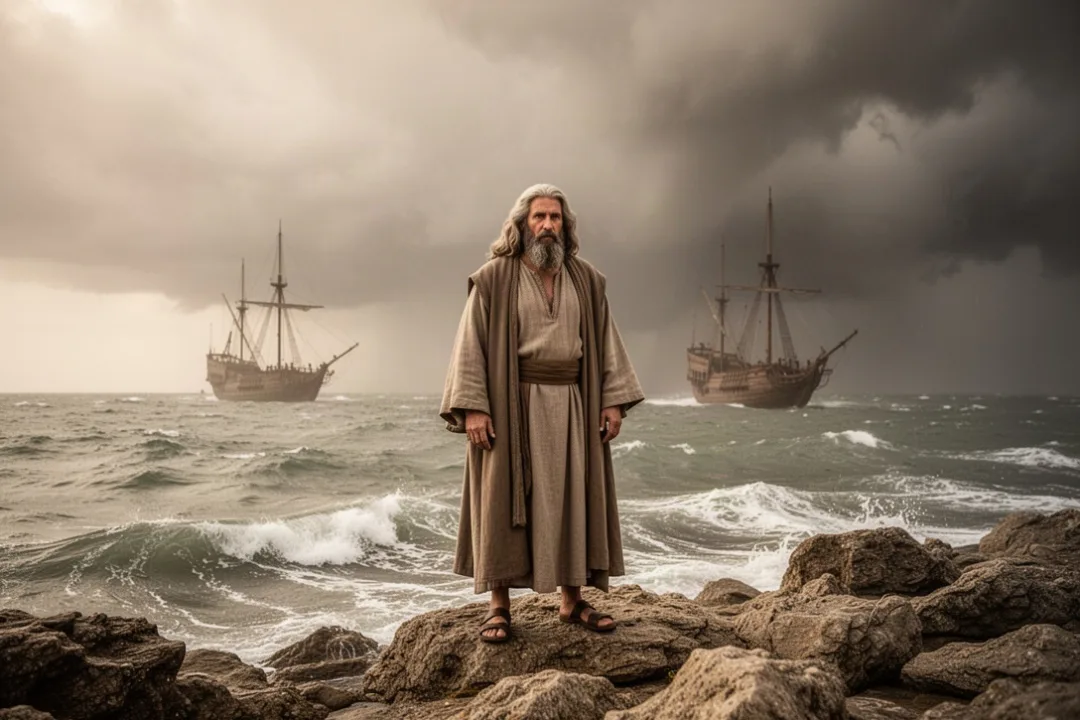
Jonah flees toward Tarshish. Instead of traveling east toward Nineveh, he boards a ship going in the opposite direction.
God rescues Jonah through the great fish. A violent storm exposes Jonah’s flight, and he is thrown into the sea before being preserved inside a great fish.
Jonah preaches, Nineveh repents, and Jonah becomes angry. The city responds to the warning, but Jonah resents God’s compassion. A plant, a worm, and a scorching wind help reveal the depth of his misplaced priorities.
This structure matters because the book does not end with Jonah proudly completing his mission. It ends with a question from God. The unresolved ending directs the reader to consider whether Jonah will accept God’s concern for Nineveh.
Why Jonah ran from God’s command
God’s initial command in Jonah 1 is direct: the prophet must go to Nineveh and speak against its evil. Jonah responds by heading for Tarshish, a distant destination associated with the western Mediterranean. The exact location of Tarshish is debated, but the narrative clearly presents it as the opposite direction from the one God gave Jonah.
Jonah’s flight is more than ordinary fear. Later, when he explains himself to God, he says he already knew that God is gracious, compassionate, patient, and ready to show mercy. Jonah appears to have fled because he suspected that the warning might lead to repentance and forgiveness.
That motive gives the story its emotional force. Jonah does not doubt God’s power; he objects to God’s generosity. He would rather see judgment fall on Nineveh than watch an enemy receive compassion. His resistance exposes a familiar human tendency: wanting justice for others while hoping for mercy for ourselves.
The story also describes Jonah going down repeatedly: down to Joppa, down into the ship, and eventually down into the sea. This downward movement reflects both physical descent and spiritual withdrawal. Jonah is not simply changing locations. He is attempting to place distance between himself and the responsibility he has been given.
What the storm and the sailors reveal about Jonah
As Jonah travels by ship, God sends a powerful storm. The sailors are frightened and begin calling on their own gods, while Jonah sleeps below deck. Their response creates an important contrast: pagan sailors show concern for human life, while the prophet who knows Israel’s God initially remains detached.
The sailors cast lots to determine who is responsible for the crisis, and the lot identifies Jonah. He admits that he is fleeing from the Lord, the God who made the sea and the dry land. His confession recognizes God’s authority over the very waters now threatening the ship.
When the sailors ask what they should do, Jonah tells them to throw him into the sea. They try to reach land instead, rowing hard against the storm. Only after their efforts fail do they pray to God and commit Jonah to the sea. Their reluctance to harm him and their fear of taking innocent blood make them morally responsive characters in the story.
After Jonah is cast overboard, the sea becomes calm. The sailors respond with reverence, offering worship and making vows. The episode shows that Jonah’s disobedience affects others, but it also shows God using a dangerous situation to bring outsiders to acknowledge divine power.
The text says that God appoints a great fish to swallow Jonah. It does not identify the creature by a modern species name, and the phrase is better understood as a divinely appointed sea creature than as a zoological claim. The fish is part of the story’s pattern: God appoints the storm, the fish, the plant, the worm, and the hot wind to accomplish particular purposes.
The fish is not presented only as punishment. It becomes a means of preservation. Jonah is in serious danger after entering the sea, but God keeps him alive in an unexpected place. The rescue is uncomfortable and corrective, yet it is still rescue.
Jonah’s prayer from inside the fish describes his distress and his renewed awareness of God. He recognizes that deliverance belongs to the Lord. The prayer uses language associated with the Psalms and with worship, suggesting that Jonah is turning back toward God, at least at the level of confession.
After three days and three nights, God commands the fish to release Jonah onto dry land. The time period emphasizes the seriousness of Jonah’s descent and the completeness of his restoration to the mission. The fish does not become the main subject of the book. Its role is to return Jonah to the place where he must face God’s command again.
How Nineveh responds to Jonah’s warning
God gives Jonah the same basic assignment a second time. This repetition is significant because it shows both Jonah’s failure and God’s willingness to recommission him. Jonah has not earned a new opportunity through perfect behavior, but God still sends him.
Jonah enters Nineveh and announces that the city will face destruction because of its wickedness. The prophetic message is brief, yet its effect is extensive. The people believe God, proclaim a fast, and put on sackcloth, traditional signs of grief, humility, and repentance.
The response reaches from ordinary citizens to the king. The king leaves his throne, removes his royal clothing, and issues a decree calling the population to turn from violence and evil. Even the animals are included in the public expression of mourning. The scene emphasizes the city-wide scope of its change in attitude.
The people do not merely perform an empty ritual. The king’s decree specifically calls them to abandon violence and change their conduct. The text does not describe Nineveh as morally perfect afterward, but it does present the people as responding seriously to the warning they receive.
God sees their actions and does not bring the announced disaster upon them. This is not a contradiction of God’s character. Prophetic warnings often function as calls to repentance, and the result God desires is changed behavior rather than destruction. The warning is conditional in effect even when the condition is not stated in every sentence.
Why Jonah was angry when Nineveh was spared
Jonah’s anger is one of the book’s most revealing moments. A prophet might be expected to celebrate when people repent, but Jonah reacts with resentment. He tells God that this outcome is exactly what he feared: divine grace would result in Nineveh’s survival.
Jonah’s complaint exposes a conflict between his theology and his desires. He accurately understands that God is merciful, but he does not want mercy applied to this particular city. Knowing true things about God does not automatically produce a compassionate character.
Jonah then asks to die. His response is extreme, but it conveys how deeply he values his preferred outcome. He would rather cease living than witness compassion toward people he considers unworthy. God answers with a question: does Jonah have a legitimate reason to be angry?
The question is not answered immediately. Instead, Jonah leaves the city and waits to see what will happen. His posture suggests that he still hopes judgment may come. The silence allows readers to examine their own reactions before the story supplies its final lesson.
What the plant, worm, and wind teach Jonah
God appoints a leafy plant to grow over Jonah and provide shade. Jonah is very pleased with the plant, perhaps for the first time in the story. Then God appoints a worm to attack it, followed by a scorching east wind. The plant withers, and Jonah again wishes for death because of his discomfort.
The contrast is deliberate. Jonah feels intense grief over a plant that lasted briefly, yet he feels no comparable grief for a large population facing destruction. God points out that Jonah cared about something he did not create or cultivate. How much more, then, should God care about the people and animals of Nineveh?
The plant lesson does not mean plants are worthless or that human suffering should be dismissed. It exposes Jonah’s distorted scale of concern. His compassion is quick when his own comfort is involved, but absent when the lives of others are at stake.
The book ends with God’s question about Nineveh. Readers are left to answer it personally. The final emphasis is not on the fish, the storm, or even the city’s repentance. It is on whether people will share God’s concern for those beyond their own community.
Reading tip: Do not treat Jonah as only a story about surviving a sea creature. The fish occupies a small part of the book; the larger issue is whether Jonah will accept mercy for people he dislikes.
Major themes in the Jonah Bible
God’s mercy extends beyond familiar boundaries
Jonah expects God’s concern to align with Israel’s interests, but the book repeatedly shows God attending to foreigners. God hears the sailors, responds to Nineveh’s repentance, and expresses concern for the city’s population and animals. The message challenges any attempt to restrict divine compassion to one preferred group.
This theme does not erase the seriousness of evil. Nineveh is condemned for wickedness, and the warning is real. Mercy is not approval of violence. Instead, mercy creates the possibility that guilty people may turn from destructive behavior.
Repentance involves changed direction
The sailors turn toward reverence, the people of Nineveh turn from violence, and Jonah turns back toward his assignment. These responses are different, but each involves movement away from a previous course. In the Jonah Bible, repentance is not merely feeling regret; it is a meaningful change in response to God.
The book also presents repentance as possible for people who have not belonged to Jonah’s community. Nineveh hears a warning and responds. That point would have challenged readers who assumed that outsiders were beyond God’s interest or beyond the reach of transformation.
Religious knowledge does not guarantee compassion
Jonah knows God’s identity and character. He can speak accurately about grace and patience, and he recognizes God’s authority over the sea. Yet he resists the practical implications of that knowledge. The narrative warns that correct beliefs can coexist with resentment, prejudice, and self-centeredness.
The sailors and Ninevites, meanwhile, respond in ways that Jonah does not expect. Their actions reveal humility and concern. This reversal encourages readers to judge spiritual maturity by conduct, not by position, vocabulary, or familiarity with religious ideas.
God can work through imperfect messengers
Jonah is not portrayed as a model prophet. He runs, sleeps during a crisis, resents repentance, and argues with God. Still, God works through his preaching, preserves his life, and continues addressing him. The story does not excuse Jonah’s attitude, but it shows that divine purposes are not limited to flawless servants.
This should not become an excuse for careless behavior. Jonah’s disobedience harms others and brings unnecessary danger. The point is that failure does not have to be the final word when a person is willing to return and respond to God’s correction.
How the Jonah story connects with other Bible passages
The Jonah narrative shares themes with several other parts of Scripture. The call for outsiders to turn from evil resembles the broader biblical concern for justice among all nations. Prophetic warnings often invite a response rather than simply announcing an unavoidable outcome.
The New Testament refers to Jonah’s experience as a sign. Jesus compares his coming death and resurrection to Jonah’s time in the fish, while also contrasting the response of Nineveh with the response of people who hear Jesus and refuse to repent. Because Bible translations differ, the safest way to read those passages is to consult the references and consider how each writer applies Jonah’s story.
The relevant passages include Matthew 12:38–41 and Luke 11:29–32. These references highlight both Jonah’s unusual deliverance and Nineveh’s response to a prophetic warning. They also place responsibility on listeners who receive greater revelation yet remain unmoved.
Jonah’s concern for enemies also fits with a wider biblical movement toward love of neighbor, care for the foreigner, and forgiveness. The book’s message is not detached from the rest of Scripture; it presses readers to consider whether their understanding of God’s grace changes how they treat outsiders.
Common questions about the great fish and Nineveh
Was Jonah a real historical prophet?
The Bible identifies Jonah as the son of Amittai, and another biblical reference connects a prophet named Jonah with the reign of an Israelite king. Readers and scholars differ over how to interpret the narrative’s historical details, literary form, and use of satire. The book’s theological message remains clear regardless: God confronts Jonah’s resistance and shows compassion toward repentant outsiders.
Did Jonah die inside the fish?
The narrative presents Jonah as alive when he prays and when the fish releases him. His time inside the fish is described as a period of distress and preservation, not as a completed death followed by ordinary medical resuscitation. The story emphasizes God’s power to save Jonah from a situation in which survival would otherwise seem impossible.
Why did God send Jonah to an enemy city?
God sent Jonah because Nineveh’s evil had come before him and because the city was capable of responding to a warning. The assignment demonstrates that God’s moral concern is not limited to Israel. It also exposes Jonah’s narrow compassion by requiring him to deliver a message that could lead his enemies to repentance rather than destruction.
What does Jonah teach about anger?
Jonah’s anger reveals how strongly people can defend their own comfort, expectations, and sense of fairness. God does not ignore the anger but questions it and uses the plant to help Jonah see its imbalance. The lesson is not that every feeling of anger is automatically wrong; it is that anger should be examined when it makes another person’s life seem less valuable than our convenience.
Practical lessons from the Jonah Bible
The book speaks to situations that reach beyond its ancient setting. You may not be called to Nineveh, but you can recognize its questions in family conflict, political disagreement, community tension, and relationships with people whose actions have caused real harm. Jonah asks what you do when grace reaches someone you would rather see punished.
Face resistance honestly. Jonah’s problem becomes clearer when he admits why he ran. Naming your motives can be the beginning of change.
Separate justice from revenge. Nineveh’s evil is taken seriously, but repentance remains possible. Wanting accountability does not require wanting another person’s destruction.
Expect compassion to challenge your preferences. God’s mercy may cross social, national, religious, or personal boundaries you would prefer to maintain.
Return after failure. Jonah receives the command again after fleeing. A failed response can be confronted without becoming a permanent identity.
Measure concern by action. The book contrasts Jonah’s distress over a plant with his lack of concern for people. Your priorities become visible through what you protect and grieve.
A careful reading also prevents shallow applications. The Jonah story does not require you to ignore abuse, excuse crimes, or remove wise boundaries. Compassion and justice belong together. The city is warned about its wrongdoing, and its people are called to abandon violent behavior.
How to read Jonah prayerfully and responsibly
Begin by reading all four chapters in one sitting. The book is short enough for its repeated words and contrasts to stand out. Pay attention to what God appoints, how different characters respond, and how often Jonah’s attitude conflicts with God’s stated concern.
Read the command in chapter 1. Ask what Jonah is told to do and what he chooses instead.
Track the outsiders. Notice how the sailors and Ninevites respond to danger, warning, and divine authority.
Read Jonah’s prayer in chapter 2. Consider which parts express genuine surrender and which parts remain unresolved.
Compare Jonah’s preaching with his anger. He delivers the message, but his reaction to repentance reveals his deeper struggle.
End with God’s question in chapter 4. Resist supplying a convenient ending. Let the unanswered question examine your own limits of compassion.
For personal reflection, consider one group of people you instinctively place outside the reach of mercy. That does not mean minimizing harm or abandoning discernment. It means asking whether your desire for justice has become a desire to withhold every possibility of repentance and restoration.
The Jonah Bible ultimately presents a God who takes evil seriously, hears cries from the sea and the city, gives people opportunities to turn, and remains patient even with a resistant prophet. Its lasting challenge is direct: if God’s compassion is wider than yours, are you willing to let your heart become wider too?
Frequently asked questions
What is the main message of the Book of Jonah?
The main message is that God’s compassion extends to people outside Jonah’s community, including those he considers enemies. The book also shows that repentance can change the outcome of a warning and that religious knowledge does not automatically produce a merciful character. Jonah’s struggle is as important as Nineveh’s repentance because readers are asked to examine their own responses to grace.
How long is the Book of Jonah?
Jonah contains four chapters and is one of the shorter books in the Old Testament. Its small size makes it possible to read in one sitting, but its narrative is carefully structured. The book moves from Jonah’s flight, to his rescue, to Nineveh’s repentance, and finally to God’s question about compassion.
What does the name Jonah mean?
Jonah is commonly connected with a Hebrew word meaning “dove.” The name itself is not the main focus of the book, and the narrative does not build its message around the symbolism of a dove. The important details are Jonah’s prophetic calling, his resistance to it, and God’s concern for Nineveh.
Is Nineveh a real place?
Yes. Nineveh was an ancient city associated with the Assyrian empire and located in the region of modern northern Iraq. Its appearance in Jonah reflects the city’s significance as a foreign power known to Israel. The biblical story uses Nineveh’s reputation to emphasize the surprising scope of God’s concern and the possibility of repentance among outsiders.















Leave a Reply