Genesis 1:1-16 presents God as the sovereign Creator who brings an unformed world into an ordered, life-supporting creation through purposeful acts of separation and naming.
Genesis 1:1-16 is the opening movement of the Bible’s creation account. It begins before the world has recognizable shape and follows the emergence of light, sky, dry land, plants, and heavenly lights. The passage ends during the fourth day, before animals and human beings appear later in the chapter.
The account is not written as a modern scientific report. It uses a highly organized literary pattern, repeated phrases, and a sequence of divine commands. At the same time, it makes substantial theological claims about the world: God alone is the source of creation, the created order is purposeful, and the natural world is not itself divine.
Readers have understood the passage in several ways. Some interpret the six days as ordinary twenty-four-hour days; others read them as long periods, literary categories, or a structured framework for describing creation. Christians and Jews have also differed over how Genesis 1 relates to scientific explanations of the universe. The central message can be studied carefully even when readers disagree about the timing or mechanism of creation.
Central idea: Genesis 1:1-16 emphasizes who created the world and how creation is ordered, rather than giving a modern technical account of physical processes.
What happens in Genesis 1:1-16 step by step
The passage moves from an uninhabitable beginning toward a world prepared for life. Each stage contributes to that movement by establishing boundaries, filling previously empty spaces, or setting patterns that govern time.
Genesis 1:1-2: God creates the heavens and the earth, while the earth is still unformed, empty, dark, and covered by the deep.
Genesis 1:3-5: God calls light into being and separates it from darkness, naming the two day and night.
Genesis 1:6-8: God establishes the expanse, or sky, to separate waters above from waters below.
Genesis 1:9-13: God gathers the waters so dry land appears, then brings forth vegetation and seed-bearing plants.
Genesis 1:14-16: God appoints the sun, moon, and stars as lights that mark times and govern the day and night.
This sequence has a clear rhythm. God speaks or acts, the creation responds, God evaluates it, and the passage marks the completion of a day. The repeated pattern gives the account a measured quality and highlights divine authority, order, and intentionality.
Genesis 1:1-2 describes a world before its ordering
The opening verse introduces God as the one who creates the heavens and the earth. “Heavens and earth” functions as a comprehensive expression for the whole created realm, not merely two isolated objects. The account therefore begins with God’s relationship to everything that exists.
Verse 2 describes the earth as unformed and empty, with darkness over the deep and God’s Spirit or wind moving over the waters. The Hebrew wording has generated discussion because some interpreters understand the Spirit as God’s personal presence, while others emphasize wind or a powerful breath. Either way, the scene presents God as present before the ordering work begins.
The description does not portray a rival deity challenging God. Darkness and the deep are part of the scene that God will arrange. The waters may appear threatening or unproductive, but they are not independent powers equal to the Creator. God’s authority precedes the formation of the world and does not depend on cooperation from another god.
The words often translated “formless and empty” communicate a lack of structure and inhabitants. The account will address both conditions. God gives shape to the spaces of creation and then fills them with things suited to those spaces. This arrangement helps explain why the opening section is more than a list of objects: it is a story of making a home for life.
Genesis 1:3-5 explains the creation and separation of light
God’s first recorded command is for light to exist. The passage does not say that the sun is created at this point; the sun and moon appear later, on the fourth day. That detail has led to many interpretations, but the immediate literary point is clear: light begins the ordering of time before the heavenly lights are appointed.
God sees that the light is good and separates it from darkness. The distinction is not presented as a battle between equal forces. Instead, God establishes a boundary and gives each period a name: day and night. Naming represents authority and definition. What was previously undifferentiated now has a recognizable rhythm.
The first day therefore introduces several major themes. Creation happens through divine command, created realities receive limits, and the world is evaluated as good. The passage also presents time as part of the created order. Day and night are not random experiences; they belong to a pattern established by God.
The separation of light and darkness should not automatically be treated as a statement about the scientific source of visible light. Ancient readers would have recognized light as essential to life, work, travel, and worship. Genesis uses that familiar reality to show that the world’s basic conditions are under divine direction.
Genesis 1:3-5 portrays light as the first visible sign that disorder is being transformed into an ordered world.
Genesis 1:6-8 establishes the sky between the waters
On the second day, God makes an expanse to separate waters above from waters below. Many English translations use terms such as “expanse,” “vault,” or “firmament”. The underlying Hebrew word refers to something spread out or extended. Translation choices reflect different attempts to communicate the passage’s ancient imagery in modern language.
The text describes a world understood in terms of waters above and waters below, with the sky or expanse between them. Rain comes from the upper waters in the ordinary experience represented by the account. The passage is not trying to explain meteorology in the manner of a modern weather system; it is showing God creating habitable space.
Unlike the first day, the second day does not explicitly include the statement that God saw the work as good. Some readers view this as a literary pause because the separation of the waters is completed in the following stage. Others see no special theological significance in the omission. The safest observation is that the account continues its ordered progression without treating the missing phrase as a contradiction.
The sky has an important role in the narrative. It creates a boundary between realms and makes room for the world below. Later, birds will occupy the space beneath the expanse, while the heavenly lights will be placed within it. Creation is being structured according to function and location, not assembled as an unconnected collection of objects.
Genesis 1:9-13 brings forth land and vegetation
The third day begins with the waters being gathered so that dry land can appear. God names the dry land earth and the gathered waters seas. Once again, naming and separation transform a previously undefined environment into a world with distinct places and boundaries.
The appearance of dry land is followed immediately by the growth of vegetation. The earth produces plants, seed-bearing herbs, and trees that bear fruit containing seed according to their kinds. The repeated reference to seed emphasizes reproduction and continuity. Creation is not only established in the present; it is designed to continue through future generations of plant life.
The phrase “according to its kind” should be read carefully. In this passage, it highlights recognizable patterns within the living world and the capacity of organisms to reproduce. It does not function as a modern biological classification system, nor does it answer every question about variation, inheritance, or the history of life.
Vegetation appears before the sun and moon in the narrative sequence. This is one reason readers have long debated whether the days should be understood as ordinary solar days, a literary arrangement, or something else. The account’s focus is not on giving a detailed botanical timeline. Its emphasis is that plant life depends on God’s provision and that the earth is made productive.
Dry land: a stable place where life can exist.
Seas: waters gathered into defined boundaries.
Plants and trees: living growth that reproduces through seed.
Fruit: a sign of abundance, continuity, and future provision.
The third day receives a repeated evaluation that the work is good. The goodness of creation is not limited to spiritual or invisible realities. Land, water, plants, and fruit are included in what God declares good. That perspective supports a view of the physical world as meaningful and worthy of care rather than disposable or inherently corrupt.
Genesis 1:14-16 gives the heavenly lights their purpose
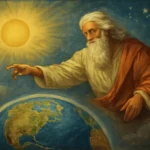
On the fourth day, God makes lights in the expanse of the heavens to separate day from night and to serve as signs for seasons, days, and years. The sun, moon, and stars are presented as created instruments within the order of the world. They help mark time, govern the rhythm of day and night, and provide light on the earth.
The passage does not use the familiar words “sun” and “moon” in the same direct way as many English readers expect. Some scholars suggest this may avoid giving those objects the names associated with neighboring cultures’ deities. Whether or not that is the specific reason, the narrative clearly places the heavenly bodies below God. They are not divine rulers; they are created lights with assigned functions.
This distinction would have been significant in the ancient world, where the sun, moon, planets, and stars were often connected with worship, omens, or divine powers. Genesis strips them of independent deity. Their brightness and regularity are real, but their existence and purpose depend on the Creator.
The sun and moon also help establish the human experience of time. Days, seasons, and years are not merely measurements imposed on a meaningless universe. Within the account, recurring times belong to the good ordering of creation. The heavenly lights serve the world rather than demanding worship from it.
Verse 16 identifies the greater light to govern the day and the lesser light to govern the night, while also mentioning the stars. The description is brief, but its theological force is strong: even the most impressive objects in the sky are creatures. They have assigned roles, limits, and depend on God’s command.
Reading tip: Pay attention to what the heavenly bodies do in Genesis 1:14-16—mark time, give light, and govern day and night. Their function matters more in the passage than their physical composition.
Many readers notice a broad correspondence between the first three days and the next three days. The opening group establishes realms, while the later group fills those realms. Day one creates or orders light and darkness; day four appoints the heavenly lights. Day two establishes the sky and waters; day five fills those regions with birds and sea creatures. Day three forms dry land and brings forth vegetation; day six fills the land with animals and people.
This pattern is not a rigid outline that answers every interpretive question, but it shows that the passage has deliberate literary design. The repetition of “there was evening and there was morning,” the evaluations of goodness, and the recurring formula “God said” all contribute to a carefully shaped account.
One useful way to observe the structure is to ask two questions at each stage:
What space or realm is being established?
What function or life will later occupy that space?
That approach prevents the passage from being reduced to a sequence of isolated objects. Light, sky, land, plants, and heavenly lights each have a place in a larger system. The account describes a world becoming ordered, productive, and ready for living beings.
What “good” means in Genesis 1:1-16
God repeatedly evaluates creation as good. In context, “good” includes suitability, beauty, order, and fitness for the purposes God assigns. Light is good because it serves the ordered world. Land and vegetation are good because they create a productive environment. The heavenly lights are good because they govern time and provide illumination.
The word does not mean that every part of creation is morally autonomous or that the passage answers every question about suffering in the natural world. It does mean that matter is not presented as a mistake. Physical creation has value because God intentionally made and approved it.
This perspective also gives the passage ethical implications. If land, water, vegetation, and the sky belong to a good created order, human beings should not treat them as worthless. Genesis 1:1-16 does not yet give the later instructions about human stewardship, but it establishes the world as something received rather than invented or owned absolutely by people.
What Genesis 1:1-16 says about God
The opening section presents God as distinct from creation. God is not one force within the universe, not a personified sun or storm, and not a local deity limited to one region. The Creator stands before and above the entire created order.
God’s creative work is also portrayed as effective and deliberate. Divine speech produces results, while divine acts establish boundaries and functions. There is no need for a struggle with competing gods or an accident that must later be repaired. Creation unfolds under purposeful authority.
The passage shows several aspects of that authority:
God commands: creation responds to divine speech and direction.
God separates: light is divided from darkness, waters are bounded, and realms receive definition.
God names: day, night, earth, and seas are identified under divine authority.
God evaluates: the created order is repeatedly judged good.
God assigns functions: lights govern time, plants reproduce, and spaces are prepared for life.
These features make Genesis 1 a theological account of kingship as well as creation. In the ancient world, rulers were associated with establishing order and assigning roles. Genesis presents God as the universal ruler who orders the cosmos without violence or rivalry.
How Genesis 1:1-16 relates to science and interpretation
Questions about science and Genesis often focus on the length of the days, the order of creation, and the meaning of the expanse. Several interpretations exist within religious communities. Some readers hold that the days describe six ordinary days. Others believe the days represent extended eras, a literary framework, or a sequence presented from a theological rather than laboratory perspective.
The Hebrew word translated “day” can refer to an ordinary day, a period of time, or a day understood within a literary sequence. Context matters, and sincere interpreters reach different conclusions. The repeated evening-and-morning formula is central to the ordinary-day reading, while the structured parallelism and questions about the sun’s placement lead others to read the passage differently.
Scientific models of cosmic and biological history address mechanisms, physical processes, and measurable development. Genesis 1 addresses ultimate origin, purpose, order, and dependence on God. Some people see these approaches as incompatible, while others understand them as answering different kinds of questions. The passage itself does not use the vocabulary of modern astronomy, geology, or biology.
A responsible reading should avoid two opposite mistakes. It should not force ancient poetic and theological language to behave like a modern textbook. It should also not assume that a text has no meaning simply because it is not written in the form of a scientific report. Careful interpretation asks what the passage emphasizes, how its structure works, and what claims it makes about God and creation.
Several recurring images help readers follow the passage. The first is darkness and light. Darkness describes the opening condition, while light signals the beginning of ordered time. The second is water and boundary. Waters are present at the start, but God divides and gathers them so that sky, sea, and land can be distinguished.
The third image is fruitfulness. Plants grow, trees bear fruit, and seeds make future growth possible. This points toward a creation that is not static. It has the capacity to reproduce and sustain life according to patterns God established.
The fourth image is the sky’s lights. The sun, moon, and stars do not merely decorate the heavens. They serve practical purposes by measuring time and governing recurring patterns. The passage links cosmic order with ordinary human experience—days, seasons, and years.
Together, these images create a movement from unformed space to ordered, fruitful space. The world is not presented as complete at verse 2. By verse 16, major realms have been separated, land has appeared, vegetation is growing, and time is being marked.
Ways to study Genesis 1:1-16 carefully
A helpful reading method begins with observation before interpretation. Notice repeated words, changes in location, and the functions assigned to each part of creation. Then ask how the passage’s details support its larger claims about God and the world.
Read the passage several times: identify the movements from darkness to light, waters to land, and emptiness to fruitfulness.
Mark repeated phrases: look for divine speech, separation, naming, evaluation, and the completion of each day.
Compare the realms: connect the first three days with the corresponding filling of creation in the later days.
Study key terms cautiously: consult more than one translation for “expanse,” “deep,” “Spirit,” and “day.”
Separate central claims from debated details: distinguish the passage’s clear theology from questions about chronology and scientific description.
Consider the original setting: ask how the account’s view of one Creator differs from ancient stories that treated natural forces as gods.
Apply the passage’s vision: reflect on what it means to see time, land, water, light, and living things as ordered gifts.
This method allows the text to speak on its own terms. It also leaves room for serious discussion among readers who share the conviction that Genesis is significant but disagree over how its days or imagery should be understood.
Why Genesis 1:1-16 remains significant
The passage gives readers a framework for thinking about existence before addressing human identity or morality. It says that the world is not self-explanatory, that creation has order, and that nature is neither divine nor meaningless. Light, land, plants, and stars exist within a pattern established by God.
It also gives time and place a theological significance. Morning and evening, seasons and years, dry land and seas are not distractions from spiritual life. They belong to the created order. The passage therefore resists a sharp division between what is “spiritual” and what is physical. The ordinary world is part of God’s purposeful work.
For worship, Genesis 1 directs attention away from created things and toward their Maker. For ethics, it encourages respect for the world that supports life. For interpretation, it teaches readers to pay attention to literary structure, cultural setting, and the difference between theological claims and modern scientific categories.
Genesis 1:1-16 does not answer every question about how the universe works. It does answer the foundational question the passage chooses to address: the world belongs to God, and its order, fruitfulness, and continuing rhythms exist by divine will.
Frequently asked questions
Does Genesis 1:1-16 describe six literal twenty-four-hour days?
Christians and Jewish interpreters have answered this differently. Some understand the repeated evening-and-morning language as six ordinary days. Others see the days as longer periods or as a literary framework that organizes the creation account. The passage’s central emphasis is God’s ordering work, so debates about duration should be distinguished from its theological claims about creation and divine authority.
What was created on the first four days of Genesis 1?
The first day introduces light and separates it from darkness. The second establishes the sky between the waters. The third brings visible land, seas, plants, and trees. The fourth appoints the heavenly lights—the sun, moon, and stars—to illuminate the earth and mark days, seasons, and years.
Why are the sun and moon created after light?
Genesis presents light before the heavenly bodies and later gives the sun and moon their functions. Interpreters explain this in different ways, including a literary arrangement that establishes day and night before assigning celestial markers to them. The passage’s emphasis is that light and the heavenly bodies are under God’s authority, not independent divine powers.
What does Genesis 1:1-16 teach about the natural world?
It portrays the natural world as created, ordered, productive, and good. Land, water, vegetation, light, and the stars have defined places and purposes, but none is itself a god. This view supports gratitude for creation and responsible care for the physical world while leaving room for discussion about scientific processes and chronology.














Leave a Reply