First Corinthians chapter 10 teaches that God’s people must learn from Israel’s failures and use their freedom in ways that honor God and protect others.
Many readers who search for “Corinthians chapter 10” mean 1 Corinthians 10, Paul’s teaching about temptation, idolatry, worship, and Christian freedom. The chapter connects Israel’s wilderness experience with the life of the church in Corinth, showing that spiritual privileges do not make a person immune to disobedience.
The chapter also addresses a practical question: How should Christians make everyday decisions when an action may be permitted but could harm someone else’s faith? Paul’s answer centers on loyalty to God, awareness of spiritual danger, concern for other people, and a desire to glorify God in ordinary activities.
First Corinthians 10 has three closely connected movements. In the opening section, Paul recalls how the Israelites experienced God’s care in the wilderness but still fell into serious sin. In the middle, he warns the Corinthians not to participate in idolatry. In the final section, he applies those principles to food, personal freedom, and the conscience of others.
The chapter’s central warning is that religious experience alone does not guarantee faithfulness. Israel had visible evidence of God’s presence and provision, yet many people still turned toward evil. Paul wants the Corinthian believers to see that baptism, communion, knowledge, or belonging to a Christian community should produce obedience rather than overconfidence.
At the same time, the chapter is not meant to create constant fear. Paul presents God as faithful in temptation and gives believers a way to respond wisely. The goal is not to avoid every activity that another person might misunderstand, but to reject idolatry and choose conduct that benefits people rather than placing unnecessary obstacles in their way.
Why Paul recounts Israel’s wilderness story
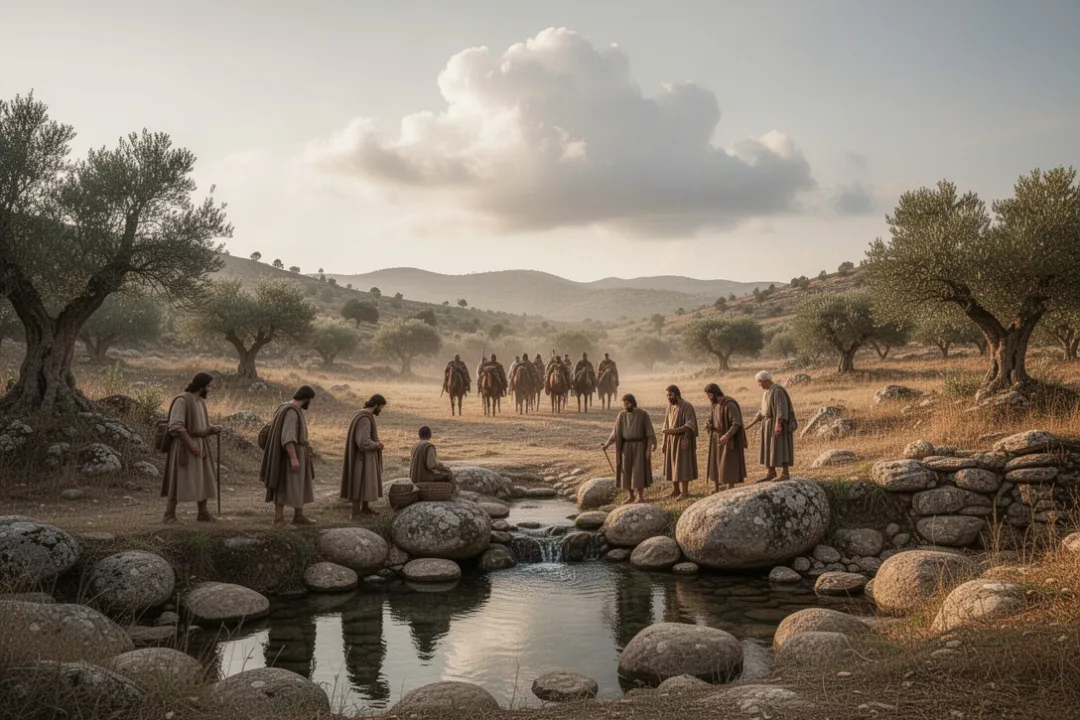
Paul begins by referring to the ancestors of Israel who traveled under the cloud and passed through the sea. These images point to God’s protection during the exodus from Egypt. Paul treats the experience as a kind of shared identification with Moses, drawing a comparison between Israel’s initiation into the covenant community and Christian baptism.
The Israelites also ate spiritual food and drank spiritual water. Paul connects the wilderness provision to God’s continuing care and describes the rock from which they drank in relation to Christ. He is not simply retelling a history lesson; he is showing that God’s people have always depended on divine grace.
Yet the majority of that generation did not please God, and many died in the wilderness. Their access to God’s gifts did not remove their responsibility to trust and obey him. Paul says these events serve as examples for Christians, especially for people who may assume that their spiritual status makes them secure regardless of their choices.
The warning includes several forms of rebellion. Israel gave itself to evil desires, participated in idolatry, engaged in sexual immorality, tested God, and complained against him. Paul refers to these episodes through references to Israel’s history rather than reproducing the biblical passages word for word.
These examples are especially relevant because Corinth was surrounded by pagan religion, public feasts, sexual temptation, social pressure, and competing loyalties. The Corinthians were not facing the same historical circumstances as Israel, but they were facing the same basic human temptation: to receive God’s blessings while treating sin casually.
Central warning: Spiritual privileges should lead to humility and obedience, not confidence that you can safely approach temptation without consequences.
What “let the one who thinks he stands” means
Paul warns readers who believe they are standing firmly to be careful that they do not fall. The statement challenges spiritual overconfidence. A person may know correct teaching, participate in worship, or have a strong reputation while still being vulnerable to pride and compromise.
This warning does not mean that every Christian is destined to fail or that assurance is impossible. It means that confidence must remain dependent on God rather than on personal strength. Humility keeps a believer alert, willing to accept correction, and ready to leave situations that make sin more likely.
The warning also explains why Paul uses Israel as an example. The Corinthians may have reasoned that idols were powerless and that their knowledge gave them freedom to attend pagan meals. Paul responds by reminding them that correct ideas do not automatically produce safe behavior.
Christian maturity includes knowing when a liberty is spiritually unwise. Someone may be able to explain why an activity is technically allowed and still need to avoid it because the setting encourages idolatry, feeds a destructive habit, or pressures another believer to act against conscience.
What 1 Corinthians 10 teaches about temptation
Paul says that the temptations believers face are common to humanity. This does not minimize the pain or seriousness of temptation. It means that temptation is not proof that God has abandoned you, nor is it a unique condition that makes obedience impossible.
God is described as faithful. He will not allow temptation to become an excuse for unavoidable sin, and he provides a way to endure it. That way may involve leaving a situation, asking for help, confessing honestly, changing routines, refusing access to something harmful, or choosing a different relationship or environment.
The familiar phrase “a way of escape” should not be reduced to one dramatic rescue. In context, it refers to a practical path through temptation so that the believer can endure without surrendering. Sometimes the escape is a changed circumstance; at other times it is the wisdom to recognize danger early and walk away.
Paul’s promise should also be handled carefully. He does not say that believers will never face powerful temptation, emotional distress, or repeated struggle. He says that God remains trustworthy and that temptation does not have the final authority over a person who turns to God for strength and obedience.
Useful responses to temptation may include:
Identify the pattern: Notice the time, place, emotion, relationship, or thought that regularly precedes the temptation.
Act before the crisis: Remove access, establish boundaries, and decide in advance what you will do when pressure comes.
Seek honest support: Talk with a mature Christian, pastor, counselor, or other trustworthy person when secrecy is strengthening the problem.
Replace the behavior: Choose a constructive response rather than merely telling yourself not to do something.
Remember God’s faithfulness: Depend on prayer, Scripture, wise community, and concrete obedience rather than willpower alone.
The chapter therefore combines warning and hope. It warns against treating temptation lightly, while assuring believers that they are not trapped. Dependence on God and practical wisdom belong together.
Why Paul says to flee idolatry
After discussing Israel’s failures, Paul gives a direct command to flee idolatry. He does not tell the Corinthians merely to study idols more carefully or to prove that they understand the difference between an idol and the living God. He tells them to get away from participation in idolatrous worship.
That command makes sense within the religious culture of Corinth. Meals connected with pagan temples could include social relationships, business networking, family expectations, and public celebrations. The Corinthians may have argued that an idol had no real divine power. Paul agrees that an idol is not truly God, but he still rejects participation in worship associated with demonic powers.
The issue is not that pagan objects possess equal authority with God. The issue is spiritual allegiance. Worship is never a neutral activity for Paul. Sharing a religious meal can communicate fellowship with the god being honored, even when the participant claims to hold a different private belief.
Paul uses the Lord’s Supper as a comparison. When Christians share the bread and cup, they participate in the fellowship and meaning of Christ’s sacrifice. In the same way, those who participate in pagan sacrificial meals enter into a religious fellowship that conflicts with devotion to Christ.
This is why Paul asks whether the Corinthians can share the Lord’s table and the table associated with demons. The question exposes a contradiction. Christian worship requires exclusive loyalty; believers cannot deliberately treat rival worship as harmless entertainment and then assume the two forms of fellowship have no conflict.
How communion relates to loyalty and worship
The reference to the Lord’s table gives the chapter a strong connection to communion. Paul is not presenting communion as a magical protection from sin. He is emphasizing that the meal expresses a real relationship with Christ and with the gathered church.
Sharing communion declares belonging to Jesus and recognition of his saving work. It therefore cannot be separated from the question of how believers live. A person cannot use the Lord’s table as evidence of spiritual security while knowingly joining worship that denies or rivals Christ.
This does not mean every contact with another religion is automatically idolatry. Christians may work with, study alongside, serve, and build respectful friendships with people from many religious backgrounds. The boundary Paul draws concerns participation in worship, not ordinary contact with neighbors or coworkers.
The principle remains useful today. A Christian may need to think carefully about religious ceremonies, ritual meals, spiritual practices, or entertainment that invites active devotion to another power. The question is not only, “Do I personally believe this?” but also, “What am I joining, affirming, or communicating by taking part?”
Paul then turns to the saying that all things are permitted. He does not repeat it as an unlimited slogan. Instead, he qualifies freedom with two tests: Is it beneficial? and Does it build others up?
Those questions distinguish Christian freedom from simple self-determination. Freedom in Christ is not the right to insist on every personal preference. It is the ability to live faithfully without being controlled by unnecessary rules, while choosing restraint when love requires it.
Paul says that believers should not seek only their own advantage. They should also consider the good of others. This does not mean pleasing everyone or allowing another person’s preferences to control every decision. It means refusing to use freedom in a way that predictably damages another person’s conscience or spiritual life.
The principle applies far beyond food offered to idols. It may affect drinking, entertainment, spending, language, social events, exercise of authority, or participation in cultural practices. The specific application depends on the situation, but the underlying question remains: How can my choice reflect love rather than self-centered entitlement?
Paul’s approach avoids two opposite mistakes. One mistake is legalism, which treats every questionable activity as forbidden for everyone. The other is individualism, which says that personal freedom settles every question. Christian wisdom considers truth, conscience, context, consequences, and the welfare of others.
What the marketplace and dinner examples mean
Paul gives practical instructions about meat sold in the marketplace. Believers could eat what was sold without conducting an investigation into its history. They did not need to become anxious detectives or assume that ordinary food was spiritually contaminated because it might once have been connected with a pagan sacrifice.
If an unbeliever invited a Christian to a meal, Paul allowed the believer to eat what was served without interrogating the host about the food. This advice protects normal social relationships and prevents unnecessary suspicion. Christians were not required to withdraw from society simply because pagan practices existed around them.
There was one significant qualification. If someone specifically identified the food as having been offered in sacrifice, the Christian should abstain. Paul’s concern was not the meat itself but the message and effect of eating it in that setting. The action could appear to approve idolatry or pressure a person with a sensitive conscience.
The contrast is helpful:
Ordinary marketplace food: Receive it without needless investigation or fear.
A private meal with an unbeliever: Accept hospitality without turning the occasion into a religious interrogation.
Food explicitly connected to an idol: Refrain when the connection is made clear, especially for the sake of conscience and witness.
Public participation in temple worship: Reject it because it represents fellowship with a rival spiritual power.
Paul’s teaching leaves room for conscience while giving conscience a clear direction. The sensitive believer should not be mocked, and the knowledgeable believer should not use freedom to display superiority. Both people are called to seek a response that honors God and protects the church.
Practical tips for applying 1 Corinthians chapter 10
Applying this chapter requires more than asking whether a rule technically permits a particular choice. Use its principles to examine motives, setting, relationships, and likely consequences. The following questions can help:
Am I treating spiritual privilege as permission to become careless? Regular worship, Bible knowledge, or Christian service should produce humility rather than confidence that you cannot fall.
Does this activity involve actual worship or spiritual allegiance? Distinguish respectful contact with people from participation in a religious practice that honors another power.
Could this choice strengthen a destructive pattern? An action may be harmless in one setting but dangerous for you because of addiction, history, or emotional vulnerability.
Will this help build up other people? Consider whether your conduct encourages faith, wisdom, and love or merely proves that you have the right to do something.
Am I pressuring someone to violate conscience? Do not use your freedom to make another Christian feel forced to imitate you against sincere conviction.
Can I give thanks to God for this choice? Gratitude does not make every action right, but the inability to connect an action with sincere worship may reveal a serious problem.
Would this choice point people toward Christ? Christian conduct is public witness, even when you do not intend to make a statement.
Common mistakes include treating “everything is permissible” as a complete answer, assuming that knowledge eliminates spiritual danger, and confusing tolerance with participation. Another mistake is applying Paul’s concern only to ancient idol temples while ignoring modern forms of devotion to status, money, pleasure, power, or identity.
It is also possible to misuse the chapter by imposing personal scruples on everyone else. Paul does not encourage believers to create an endless list of restrictions. He teaches discernment shaped by love, not fear-driven control.
Helpful test: Before exercising a freedom, ask whether the choice is faithful to Christ, safe for your own spiritual life, and genuinely beneficial to the people affected by it.
What “do everything for God’s glory” means
Paul closes the discussion by giving a broad principle: whether believers eat, drink, or do anything else, they should do it for God’s glory. This statement turns an argument about food into a vision for the whole Christian life.
Glorifying God means living in a way that displays his character, recognizes his authority, and directs attention toward what is good and true. It includes major spiritual decisions, but it also includes meals, conversations, friendships, work, recreation, and public behavior.
The principle does not require a person to make every ordinary action solemn or performative. It asks whether daily choices are consistent with gratitude, holiness, love, and truthful witness. A simple meal can honor God when received with thanks; a supposedly religious action can dishonor him when performed with pride or harm toward others.
Paul then tells the Corinthians not to place unnecessary stumbling blocks before Jews, Greeks, or the church of God. His concern is missionary and relational. Believers should not make choices that needlessly obstruct another person from hearing or responding to the gospel.
He presents his own conduct as an example, saying that he seeks the benefit of many rather than his own advantage. His aim is that people may be saved. This does not mean Paul changes the gospel or approves sin to gain acceptance. It means he willingly gives up legitimate preferences when doing so removes an unnecessary barrier.
How 1 Corinthians 10 differs from 2 Corinthians 10
The phrase “Corinthians chapter 10” can refer to either 1 Corinthians 10 or 2 Corinthians 10. First Corinthians 10 focuses on Israel’s warnings, idolatry, temptation, food connected with pagan worship, and the responsible use of freedom.
Second Corinthians 10 has a different emphasis. Paul defends the nature of his apostolic ministry, explains that Christian warfare is not fought with merely human weapons, and addresses criticism of his authority and appearance. It includes teaching about strongholds, arguments, obedience, and boasting in the Lord.
Both chapters address the difference between outward confidence and genuine spiritual authority, but they should not be blended together. If a study guide, sermon, or Bible question mentions temptation and idol food, it is almost certainly discussing 1 Corinthians 10. If it mentions spiritual weapons and Paul’s defense of his ministry, it is referring to 2 Corinthians 10.
Questions 1 Corinthians chapter 10 asks you to consider
Paul’s teaching invites personal examination without encouraging obsessive fear. You can ask whether you are relying on Christian identity while ignoring a repeated area of disobedience. You can also consider whether a supposedly harmless freedom is shaping your desires, weakening your witness, or pressuring someone else.
The chapter encourages a balanced faith. It takes spiritual evil seriously, but it does not portray believers as helpless. It values conscience, but it does not make every personal preference a universal command. It recognizes freedom, but it places freedom under love, holiness, and God’s glory.
Its message can be expressed simply: remember the failures of those who came before you, refuse every form of idolatry, trust God in temptation, and use your freedom to serve rather than dominate. Those principles apply in church life, private decisions, public relationships, and ordinary daily choices.
Frequently asked questions
Is 1 Corinthians chapter 10 mainly about temptation?
Temptation is one of its best-known themes, especially Paul’s assurance that God is faithful and provides a way to endure. However, the chapter also addresses Israel’s failures, idolatry, communion, Christian liberty, conscience, relationships with unbelievers, and the call to glorify God in every activity.
What does 1 Corinthians 10 say about eating food offered to idols?
Paul distinguishes ordinary food from deliberate participation in idol worship. Christians did not need to investigate the background of marketplace food, but they should avoid meals clearly presented as part of pagan worship. The decision should also consider another person’s conscience and the message communicated by the meal.
Does this chapter say Christians cannot enjoy any freedom?
No. Paul recognizes that believers have freedom, but he says freedom should be evaluated by its benefit and its effect on others. A permitted action may still be unwise if it strengthens a harmful habit, resembles idolatry, damages someone’s conscience, or distracts people from the gospel.
What is the main lesson of “do everything for God’s glory”?
The principle means that ordinary choices should reflect gratitude, loyalty to God, love for others, and a credible Christian witness. It applies to more than religious activities. Eating, drinking, work, entertainment, conversations, and social decisions can all be considered in light of whether they honor God and help people.














Leave a Reply