“Corinthians 4” can refer to either 1 Corinthians 4 or 2 Corinthians 4, and the two chapters address different problems with a related message about faithful Christian service.
Why “Corinthians 4” can mean two different chapters
The Bible contains 1 Corinthians 4 and 2 Corinthians 4. Both letters were written by the apostle Paul to the Christian community in Corinth, an important ancient city in Greece. Because the references look similar, a search for “Corinthians 4” may be asking about either chapter.
First Corinthians 4 focuses on church leadership, spiritual pride, judgment, and the apostles’ hardships. Paul urges the Corinthians to evaluate leaders as servants and stewards, not as celebrities or rivals. He also challenges their confidence that they have already reached spiritual maturity.
Second Corinthians 4 focuses on Paul’s ministry under pressure. It describes the gospel as a treasure carried in fragile human lives, explains how suffering can display the life of Jesus, and points believers toward eternal realities rather than temporary troubles.
Quick distinction: 1 Corinthians 4 asks how Christians should view leaders and spiritual status. 2 Corinthians 4 asks how Christians can remain faithful when ministry and life involve weakness, opposition, and suffering.
The historical and spiritual context of both chapters
Paul wrote 1 Corinthians to address serious divisions and disorder in the Corinthian church. Some believers identified themselves with particular teachers, including Paul, Apollos, and Cephas, creating factions within the congregation. Others were impressed by persuasive speech, public influence, or displays of spiritual knowledge.
Paul responds by redirecting attention away from personalities and toward Christ’s authority. The apostles are not owners of the church. They are entrusted with a message and will answer to God for how they handle it. This context explains why 1 Corinthians 4 speaks so strongly about humility, accountability, and the difference between appearance and reality.
Second Corinthians comes from a more personal setting. Paul is defending the integrity of his ministry against people who judged him by outward standards. His opponents seem to have valued impressive presentation, rhetorical strength, and visible success, while Paul’s ministry included rejection, physical danger, emotional strain, and apparent weakness.
In 2 Corinthians 4, Paul explains that the power belongs to God, not to the messenger. His weakness does not disprove his calling. Instead, it becomes the setting in which God’s sustaining power can be seen more clearly.
How to read the reference step by step
If someone gives you the reference “Corinthians 4” without naming the book, use the surrounding words to identify the intended chapter. The following process helps prevent confusion:
Check the number before Corinthians. “1 Corinthians 4” and “2 Corinthians 4” are separate chapters with different themes.
Look for the subject being discussed. Church factions and apostolic leadership usually point to 1 Corinthians 4. Suffering, spiritual perseverance, and treasure in jars of clay usually point to 2 Corinthians 4.
Read the complete chapter. Individual verses can sound different when separated from Paul’s argument, especially passages about judgment, hardship, or spiritual confidence.
Read the surrounding chapters. First Corinthians 3–4 develops Paul’s correction of church pride. Second Corinthians 3–5 develops his defense of the new-covenant ministry and resurrection hope.
Ask what the chapter reveals about Christ and Christian life. Both chapters move beyond information toward a transformed understanding of service, weakness, humility, and hope.
A reference such as 1 Corinthians 4:20 is not interchangeable with 2 Corinthians 4:20. The first belongs to a chapter about God’s kingdom being demonstrated in spiritual reality rather than speech alone. The second belongs to a chapter emphasizing unseen and eternal realities, and its final verse is numbered differently because the chapters are organized independently.
What 1 Corinthians 4 teaches about Christian leaders
Paul begins 1 Corinthians 4 by describing himself and other apostles as servants of Christ and stewards of God’s revealed truth. The image is practical: a steward manages something that belongs to someone else. That means Christian leaders do not possess the gospel as personal property, and they are not free to reshape it to gain admiration.
The central standard is faithfulness. Paul does not say that leaders must satisfy every critic or create an impressive public image. He says that those entrusted with a responsibility must be dependable. Their ultimate evaluation comes from the Lord, whose judgment reaches motives and hidden actions as well as visible results.
This does not mean churches should ignore serious wrongdoing. The chapter is not a command to protect leaders from all examination or accountability. Rather, it warns against premature and self-important judgment. Human opinions are limited, and people often evaluate ministry by the wrong standards.
Paul’s warning against judging by appearances
Paul tells the Corinthians not to make final judgments before the proper time. God will bring hidden things to light and reveal the motives of hearts. The point is not that discernment has no place in Christian life. Scripture elsewhere calls believers to recognize false teaching and harmful conduct. The point is that ultimate judgment belongs to God.
That distinction matters in churches today. You can examine teaching, character, financial practices, and treatment of people without pretending to know every motive. A wise response combines careful discernment with humility. It avoids both naïve trust and confident condemnation.
Paul also exposes the danger of comparing one leader with another. The Corinthians had turned gifted teachers into symbols of group identity. Paul asks questions that, in effect, remind them that everything they possess was received. Their knowledge, spiritual gifts, and teachers are not reasons for boasting as if they had created these blessings themselves.
How spiritual pride distorts Christian maturity
In the middle of the chapter, Paul uses irony to challenge the Corinthians’ inflated self-image. They behave as if they are already rich, powerful, and fully established, while the apostles appear weak and dishonored. Paul contrasts their comfortable confidence with the apostles’ visible hardship.
His purpose is not to praise misery for its own sake. He is showing that the cross-shaped pattern of Christian service does not always look impressive. A person may have knowledge, influence, and strong opinions while still lacking humility and love. External success is not a reliable measure of spiritual maturity.
Paul’s language also corrects a common misunderstanding: becoming a Christian does not place someone above correction, sacrifice, or dependence on God. Spiritual maturity is not demonstrated by acting as though you need no instruction. It is shown through humility, endurance, obedience, and love.
Practical principle: Christian influence should be measured by faithfulness to Christ and care for people, not merely by platform size, confident speech, education, or visible success.
Why Paul describes himself as a spiritual father
Paul explains that he became like a father to the Corinthians through the gospel. He is not claiming ownership over them or placing himself above Christ. He is describing a relationship of personal responsibility and affection: he brought them the message of Christ and invested himself in their spiritual formation.
Because of that relationship, he urges them to imitate his way of life. This request is not an invitation to copy every personal detail of Paul’s circumstances. It means they should follow his Christ-centered pattern of humility, sacrifice, and obedience.
Paul then says he is sending Timothy, a trusted coworker who will remind them of his ways in Christ. Timothy’s role is pastoral rather than theatrical. He is meant to help the Corinthians remember that Christian teaching includes a way of living, not merely a set of arguments.
The chapter ends with a firm challenge. Some Corinthians are acting as though Paul will not return and will not hold them accountable. Paul says that the issue is not simply speech but spiritual power. God’s kingdom is not established by impressive talk alone; it is demonstrated in transformed lives and faithful conduct.
What 2 Corinthians 4 teaches about ministry under pressure
Second Corinthians 4 begins with Paul’s response to discouragement. Because he has received a ministry through God’s mercy, he refuses to give up. His perseverance does not rest on personal toughness. It flows from the conviction that God entrusted him with the ministry and continues to sustain him.
Paul describes his conduct as open and honest. He rejects manipulation, hidden shame, and the distortion of God’s message. His defense is significant because some people judged his ministry by outward standards. Paul insists that the messenger’s integrity matters: the gospel should be presented with truthfulness rather than clever pressure.
How the gospel can remain hidden from some people
Paul says that the gospel is veiled to those who are perishing, with the “god of this age” described as blinding unbelieving minds. He is explaining why the message of Christ may be rejected even when it is proclaimed clearly. Spiritual opposition and human resistance can prevent people from seeing the gospel’s glory.
Paul does not respond by inventing a more attractive message. He continues to proclaim Jesus Christ as Lord and presents himself as a servant for the sake of the church. The focus remains on God’s revelation in Christ, not on the messenger’s personality.
This section also guards against making Christian communication primarily about performance. Clear communication matters, but the goal is not to make the speaker look brilliant. The goal is to make the truth about Christ visible and understandable without manipulation.
What “treasure in jars of clay” means
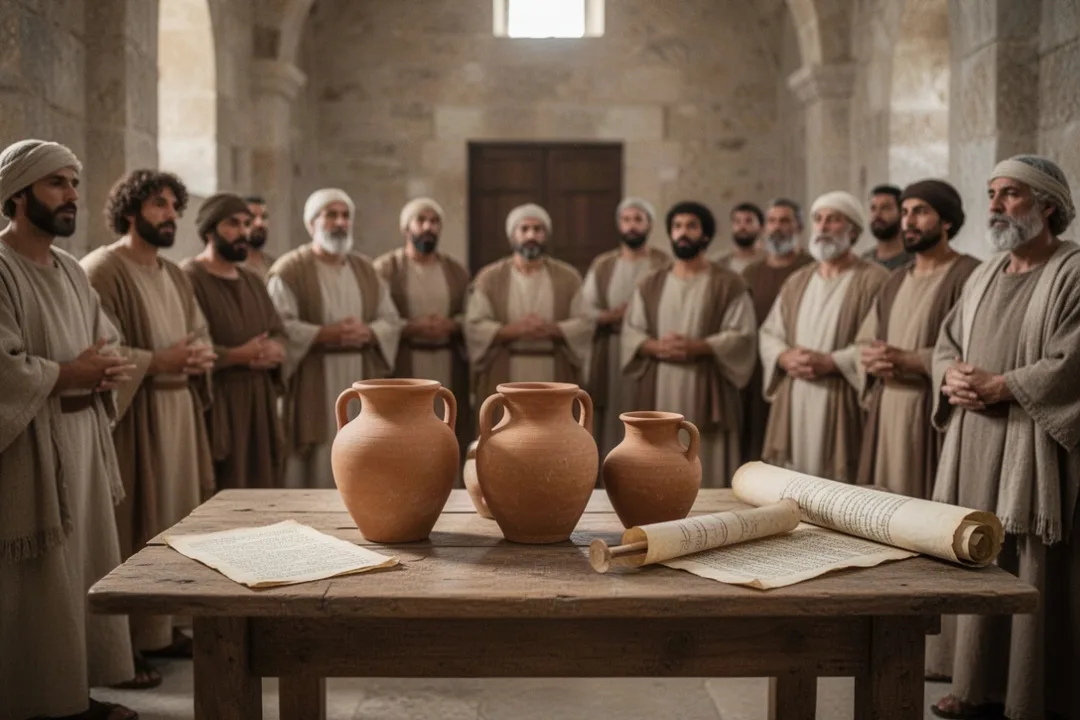
One of the best-known images in 2 Corinthians 4 compares the gospel’s treasure with fragile containers. In the ancient world, ordinary clay vessels were inexpensive, breakable, and unremarkable. Paul uses that image to describe the contrast between the priceless message and the weakness of its human messengers.
The image does not mean that human beings are worthless. It means that the source of extraordinary spiritual power is not the messenger’s status or strength. God places the treasure in vulnerable people so that the surpassing power may be recognized as belonging to God.
This teaching offers balance. You should not use weakness as an excuse for careless behavior, dishonesty, or refusal to grow. At the same time, you should not assume that God can work only through polished, powerful, or publicly impressive people. Faithful service may come through someone who is limited, tired, grieving, or overlooked.
How Paul describes suffering without glorifying it
Paul lists a series of pressures: being afflicted, perplexed, persecuted, and struck down. He does not claim that believers will avoid trouble. Instead, he distinguishes between being pressed and being destroyed. The ministry is under real pressure, but God does not abandon the people carrying it.
Paul connects the apostles’ suffering with the death and life of Jesus. Their bodies bear the cost of serving, while the life of Jesus becomes visible through their endurance. This does not mean that Paul’s suffering adds to Christ’s saving work. It means his ministry follows the pattern of the crucified and risen Lord.
For readers facing hardship, the passage offers neither a promise of instant relief nor a simplistic explanation for every painful event. It offers a framework for hope: present suffering is not the final measure of God’s work, and weakness does not prove that God has withdrawn.
Why Paul keeps speaking despite danger
Paul says that he has the same spirit of faith expressed in the biblical tradition: because he believes, he speaks. His proclamation continues because he trusts the God who raised Jesus and who will also raise his people. The foundation of his courage is therefore resurrection hope, not optimism about circumstances.
Paul also views his suffering through the lens of service. He is willing to endure hardship for the benefit of others so that more people may receive grace and give thanks to God. This does not make suffering automatically good. It shows that God can use costly service to extend mercy and produce thanksgiving.
The result is an inward renewal that continues even while the outward person experiences decline. Paul acknowledges the reality of physical and emotional wear, but he refuses to let visible deterioration define the whole story. Inner renewal is possible because God’s grace is active in the midst of weakness.
How the two chapters address different forms of pride
Although 1 Corinthians 4 and 2 Corinthians 4 were written in different situations, both challenge a distorted view of Christian strength. In 1 Corinthians, pride appears as factionalism, self-satisfaction, and confidence in status. In 2 Corinthians, the issue is the demand that ministry look impressive according to ordinary standards.
First Corinthians 4 says, in effect, that Christians should not turn leaders into trophies or treat knowledge as proof of superiority. Second Corinthians 4 says that Christians should not reject a faithful ministry simply because its messenger is weak or afflicted. Together, the chapters point toward humble dependence on God.
1 Corinthians 4: Do not boast in human leaders or confuse confidence with maturity.
2 Corinthians 4: Do not confuse human weakness with ministry failure.
Both chapters: Judge by God’s standards rather than by appearance, reputation, or public power.
This connection is useful when assessing your own spiritual life. You might feel superior because of your knowledge, church position, or associations. Or you might feel disqualified because your service looks small and your limitations are visible. These chapters challenge both reactions.
What Corinthians 4 says about endurance and hope
Second Corinthians 4 is especially direct about the relationship between temporary trouble and eternal glory. Paul does not minimize affliction. He calls it real and weighty. Yet he compares it with a future glory that is beyond measure and lasting, while the visible circumstances of the present life are temporary.
His instruction is to focus on what cannot be seen. This does not require ignoring ordinary responsibilities or pretending that pain is unreal. It means recognizing that visible circumstances are not the whole of reality. Resurrection, God’s presence, and the future renewal of believers give present suffering a different horizon.
That hope can shape daily decisions. It can help you remain honest when dishonesty appears profitable, continue serving when recognition is absent, and resist the belief that a difficult season has erased God’s purposes. Christian endurance is not denial; it is faithful action grounded in a larger promise.
Practical ways to apply 1 and 2 Corinthians 4
The chapters offer specific questions for personal reflection, church leadership, and relationships. Their application should remain connected to the original themes rather than becoming a collection of general inspirational ideas.
Examine your view of leaders. Do you treat pastors, teachers, or ministry personalities as servants accountable to God, or as representatives of your preferred group?
Separate discernment from condemnation. Test teaching and behavior carefully, while remembering that God alone knows every motive and gives final judgment.
Measure maturity by character. Knowledge, confidence, and public success matter less than faithfulness, humility, love, and obedience.
Tell the truth about weakness. Do not pretend that ministry, family life, or faith is painless. Honest weakness can lead to dependence on God and appropriate support from others.
Reject manipulation. Communicate the gospel clearly and truthfully rather than using pressure, exaggeration, or image management.
Look beyond appearances. A small act of service may carry lasting value even if it receives no public recognition.
Hold on to resurrection hope. Present hardship is serious, but it does not have the authority to define your final future.
These applications also provide a healthy way to evaluate churches. Ask whether a congregation rewards celebrity, defensiveness, and outward polish, or whether it encourages truth, accountability, service, and spiritual growth. A church shaped by Corinthians 4 will take both integrity and weakness seriously.
Important cautions when interpreting Corinthians 4
Neither chapter should be used to silence legitimate concerns. Paul’s teaching about not judging prematurely does not excuse abuse, deception, exploitation, or criminal conduct. Christian communities still need wise safeguards, responsible leadership, and appropriate reporting when someone is harmed.
Likewise, 2 Corinthians 4 should not be used to pressure people to remain in dangerous situations. Paul’s endurance arose from a particular apostolic calling and does not mean every believer must accept preventable harm. Seeking safety, medical care, pastoral help, or legal assistance can be consistent with wisdom and faith.
Another caution concerns the phrase “outwardly wasting away.” Paul is speaking honestly about mortality and hardship, not issuing a command to neglect the body. The chapter holds physical weakness and spiritual renewal together. Caring for your health, resting, and receiving help are not signs that you lack faith.
Finally, the image of treasure in fragile vessels should not become an excuse for poor preparation or careless teaching. God’s power is displayed through weakness, but faithfulness still includes study, honesty, responsibility, and love for those being served.
How to study either chapter carefully
Begin by identifying the book and reading the chapter in several translations if possible. Since wording differs among translations, focus on the flow of thought, repeated contrasts, and connections with the surrounding chapters rather than building an interpretation on one isolated phrase.
For 1 Corinthians 4, mark the references to servants, stewards, judgment, boasting, suffering, imitation, and power. Ask why Paul contrasts the Corinthians’ sense of arrival with the apostles’ experience of weakness. Then read chapter 3 to see how the discussion of leaders and God’s building leads into chapter 4.
For 2 Corinthians 4, mark the references to mercy, truth, blindness, glory, suffering, faith, renewal, and unseen things. Read chapter 3 first to understand the contrast between the old covenant and the new-covenant ministry, then read chapter 5 to see how resurrection and eternal hope continue.
A helpful study sequence is:
Identify the problem Paul is addressing in the church.
Observe the images he uses, such as stewards, fathers, jars of clay, and visible versus unseen things.
Trace the contrasts between human appearance and God’s evaluation.
Connect the argument to Jesus. Notice how service, suffering, death, resurrection, and lordship shape Paul’s reasoning.
Apply the principle carefully to your conduct without ignoring the chapter’s original context.
Read together, the two chapters give a grounded picture of Christian service. Leaders are stewards rather than owners. Believers are called to humility rather than spiritual boasting. Ministry may involve weakness and pressure, yet God’s power and future restoration remain greater than what can be seen at present.
Frequently asked questions
Is “Corinthians 4” referring to 1 Corinthians or 2 Corinthians?
It could refer to either one. The full reference must include the first number: 1 Corinthians 4 concerns church leadership, pride, apostolic suffering, and spiritual maturity; 2 Corinthians 4 concerns Paul’s ministry, weakness, suffering, and eternal hope. If a quotation or theme mentions “jars of clay,” it is from 2 Corinthians 4.
What is the main message of 1 Corinthians 4?
First Corinthians 4 teaches that Christian leaders are servants and stewards who will answer to God. It warns believers not to boast in leaders, judge motives arrogantly, or mistake knowledge and confidence for maturity. Paul also presents his hardships as a correction to the Corinthians’ inflated view of spiritual status and calls them toward humble, Christ-centered living.
What does the treasure in jars of clay represent?
In 2 Corinthians 4, the treasure represents the gospel and its life-giving message, while the jars of clay represent fragile human messengers. The image emphasizes that the extraordinary power belongs to God, not to the speaker’s talent, reputation, or strength. It encourages humility while still calling ministers to honesty, responsibility, and faithful service.
How can 2 Corinthians 4 help someone facing suffering?
The chapter acknowledges genuine distress instead of pretending that hardship is easy. It encourages believers to distinguish between being pressured and being abandoned, and to view present troubles in light of resurrection and eternal hope. It does not promise that every problem will quickly disappear, but it teaches that suffering does not have the final word or define a person’s future.

















Leave a Reply