Charles Foucauld was a French Catholic priest, hermit, and missionary whose life moved from military service and exploration to prayer, simplicity, and service among the poor. He is best known for a spirituality centered on the hidden life of Jesus, humble presence, and friendship with people of other faiths.
Foucauld was born in 1858 and died in 1916 at Tamanrasset, in the Sahara. Pope Francis canonized him on May 15, 2022, recognizing a life that continues to influence Christian communities, religious congregations, and laypeople seeking a quieter, more generous way to live their faith.
Charles Eugène de Foucauld came from an aristocratic French family and experienced the loss of both parents while he was still young. He was raised with his sister Marie, and his early life included a conventional education, military training, and a period in which he described himself as distant from religious belief.
As a young officer, Foucauld served in the French army. He later took part in an expedition through Morocco in the early 1880s, traveling in disguise because European access to parts of the country was restricted. His observations and maps earned him recognition as an explorer and geographer, but the experience also changed how he viewed Muslim faith and North African society.
His return to France began a period of spiritual searching. The hospitality and devotion he had encountered among Muslims made him reconsider the religious indifference of his own life. In 1886, while in Paris, he sought guidance from Abbé Henri Huvelin, a priest connected with the parish of Saint-Augustin.
That encounter led to his conversion to Christianity. Foucauld later saw this moment not as an isolated emotional event but as the beginning of a complete reorientation. He wanted to imitate Jesus more closely, especially the years Jesus spent living an ordinary, hidden life before beginning his public ministry.
At the center of Foucauld’s life: he believed that Christian discipleship meant becoming close to people through ordinary presence, humble work, prayer, and concrete care rather than relying mainly on public influence.
How Foucauld’s conversion changed the direction of his life
After his conversion, Foucauld gave away much of the status and comfort associated with his background. He began looking for a form of religious life marked by poverty and obedience, not as an abstract ideal but as a practical way to remain available to God and to others.
He spent time with Trappist monks, first in France and later at monasteries in Syria. The Trappists offered a disciplined life of prayer, manual labor, silence, and community. Foucauld appreciated this tradition, but he gradually felt called to an even more solitary and hidden existence.
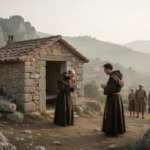
In 1897, he left the Trappists. He went to Nazareth, where he lived near a convent of Poor Clares and worked as a handyman. This period became decisive for his understanding of the hidden life of Jesus. Foucauld was drawn to the years Jesus spent in ordinary work and family life, years that received little public attention in the Gospel accounts.
For Foucauld, Nazareth represented more than a location. It became a way of living: quiet, humble, physically close to ordinary people, and free from the desire for recognition. He believed that a person could bear witness to the Gospel without preaching publicly or holding an official position.
His spirituality developed through prayer, long periods of silence, Eucharistic devotion, and meditation on the life of Jesus. At the same time, it was not meant to be a retreat from human need. Foucauld wanted a life in which prayer led him toward greater fraternity with every person, especially those who were poor, isolated, or viewed as outsiders.
Why Nazareth became the foundation of his spirituality
Foucauld’s idea of Nazareth shaped nearly everything he later wrote and attempted. He saw Jesus’ hidden years as a revelation of God’s preference for humility, patience, and ordinary work. A person did not need public success to live a meaningful vocation.
This conviction challenged the assumption that religious importance depends on visibility. Foucauld had once known social status, education, military identity, and public recognition. After his conversion, he became increasingly interested in the unnoticed forms of faithfulness found in daily work, hospitality, and prayer.
His Nazareth spirituality included several connected practices:
Living simply: using possessions and money in a way that left more room for generosity.
Working with one’s hands: accepting ordinary labor as compatible with prayer and dignity.
Staying close to people: building relationships rather than treating ministry as a distant project.
Praying in hiddenness: seeking God without depending on praise or visible results.
Receiving others as brothers and sisters: making human dignity more important than social, religious, or cultural differences.
Foucauld did not treat hiddenness as an excuse for passivity. He continued to make demanding choices, study languages, travel, write, and serve. His point was that these activities should not be driven by ambition. Hiddenness concerned the spirit of the work, not simply whether other people could see it.
After becoming a priest in 1901, Foucauld returned to North Africa. He served first in Beni Abbès, an oasis settlement in present-day Algeria, and later lived among the Tuareg people at Tamanrasset in the Ahaggar region.
He did not establish a large parish or gather a conventional congregation around himself. Instead, he tried to create a place of prayer and welcome. His home functioned as a small hermitage, a guesthouse, a point of contact, and a setting for practical service.
Foucauld learned the language and culture of the Tuareg, worked on a dictionary and linguistic materials, and developed relationships with local people. His work included hospitality, correspondence, study, and assistance to those who came to him. He believed that a missionary should know people personally and respect their history and dignity.
His presence in the Sahara was shaped by the realities of French colonial rule, and modern readers should approach that setting with care. Foucauld’s writings contain both genuine respect for Muslim neighbors and assumptions belonging to his historical context. His life can be studied fruitfully without ignoring the unequal political environment in which he worked.
He wanted to be recognized as a universal brother, a person whose home was open to Christians, Muslims, and people with no religious affiliation. This did not mean that he considered religious differences unimportant. Rather, he believed that respectful friendship and service were essential expressions of Christian witness.
Foucauld’s ministry was often small in scale and lacked the visible results he may once have imagined. He did not convert a large community or found a thriving monastery during his lifetime. His influence grew largely after his death, through his writings and through people who adopted his ideals.
How Charles Foucauld understood mission
Foucauld’s approach to mission differed from models based mainly on public preaching, institutional expansion, or measurable success. He believed that a Christian could communicate the Gospel through trustworthy presence, generous hospitality, and a life whose priorities were visibly shaped by prayer.
He did preach at times and remained committed to his Catholic faith. Yet he also recognized that a person’s conduct often speaks before formal explanations do. A life of patience, service, and friendship could create the conditions for meaningful conversation.
His understanding of mission rested on several ideas:
People should be treated as neighbors and friends, not as projects.
Learning a community’s language and customs is part of respectful service.
Hospitality should be offered without demanding immediate agreement or repayment.
Religious conviction should not remove the need for humility or listening.
Small acts of care can have lasting value even when their effects are not visible.
This approach has particular significance for people who live or work among those with different religious beliefs. Foucauld’s example encourages patient relationship-building rather than argument as the first response to difference.
What “universal brother” meant to Foucauld
Foucauld used the language of universal brotherhood to express a radical commitment to human solidarity. He wanted his life to say that every person deserved welcome, attention, and practical concern. The phrase was connected to his belief that love of God could not be separated from love of one’s neighbor.
His hospitality was concrete. He welcomed visitors, offered food and shelter when possible, listened to people’s concerns, and tried to help with their needs. This was not simply a personal style. It was part of his understanding of Christian identity.
Universal brotherhood did not mean ignoring conflict or pretending that all relationships are easy. Foucauld lived in a region marked by poverty, political tension, cultural difference, and colonial power. His ideal is most useful when it is applied with honesty: respect must include listening, awareness of unequal power, and willingness to accept correction.
For contemporary readers, his phrase can be translated into practical questions:
Whose presence do you normally overlook?
Do people experience you as available, or only as efficient?
Can you serve without controlling the outcome?
Do you learn from neighbors whose background differs from yours?
Does your religious or moral conviction make you more compassionate in daily life?
Foucauld’s prayer and the “Prayer of abandonment”
One of the writings most associated with Charles Foucauld is the Prayer of abandonment. It expresses a desire to place one’s life in God’s hands, surrender personal control, and trust divine care. The prayer is often connected to Jesus’ relationship with the Father and to Foucauld’s meditation on the Gospel.
The prayer should not be read as a demand to accept abuse, neglect, or injustice without response. Abandonment, in Foucauld’s sense, is a spiritual act of trust rather than an excuse for human irresponsibility. It means releasing the need to control every result while continuing to act faithfully.
Many people find this prayer meaningful during illness, uncertainty, grief, or vocational change. Its language can help someone distinguish between faithful action and the illusion that every outcome depends entirely on personal strength.
Foucauld also composed the short prayer commonly called the Prayer of the little brother of Jesus, which reflects his desire to imitate Jesus in simplicity and closeness to ordinary people. The exact wording of prayers can vary in English, so readers may encounter different translations and adaptations.
“My Father, I abandon myself to you.”
This brief line is often remembered because it captures a central theme of Foucauld’s spirituality: trust expressed through surrender, simplicity, and a willingness to receive each day as a gift rather than a possession.
What happened to Charles Foucauld at Tamanrasset
Foucauld lived at Tamanrasset for several years, continuing his prayer, study, hospitality, and service. He maintained relationships with Tuareg neighbors and worked on language materials that later became valuable for the study of the Tuareg language.
He was killed on December 1, 1916, during a period of violence and upheaval connected with the First World War and resistance to French rule in the Sahara. He was 58 years old. The circumstances of his death were tragic, but his legacy was not based on dying violently. It grew from the pattern of life he had practiced for years before that moment.
Foucauld had not achieved the large religious foundation he hoped to create. No community of followers gathered around him during his lifetime in the form he envisioned. His influence expanded later through people who discovered his writings and tried to embody his ideals in different settings.
How his communities and spiritual family developed after his death
Several religious communities and associations eventually drew inspiration from Foucauld. Among the best known are the Little Brothers of Jesus and the Little Sisters of Jesus. Other groups, priests, religious women, and laypeople have also adapted his spirituality.
These communities generally emphasize prayer, simple living, manual work, presence among ordinary people, and solidarity with those on the margins. Their members may live in neighborhoods, workplaces, rural areas, or places affected by poverty rather than in isolated religious institutions.
Not every group inspired by Foucauld follows the same structure. Some are contemplative, some are active, and some are lay movements. Their common thread is usually the attempt to unite contemplation with closeness to daily life.
Foucauld’s influence can also be seen beyond formal communities. A teacher, nurse, parish volunteer, social worker, or parent might draw on his example without adopting a religious vocation. His emphasis on ordinary presence makes his spirituality adaptable to many forms of service.
Why the Catholic Church canonized him
Charles de Foucauld was beatified in 2005 and canonized by Pope Francis on May 15, 2022. Canonization recognizes a person as a saint in the Catholic Church and proposes that person as an example of holiness for the faithful.
The Church’s recognition focused on the overall pattern of his life: conversion, prayer, poverty, service, and commitment to fraternity. It did not mean that every historical detail or personal decision should be copied without reflection. Saints belong to particular times and cultures, and their lives require thoughtful reading.
His canonization also brought renewed attention to a spiritual path that does not depend on prominent leadership. Foucauld became a model of holiness through hidden faithfulness, especially for people whose work is repetitive, private, or rarely praised.
A balanced reading helps: admire Foucauld’s commitment to prayer, hospitality, and fraternity while also examining the limits of his historical perspective and the colonial setting in which he lived.
Practical ways to learn from Charles Foucauld
You do not need to become a hermit or move to the Sahara to engage with Foucauld’s spirituality. Its practical value lies in small choices that make your life more attentive, less self-centered, and more available to others.
Set aside regular quiet: spend a short, consistent period each day in prayer, silence, or reflective reading.
Choose one hidden act of service: help someone without announcing it or expecting recognition.
Practice patient hospitality: make room for a visitor, neighbor, coworker, or family member who needs time and attention.
Learn before judging: listen to another person’s language, history, or religious perspective with genuine curiosity.
Work faithfully at ordinary tasks: treat routine responsibilities as opportunities for care rather than interruptions to a more important life.
Release the outcome: do what is right and possible, then resist measuring your worth by immediate results.
These practices work best when they remain specific. “Be more loving” is difficult to evaluate, while “call an isolated relative every Sunday” or “welcome a new neighbor with a meal” gives compassion a visible form.
Common mistakes when interpreting Foucauld’s spirituality
Foucauld’s writings can be misunderstood if his ideals are separated from the responsibilities of ordinary life. His emphasis on poverty, surrender, and hiddenness requires discernment rather than imitation without limits.
Confusing poverty with neglect: simplicity should not mean refusing necessary medical care, safety, education, or support.
Confusing abandonment with passivity: trust in God does not eliminate the duty to resist injustice or seek help.
Confusing silence with avoidance: quiet prayer should deepen truthful communication, not replace it.
Confusing service with control: helping another person does not give you authority over that person’s choices.
Ignoring historical context: Foucauld’s relationship with colonial society and Muslim communities deserves honest, careful study.
Expecting dramatic results: his vocation was valuable even when it produced no obvious institutional success.
A healthy reading keeps together spiritual depth and practical responsibility. The goal is not to romanticize hardship or copy every detail of Foucauld’s life. It is to ask how prayer can make your presence more truthful, generous, and respectful.
What Charles Foucauld can teach people today
Foucauld remains relevant because many people want a form of faith that is less performative and more rooted in daily conduct. His life raises questions about how to serve without seeking attention, how to live with religious difference, and how to value work that produces no immediate applause.
His example also speaks to people who feel that their lives are ordinary or hidden. A family member caring for an aging parent, a worker doing dependable behind-the-scenes tasks, or a neighbor who quietly supports vulnerable people may recognize something of Foucauld’s vision in their own responsibilities.
His approach to interfaith relationships is especially significant. He does not offer a simple formula for modern dialogue, and his historical context has limits. Still, his insistence on learning from neighbors, welcoming people personally, and letting service precede self-importance provides a useful starting point.
The lasting question is not whether you can reproduce Foucauld’s exact lifestyle. It is whether your daily choices express humility, attention, courage, and solidarity. His spirituality asks you to notice the person in front of you, do the good that is actually possible, and trust that a hidden life can still bear meaning.
Where to begin reading Charles Foucauld
Readers new to Foucauld may begin with a reliable biography or a collection of his letters and spiritual writings. His work includes personal reflections, prayers, notes on the Gospel, correspondence, and observations from North Africa. These texts vary in purpose and should not all be treated as polished theological works.
Reading a short prayer alongside a biography can provide helpful balance. The biography supplies historical context, while the prayer reveals the spiritual language that shaped his decisions. Readers should also consult works that discuss colonialism, Islam, and the Tuareg people so that Foucauld’s experiences are not presented in isolation.
A useful reading approach includes three questions:
What was Foucauld trying to practice in this particular period of his life?
Which parts of his writing reflect timeless spiritual concerns, and which reflect his historical setting?
How might his emphasis on presence and fraternity be applied responsibly today?
Approached this way, Charles Foucauld is neither a flawless hero nor merely a historical curiosity. He is a complicated saint whose life invites serious reflection on conversion, hidden service, religious friendship, and the discipline of love.
Frequently asked questions
Was Charles Foucauld a priest?
Yes. Charles Foucauld was ordained a Catholic priest in 1901 after spending time with the Trappists and living for a period in Nazareth. He later served in North Africa, where his ministry centered on prayer, hospitality, language study, personal relationships, and practical service rather than building a large parish or religious institution.
What is Charles Foucauld’s most famous prayer?
He is especially associated with the Prayer of abandonment, which expresses trust in God and a willingness to surrender the need to control every outcome. English versions differ, and the prayer is often read as a meditation on trust, not as permission to accept abuse, injustice, or avoidable harm.
How did Charles Foucauld relate to Muslims?
Foucauld lived among Muslim communities in North Africa and developed relationships with local people, including Tuareg neighbors. He studied their language and offered hospitality. His example includes genuine respect and friendship, but it also belongs to a colonial setting and should be examined with historical awareness rather than idealized without qualification.
Why was Charles Foucauld canonized?
The Catholic Church canonized Foucauld because of the overall witness of his life: conversion, prayer, poverty, humble service, and commitment to universal fraternity. His canonization recognizes his spiritual example, especially the belief that holiness can grow through ordinary work, hidden faithfulness, hospitality, and presence among people who are often overlooked.














Leave a Reply