Catholic VBS is a parish-based Vacation Bible School that combines Scripture, prayer, Catholic teaching, music, crafts, games, service, and community for children during a focused summer program. A strong VBS gives children more than a collection of activities: it helps them encounter Jesus, understand their faith, and see the parish as a welcoming spiritual home.
To plan one, choose a clear Catholic theme, set a realistic schedule, recruit and train volunteers, prepare age-appropriate sessions, and build in time for prayer and family involvement. The best program is organized enough to feel safe and purposeful while leaving room for children to ask questions, make friends, and grow in faith.
Many Vacation Bible School programs use Bible stories, songs, crafts, and games. A Catholic VBS includes those elements while placing them within the Church’s understanding of Scripture, worship, community, and service. Children can learn that the Bible is not separate from parish life; it connects with the Mass, the sacraments, Catholic prayer, the lives of the saints, and the call to love their neighbors.
The program does not need to become a full theology course. Children remember a small number of strong ideas better than a crowded schedule of disconnected facts. A daily focus such as “Jesus calls us to follow him” or “God’s love sends us out to serve” can shape the story, prayer, activities, and conversation throughout the day.
A Catholic VBS also respects the variety of children who attend. Some may go to Catholic school, parish religious education, or youth ministry. Others may be visiting the parish for the first time, belong to another Christian tradition, or have little experience with organized religion. Clear explanations and a welcoming tone help every child participate without assuming too much prior knowledge.
Choose the purpose, theme, and age range first
Begin with a short planning statement that answers one question: What should children know, feel, or practice because of this VBS? A purpose might be to help children recognize God’s presence in Scripture, learn how Catholics pray, or discover practical ways to serve people who are vulnerable. This statement keeps the program focused when you are choosing songs, decorations, crafts, and activities.
Next, select a theme that is simple enough for younger children but meaningful for older ones. The theme should point toward Christ and support a Catholic understanding of discipleship. It might center on walking with Jesus, living as the Body of Christ, creation and stewardship, the saints, or the virtues.
Consider these questions before choosing a theme:
Can children repeat the main idea in one sentence?
Can the theme support a Scripture story each day?
Does it connect naturally with prayer, service, and parish life?
Can younger children understand it through images and actions?
Can older children discuss it without feeling that the material is childish?
Will the theme work with the available budget, space, and volunteers?
Set the age range early. A program for preschoolers through sixth graders may be convenient for families, but the teaching methods must vary considerably. Children in preschool need short activities, repetition, movement, and close supervision. Elementary-age children can handle longer discussions, team challenges, and projects. Middle school students may benefit from leadership roles, service planning, and honest conversations about faith.
Planning principle: Choose one central faith message and repeat it in different ways. Children often remember the phrase, song, gesture, or service experience that makes the message concrete.
Build a Catholic VBS around a daily faith rhythm
A consistent daily rhythm helps children feel secure and helps volunteers know what comes next. The exact schedule can fit a morning, afternoon, evening, or full-day program. What matters is that the day moves between energetic activities and quieter moments instead of placing all the teaching in one long block.
A practical day might include:
Welcome and gathering: Check children in, introduce the day’s theme, and establish a positive group identity.
Opening prayer and music: Invite children to praise God, listen, and prepare to participate.
Bible discovery: Present the Scripture story through storytelling, drama, images, or guided reading.
Small-group discussion: Let children ask questions and connect the story with ordinary life.
Craft or hands-on activity: Give the theme a physical expression children can make or use.
Games and movement: Reinforce cooperation, attention, and joy without turning every activity into a competition.
Service or mission project: Give children a practical way to care for others.
Closing reflection and prayer: Repeat the main message and send children home with one simple action.
Prayer should not be treated as a filler between activities. Keep it brief enough for the age group, but make it genuine and varied. Children can learn the Sign of the Cross, pray with silence, respond to a short litany, listen to a Scripture passage, sing a hymn, or offer prayers for people in need.
Include Catholic prayers that children may encounter at home or Mass, while explaining their meaning in plain language. For example, the Our Father can lead to a conversation about trusting God and asking for daily needs. The Hail Mary can introduce Mary’s willingness to respond to God and her role in the story of salvation. Avoid requiring children to memorize several new prayers at once.
Plan the Scripture and Catholic teaching carefully
Choose Scripture passages that are understandable, vivid, and connected to the theme. Gospel stories about Jesus welcoming children, healing people, showing mercy, praying, or feeding a crowd often work well because children can enter the story through concrete details. Stories from the Old Testament can also be valuable when they are presented in relation to God’s continuing plan of salvation.
Do not reduce every story to a vague lesson such as “be nice.” Ask what the passage reveals about God, Jesus, the dignity of each person, and the way disciples respond. A story about the Good Samaritan, for instance, can lead to questions about who counts as a neighbor, how prejudice affects our choices, and what compassion looks like in action. Use the Bible reference and explain the passage in your own words rather than relying on an unfamiliar translation or long reading.
Connect Scripture with Catholic life without forcing a sacramental activity into every session. A lesson about forgiveness may naturally connect with the Sacrament of Reconciliation. A discussion about gathering as a community can point toward the Eucharist and the Sunday assembly. A service activity may help children understand that faith is lived beyond the church building.
When sacramental topics arise, teach them accurately and simply. Children do not need every theological distinction, but they should receive clear language. The Eucharist is not merely a symbol of friendship; Catholics believe Christ is truly present. Baptism is not only a naming ceremony; it begins a person’s life in Christ and brings that person into the Church. Ask the pastor, deacon, director of religious education, or another qualified parish leader to review lessons involving doctrine.
Use age-appropriate teaching for every group
Children learn through different combinations of listening, movement, imagination, conversation, and repetition. A single teaching method will not serve every group well. Give each lesson a central point, then use several ways to reach it.
Preschool and kindergarten children
Young children need predictable routines and very short transitions. Use simple language, large visual materials, songs with motions, storytelling with safe props, and activities that can be completed without complicated instructions. A five-minute explanation may be too long, while a brief story followed by movement and a repeated phrase can be effective.
Plan for frequent bathroom breaks, water, snack time, and moments when children need help regulating their emotions. Avoid activities with tiny pieces unless adults can supervise closely. The goal is not to cover a large amount of content; it is to help children associate church with God’s love, safety, prayer, and belonging.
Elementary school children
Elementary-age children can explore cause and effect, make choices in a story, and work on projects that take more than one step. Invite them to wonder aloud: Why did the person in the story act that way? What would be difficult about following Jesus here? Who might need help in our neighborhood?
Use small groups so quieter children have a chance to speak. Give volunteers open-ended questions instead of scripts that require children to reach one predetermined answer. A craft should support the faith message rather than simply occupy hands. For example, children might create prayer cards for residents of a nursing home, decorate collection bags for a food pantry, or assemble reminders about caring for creation.
Middle school students
Older children often recognize when material feels artificially childish. Give them real responsibilities, honest questions, and opportunities to lead. They might help prepare a service project, create a short skit, assist younger groups, or discuss how Catholic values affect decisions about friendship, social media, fairness, and responsibility.
Do not assume that older students have no need for play. Games can build community and relieve tension, especially when they are balanced with meaningful discussion. Establish expectations for respectful conversation, and make room for questions about suffering, doubt, prayer, Church participation, and differences among Christians.
Design stations that reinforce the same message
Many VBS programs rotate groups through stations. This format can work well when every station knows the daily faith goal. Without coordination, children may experience a Bible story in one room, a random craft in another, and a game with no connection to either.
Give station leaders a one-page guide containing the daily theme, Scripture reference, main point, vocabulary, safety information, and one question to repeat. The Bible leader might introduce the story, the craft leader might help children create a response to it, and the service leader might show how the response becomes an action.
Useful station categories include:
Story station: Scripture, drama, storytelling, images, or a guided activity.
Prayer station: Quiet reflection, intercession, Catholic prayers, music, or a simple prayer practice.
Creative station: Art, crafts, writing, music, or drama connected to the theme.
Movement station: Cooperative games, outdoor play, or challenges that encourage teamwork.
Service station: A project that benefits a parish ministry or local community partner.
Saints and witnesses station: A real person whose life illustrates the day’s virtue or mission.
Stations should have clear start and stop times, but avoid packing the schedule so tightly that volunteers must rush children from room to room. Younger groups may need longer transitions. Post a simple visual schedule so children can see what comes next, particularly children who benefit from predictable routines.
Make music, crafts, and games serve the faith goal
Music can become one of the strongest memories of VBS, especially when children sing the same theme song each day. Choose songs with lyrics that are theologically sound, understandable, and comfortable for children to sing. Add motions when they support the words, but do not make performance the main purpose.
Review song lyrics before using them. A song can be upbeat and memorable while still teaching a distorted idea about prayer, suffering, forgiveness, or God’s relationship with humanity. Include at least one quieter song or musical prayer so children experience more than constant high energy.
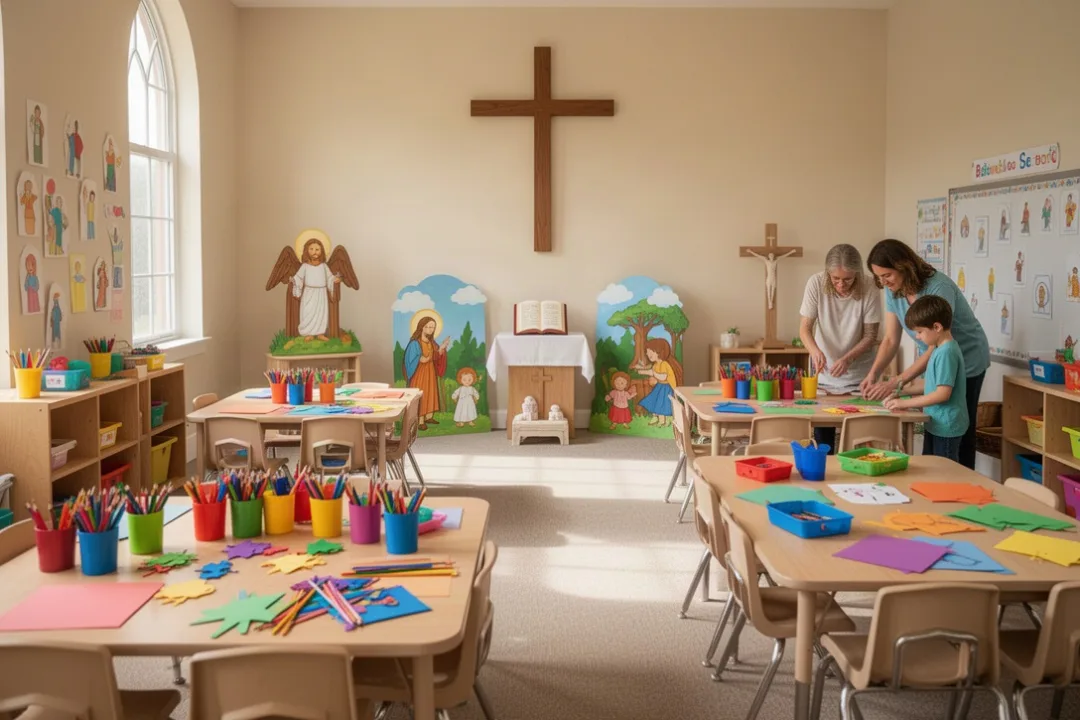
Crafts should be manageable, affordable, and connected to the message. Children may create a cross-shaped prayer card, a kindness chain, a saint symbol, a stewardship reminder, or a small object used during family prayer. Avoid projects that require adults to do most of the work or produce excessive waste.
Games can teach cooperation, patience, generosity, and attention. They do not all need to be explicitly religious. A relay race can build teamwork, and a water game can simply provide welcome relief on a hot day. Explain the connection when one exists, but do not add a forced spiritual lesson to every activity.
Plan service projects children can understand
Service gives children a concrete way to respond to what they are learning. Select projects that are safe, age-appropriate, and connected to a real need. Children can assemble hygiene kits, write encouraging notes, collect shelf-stable food, prepare supplies for a parish pantry, make blankets from approved materials, or care for a church garden.
Explain who benefits and why the project matters. Do not present people who are poor, sick, elderly, or displaced as objects of pity. Catholic service respects the dignity of every person and helps children understand that charity includes both personal care and a concern for justice.
Ask a parish ministry or community organization what is genuinely useful before collecting donations. Some groups have restrictions on food, clothing, toys, handmade items, or volunteer contact. If children cannot visit the people they are serving, they can still pray for them and learn about the ministry in respectful, age-appropriate terms.
Safety and dignity reminder: Never photograph or identify recipients of service without proper permission. Follow the receiving organization’s instructions, and make the project about faithful care rather than public recognition.
Recruit and train the right volunteer team
A reliable volunteer team matters more than elaborate decorations. Recruit people for specific roles rather than asking everyone to “help wherever needed.” Useful positions include group leaders, station leaders, registration workers, supply coordinators, musicians, snack and hydration volunteers, first-aid contacts, floaters, and a program coordinator.
Ask volunteers to commit to the entire program whenever possible. Children benefit from familiar adults, and a consistent team can identify concerns more quickly. Invite teens to serve as assistants, but pair them with trained adults and give them responsibilities that match their maturity and experience.
Provide training before the first day. Cover the following topics:
Check-in, pick-up, attendance, and authorized release procedures.
Child protection policies, boundaries, reporting responsibilities, and supervision rules.
Emergency procedures, allergy awareness, medication policies, and incident documentation.
How to welcome children with disabilities, sensory needs, language differences, or anxiety.
How to manage behavior with calm redirection rather than humiliation or threats.
How to lead prayer and faith conversations without pressuring children to disclose private experiences.
Where to find lesson plans, supplies, water, first-aid materials, and administrative help.
Follow the parish, diocesan, and local requirements that apply to background checks, child safety training, transportation, food handling, and emergency care. Procedures vary, so the pastor or parish administrator should confirm what is required before registration opens.
Create an inclusive and accessible parish experience
Accessibility should be part of planning rather than an adjustment made after a child arrives. Ask families privately about allergies, mobility needs, communication preferences, sensory sensitivities, medical concerns, and other supports. Protect that information and share it only with adults who need it to provide safe care.
Offer visual instructions, quiet spaces, flexible participation, and alternatives to activities involving loud noise, messy materials, competitive pressure, or unfamiliar physical contact. A child who does not sing, sit still, make eye contact, or join a group game can still participate meaningfully in prayer and community.
Use language that welcomes families with different backgrounds. Explain Catholic practices rather than assuming that every child knows what to do in a church. If the program includes a Mass or Eucharistic adoration, tell families what will happen and clarify that participation in Communion follows Catholic practice.
Consider practical barriers as well. Registration fees can prevent participation, so provide scholarships or a pay-what-you-can option if the parish is able. Offer information in the languages common in the parish community. If possible, provide transportation guidance, before- or after-care information, and a clear contact person for questions.
Prepare registration, communication, and supplies
Registration should collect only information the parish needs to run the program safely and effectively. Include the child’s name and age, parent or guardian contacts, authorized pick-up adults, emergency information, allergies, medical needs, accessibility needs, and photo permissions. Keep a separate, secure system for sensitive information rather than posting it where all volunteers can see it.
Send families practical information before the first day. Tell them the schedule, location, clothing and footwear recommendations, snack arrangements, drop-off and pick-up procedures, contact number, and what children should bring. If water activities are planned, give specific instructions about towels, modest clothing, sunscreen, and supervision.
Build a supply list from the lesson plans instead of shopping first. Categorize supplies by station and day, then label bins clearly. Keep extra basic materials available, but avoid buying decorations that have no use after the program. Parish members may donate craft supplies, but confirm that donated items are clean, safe, and suitable for the planned activities.
Prepare a contingency plan for weather, illness, power failure, volunteer absence, and room changes. Outdoor games need an indoor alternative. A canceled activity should not derail the faith goal; prepare a simple discussion, prayer, story, or cooperative game that can replace it.
Connect VBS with families and parish life
Children’s learning becomes stronger when families hear the same central message at home. Send home a brief daily note with the Scripture reference, theme phrase, prayer prompt, and one question for conversation. Keep it short enough that families can use it without feeling assigned homework.
Invite parents and caregivers to a closing celebration, service presentation, family prayer time, or parish picnic. If the program includes a Mass, coordinate carefully with the pastor and explain the schedule in advance. Children can help with appropriate roles such as greeting, singing, carrying symbols, or presenting a service gift, provided the liturgy remains prayer rather than a performance.
Use VBS as a bridge to ongoing parish opportunities. Families might be invited to Sunday Mass, children’s liturgy, religious education, sacramental preparation, a food pantry, youth group, or a family prayer gathering. Make the invitation specific, welcoming, and free from pressure.
After the program, thank volunteers and ask families what worked. Use a short survey with questions about communication, schedule, faith content, accessibility, safety, and the child’s experience. Meet with the planning team while details are still fresh. Record improvements for next year, including which supplies remained unused and which activities needed more time.
Use a practical timeline for planning
Begin several months ahead if the parish expects a large group, needs extensive volunteer screening, or plans to coordinate with diocesan resources. Smaller programs can move faster, but every parish benefits from giving families and volunteers enough notice.
Four to six months before: Confirm the dates, budget, age range, theme, leadership team, facilities, and child protection requirements.
Three to four months before: Select Scripture, develop the daily schedule, recruit volunteers, and open communication with service partners.
Two to three months before: Publish registration, order essential supplies, review accessibility, and begin volunteer training.
Four to six weeks before: Finalize groups, assign rooms, complete background checks and required training, and prepare family communications.
One to two weeks before: Assemble lesson materials, label supplies, confirm volunteer schedules, and walk through emergency procedures.
During VBS: Hold brief daily staff check-ins to identify safety concerns, supply needs, schedule problems, and children who need additional support.
After VBS: Thank the community, collect feedback, document attendance and expenses, and identify next steps for family and parish engagement.
Measure success by faith, belonging, and care
Attendance can show whether families found the program accessible, but it does not tell the whole story. Look for signs that children felt welcomed, understood the central message, participated in prayer, worked cooperatively, and recognized a practical way to live their faith.
Ask children age-appropriate questions such as: What did you learn about Jesus? Which prayer or song helped you focus? What service project did you enjoy? What would you tell a friend about the parish? Younger children can answer verbally or with drawings, while older children can provide written feedback.
Pay attention to volunteer experience as well. A program that exhausts adults through unclear instructions and constant last-minute changes will be difficult to sustain. Strong planning includes enough breaks, clear assignments, realistic expectations, and a culture in which volunteers can raise concerns early.
A successful Catholic VBS does not require expensive sets, a large staff, or a flawless performance. It requires faithful teaching, safe relationships, thoughtful hospitality, and opportunities for children to respond to God through prayer and service. When those elements are planned together, the parish can offer a summer experience that continues to shape children long after the final song.
Frequently asked questions
How long should a Catholic VBS last?
Many parish programs run for three to five days, with each day lasting two to four hours. A shorter schedule can work well for younger children or a small volunteer team. Choose a length that allows time for Scripture, prayer, movement, and breaks without making children or volunteers feel rushed. Consistency matters more than a particular number of days.
Can a Catholic parish use a non-Catholic VBS curriculum?
A parish can use outside material as a starting point, but leaders should review every lesson, song, prayer, and activity for theological accuracy and fit with Catholic practice. Add Catholic content where needed, especially connections to the Mass, sacraments, saints, prayer, and service. A pastor or parish catechetical leader should approve the final plan.
What should children bring to Catholic VBS?
Families generally need to send children in comfortable clothing and closed-toe shoes, with a labeled water bottle and any required medication. The exact list depends on the schedule. Tell families in advance about snacks, outdoor activities, water games, sunscreen, hats, towels, or materials the parish will provide. Avoid asking children to bring valuable personal items.
How can teens help with Catholic VBS?
Teens can lead songs, assist with crafts and games, welcome families, help younger children transition between rooms, support service projects, and share a personal faith reflection when properly prepared. They should work under adult supervision and should not be placed alone in charge of a group. Give them clear duties, training, and feedback so their service is responsible and meaningful.













Leave a Reply