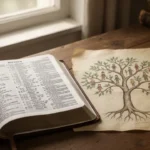
The first book of the Bible is Genesis. It opens both the Christian Old Testament and the Hebrew Bible’s Torah, and its name means beginning or origin. Genesis explains the Bible’s earliest account of creation, humanity’s relationship with God, the spread of sin, and the beginnings of the family that becomes Israel.
Genesis contains 50 chapters. Its first half focuses on the origins of the world and humanity, while its second half follows the families of Abraham, Isaac, Jacob, and Joseph. The book does not present a complete history of every ancient people; instead, it traces a focused story about God, human choices, promise, judgment, and covenant.
Genesis is the first of the five books of Moses, known in Christianity as the Pentateuch and in Judaism as the Torah. The other four books are Exodus, Leviticus, Numbers, and Deuteronomy. Together, these books establish the beginnings of Israel’s story, laws, worship, and covenant relationship with God.
In the Christian Bible, Genesis begins the Old Testament. In the Hebrew Bible, it is the first book of the Torah and is commonly called Bereshit, a Hebrew word associated with its opening phrase, “In the beginning.” The same book is also known as Genesis because the Greek title refers to origins or beginnings.
The book connects to much of what follows. Later biblical books refer back to Adam and Eve, Noah, Abraham, Isaac, Jacob, and Joseph. Themes introduced in Genesis—creation, blessing, human rebellion, covenant, descendants, land, and divine faithfulness—continue through the rest of the Bible.
Direct answer: If you are looking for the first book of the Bible, start with Genesis. Its central movement is from the creation of the world to the growth of one family through which the Bible’s larger story continues.
How to understand the main parts of Genesis
A useful way to read Genesis is to follow its major movements rather than treating all 50 chapters as one uninterrupted story. The book begins with broad accounts about the world and then narrows its attention to one family. The following breakdown gives you a practical reading path.
Creation and the first human beings — Genesis 1–2: These chapters describe God creating the heavens, earth, living creatures, and human beings. They present human beings as having a distinctive role and dignity within creation.
Human disobedience and its consequences — Genesis 3–5: Adam and Eve disobey God, and the effects of broken trust spread through their family and the wider human community. Cain and Abel illustrate jealousy, violence, and responsibility for one’s actions.
Noah and the flood — Genesis 6–9: Genesis portrays widespread violence and corruption, the flood judgment, Noah’s preservation, and a covenant symbolized by the rainbow. The story also shows that a new beginning does not remove humanity’s continuing weakness.
The nations and the tower of Babel — Genesis 10–11: These chapters describe the growth and division of human communities. The tower story explores pride, self-exaltation, and the scattering of people and languages.
Abraham and Sarah — Genesis 12–25: God calls Abram, later named Abraham, and makes promises involving descendants, blessing, and land. The narrative follows his journeys, failures, faith, family tensions, and covenant relationship with God.
Isaac and Rebekah — Genesis 24–26: Isaac’s story connects Abraham’s generation to the next one. The account includes his marriage to Rebekah, family conflict, and the continuation of the covenant promise.
Jacob and Esau — Genesis 25–36: Jacob struggles with his brother, leaves home, marries, builds a large household, and later receives the name Israel. His life combines deception, fear, reconciliation, and transformation.
Joseph and his brothers — Genesis 37–50: Joseph is sold by his brothers, rises to authority in Egypt, and later reunites with his family during a famine. His story ends with the family settled in Egypt, setting the stage for Exodus.
What the creation accounts in Genesis say
Genesis 1 presents creation in an ordered sequence that moves from darkness and emptiness toward a world filled with light, land, plants, animals, and human beings. The repeated structure emphasizes order, purpose, and divine authority. Humans appear as part of creation but also receive a distinctive responsibility within it.
Genesis 2 offers a more concentrated account centered on the first man, the garden, and the woman who becomes his companion. Rather than functioning like a modern scientific report, the chapter explores questions about human identity, work, relationship, limits, and dependence on God.
The two creation accounts have different emphases and literary patterns. Genesis 1 highlights the ordered scope of creation, while Genesis 2 focuses closely on human life in the garden. Read together, they introduce the Bible’s view that the world is not accidental or meaningless and that human beings are accountable for how they live within it.
Genesis also gives a significant place to the creation of humanity. Human beings are described as made in the image of God, a phrase associated with human value, responsibility, and representative purpose. The text connects this status with both men and women, rather than assigning the divine image to only one sex or social group.
What happens when Adam and Eve disobey
Genesis 3 describes Adam and Eve living in the garden with freedom to enjoy its abundance but with a clear prohibition concerning one tree. The serpent challenges God’s command, and the humans eat from the forbidden tree. The immediate effects include shame, fear, hiding, blame, and a damaged relationship with God and one another.
The story is often called the Fall in Christian teaching. That term refers to humanity’s movement from trust and harmony into disobedience and alienation. Genesis does not describe sin merely as breaking a rule; it presents a deeper desire to define good and evil independently of God.
The consequences extend beyond the garden. Work becomes painful, relationships become marked by conflict, and humans must leave the garden. Yet the narrative also contains signs of continued care and future hope. God seeks the humans, addresses their actions, and provides clothing before they leave.
For Christian readers, Genesis 3 helps explain why later biblical books discuss sin, judgment, redemption, and restoration. Jewish interpretation also treats the chapter as a foundational account of human disobedience and mortality, though traditions differ in how they describe inherited guilt and its consequences.
Why Cain, Abel, and the flood matter
Cain and Abel, the sons of Adam and Eve, show how quickly broken trust can become violence. Cain becomes angry when God favors Abel’s offering, and he kills his brother. Genesis presents Cain as responsible for his choice while also showing that God places limits on vengeance and does not simply erase him from the human story.
The flood narrative in Genesis 6–9 expands the theme of violence from one family to the wider world. The text describes human corruption as pervasive, then follows Noah, his family, and the animals preserved in the ark. After the flood, God establishes a covenant with Noah and every living creature, using the rainbow as its sign.
The covenant after the flood is significant because it is presented as a commitment concerning the whole earth, not only one nation. It expresses a promise that a flood will not again destroy all life in the same way. The story therefore combines judgment with preservation and a renewed responsibility for human beings.
Genesis 11 follows with the tower of Babel. The people seek a name and a unified center of power, but God confuses their language and scatters them. The episode explains human diversity within the book’s story while warning against prideful self-sufficiency and concentrated ambition.
Reading tip: Genesis often places human failure beside divine patience. The book does not hide the violence, deception, jealousy, or fear of its main characters, but it also continues to show God working through imperfect people.
How Abraham becomes central to Genesis
Genesis 12 marks a major change in scale. After the broad stories of creation, the flood, and the nations, God calls Abram to leave his homeland and travel to a land that will be shown to him. The promise includes descendants, a land, and blessing for other peoples.
Abram’s name later becomes Abraham, and his wife Sarai becomes Sarah. Their story is not a simple account of flawless faith. They face famine, danger, delays, family conflict, and uncertainty about how God’s promise will be fulfilled. Abraham sometimes acts courageously and sometimes responds with fear or questionable decisions.
The covenant with Abraham is one of Genesis’s central themes. God promises to establish a lasting relationship with Abraham and his descendants. Circumcision becomes the sign of this covenant in Genesis 17. The covenant is not presented as a reward for perfect behavior; the narrative repeatedly shows the tension between divine promise and human weakness.
Abraham’s willingness to respond to God’s test involving Isaac in Genesis 22 has been interpreted in different ways by Jewish and Christian readers. The account ultimately emphasizes that Isaac is not sacrificed and that God provides a substitute. It raises difficult questions about trust, obedience, testing, and the meaning of sacrifice.
Isaac is the son of Abraham and Sarah and the father of Esau and Jacob. His role in Genesis is quieter than Abraham’s or Joseph’s, but he is essential to the continuity of the family promise. His marriage to Rebekah and the birth of the twins lead directly into the next major family conflict.
Jacob and Esau represent a divided household shaped by rivalry and favoritism. Jacob obtains Esau’s birthright and blessing through troubling acts of manipulation. He then leaves home, spends years with his relative Laban, and experiences deception in return. These episodes show how family patterns of mistrust and competition pass from one generation to another.
Jacob’s encounter with God at Bethel and his later struggle at Peniel are important turning points. At Peniel, Jacob receives the name Israel, which becomes the name of his descendants and, eventually, the nation. His new name does not erase his past; it signals a changed identity shaped by struggle and blessing.
Jacob’s twelve sons become the ancestors associated with the twelve tribes of Israel. Genesis does not give every son equal narrative attention, but it establishes the family structure that becomes central in Exodus and later books. The book’s promises therefore move from one person to a growing household.
How Joseph’s story ends Genesis
Joseph is Jacob’s favored son, and his brothers resent him. They sell him to traders, and he eventually arrives in Egypt. After a period of servitude and imprisonment, Joseph interprets dreams and rises to a powerful administrative position during a time of anticipated famine.
The famine brings Joseph’s brothers to Egypt seeking food. They do not recognize him at first, and the reunion unfolds through testing, confession, and emotional tension. Joseph eventually reveals his identity and brings Jacob and the rest of the family to Egypt.
Joseph’s interpretation of events is expressed in Genesis 50:20. Rather than quoting the verse, its meaning can be paraphrased this way: his brothers intended harm, but God used the situation to preserve many lives. This does not excuse the brothers’ actions. It presents providence without denying human responsibility.
Genesis ends with Joseph’s death, not with the family returning to the promised land. That unfinished ending matters. The family is alive and growing in Egypt, but the next book must explain how their descendants become enslaved, delivered, and formed into a covenant people.
Major themes to watch for while reading Genesis
Genesis rewards readers who pay attention to repeated ideas. The book’s stories vary widely, yet they are connected by a set of themes that remain important throughout the Bible.
Beginnings: Genesis addresses the origins of the world, human beings, marriage, sin, nations, languages, worship, and Israel’s family.
Human dignity and responsibility: People are presented as bearing God’s image, but they are also accountable for violence, deception, injustice, and disobedience.
Blessing: God’s blessing is not limited to private prosperity. The promises to Abraham connect his family’s future with blessing for other peoples.
Covenant: God makes binding promises with Noah, Abraham, and their families. Signs such as the rainbow and circumcision mark these relationships.
Family conflict: Sibling rivalry, favoritism, jealousy, and deception appear repeatedly. The family chosen for the story is deeply imperfect.
Land and displacement: Characters leave homes, travel through unfamiliar places, face famine, and wait for promises involving land and security.
Providence: Genesis repeatedly shows God working through ordinary events, human decisions, suffering, and unexpected reversals.
Continuity across generations: Promises made to one generation remain connected to children, grandchildren, and a growing community.
How Genesis is understood in Jewish and Christian traditions
Jewish and Christian communities both treat Genesis as sacred Scripture, but their interpretive traditions are not identical. Jewish readings often place the book within the Torah and explore its legal, ethical, communal, and theological significance. Christian readings commonly connect Genesis with later teachings about creation, sin, faith, covenant, and redemption.
Many Christian readers interpret Adam, Abraham, and Joseph in relation to later Christian beliefs. Abraham is frequently associated with faith, while Genesis 3 is often connected with teachings about sin. Jewish and Christian commentators also differ in how they understand the nature of humanity after Eden and the significance of particular covenant promises.
Genesis has also been read in different ways regarding its relationship to science and history. Some readers understand the creation accounts as describing events in a direct chronological manner. Others read them primarily as theological and literary accounts that communicate truths about God, humanity, and the world without intending to provide a modern scientific timeline.
The text itself does not use the categories of modern science. When reading Genesis, it helps to ask what each passage emphasizes: who creates, why humans matter, how evil spreads, how promises develop, and what kind of relationship God establishes. Those questions can be explored alongside, rather than confused with, questions about scientific models.
Traditional Jewish and Christian teaching has often associated Genesis and the other books of the Pentateuch with Moses. The Bible does not present a modern author biography for Genesis, and Genesis itself does not name Moses as its writer in the way a contemporary book might identify an author.
Modern biblical scholarship includes several views about how Genesis reached its final form. Scholars examine its language, repeated episodes, literary patterns, theological themes, and relationship to ancient Near Eastern traditions. Some emphasize a long process of oral transmission and editing, while others give greater weight to a unified composition or traditional Mosaic connection.
You can read Genesis carefully without settling every authorship question first. The book’s structure, recurring promises, and connected family narratives remain visible regardless of which theory a reader accepts. Questions about composition are meaningful, but they should not obscure the text’s central concerns.
How long does it take to read Genesis?
Genesis has 50 chapters, but reading time depends on your pace and whether you pause to study names, geography, cultural customs, or different interpretations. A straightforward reading can often be completed in several sittings, while a slower study may take weeks.
A chapter-by-chapter plan is one practical approach. You might read Genesis 1–11 first to understand its universal beginnings, then read Genesis 12–36 for the patriarchal family, and finish with Genesis 37–50 for Joseph. The divisions are not absolute, but they make the book easier to follow.
For a focused first reading, keep track of four questions:
What promise or problem drives this chapter?
How do the characters respond to God, danger, or one another?
What changes in the family or community?
What theme appears again later?
It is also useful to record names and relationships. Genesis contains multiple generations, repeated names, and family connections that can become confusing. A simple family tree for Abraham, Isaac, Jacob, and Joseph can make the later chapters much easier to understand.
What to keep in mind when reading Genesis
Genesis includes material that can be difficult, including violence, deception, sexual wrongdoing, family abuse, slavery, grief, and divine judgment. The narrative does not always pause to give a direct moral explanation of every event. A character’s action being reported does not necessarily mean that the action is being approved.
Pay attention to what the story shows as well as what it states. Repeated consequences often reveal the book’s moral perspective. Favoritism produces conflict, deception damages trust, violence spreads, and reconciliation remains possible but costly.
Do not reduce Genesis to a collection of isolated stories. The account of Noah connects to the nations, the nations connect to Abraham, Abraham’s family connects to Jacob, and Jacob’s family connects to Joseph. The book’s meaning grows through patterns, contrasts, promises, and repeated reversals.
Genesis is also not only about famous individuals. It raises questions about communities, inheritance, hospitality, migration, famine, marriage, work, and the treatment of outsiders. Its characters live in households and networks where personal choices affect many other people.
If you want a concise answer to remember, it is this: Genesis is the first book of the Bible and the book of beginnings. It moves from creation to the formation of Abraham’s family, preparing the reader for the deliverance and covenant story that continues in Exodus.
Frequently asked questions
Is Genesis the first book in both the Old Testament and the Bible?
Yes. Genesis is the first book of the Christian Bible and the first book of the Old Testament. It is also the first book of the Jewish Torah, which Christians call the Pentateuch. Its position makes it the starting point for major biblical themes such as creation, sin, covenant, blessing, and the beginnings of Israel’s family.
Does Genesis begin with the creation of the earth?
Genesis begins with an account of God creating the heavens and the earth, followed by a more focused account of the first humans in the garden. The chapters communicate theological and moral claims about God, creation, humanity, and responsibility. Readers and religious traditions differ on how the creation passages relate to scientific explanations and chronology.
What is the difference between Genesis and Exodus?
Genesis tells about the origins of the world, humanity, sin, the nations, and the family of Abraham. It ends with Jacob’s family living in Egypt. Exodus begins later, when that family has become a large people facing oppression in Egypt. It then describes their deliverance, Moses’ leadership, and the establishment of a covenant community.
Why is Genesis important to the rest of the Bible?
Genesis introduces people, promises, and problems that shape the rest of Scripture. It establishes the ideas of creation, human rebellion, covenant, blessing, descendants, land, and God’s relationship with a chosen family. Later biblical books repeatedly refer to figures such as Abraham, Isaac, Jacob, Joseph, Adam, and Noah.