Genesis chapter 30: Jacob’s family and growing wealth
Genesis chapter 30: Jacob’s family and growing wealth
Genesis chapter 30 tells how Jacob’s household expands through the births of several children and how his relationship with Laban becomes increasingly strained. The chapter centers on Rachel and Leah’s rivalry, the use of their servants as secondary wives, the mandrakes episode, and Jacob’s growing flocks.
The chapter includes the births of Dan, Naphtali, Gad, Asher, Issachar, Zebulun, and Dinah. It also describes Rachel’s eventual pregnancy with Joseph and Jacob’s attempt to build an independent livelihood after years of service to Laban.
Genesis 30 begins with Rachel’s distress over her infertility. She envies her sister Leah, who has already borne children to Jacob, and demands that Jacob give her children. Jacob responds with anger, reminding Rachel that he is not the one who controls conception.
Rachel then gives her servant Bilhah to Jacob as a wife. In the customs of the ancient Near East, a wife could present her servant to her husband, and children born through that arrangement could be regarded as belonging to the primary wife. Bilhah bears Dan and Naphtali, and Rachel interprets their names through the language of struggle and competition.
Leah, who has stopped bearing children for a time, responds by giving her servant Zilpah to Jacob. Zilpah bears Gad and Asher. The naming of these children reflects Leah’s hope that others will regard her as fortunate and blessed.
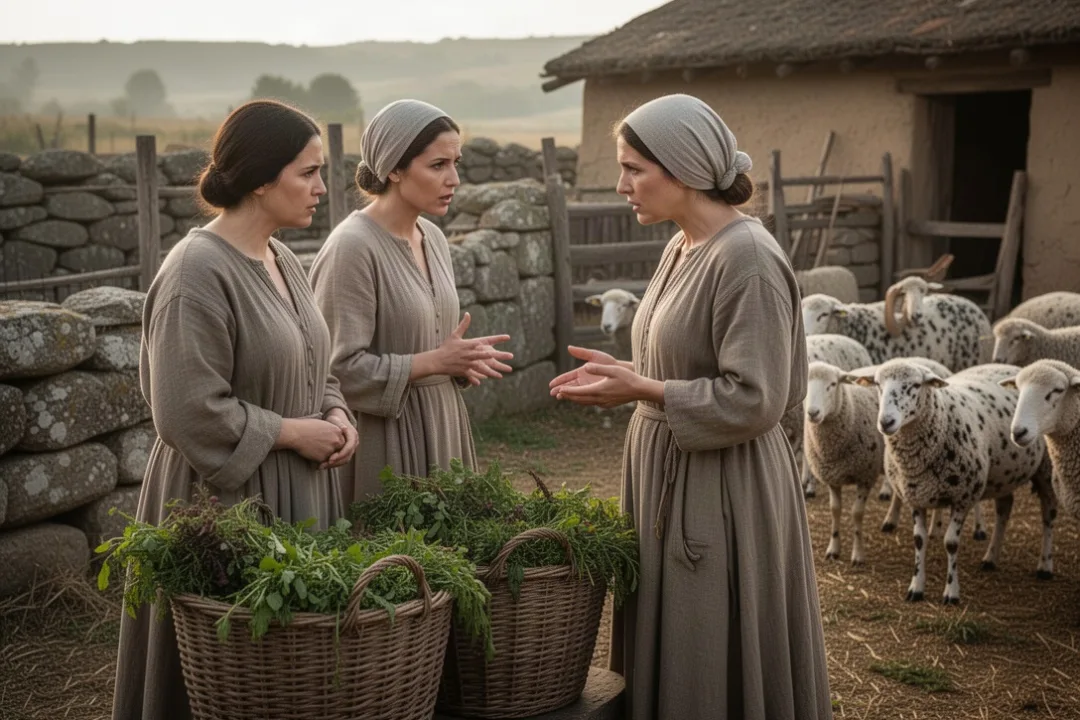
The family rivalry continues when Reuben finds mandrakes during the wheat harvest. Rachel asks Leah for some of them, but Leah protests that Rachel has already taken Jacob’s affection. Rachel offers a bargain: Leah may spend the night with Jacob in exchange for the mandrakes.
Leah conceives Issachar and later Zebulun, and she also gives birth to Dinah. The text then reports that God remembers Rachel, and she conceives Joseph. Rachel’s long-awaited pregnancy changes the direction of the story, although the family tensions do not disappear.
After Joseph’s birth, Jacob asks Laban to let him return to his homeland. Laban recognizes that his own prosperity has increased because of Jacob’s work and asks him to name his wages. Jacob proposes to receive the speckled, spotted, and dark-colored animals from the flock, leaving the more uniformly colored animals with Laban.
Jacob separates the selected animals and uses branches with peeled markings near the watering places. The chapter presents the flocks as becoming stronger and more numerous under Jacob’s management. This leads directly into the disputes and departures described in the next chapter.
Why Rachel and Leah compete through childbirth
Rachel and Leah’s conflict cannot be separated from the social importance of children in their world. Children provided family continuity, labor, security, and status. For these women, childbirth is not merely a private matter; it affects their standing within Jacob’s household and their place in the future of the family.
Leah begins the chapter with a painful disadvantage: Jacob loves Rachel more, while Leah has borne children. Rachel begins with Jacob’s affection but lacks the children she desperately wants. Each woman possesses something the other desires, so their rivalry grows from unequal forms of security.
Rachel’s statement to Jacob is emotionally intense because it treats childlessness as an unbearable condition. Jacob’s angry reply reveals his own frustration, but it does not solve Rachel’s pain. The exchange shows how infertility can create grief, resentment, and pressure within a marriage.
The chapter does not present the household arrangement as peaceful or ideal. Bilhah and Zilpah become part of a competition that has already damaged the relationship between Rachel and Leah. Their pregnancies increase the number of children but do not heal the emotional wounds among the adults.
Reading the family conflict carefully: Genesis often reports actions without approving them. The rivalry, use of servants, and bargaining over childbirth reveal the brokenness of the household rather than providing a simple model for family relationships.
The names given to the children preserve the women’s interpretations of events. Dan is connected with Rachel’s sense that God has judged her case. Naphtali reflects her struggle with Leah. Gad and Asher express Leah’s hope that good fortune and public approval will follow.
These names also show that the children are born into a story they did not create. Each birth carries the emotional weight of the competition between the sisters. The chapter therefore presents the growth of Jacob’s family as both a blessing and a source of continuing tension.
Bilhah and Zilpah are described as servants connected to Rachel and Leah. Their role reflects an ancient household practice in which a wife could provide a servant to bear children on her behalf. This arrangement appears elsewhere in Genesis, including the story of Sarah, Hagar, and Abraham.
The practice gave the primary wife a recognized connection to the children, but it did not necessarily protect the servant from being treated as a means to an end. Genesis 30 keeps the focus on Rachel and Leah’s interpretations, while Bilhah and Zilpah receive little independent speech.
Rachel names Bilhah’s sons Dan and Naphtali. The names express Rachel’s belief that God has heard her case and enabled her to compete with Leah. The wording presents motherhood as a contested position, not simply as a private joy.
Leah gives Zilpah to Jacob after Rachel’s success through Bilhah. Zilpah bears Gad and Asher, and Leah’s names emphasize good fortune and happiness. Leah appears to gain status through these births, yet the underlying competition remains.
Readers should avoid treating the servants as interchangeable details. Their presence points to the vulnerability of women with lower household status and shows how powerful family members could control their reproductive lives. The chapter is historically descriptive, and its narrative does not erase the human cost of the arrangement.
What the mandrakes episode means
Mandrakes were plants associated in the ancient world with fertility, desire, or medicinal benefits. Reuben finds them during harvest, and Rachel asks Leah for them. The text does not claim that the plants themselves cause pregnancy; instead, the scene uses them within the emotional and cultural world of the family.
Rachel’s request creates another confrontation. Leah answers that Rachel has already taken Jacob, implying that Jacob’s affection and companionship have been unfairly distributed. Rachel then offers Leah the opportunity to spend the night with Jacob in exchange for the mandrakes.
When Jacob comes home, Leah tells him that she has effectively obtained his company through the agreement with Rachel. She conceives Issachar and later Zebulun, and then gives birth to Dinah. The passage connects the encounter to Leah’s pregnancies, but it does not present the mandrakes as the cause.
Rachel’s continued infertility after obtaining the mandrakes is one of the clearest clues. She does not conceive until the text later says that God remembers her. The narrative places ultimate control of conception with God rather than with a fertility plant or human bargain.
The episode also exposes the transactional nature of the household. Jacob’s attention becomes something the sisters negotiate, while Leah’s earlier complaint shows how neglected she feels. The bargain may appear practical, but it reveals how little agency either woman experiences in her marriage.
Dinah is mentioned briefly at the end of Leah’s sequence of births. Her appearance is significant because she is the only daughter named in this chapter, although the household likely includes more children than the narrative records. Her later story becomes important in Genesis 34.
Why Rachel’s birth of Joseph changes the story
The statement that God remembers Rachel marks a turning point. In biblical language, remembering does not suggest that God had forgotten a person; it signals divine attention expressed through action. Rachel conceives and gives birth to Joseph, whose name reflects her hope for another son.
Joseph’s birth matters beyond Rachel’s personal relief. He becomes one of the most important figures in Genesis, and his later story connects Jacob’s family with Egypt, famine, preservation, and the growth of Israel. At this point in the narrative, however, Joseph is simply the long-awaited child who changes Rachel’s place in the household.
The birth does not erase the earlier pain. Leah has more children, Rachel has Jacob’s special affection, and both women have used servants in the competition. The chapter shows that a longed-for blessing may arrive without resolving every relational problem around it.
Rachel’s experience also adds another layer to the biblical presentation of fertility. Genesis repeatedly shows births occurring within situations of delay, grief, rivalry, or uncertainty. The point is not that every case of infertility has the same explanation, but that the narrative treats childbearing as an area of profound human vulnerability.
How Jacob negotiates wages with Laban
After Joseph’s birth, Jacob asks Laban to let him return to his own country. Jacob has spent many years working for Laban, first for Rachel and then for Leah, and he now wants to provide for his own household. Laban admits that his prosperity has grown because of Jacob’s work.
Rather than leaving immediately, Jacob agrees to continue tending Laban’s flocks under a new wage arrangement. Jacob proposes that he receive animals with particular markings, including speckled, spotted, and dark-colored sheep and goats. The more uniformly colored animals would remain Laban’s property.
On the surface, Jacob’s proposal appears modest because the selected animals may have seemed less valuable or less common within the flock. It gives Laban a reason to accept the arrangement while allowing Jacob to begin building his own herd.
Laban accepts, but he then removes many of the animals that would have formed Jacob’s portion and places them under the care of his sons. This action creates distance between the flocks and makes the agreement more difficult for Jacob. The episode anticipates the accusation in Genesis 31 that Laban repeatedly changed Jacob’s wages.
The wage dispute is part of a broader pattern. Laban has benefited from Jacob’s labor, while Jacob has endured manipulation within the marriage arrangements and the employment agreement. Genesis 30 therefore shifts from household rivalry to economic conflict, but the theme of unequal power continues.
What Jacob’s breeding strategy shows about the flocks
Jacob places peeled branches near watering troughs when the stronger animals mate. The chapter says that the stronger animals produce marked offspring, while the weaker animals are associated with Laban’s flock. Jacob’s actions are presented as part of his effort to increase his own wealth.
Modern readers may wonder whether the passage describes a biological breeding method, an ancient belief about visual impressions, or a narrative device emphasizing Jacob’s prosperity. Genesis 30 does not provide a modern genetics lesson. Its immediate concern is that Jacob’s flock becomes stronger while Laban’s advantage declines.
The next chapter gives a fuller explanation of Jacob’s understanding of what happened. There, Jacob attributes the outcome to God’s intervention and to Laban’s repeated unfairness. Genesis 30 emphasizes Jacob’s methods, while the broader narrative places his success within divine providence.
The account should not be used as a general livestock-breeding guide. It belongs to an ancient story shaped by pastoral practices, family inheritance, and theological claims about blessing. Its main narrative purpose is to show Jacob becoming prosperous despite Laban’s control over the labor arrangement.
Jacob’s wealth also creates a new kind of danger. As his animals increase, Laban’s sons become hostile toward him. Material success improves Jacob’s ability to leave, but it also intensifies the resentment that will force the family conflict into the open.
Major themes in Genesis chapter 30
Human desire and divine sovereignty
The characters make plans, bargain, compete, and attempt to control outcomes. Rachel seeks children through Bilhah and the mandrakes, Leah responds with Zilpah and her own bargain, and Jacob develops a strategy for increasing his flock. Yet the chapter repeatedly places births and prosperity within God’s larger purposes.
This does not mean human choices are irrelevant. The characters’ decisions have real consequences, and the chapter does not excuse deception or exploitation. It presents divine purpose operating through a deeply imperfect family rather than through flawless human behavior.
Family growth does not guarantee family harmony
Jacob’s household becomes larger, but it does not become more peaceful. The births create the foundation for the tribes of Israel, yet the family relationships are marked by jealousy, favoritism, competition, and emotional neglect.
This contrast is central to the chapter. Numerical growth and relational health are not the same thing. A household can be materially successful while its members still carry resentment and insecurity.
Women seek dignity in a system shaped by men
Rachel and Leah have limited power over marriage, affection, fertility, and household status. They respond with the tools available to them: servants, bargaining, naming, and appeals to God. Their actions are sometimes manipulative, but the surrounding structure is also restrictive.
Jacob is the husband and the central economic worker, yet he does not control the final outcome of every negotiation. Laban controls the labor arrangement, while Rachel and Leah compete within a marriage that Jacob has failed to make equitable. The chapter gives readers a complicated picture of power rather than a simple division between innocent and guilty characters.
Prosperity can expose injustice
Laban’s prosperity depends on Jacob’s labor, but Laban does not willingly release him. When Jacob begins to prosper independently, Laban’s household becomes threatened. The conflict suggests that an arrangement can look successful to the person in power while remaining exploitative to the worker.
Jacob is not portrayed as entirely transparent or passive. He acts strategically to protect his interests. Still, the narrative places his actions within a history of service and changing wages, making the economic conflict part of the larger struggle over who will benefit from his labor.
Genesis 30 contains quick transitions, unfamiliar customs, and several names with symbolic explanations. These practices can help you read the chapter without flattening its difficult material:
Separate description from approval. The text reports polygamy, surrogate childbirth, rivalry, and deceptive labor practices, but reporting an action does not mean endorsing it.
Track each woman’s role. Rachel, Leah, Bilhah, and Zilpah do not have the same status or narrative voice. Keeping those distinctions clear prevents confusion.
Read the names as interpretations. The names of the children reveal how Rachel and Leah understand their experiences, but they do not provide a complete explanation of each birth.
Do not treat mandrakes as magical. They reflect ancient fertility associations, while the narrative ultimately attributes Rachel’s pregnancy to God’s action.
Read the flock episode with Genesis 31. The following chapter supplies additional information about Jacob’s understanding of the breeding results and Laban’s conduct.
Avoid modernizing the breeding account too quickly. The passage is theological and narrative as well as practical; it is not written as a contemporary account of heredity.
Notice the repeated pattern of contested blessing. Children, affection, wages, and livestock all become subjects of competition and negotiation.
A useful question for study: Ask not only who receives a blessing, but also what conflict surrounds that blessing. Genesis 30 presents increase alongside jealousy, exploitation, and the need for eventual separation.
Questions Genesis chapter 30 raises for modern readers
The chapter can be difficult because it connects faith with painful subjects such as infertility, marital favoritism, reproductive control, and economic exploitation. A responsible reading should allow those difficulties to remain visible rather than turning every event into a simple moral lesson.
For someone experiencing infertility, Rachel’s story may feel especially personal. Her distress is real within the narrative, but her eventual pregnancy should not be used to promise that every person who waits will receive the same outcome. The chapter offers a story of longing and divine attention, not a formula for predicting reproductive results.
The rivalry between Rachel and Leah also invites reflection on how people compare their lives. Leah has children but lacks Jacob’s affection; Rachel is loved but lacks children for much of the story. Their comparison causes each woman to measure her worth through what the other possesses.
The economic section raises questions about fair compensation and dependency. Jacob’s years of labor enrich Laban, while the rules governing Jacob’s wages remain under Laban’s influence. The chapter recognizes that prosperity gained under another person’s control may not be secure until ownership and freedom are established.
Above all, Genesis 30 portrays a family moving toward the fulfillment of a larger promise through ordinary, conflicted, and sometimes harmful relationships. The chapter does not remove human responsibility, but it shows that the future of the family does not depend on its members being free from failure.
How Genesis chapter 30 connects to the surrounding chapters
Genesis 29 establishes the relationships that dominate chapter 30. Jacob receives Leah and Rachel through Laban’s arrangements, and the unequal affection between the sisters becomes the setting for the births recorded here. Without chapter 29, the emotional force of Rachel’s infertility and Leah’s resentment would be harder to understand.
Genesis 30 then prepares the events of chapter 31. Jacob’s growing flocks, Laban’s changing attitude, and the dissatisfaction surrounding the wage agreement all point toward Jacob’s departure. The family and economic conflicts that develop here cannot remain contained within Laban’s household.
The chapter also lays groundwork for later biblical history. The children born through Rachel, Leah, Bilhah, and Zilpah become ancestors of the tribes associated with Israel. Joseph’s birth, in particular, leads into the extended narrative of preservation and relocation in Egypt.
Reading the chapter in this wider sequence helps explain why it includes both intimate household details and livestock management. The private struggles of the family and the public development of Jacob’s wealth are moving toward the formation of a people and the fulfillment of the promises made to Abraham, Isaac, and Jacob.
Frequently asked questions
Why was Rachel so distressed about not having children?
In Rachel’s setting, children affected a woman’s social standing, family continuity, and security. Her distress also reflects the personal pain of being unable to conceive while her sister was having children. The chapter presents her anguish seriously, but it does not teach that infertility results from personal failure or that pregnancy can be guaranteed through faith, bargains, or fertility practices.
What were the mandrakes in Genesis chapter 30?
Mandrakes were plants known in the ancient world and associated in popular belief with fertility, desire, or medicinal effects. Rachel wanted them because of those associations, but the story does not credit the plants with causing her pregnancy. Rachel conceives later when the text says that God remembers her, making the mandrakes part of the cultural setting rather than a magical solution.
Did Jacob’s method actually cause the marked animals to multiply?
The passage describes Jacob placing peeled branches near the watering places and then seeing stronger marked animals produced. It should not be treated as a modern explanation of inherited traits. The story’s larger context presents Jacob’s prosperity as connected with God’s provision and Laban’s unfair treatment, while Genesis 31 adds further details about how Jacob understood the results.
Who were the children born in Genesis chapter 30?
Bilhah bears Dan and Naphtali; Zilpah bears Gad and Asher; Leah bears Issachar, Zebulun, and Dinah; and Rachel bears Joseph. These children join Reuben, Simeon, Levi, and Judah, who were born earlier in Genesis 29. Their births form the family foundation for the tribes associated with Israel, though the chapter focuses on the family conflict surrounding them.











Leave a Reply