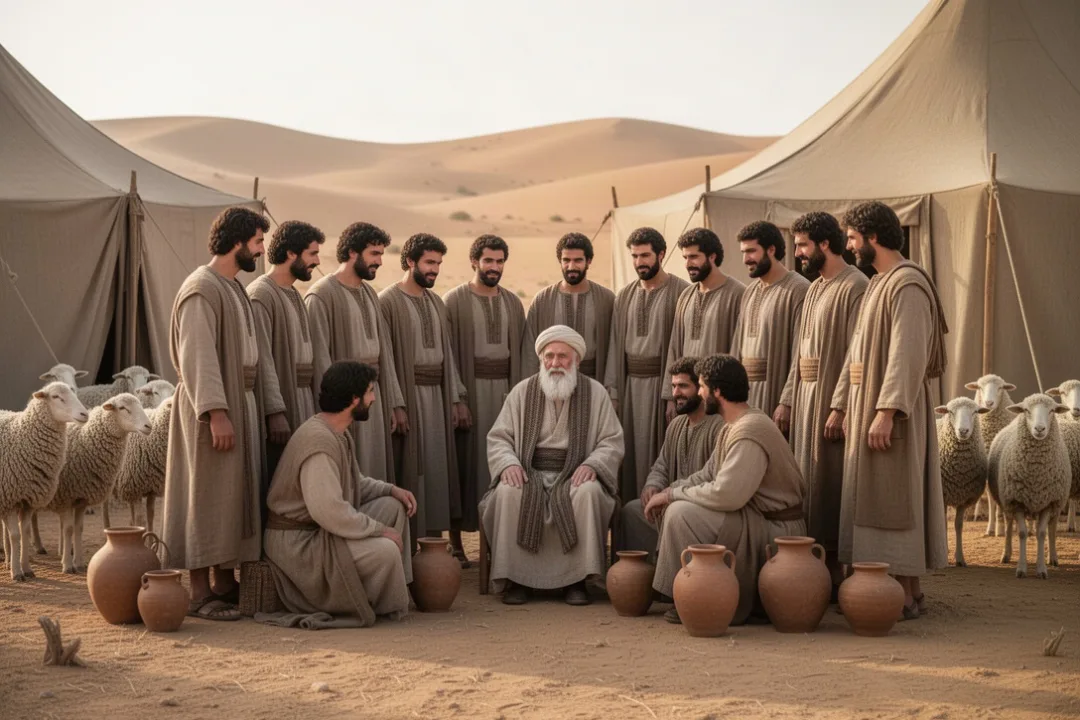
Jacob was the son of Isaac and the grandson of Abraham. In the book of Genesis, God gave him the name Israel, so the names Jacob and Israel can refer to the same person. His sons therefore appear in the Bible both as Jacob’s children and as the ancestors of the people of Israel.
The story of the sons of Jacob is told mainly in Genesis 29–50. Their family life included rivalry, favoritism, grief, deception, reconciliation, and the movement of Jacob’s household from Canaan to Egypt. These events help explain how a family became a nation.
Jacob’s 12 sons were born to four women: Leah, Rachel, Bilhah, and Zilpah. Jacob’s daughter Dinah was also born to Leah, but she is not included among the sons or the twelve tribal ancestors.
Central distinction: Jacob had 12 sons, but later tribal lists do not always name the same 12 tribes. Joseph’s inheritance is represented through his two sons, Ephraim and Manasseh, while the tribe of Levi was set apart for religious service rather than receiving a standard territorial inheritance.
The 12 sons of Jacob in birth order
The narratives in Genesis allow the sons to be arranged in a generally recognized birth order. The first four were Leah’s sons, followed by the sons of Bilhah and Zilpah, then Leah’s later sons, and finally Rachel’s sons.
Reuben — son of Leah
Simeon — son of Leah
Levi — son of Leah
Judah — son of Leah
Dan — son of Bilhah, Rachel’s servant
Naphtali — son of Bilhah
Gad — son of Zilpah, Leah’s servant
Asher — son of Zilpah
Issachar — son of Leah
Zebulun — son of Leah
Joseph — son of Rachel
Benjamin — son of Rachel
Genesis 29–30 describes the births of most of these sons, while Genesis 35 records Benjamin’s birth and Rachel’s death. The order matters because the sons’ positions within the family affected inheritance, leadership, and the later blessings given by Jacob.
Which mother gave birth to each son?
Jacob’s household included two wives and two servant women whose children were legally connected to Rachel and Leah. The Bible presents these relationships within the customs and family structures of the ancient Near East.
Leah: Reuben, Simeon, Levi, Judah, Issachar, and Zebulun
Rachel: Joseph and Benjamin
Bilhah: Dan and Naphtali
Zilpah: Gad and Asher
Leah was Jacob’s first wife, although Jacob had intended to marry Rachel. Genesis 29 describes how Jacob was given Leah first and then married Rachel. This arrangement created tension between the sisters, particularly because Rachel initially could not have children while Leah had several sons.
Rachel later gave Jacob Joseph and Benjamin. Because Rachel was Jacob’s favored wife, her sons received special attention in the narrative. Jacob’s attachment to Joseph became a major source of resentment among the older brothers, and his grief over Joseph shaped the family for many years.
Bilhah and Zilpah were servants associated with Rachel and Leah. Their sons were counted among Jacob’s children and among the ancestors of Israel’s tribes. This explains why the family tree includes sons born to four different women.
What each son’s name and story reveal
Reuben was Jacob’s firstborn son
Reuben was Leah’s first son and therefore Jacob’s firstborn. Leah’s words at his birth, recorded in Genesis 29, connect his name with her hope that Jacob would recognize her hardship and affection.
As firstborn, Reuben might have expected a privileged position. However, Genesis 35 records a serious offense involving Bilhah, one of Jacob’s concubines. Later, Jacob’s blessing in Genesis 49 describes Reuben as unstable and says he would not retain the highest standing. The episode shows that birth order alone did not guarantee lasting authority.
Simeon and Levi were associated with violence
Simeon was Leah’s second son, and Levi was her third. They are closely linked in the account of Dinah, their sister, in Genesis 34. After Dinah was violated by Shechem, Simeon and Levi responded with a violent deception against the men of the city.
Jacob condemned their anger in his final words in Genesis 49. Their descendants later had very different histories. Simeon received territory within the region assigned to Judah, while Levi did not receive one unified land territory because the Levites were distributed among Israelite towns and served in religious duties.
Judah became a leading royal line
Judah was Leah’s fourth son and one of the most prominent figures among Jacob’s children. His name is associated in Genesis with praise. His importance grows as the Joseph story develops, especially when Judah offers himself in place of Benjamin before the Egyptian ruler in Genesis 44.
Jacob’s blessing in Genesis 49 gives Judah a position of leadership among his brothers. Later biblical history connects the tribe of Judah with King David, Jerusalem, and the southern kingdom. In the New Testament genealogies, Jesus is also presented as belonging to the line of Judah.
Judah’s story is complex rather than flawless. Genesis 38 records his failure in dealing justly with Tamar, followed by his recognition of his own wrongdoing. His later willingness to protect Benjamin marks a significant change in character.
Dan and Naphtali were Rachel’s servant’s sons
Dan was born to Bilhah after Rachel gave her servant to Jacob. Genesis 30 connects Dan’s name with Rachel’s sense that she had received justice in the struggle over children. Dan was the first son born through Bilhah.
Naphtali was Bilhah’s second son. Rachel’s words at his birth describe a struggle with her sister. These naming explanations reflect the rivalry between Rachel and Leah, which shaped the circumstances of the children’s births.
The tribe of Dan later received land in the coastal and central regions of Canaan, although part of the tribe eventually moved north. Naphtali received territory in the northern area of Israel around the region near the Sea of Galilee.
Gad and Asher were born to Leah’s servant
Gad was the first son of Zilpah, Leah’s servant. Asher was her second son. The names given to them express Leah’s response to the changing fortunes of her household: Gad is connected with prosperity or good fortune, while Asher is associated with happiness or blessing.
Gad’s descendants settled east of the Jordan River, alongside Reuben and half of Manasseh. That region was suitable for livestock, which mattered to these tribes. Asher received land along the northern Mediterranean coast, an area associated with fertile resources.
Issachar and Zebulun were Leah’s later sons
Issachar was Leah’s fifth son and her ninth child. Genesis 30 connects his name with the idea of wages or reward. The story refers to a dispute involving mandrakes, but the name explanation reflects Leah’s understanding of the circumstances surrounding his birth.
Zebulun was Leah’s sixth son and Jacob’s tenth son. Leah’s words connect his name with the hope that Jacob would honor or dwell with her. The tribe of Zebulun later received territory in northern Canaan, near the lands of Naphtali and Issachar.
Issachar and Zebulun appear together in several biblical lists and traditions. Their territories were located in the north, and later passages describe their people as participating in Israel’s military and political life.
Joseph became the central figure in the family’s survival
Joseph was Rachel’s first son and Jacob’s eleventh son. Genesis says Jacob loved Joseph more than the other sons and gave him a distinctive garment. Joseph also reported dreams that suggested his family would one day bow before him, which intensified his brothers’ resentment.
The brothers sold Joseph, and he was taken to Egypt. There, after years of hardship, he rose to authority under Pharaoh. When famine struck the region, Joseph managed Egypt’s food supply and eventually saved his family from starvation.
Joseph’s story occupies much of Genesis 37–50. It connects the family of Jacob with Egypt and explains why the Israelites were living there before the events described in Exodus. Joseph’s final position allowed him to preserve the family even though his brothers had intended him harm.
Jacob gave Joseph’s two sons, Ephraim and Manasseh, a status that affected later tribal counting. In Genesis 48, Jacob adopted and blessed them as his own in a special act of family inheritance. As a result, Joseph is sometimes represented by two tribes rather than one.
Benjamin was Rachel’s second and final son
Benjamin was born as Rachel died, according to Genesis 35. Rachel initially named him Ben-Oni, a name connected with her suffering, but Jacob called him Benjamin. He was the youngest of Jacob’s sons and the only full brother of Joseph.
Jacob became intensely protective of Benjamin after Joseph disappeared. This concern explains why Jacob was reluctant to let Benjamin travel to Egypt with his older brothers during the famine. Judah’s promise to protect him eventually persuaded Jacob to agree.
The tribe of Benjamin occupied a relatively small but strategically important area near Jerusalem. Israel’s first king, Saul, came from Benjamin, and the apostle Paul later identified himself as a Benjaminite.
How Jacob’s sons became the tribes of Israel
The sons were not merely remembered as individuals. Each became associated with a tribal group that formed part of Israel’s national identity. Biblical passages such as Genesis 49, Deuteronomy 33, and Joshua 13–21 describe the tribes in different settings.
When Israel entered and settled in Canaan, land was distributed among tribal groups. The boundaries and fortunes of the tribes changed over time, and not every later list uses the same arrangement. The basic idea remains that Jacob’s family expanded into the people known as Israel.
Reuben: received land east of the Jordan River.
Simeon: received towns within the territory assigned to Judah.
Levi: received designated towns and religious responsibilities rather than one large tribal territory.
Judah: received a substantial southern territory and became a major center of leadership.
Dan: received territory in central Canaan and later established a settlement in the north.
Naphtali: received land in the far north.
Gad: settled east of the Jordan.
Asher: received land near the northern coast.
Issachar: received territory in the fertile northern interior.
Zebulun: received territory in northern Canaan.
Ephraim and Manasseh: represented Joseph’s family with territories on both sides of the Jordan.
Benjamin: received land near the central hill country and Jerusalem.
This list contains a familiar counting pattern: Joseph is divided into Ephraim and Manasseh, while Levi is treated separately. The total can still be described as twelve because the tribal lists are arranged for different purposes.
How to count them: If you are listing Jacob’s actual sons, name Joseph once and include Levi. If you are discussing landholding tribes in Canaan, count Ephraim and Manasseh separately and usually treat Levi differently because of its religious role.
Why the number 12 appears so often
The number twelve provides a framework for Israel’s tribal identity. It connects the original family to the nation’s organization and appears in descriptions of tribal representatives, camp arrangements, land distribution, and symbolic visions.
Still, the twelve names are not identical in every passage. For example, a list may omit Levi because the Levites had no ordinary territory, or it may use Ephraim and Manasseh in place of Joseph. The list in Revelation 7 also differs from some Old Testament lists, showing that the biblical writers could adapt the tribal symbolism to the purpose of a passage.
These variations do not mean that the Bible has forgotten Jacob’s sons. They reflect different ways of describing family ancestry, land ownership, religious service, or symbolic identity.
Jacob’s final blessings and the future of the family
Before Jacob died, he called his sons together and spoke about their futures. This scene appears in Genesis 49. The words are not identical blessings in the modern sense; some are commendations, some are warnings, and some describe the character or future reputation of a tribe.
Reuben is addressed as the firstborn whose instability weakened his position. Simeon and Levi are criticized for violent anger. Judah receives imagery of leadership, while Joseph receives an extensive blessing that emphasizes fruitfulness and endurance.
Jacob’s words help explain later developments, but they should not be read as a simple political chart. The tribes’ histories were shaped by migration, warfare, alliances, worship, royal power, and the division of the kingdom. The final chapter of Genesis presents the family as a group with both shared identity and serious internal differences.
How the sons’ relationships change in Genesis
At the beginning of the Joseph narrative, the brothers are divided by jealousy and favoritism. They cannot speak peacefully with Joseph, and their resentment leads them to sell him. Their action creates a false story that convinces Jacob Joseph is dead.
Years later, famine brings the brothers before Joseph in Egypt, although they do not recognize him. Joseph tests them, particularly regarding Benjamin. These tests reveal whether they remain willing to sacrifice one brother for their own safety.
Judah’s speech in Genesis 44 is especially significant. He offers himself as a substitute for Benjamin because he had promised Jacob that the younger brother would return safely. This reversal contrasts with the earlier sale of Joseph and leads to the family’s reconciliation.
Joseph interprets the family’s history through God’s providence, while still acknowledging the evil of what the brothers did. Genesis 50 presents forgiveness without pretending that betrayal was harmless. The family survives because reconciliation becomes possible.
Counting Dinah as one of the twelve sons: Dinah was Jacob’s daughter, not a son. She was Leah’s daughter.
Calling Joseph’s sons Jacob’s grandsons only: They were Jacob’s grandsons by birth, but Genesis 48 gives Ephraim and Manasseh a special inheritance status.
Assuming Levi received a normal tribal territory: The Levites were given towns and religious duties rather than one unified region like most other tribes.
Assuming the sons were all born to Rachel and Leah: Bilhah and Zilpah also gave birth to Jacob’s sons.
Confusing birth order with later importance: Reuben was the firstborn, but Judah became associated with royal leadership and Joseph became central to the family’s preservation.
Assuming every tribal list must contain the same names: Biblical lists vary depending on whether they emphasize ancestry, land, religious service, or symbolism.
Where to read about Jacob’s sons in the Bible
Several sections of Genesis provide the main material for studying Jacob’s sons. Reading them in sequence makes the family relationships easier to follow.
Genesis 29–30: describes the births of most of Jacob’s sons through Leah, Rachel, Bilhah, and Zilpah.
Genesis 34: tells the story of Dinah and the violent response of Simeon and Levi.
Genesis 35: records Benjamin’s birth and Rachel’s death.
Genesis 37: begins Joseph’s conflict with his brothers and his sale into Egypt.
Genesis 42–45: describes the brothers’ meetings in Egypt and Judah’s appeal for Benjamin.
Genesis 48: records Jacob’s blessing and adoption of Ephraim and Manasseh.
Genesis 49: records Jacob’s final words about his sons.
Exodus through Joshua: follows the tribes as Israel leaves Egypt, journeys through the wilderness, and receives land.
Reading these passages together prevents the sons from becoming only a memorized list. Each name belongs to a larger story about family conflict, divine promises, national identity, and the formation of Israel.
What the sons of Jacob represent in the wider biblical story
The sons of Jacob connect several major themes in Scripture. They carry forward the promises made to Abraham and Isaac, while also showing how those promises unfold through an imperfect family. Their story includes human choices that cause real damage, yet it also describes protection, preservation, and renewed relationship.
The family’s movement into Egypt sets the stage for the book of Exodus. Their descendants will later be oppressed, delivered, organized as a people, and brought toward the land promised to their ancestors. The twelve sons therefore stand at the transition between the patriarchal family narratives and the national history of Israel.
Judah, Joseph, and Levi also become especially important in later biblical theology. Judah is linked with kingship, Joseph with preservation and abundance, and Levi with priestly service. Benjamin contributes its own military and royal traditions, while the other tribes preserve the wider identity of Israel.
Knowing the names and relationships of Jacob’s sons makes many later passages easier to understand. When a biblical text mentions Judah, Levi, Ephraim, Benjamin, or another tribe, it is drawing on this family history and on the distinct role each group came to occupy.
Frequently asked questions
Were all 12 sons of Jacob born to the same woman?
No. Leah gave birth to Reuben, Simeon, Levi, Judah, Issachar, and Zebulun. Rachel gave birth to Joseph and Benjamin. Bilhah, Rachel’s servant, gave birth to Dan and Naphtali, while Zilpah, Leah’s servant, gave birth to Gad and Asher. Jacob’s family therefore included children connected to four women.
Which son of Jacob became the ancestor of the priests?
Levi became the ancestor of the Levites, the tribe assigned special duties connected with Israel’s worship. Aaron and Moses came from the tribe of Levi, and Aaron’s descendants served as priests. Unlike most tribes, Levi did not receive one large, continuous territory; Levites lived in towns distributed among the other tribes.
Why are Ephraim and Manasseh sometimes counted instead of Joseph?
Jacob gave Joseph’s sons, Ephraim and Manasseh, a special inheritance in Genesis 48. They were treated as tribal founders in the distribution of land. As a result, lists focused on territory may name Ephraim and Manasseh separately while leaving out Joseph’s name. Levi may also be omitted from those lists because of its religious responsibilities.
Which son of Jacob was the ancestor of King David?
David came from the tribe of Judah, Jacob’s fourth son through Leah. Jacob’s words in Genesis 49 associate Judah with leadership, and later biblical history develops that connection through David’s royal family. The tribe of Judah also became the dominant tribe of the southern kingdom after Israel’s monarchy divided.