Female warriors in the Bible: Deborah, Jael and others
Female warriors in the Bible: Deborah, Jael and others
When people search for female warriors in the Bible, they often expect a list of women who carried weapons and fought in formal armies. The Bible includes some women connected directly to violence and battle, but its examples are broader than that. Women appear as military leaders, defenders, rescuers, strategists and political actors whose courage changes the outcome of conflicts.
The clearest examples are Deborah and Jael in the book of Judges. Deborah leads Israel during a national crisis, while Jael kills the enemy commander Sisera after he flees from battle. Other women, including Esther, the wise woman of Abel, and a woman who kills Abimelech from a city tower, show different forms of courage in wartime. Judith is also widely remembered as a biblical heroine, although her book belongs to the Catholic and Orthodox deuterocanonical tradition rather than the Hebrew Bible or most Protestant Bibles.
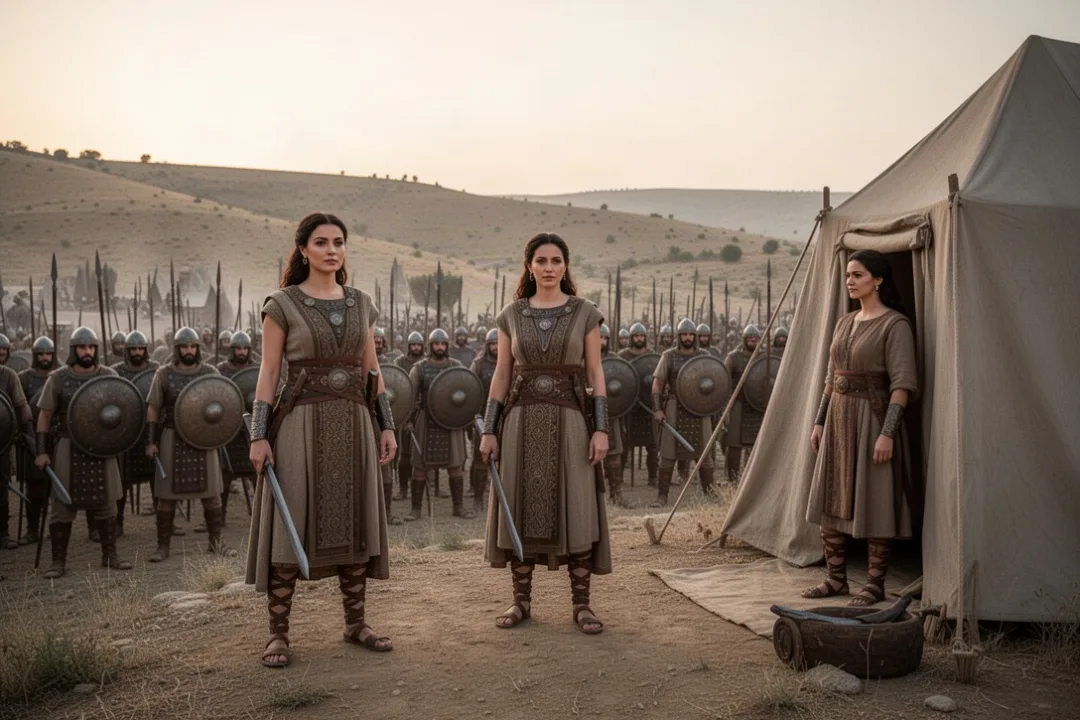
Deborah is the Bible’s most explicit female military leader. Judges 4 presents her as a prophet and judge who settles disputes among the Israelites. She is associated with the hill country of Ephraim, where people come to her for judgment, and she summons Barak to carry out a military campaign against Israel’s oppressor.
The conflict centers on Jabin, king of Canaan, and his army commander Sisera. Judges describes Sisera as having nine hundred iron chariots, a formidable force in the terrain and warfare of that period. Deborah tells Barak to gather troops from the tribes of Naphtali and Zebulun and to move toward Mount Tabor.
Barak agrees to go only if Deborah accompanies him. She accepts, but tells him that the honor for the victory will go to a woman. The text does not portray Deborah as a passive adviser standing safely away from danger. Her presence gives authority to the campaign, and her prophetic direction determines when Barak should move against Sisera’s forces.
What makes Deborah a warrior leader: she combines spiritual authority, political judgment and battlefield direction. The biblical account does not reduce leadership to physical strength or weapon use.
Judges 4 says that the Lord throws Sisera’s army into confusion before Barak’s troops. Sisera abandons his chariot and escapes on foot, while the Israelite forces pursue the defeated army. The chapter emphasizes the collapse of a military power that had oppressed Israel for years.
Judges 5 retells the victory in a poetic song attributed to Deborah and Barak. The song praises communities that joined the fight and criticizes tribes that stayed away. This detail matters because Deborah is not merely a character in someone else’s victory story. Her voice interprets the battle, names the participants and evaluates the choices of Israel’s tribes.
Deborah’s role includes several kinds of authority:
Prophetic authority: she communicates the divine command to begin the campaign.
Judicial authority: she already serves as a public judge before the battle.
Military authority: she directs Barak and accompanies the army.
Poetic and interpretive authority: she helps preserve the meaning of the victory in Judges 5.
For readers asking whether the Bible presents a woman as a military commander, Deborah provides the strongest answer: yes, in the story of Israel’s deliverance from Sisera. The narrative gives her a public role that includes judgment, prophecy and wartime leadership rather than treating courage as an unusual private exception.
Jael defeated Sisera through courage and strategy
Jael is the other central female warrior in Judges 4–5. She is not described as an Israelite soldier marching with Barak’s army. Instead, she encounters Sisera after he leaves the battlefield and seeks refuge in her tent. Her actions turn the military victory into a complete defeat for the enemy commander.
Jael welcomes Sisera into her tent and covers him. When he asks for water, she gives him milk. After he tells her to stand at the entrance and deny that he is there, she takes a tent peg and a mallet and drives the peg through his temple while he sleeps. Judges 4 describes the act directly, and Judges 5 celebrates Jael as blessed among women.
This is a disturbing story by modern standards, and the text does not invite readers to treat violence casually. Jael’s action occurs in the setting of a war against an oppressor, and the narrative presents Sisera as Israel’s enemy. At the same time, the story uses hospitality, deception and domestic tools as part of Jael’s strategy. She defeats a heavily armed commander without appearing on a conventional battlefield.
Jael’s importance is not simply that she kills Sisera. Her action fulfills Deborah’s earlier prediction that the decisive honor would belong to a woman. The Israelite army wins the larger battle, but Jael’s intervention removes the commander who escaped from that defeat.
Her story raises questions that are useful when reading other biblical accounts of war:
Does the narrative describe a woman as a soldier, or as a civilian who intervenes during war?
Does she rely on physical force, strategic deception, political influence or a combination of these?
How does the story’s ancient wartime setting affect the way her actions are presented?
Is the emphasis on her individual courage, the liberation of her people, or both?
Jael is therefore best described as a wartime heroine and defender rather than a regular army member. Her example broadens the meaning of “warrior” in biblical literature. A woman does not need to appear in armor or command troops to become decisive in a conflict.
Other women acted directly in violent conflicts
The woman of Thebez stopped Abimelech
Judges 9 tells the story of Abimelech, a ruler who attacked the city of Thebez. During the assault, he approached a fortified tower where many people had taken refuge. An unnamed woman dropped a millstone from the tower and struck him on the head. Mortally wounded, Abimelech then ordered his armor-bearer to kill him so that people would not say a woman had killed him.
The story is brief, but its point is clear: an unnamed woman becomes the person who ends the career of a violent ruler. Abimelech’s concern about public reputation highlights the social meaning of the event. The woman’s identity is not preserved, yet her action is remembered as the decisive blow in the conflict.
She may not fit the modern image of a battlefield warrior, but she is certainly a defender of a besieged community. Her position in the tower gives her access to a weapon and a tactical advantage. Like Jael, she uses the resources immediately available to her rather than fighting according to the conventions of an army.
The wise woman of Abel saved her city
In 2 Samuel 20, a rebel named Sheba leads a revolt against King David. David’s commander Joab pursues him to the city of Abel Beth-maacah and begins attacking its wall. The text introduces an unnamed woman as a wise woman who speaks to Joab from the city.
She negotiates with him and reminds him that Abel has a reputation as a city where people seek wise counsel. Rather than accepting the destruction of the entire community, she asks what Joab wants. He answers that he is seeking Sheba, not the city itself. The woman persuades the people of Abel to hand Sheba’s head over the wall, and Joab withdraws.
This woman does not kill an enemy with her own hands, but she prevents a siege from destroying her community. Her methods are negotiation, political judgment and collective action. She identifies the real threat, communicates with an opposing commander and organizes a solution that preserves the city.
The account challenges a narrow definition of courage. A sword is not the only instrument used to protect people in a war. The wise woman of Abel demonstrates that leadership can mean knowing when to negotiate, what to concede and how to prevent needless deaths.
Women shaped military morale and national memory
Women also appear in the Bible as singers whose words influence how military victories are understood. After David’s success against the Philistines, women come from Israel’s towns with singing and dancing in 1 Samuel 18. Their song praises Saul’s victories but attributes even greater military success to David.
These women are not presented as combatants. Still, their public celebration affects royal politics and contributes to Saul’s jealousy of David. The episode shows that women’s voices could shape the honor, reputation and political consequences attached to warfare.
Psalm 68 also refers to women who proclaim victory and divide the spoils. The passage is poetic and does not provide a straightforward account of female soldiers. It does, however, show women participating in the public celebration of military success and in the distribution of what was captured.
Read the categories carefully: biblical women connected with war are not all soldiers. Some lead armies, some defeat individual enemies, some defend cities, and others shape public memory after a victory.
Esther used political courage to protect her people
Esther is not a battlefield warrior, but she is one of the Bible’s most important examples of a woman confronting a lethal political threat. In the book of Esther, Haman develops a plan to destroy the Jewish people throughout the Persian Empire. Esther, who is queen, must decide whether to reveal her Jewish identity and challenge the king’s policy.
Approaching the king without being summoned could place Esther in serious danger. She does not rush into the palace unprepared. Instead, she asks the Jewish people in Susa to fast, prepares herself and carefully arranges two banquets for the king and Haman. Her strategy depends on timing, self-control and persuasive disclosure.
At the second banquet, Esther identifies herself as Jewish and exposes Haman’s plan. The king responds against Haman, and the Jews receive permission to defend themselves against those who attack them. Esther’s action does not erase the threat immediately, but it changes the political conditions so that her people can survive.
The book does not describe Esther carrying a weapon or commanding troops. Her form of warfare is courtroom and political resistance. She uses access to power to confront an official who has manipulated the king and placed an entire population at risk.
Esther’s story also shows why labels need care. Calling her a “warrior” can be meaningful if the term includes courageous resistance and protection of a community. It becomes misleading if it suggests that she personally fought in the later violence described in the book. Esther’s achievement is the removal of a genocidal threat through political strategy.
Her example offers practical lessons for reading biblical leadership:
Preparation matters: Esther gathers support before taking a dangerous public step.
Timing matters: she chooses when and how to reveal the truth.
Personal risk can serve communal protection: her position becomes useful when she identifies with the threatened people.
Influence can be exercised indirectly: she changes the decision-making environment rather than fighting an army herself.
Esther belongs in a broad discussion of female warriors because biblical conflict is not limited to hand-to-hand combat. Her courage protects lives through political action, just as the wise woman of Abel protects her city through negotiation.
Judith is a warrior heroine in the deuterocanonical tradition
Judith is one of the most famous female warrior figures associated with the Bible. Her story appears in the Book of Judith, which is included in Catholic and Orthodox Bibles but not in the Hebrew Bible or most Protestant Bibles. Any accurate discussion should state this difference rather than presenting Judith as equally canonical in every Christian tradition.
In the book, the Assyrian commander Holofernes threatens the Jewish town of Bethulia. Judith, a wealthy widow known for her devotion and discipline, decides to act when the city’s leaders are close to surrender. She dresses carefully, leaves the city with her maid and presents herself to the enemy camp.
Judith gains access to Holofernes and waits for an opportunity. After he becomes incapacitated, she takes his sword and beheads him. She returns to Bethulia with proof that the enemy commander is dead, and the Jewish forces use the moment to attack the disorganized Assyrian army.
Judith combines several elements seen in Deborah, Jael and Esther: faith, strategic planning, personal courage and concern for a threatened people. Unlike Esther, she enters the enemy camp. Unlike Deborah, she does not lead an army in open battle. Unlike Jael, her action is part of a deliberate rescue plan that includes reconnaissance, deception and the return of evidence to her community.
The Book of Judith is also shaped by the conventions of ancient heroic storytelling. Readers should distinguish between the book’s religious and literary message and the historical questions surrounding its setting. The story’s exact historical details are debated, but its portrayal of a woman saving her people has had a lasting influence in Jewish and Christian art, literature and preaching.
Judith’s place in the canon affects how you answer the question “Who are the female warriors in the Bible?” A careful answer might say:
In the Hebrew Bible and most Protestant Old Testaments: Deborah and Jael are the clearest named examples, with other women acting as defenders or strategists.
In Catholic and Orthodox Bibles: Judith is an additional major example of a woman who defeats an enemy commander.
In a broader biblical-literary tradition: Esther and unnamed city defenders also belong in the discussion, though they use political or tactical power rather than regular military service.
What these biblical women reveal about courage and power
The Bible does not present one standard pattern for female courage in conflict. Deborah leads, Jael ambushes, the woman of Thebez strikes from a fortified position, the wise woman of Abel negotiates, Esther works through royal politics and Judith penetrates an enemy camp. Their methods differ because their situations differ.
Several themes connect these stories. First, many of the women act when established male leadership is failing or incomplete. Sisera’s army is powerful, Abimelech attacks a city, Joab threatens Abel, Haman manipulates the Persian court and Holofernes endangers Bethulia. The women respond to a crisis that demands more than ordinary obedience.
Second, the stories often contrast visible power with practical power. Iron chariots, royal authority and military commanders appear strong, yet the decisive action comes through people whom the powerful underestimate. A tent, a household tool, a city wall, a royal banquet or a widow’s courage becomes the setting for resistance.
Third, not every story should be turned into a simple instruction to imitate violence. These accounts belong to ancient narratives about war, invasion, political oppression and communal survival. Their value may lie in their portrayal of courage, wisdom, responsibility and protection rather than in treating every action as a universal model for conduct.
It also helps to avoid flattening the women into modern categories. The Bible does not use the contemporary phrase “female warrior” as a formal label. Some women are military leaders; others are civilians who act during war. Some protect a city through diplomacy, while others use lethal force against a commander.
A concise way to understand the group is:
Deborah: prophet, judge and leader of Israel’s campaign against Sisera.
Jael: woman who kills the fleeing enemy commander and completes Israel’s victory.
The woman of Thebez: unnamed defender who mortally wounds Abimelech from a tower.
The wise woman of Abel: negotiator who saves her city from destruction during a siege.
Esther: queen who risks her life and uses political influence to protect the Jewish people.
Judith: heroine of a deuterocanonical book who infiltrates an enemy camp and kills its commander.
Together, these accounts show that strength in biblical conflict takes many forms. Leadership may happen on a battlefield, at a city wall, in a royal court or inside an enemy camp. The women’s stories remain significant because they place female courage at the center of events that determine whether communities live, surrender or survive.
Frequently asked questions
Was Deborah a soldier in the Bible?
The Bible describes Deborah as a prophet, judge and leader connected to Israel’s military campaign, but it does not specifically say that she fought as an ordinary soldier. She summons Barak, gives the battle command and accompanies him. Her role is best understood as senior leadership with prophetic and military authority rather than standard infantry service.
Did Jael fight in Deborah’s army?
No. Jael is not shown marching with Deborah and Barak or serving in Israel’s army. She encounters Sisera after he flees the battle and offers him shelter in her tent. She then kills him with a tent peg. Her action makes her a wartime defender and heroine, but not a conventional enlisted soldier.
Is Judith included in every Bible?
No. The Book of Judith is part of the Catholic and Orthodox deuterocanonical collections, but it is not included in the Hebrew Bible or most Protestant Bibles. The story presents Judith as a courageous widow who saves her people by entering the enemy camp and killing its commander. Her canonical status differs by tradition.
Are there women soldiers in the Bible besides Deborah?
The Bible does not give many clear examples of women serving as regular soldiers. Deborah is the strongest example of female military leadership. Other women connected with conflict include Jael, the defender of Thebez, Esther and the wise woman of Abel. Their roles involve ambush, defense, negotiation or political strategy rather than routine army service.













Leave a Reply