Have you ever believed something about God but still felt unsure about what it means for your daily life? Ephesians 1:15-23 addresses that tension through a prayer Paul writes for believers. He does not mainly ask for easier circumstances, greater comfort, or more impressive religious experiences. He asks that Christians would see what God has given them, understand the hope of their calling, recognize the value of their inheritance, and know the power already at work for them through Christ.
The passage is therefore both a prayer and a guide for spiritual perspective. Paul begins by recognizing the Ephesians’ faith in Jesus and their love for other believers. He then asks God to give them wisdom and revelation so they can know him more deeply. The prayer moves from inner understanding to three realities: Christian hope, God’s inheritance, and resurrection power. It ends by presenting Jesus as exalted above every authority and the church as his body.
Ephesians 1:15-23 follows a long opening section in which Paul describes the spiritual blessings believers have in Christ. He has already referred to adoption, redemption, forgiveness, God’s purpose, and the promised Holy Spirit. Instead of treating these truths as abstract doctrine, he responds with prayer.
That movement matters. Christian teaching is meant to shape Christian vision. Paul does not present information simply to fill the mind. He wants believers to understand their identity and resources so deeply that their faith, love, endurance, and worship are changed.
The first three chapters of Ephesians emphasize what God has done in Christ. The later chapters focus more directly on how believers should live in response. This prayer stands at the transition between those emphases. It asks God to help the church grasp the meaning of grace before trying to live out its calling.
The passage also shows that spiritual maturity involves more than knowing religious vocabulary. A person may be familiar with Christian ideas and still need a clearer understanding of God’s character, the future he promises, and the power he supplies. Paul’s prayer assumes that believers need continual growth in spiritual knowledge, not merely a one-time lesson.
Central idea: Ephesians 1:15-23 asks God to open believers’ understanding so they can live from the hope, inheritance, and resurrection power they already have in Christ.
Why Paul begins with faith and love
Paul says he has heard of the Ephesians’ faith in the Lord Jesus and their love toward God’s people. These two qualities are closely connected throughout the New Testament. Faith directs trust toward Christ, while love expresses that trust in relationships with other people.
Faith in this passage is more than agreement with certain claims. It points to reliance on Jesus as Lord and to a continuing relationship with him. The Ephesians are not merely interested in Christian teaching; their lives are oriented around Christ. Their faith has a relational and practical dimension.
Love for the saints is equally significant. The phrase refers to fellow believers, not to a small group of unusually advanced Christians. Paul sees love within the church as evidence that the gospel is producing real change. A church can have impressive knowledge, organization, or public visibility, but Christian love remains a basic mark of spiritual life.
Paul’s order also offers a useful corrective. Faith and love belong together. Faith without love can become harsh, proud, or self-protective. Love without a stable trust in Christ can become exhausted by the demand to meet every need. In Ephesians, faith receives from Christ and love gives itself for others.
Paul’s thanksgiving does not mean the Ephesians have reached perfection. He thanks God for what is already visible while continuing to pray for deeper understanding. This provides a balanced view of spiritual growth: believers can be genuinely faithful and loving while still needing greater wisdom, hope, and awareness of God’s power.
What Paul means by knowing God better
Paul prays that God will give the Ephesians a spirit of wisdom and revelation in the knowledge of him. The request is not primarily for secret information or predictions about the future. It is a request for God-given insight into who God is and what he has accomplished through Christ.
In biblical language, knowing God includes relationship, recognition, trust, and obedience. It is possible to know facts about God without knowing God personally. Paul wants the Ephesians to perceive the significance of the blessings already described in the chapter.
Wisdom helps believers understand how divine truth fits together and how it should guide life. Revelation means that God must make spiritual realities clear. Human intelligence has value, but it cannot manufacture a living awareness of grace, hope, or Christ’s authority. The prayer recognizes that spiritual understanding is both a gift and a responsibility.
Paul then describes the “eyes” of the heart being enlightened. He is speaking figuratively about the inner person: the center of thought, desire, will, and perception. The image suggests that a person can possess information without seeing its true importance. Enlightenment in this sense means learning to view life through God’s purposes.
This prayer can reshape the way you approach Bible reading. Instead of asking only, “What does this passage say?” you can also ask, “What does this show me about God, Christ, myself, the church, and the hope God gives?” Those questions do not replace careful interpretation. They help connect understanding with worship and practice.
How the hope of God’s calling changes Christian life
The first major reality Paul wants believers to know is the hope of God’s calling. This does not mean vague optimism or the expectation that every circumstance will turn out as desired. Christian hope rests on God’s decision to call people into relationship with Christ and toward a promised future.
God’s calling includes belonging to him, receiving forgiveness, becoming part of his people, and sharing in the future restoration connected with Christ. The hope is not simply an escape from present difficulty. It is confidence that God’s purpose will be completed, even when current conditions appear uncertain.
This hope can steady believers when immediate evidence is discouraging. A person may be facing illness, grief, financial pressure, conflict, loneliness, or uncertainty about the future. Ephesians does not minimize those experiences. Instead, it places them within a larger story in which God’s call and promise are more lasting than present circumstances.
Hope also affects moral decisions. If your future is secured by God’s grace, you do not have to build your identity through constant approval, achievement, or control. You can practice patience, honesty, generosity, and forgiveness because your deepest future does not depend on winning every moment.
Paul’s wording points to the richness and value of this calling, not merely its existence. God’s call is not a minor religious label added to an otherwise unchanged life. It gives believers a new identity and direction. They belong to a people gathered around Christ and are invited to live as signs of his coming renewal.
What “the riches of his inheritance” means
The second reality Paul asks believers to understand is the riches of God’s inheritance among the saints. This phrase can be understood in two closely related ways: believers receive an inheritance from God, and God regards his people as an inheritance of great value. Both ideas fit the passage’s emphasis on abundance, belonging, and divine purpose.
In the surrounding context, believers are described as receiving blessings in Christ and being marked by the Holy Spirit. Their inheritance includes reconciliation with God, a place within his family, participation in his people, and hope for the future. The emphasis is not on luxury or material prosperity. It is on the lasting spiritual wealth found in belonging to God.
The phrase “among the saints” directs attention to the community. God’s inheritance is not presented as an isolated possession for private spirituality. Believers share in God’s promises as members of one people. This challenges individualistic ideas of faith that treat Christianity as only a personal relationship between one person and God.
God’s people are also described as precious to him. That does not mean believers are valuable because they have earned divine admiration. Their worth arises from God’s gracious choice and redemption. The church’s value is therefore both humbling and encouraging: it depends on God’s grace, and it should shape how Christians treat one another.
When you forget your value before God, you may look for worth in performance, popularity, possessions, or other people’s approval. Ephesians directs attention elsewhere. Your identity is rooted in God’s action, not in the unstable judgments of culture or the changing results of your own efforts.
What God’s great power means for believers
The third reality Paul wants believers to know is the immeasurable greatness of God’s power toward those who believe. The power described here is not an impersonal force that Christians learn to control. It is God’s active strength working according to his character and purpose.
Paul explains this power through what God accomplished in Christ. God raised Jesus from the dead and seated him at his right hand in the heavenly places. The language communicates resurrection and enthronement: Jesus has passed through death and now reigns with supreme authority.
Paul also places Christ above every rule, authority, power, and dominion. These terms may include earthly rulers and spiritual forces, but the main point is clear: no rival authority stands on an equal level with Jesus. His authority is not limited to one age or one political arrangement. He is above every name that can be named now and in the future.
This does not promise that evil has disappeared from human experience. The New Testament continues to acknowledge suffering, temptation, injustice, and spiritual opposition. It does mean that these forces are not ultimate. Christ’s authority is greater than every power that threatens God’s people.
The same power that raised Christ is described as working toward believers. This does not mean Christians will always display dramatic signs or avoid weakness. It means God’s power is sufficient for resurrection-shaped life: faithfulness under pressure, repentance after failure, endurance in suffering, courage in witness, and love that cannot be explained by self-interest alone.
Many readers instinctively interpret power as control over circumstances. Paul directs attention first to God’s power to raise and exalt Christ. That changes the question from “How can I make everything go my way?” to “How is God sustaining me and shaping me through Christ?” The answer may include deliverance, but it may also include perseverance and transformation in the middle of difficulty.
Keep the promise in proportion: Ephesians 1:15-23 does not guarantee comfort, wealth, or immediate solutions. It promises that the resurrection power of God is greater than death and that Christ’s authority stands above every opposing power.
Why Christ’s exaltation matters
Paul’s description of Jesus moves beyond the resurrection itself. Christ is raised, seated in the heavenly realm, placed above every authority, and given a name that surpasses every other name. This is a picture of the reigning Christ, not only the suffering or historical Jesus.
His exaltation assures believers that the cross was not a defeat. Jesus’ humiliation and death were followed by vindication and universal authority. The passage does not separate Jesus’ saving work from his present rule. The one who redeems his people is also the one who reigns over all things.
Christ’s authority reaches “all things,” and God has appointed him as head over everything for the church. This means Jesus’ rule is not distant from the needs of his people. His universal authority is exercised for the good and completion of the church.
The word “head” communicates more than leadership in an organizational sense. Christ is the source, ruler, and sustaining center of the church. The church does not define itself independently of him. Its mission, unity, holiness, and hope come from its relationship to the risen Lord.
That truth protects the church from two opposite errors. First, the church must not act as though it can succeed through human influence alone. Second, Christians do not need to fear that the church’s future depends entirely on their ability to control events. Christ is the church’s head, and his authority is greater than the church’s visible strength or weakness at any particular moment.
How to understand the church as Christ’s body
Paul describes the church as Christ’s body and as the fullness of the one who fills all things. The body image emphasizes connection, dependence, and shared life. Individual believers are not complete Christian communities by themselves. They belong to one people joined to Christ and to one another.
Being Christ’s body does not mean the church replaces Jesus or becomes divine. Christ remains the head, and the church receives its life and direction from him. The image instead shows how closely Christ identifies with his people and how seriously believers should treat their relationship with one another.
The body also implies diversity. A body contains different parts with different functions, yet it acts as a connected whole. Ephesians later develops themes of spiritual gifts, unity, maturity, and mutual service. In this opening prayer, the foundation is already visible: the church’s life comes from Christ rather than from uniformity.
The phrase “fullness” has been interpreted in different ways, but its central force in this passage is that Christ fills and sustains all things while the church participates in his life and purpose. The church is not an accessory to Christ’s work. It is the community through which his presence and rule are displayed in the world, always dependent on him.
This gives ordinary church life lasting significance. Prayer, encouragement, hospitality, teaching, care for the vulnerable, confession, forgiveness, and faithful service may seem small when compared with political or cultural power. Yet the body of Christ is formed through these practices. Faithful community is part of God’s cosmic purpose, not a secondary activity.
Practical ways to pray Ephesians 1:15-23
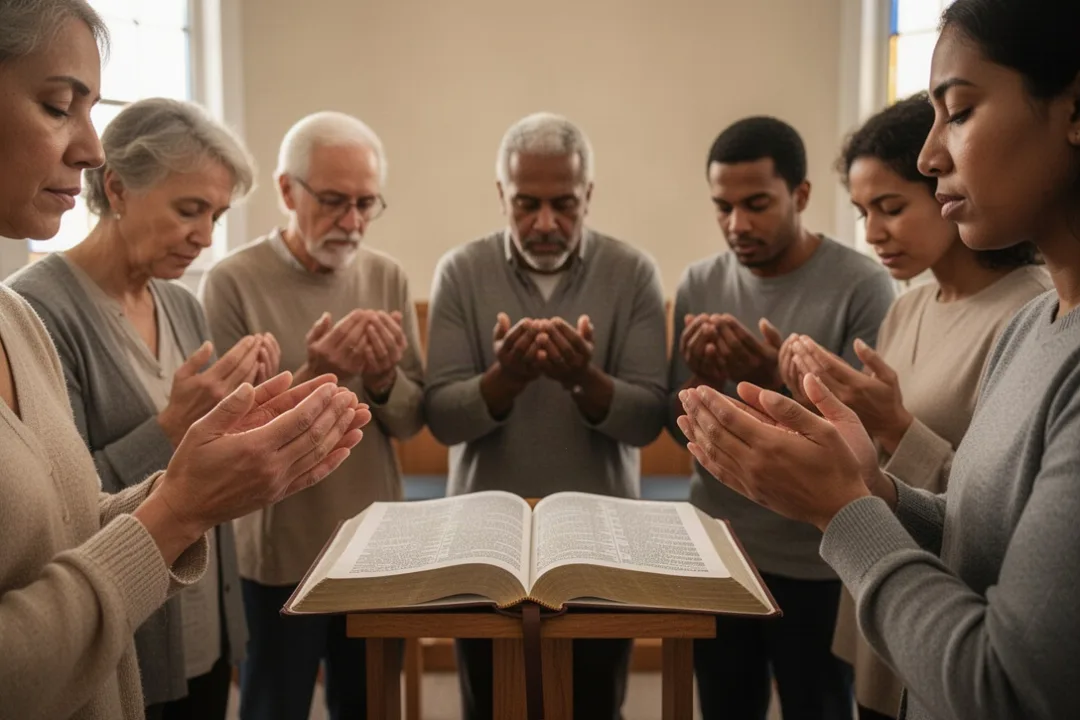
Paul’s prayer can become a pattern for your own prayers. It gives you language for asking God to deepen understanding rather than simply asking him to change external conditions. You can pray the passage for yourself, your family, your congregation, or someone facing a difficult season.
Begin with gratitude. Name signs of faith in Christ and love within the church. Thank God for grace already at work rather than praying only from a sense of lack.
Ask for clearer spiritual vision. Pray for wisdom to understand God’s character, Christ’s work, and the meaning of your calling.
Remember the three realities. Ask God to help you grasp the hope of his calling, the riches of his inheritance, and the greatness of his power.
Connect power with resurrection. Instead of defining power as control, ask how God is giving endurance, holiness, courage, and new life through Christ.
Pray for the church as a body. Ask for unity, mutual care, humility, and a clearer dependence on Jesus as the church’s head.
Let prayer lead to action. Consider one concrete response, such as encouraging another believer, reconciling with someone, serving quietly, or resisting fear.
A simple practice is to take one phrase each morning and turn it into a personal prayer. You might pray, “Help me understand the hope of your calling,” in your own words while considering the decisions and pressures before you. The point is not to repeat a formula but to let Paul’s priorities reshape your attention.
Common mistakes when interpreting Ephesians 1:15-23
This passage is rich, but several misunderstandings can distort its message. Careful reading keeps the promises connected to the larger argument of Ephesians and to the person of Christ.
Reducing hope to positive thinking: Christian hope is grounded in God’s calling and future purpose, not in confidence that every personal plan will succeed.
Turning inheritance into a promise of wealth: The passage focuses on belonging to God, spiritual blessing, and participation in his purposes rather than guaranteed financial prosperity.
Treating power as personal control: God’s power is revealed through Christ’s resurrection and reign. It is not a technique for forcing desired outcomes.
Reading “all things” as the absence of suffering: Christ’s authority does not mean believers never experience pain, injustice, or opposition. It means none of these has ultimate authority.
Separating faith from love: Paul praises both. A Christian life that claims trust in Christ while disregarding fellow believers misses the shape of the prayer.
Making the church secondary: The church is described as Christ’s body and is central to the passage’s vision of God’s work in the world.
Assuming spiritual growth is automatic: Paul prays for believers who already have faith and love. Mature understanding requires continuing dependence on God.
Another common mistake is reading the prayer only as a promise of what believers should feel. Some Christians may not experience constant confidence, emotional excitement, or an immediate sense of God’s power. Ephesians gives a theological foundation for faith even when feelings fluctuate.
It is also possible to read the passage individualistically. Paul addresses believers as members of a community, and his prayer includes the church’s shared inheritance and identity. Personal application matters, but it should lead toward deeper participation in the body of Christ rather than isolation from it.
Questions for personal study and group discussion
These questions can help you move from observation to response without forcing the passage into a quick application.
What evidence of faith and love do you see in your own life or church community?
Where do you most need wisdom: understanding God, making a decision, responding to conflict, or persevering through hardship?
Which of the three themes—hope, inheritance, or power—do you tend to overlook?
How does Christ’s authority challenge your fear of people, institutions, spiritual opposition, or uncertain circumstances?
What would change if you treated the church as Christ’s body rather than as a service provider or social group?
What specific act of faith or love might follow from praying this passage?
When studying the passage, pay attention to its movement. Paul starts with thanksgiving for visible faith and love, asks for enlightened understanding, names the hope and inheritance believers need to recognize, and grounds God’s power in Christ’s resurrection and reign. The prayer becomes more expansive as it moves from individual perception to the whole church and the whole created order.
How Ephesians 1:15-23 gives perspective in difficult seasons
In a difficult season, you may want a direct explanation for why something happened. Ephesians does not answer every question about suffering, but it gives a durable framework for facing uncertainty. Your life is held within God’s calling, your identity is connected to his people, and Christ’s authority is greater than every visible or invisible power.
The passage also helps distinguish circumstantial weakness from spiritual abandonment. A believer may feel powerless while still being sustained by God. Jesus’ resurrection shows that God’s work can be present even when life appears to be moving through loss, waiting, or apparent defeat.
That perspective can produce patience without passivity. Christians still act, pray, seek justice, care for others, make wise choices, and resist evil. They do so without pretending that their own strength is ultimate. The church’s confidence rests in the risen Christ who fills and governs all things.
Ephesians 1:15-23 therefore invites a prayer that is both deeply personal and larger than personal concerns. Ask God to open your inner understanding, but also ask to see how your life belongs to Christ’s body and serves his purposes. The result is not escape from ordinary responsibilities. It is a clearer way to live them—with hope, love, confidence, and dependence on the power of God revealed in Jesus.
Frequently asked questions
What is the main message of Ephesians 1:15-23?
Paul prays that believers will understand the hope of God’s calling, the richness of their inheritance, and the greatness of God’s power. That power is demonstrated in raising and exalting Jesus above every authority. The passage also identifies the church as Christ’s body, showing that Christian identity and purpose are rooted in relationship with the risen Lord and with fellow believers.
What does “the eyes of your heart” mean in Ephesians 1:18?
The phrase describes a person’s inner capacity to perceive spiritual truth. Paul is asking God to enlighten believers’ understanding, desires, and will so they can recognize what their faith means. It does not refer to a physical organ or a hidden mystical faculty. The image emphasizes that spiritual insight involves the whole person, not intellectual information alone.
Does Ephesians 1:19 promise that Christians will always have visible power?
No. Paul does not promise constant success, influence, health, wealth, or freedom from suffering. He connects God’s power to Christ’s resurrection and exaltation. That power may appear through endurance, holiness, courage, faithful love, and new life in difficult circumstances. Its certainty rests in God’s action, not in the believer’s ability to control events or produce dramatic results.
What does it mean that the church is Christ’s body?
It means the church belongs to Christ, receives life and direction from him, and is joined together as a community of believers. The image highlights dependence, unity, and different forms of service. It does not mean the church replaces Jesus or becomes divine. Christ remains the head, while the church represents his presence and purposes through shared life and faithful action.
















Leave a Reply