David and Goliath scripture: Meaning and lessons from 1 Samuel 17
David and Goliath scripture: Meaning and lessons from 1 Samuel 17
When a problem feels far bigger than your ability to solve it, you may wonder what the David and Goliath scripture really says about facing overwhelming odds. The story appears in 1 Samuel 17, where David, a young shepherd, confronts Goliath, a heavily armed Philistine warrior. David wins, but the passage is about more than courage or confidence: it centers on trust in God, the honor of God’s name, and the difference between human strength and faithful dependence.
The chapter does not present David as someone who believes he is naturally stronger than Goliath. Instead, David believes that God is greater than the enemy and that Israel’s battle cannot be understood only by looking at weapons, height, armor, or military experience. That perspective shapes the entire episode and helps explain why the story has remained meaningful to readers facing fear, injustice, temptation, or seemingly impossible responsibilities.
Where the David and Goliath scripture appears in the Bible
The main account is found in 1 Samuel 17, within the Old Testament history of Israel’s early monarchy. The chapter follows the anointing of David in 1 Samuel 16, when Samuel identifies him as the future king. David is still serving as a shepherd and occasionally assisting King Saul, but he has not yet taken the throne.
The story takes place during conflict between the Israelites and the Philistines. The opposing armies gather in the region of Judah, with a valley separating them. Rather than beginning with a full battle, the passage focuses on a challenge issued by Goliath, who proposes that one Israelite warrior fight him on behalf of the entire army.
Goliath’s challenge creates a crisis because the Israelites see a terrifying opponent whom no one is willing to face. For forty days, he comes forward morning and evening to challenge Israel, according to the chapter. Saul and the army respond with fear, while David arrives at the camp to bring provisions to his older brothers and receive news about them.
The narrative continues through 1 Samuel 18, which describes the public response to David’s victory, his growing relationship with Saul, and the beginning of Saul’s hostility toward him. Reading chapter 17 with its surrounding chapters shows that the event is not an isolated story about a brave boy. It introduces David’s public rise and highlights the contrast between David’s faith and Saul’s troubled leadership.
Reference to remember: The direct David and Goliath account is 1 Samuel 17. The chapters before and after it provide essential context about David’s anointing, his service to Saul, and his emergence as a national leader.
What happens in 1 Samuel 17
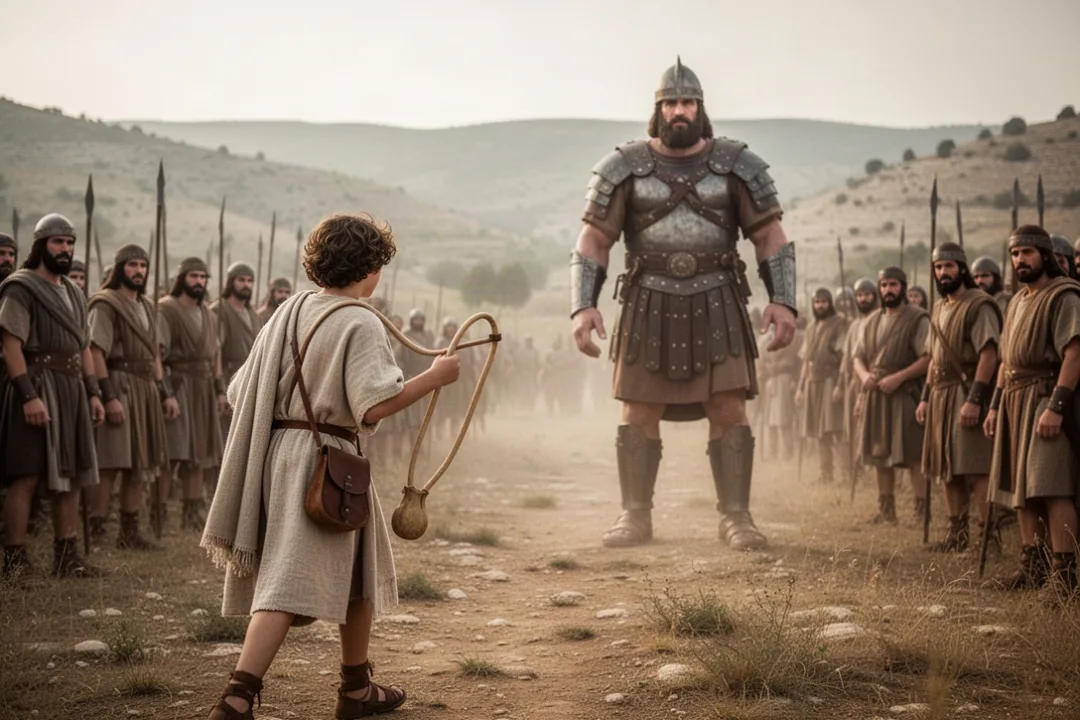
Goliath is introduced as a champion from Gath, one of the Philistine cities. The text emphasizes his imposing presence, armor, weapons, and physical size. He calls on Israel to send out a representative, and his words are not merely personal insults. He challenges the confidence and identity of the entire Israelite army, including its relationship with the living God.
David hears the challenge when he visits the battlefield. His brothers criticize his motives and accuse him of leaving the sheep unattended, but David continues asking what will be done for the man who defeats Goliath. His concern is expressed in religious terms: he is disturbed that an uncircumcised Philistine is defying the armies of the living God.
That detail explains David’s motivation. He is not looking for fame, an exciting opportunity, or proof that he is more talented than trained soldiers. He believes Goliath’s challenge dishonors God’s name. The issue, as David sees it, is not simply that Israel has an intimidating opponent. It is that the opponent is treating God’s people as though their God were powerless.
Saul eventually hears about David and summons him. David tells the king that he will fight Goliath. Saul objects because David is young and Goliath has been a warrior for a long time. David responds by describing his experience protecting his father’s sheep from a lion and a bear. He interprets those earlier rescues as evidence that God has delivered him before and can deliver him again.
Saul tries to equip David with his own armor, helmet, and sword. David attempts to walk in the equipment but removes it because he is not accustomed to using it. He takes his staff, selects five smooth stones from a stream, places them in his shepherd’s bag, and approaches Goliath with his sling.
Goliath is offended that Israel sends someone who appears so insignificant. David’s answer focuses on the source of victory. He does not claim that the sling will prove superior to Goliath’s weapons. He declares that the contest will show that the battle belongs to the Lord and that God can save without relying on ordinary military advantages.
David then uses the sling to strike Goliath in the forehead. The Philistine falls, and David uses Goliath’s own sword to complete the defeat. The Philistine army flees, while the Israelites pursue them. The chapter ends by showing that the victory changes David’s position in Israel and draws attention from Saul and the nation.
Saul’s armor represents a reasonable human response to danger. A warrior facing another warrior would normally need protection, weapons, and training. The problem is not that armor is always wrong. The issue is that David cannot fight faithfully by pretending to be someone else or by depending on equipment he has never learned to use.
David has experience with a shepherd’s tools, not a king’s military armor. His staff and sling are familiar, and he understands how to use them. The scene therefore illustrates faithful preparation rather than a rejection of all practical means. David does not walk onto the battlefield empty-handed and call that trust. He uses the skills and tools available to him while placing the outcome in God’s hands.
This distinction matters when applying the passage. A person facing a difficult task should not assume that faith requires refusing training, advice, medical care, education, safety measures, or professional help. David’s example encourages you to use appropriate resources without treating those resources as the ultimate source of security.
His refusal of the armor also points to integrity. David does not need to imitate Saul or appear more impressive than he is. He approaches Goliath as a shepherd who trusts God and knows how to use a sling. The story honors honest dependence, not performance designed to impress an audience.
What the David and Goliath story teaches about fear
Fear controls the Israelite army before David arrives. The soldiers see Goliath’s size, armor, experience, and repeated threats. Their fear is understandable, but the passage shows that they have allowed the visible situation to define what they believe is possible. David sees the same giant but interprets him through a different frame: Goliath is defying God, and God is not limited by the enemy’s appearance.
David’s faith does not mean he feels no danger. He knows Goliath is a trained warrior and recognizes that the encounter could cost him his life. Biblical courage in this passage is therefore not the absence of fear. It is the decision to act rightly despite fear because God’s character and authority matter more than the threat.
The chapter also shows how fear spreads through a community. Goliath repeats his challenge, and the army repeatedly responds with retreat. One person’s intimidation shapes the behavior of many. David interrupts that pattern by questioning the assumptions behind the fear. His response does not deny the giant’s strength; it denies that Goliath’s strength is the highest power in the situation.
For modern readers, the “giant” may be a serious illness, debt, abuse, addiction, grief, conflict, or an intimidating responsibility. The passage should not be used to promise that every problem will disappear immediately. Its deeper emphasis is that fear does not deserve the final word, and visible power does not determine ultimate authority.
How David’s words reveal the central message
David’s speech before the fight gives the clearest explanation of the chapter. He says that Goliath has come with weapons, but David comes in the name of the Lord. He also explains that the outcome will teach the Philistines and Israel that the Lord saves without depending on swords or spears.
These statements shift attention away from David’s personal bravery. David is involved, but he does not present himself as the real hero. He understands his action as a public witness to God’s power and faithfulness. The result is intended to affect both armies, not merely settle a private dispute.
David’s confidence also reflects Israel’s covenant identity. Goliath speaks as though Israel has been abandoned and can be defeated by superior force. David responds as a member of a people whose God has made promises to them. His confidence is not generic optimism. It is rooted in what he believes about the living God and God’s relationship with Israel.
That theological center protects the story from becoming a simple formula: “Believe in yourself, and you can defeat anything.” David does not win because self-confidence is a magical force. He wins because the narrative presents God as acting through a faithful servant. The proper emphasis is not “become David through your own strength,” but “trust God and obey faithfully when fear invites you to retreat.”
How the story connects with David’s earlier life
The events in 1 Samuel 17 make more sense after 1 Samuel 16. Samuel has been sent to Jesse’s household to anoint one of Jesse’s sons. David is not initially presented as the obvious choice. He is the youngest and is found tending the sheep while his older brothers are considered.
That earlier chapter establishes a theme that continues into the Goliath account: God does not evaluate people by outward appearance alone. Saul is physically impressive and stands out among the people, yet his leadership is weakening. David appears ordinary, but God sees qualities that others overlook. The contrast prepares readers to understand why David can be used in an unexpected way.
David’s work as a shepherd also shapes his readiness. His private responsibilities have taught him to protect vulnerable animals, make decisions under pressure, and act when danger appears. The experience has not made him boastful. Instead, he attributes his survival to God’s help. His public courage grows out of private faithfulness.
The story therefore challenges the idea that preparation only happens on visible platforms. David’s battlefield moment follows a long period of ordinary work. His ability to respond is connected to habits and responsibilities developed when few people were watching.
Practical lessons for applying the scripture wisely
The David and Goliath scripture can shape daily decisions when it is applied carefully. The goal is not to force every situation into a dramatic battle narrative. It is to learn how David identifies the true issue, remembers God’s past faithfulness, uses his abilities responsibly, and refuses to let intimidation decide his actions.
Name the real threat. Ask whether the problem is only its visible size or whether fear, injustice, dishonesty, or spiritual discouragement is also involved.
Remember specific evidence of help. David recalls the lion and the bear. You can write down previous moments when you received wisdom, endurance, protection, or support.
Use what you have learned. David uses a skill developed while shepherding. Apply your training, experience, sound advice, and available resources rather than waiting for perfect conditions.
Separate faith from denial. Trusting God does not require pretending that danger, loss, or uncertainty is not real.
Refuse borrowed identities. Do not measure your faithfulness by copying another person’s personality, platform, methods, or appearance.
Take the next responsible step. Courage often begins with one clear action, such as asking for help, telling the truth, setting a boundary, or beginning necessary work.
Give God the credit. Success should produce humility and gratitude rather than contempt for people who are still afraid.
Practical caution: David’s victory does not mean you should confront dangerous people recklessly. In situations involving violence, abuse, criminal behavior, or serious mental or physical illness, seek qualified help and use appropriate safety measures.
Common mistakes when interpreting David and Goliath
Because the story is familiar, readers can easily reduce it to a slogan. Several interpretations miss the passage’s setting or create expectations the text does not make. Reading the details in context keeps the application both faithful and useful.
Turning the story into self-help. “You can defeat any giant” sounds encouraging, but it can imply that personal confidence guarantees success. The chapter emphasizes God’s honor and sovereignty, not unlimited human achievement.
Assuming every outcome will be immediate victory. Scripture includes faithful people who suffer, wait, grieve, and face apparent defeat. David’s victory here is not a universal promise that every difficult circumstance will resolve as you hope.
Ignoring David’s preparation. He does not win through a random lucky act. His shepherding experience, skill with a sling, awareness of the situation, and willingness to act all matter.
Making the lesson about appearance alone. The passage contrasts visible strength with faith, but it does not teach that physical strength, military skill, or expertise are inherently bad.
Reading Goliath as a symbol without reading the history. The event is presented as part of Israel’s real conflict with the Philistines and David’s rise. Symbolic application should not erase the original narrative.
Using the story to shame fearful people. The Israelite soldiers are afraid because the danger is real. The passage invites trust and courage; it should not be used to dismiss someone who needs protection or support.
Overlooking the wider story. David’s victory does not end all his problems. Later chapters include political danger, betrayal, moral failure, and long periods of waiting. One victory is part of a larger life of dependence on God.
What the five stones mean in the biblical text
Many readers ask why David chooses five stones when he needs only one to strike Goliath. The passage does not explicitly explain the number, so claims that the five stones represent five specific virtues or enemies go beyond what the text states. A careful reading should distinguish biblical details from later imaginative interpretations.
The stones are ordinary objects gathered from a stream, and their ordinariness reinforces the contrast between Goliath’s elaborate armor and David’s simple equipment. David does not need a spectacular weapon to demonstrate God’s power. He uses a familiar tool with precision and courage.
The remaining stones may simply reflect practical preparation. A sling could be used more than once, and David could reasonably prepare for continued action. The narrative later mentions that Goliath’s relatives were also defeated by David’s men, but that detail does not prove that the five stones were a coded prediction of five future opponents.
The most secure point is that God can work through ordinary means. The stone is not treated as a magical object. David’s faith is directed toward God, not toward the material he carries.
How the account points beyond David’s individual courage
David’s victory affects the entire nation. The Israelites move from paralysis to pursuit after Goliath falls. This shows that faithful action can influence a community, especially when people have been immobilized by fear. At the same time, the text does not present David as an independent celebrity. His role is connected to Israel’s future and to the kingship promised in the surrounding narrative.
The chapter also exposes Saul’s weakness. As king, Saul should be leading Israel, but he is among those who fear Goliath. David’s willingness to act highlights the difference between holding a position and exercising faithful leadership. Authority without courage cannot protect a community when a crisis arrives.
Later biblical writers use David as a significant figure in Israel’s history, but the Goliath account should not be separated from the moral complexity of David’s life. He becomes king, writes and inspires worship, commits serious sin, experiences grief, and faces consequences. His victory over Goliath does not make him flawless. It shows what God can do through a person who trusts and obeys in a particular moment.
For Christian readers, David’s story may also be considered within the larger biblical movement toward God’s promised king. The New Testament identifies Jesus with the line of David, but 1 Samuel 17 itself should first be read in its own historical and literary setting. Responsible interpretation allows later connections without replacing the original meaning of the passage.
Questions to ask when facing your own “Goliath”
A practical reading of the passage begins with honest questions rather than quick comparisons. Ask what has made the situation seem unbeatable, who is affected by it, and what response would reflect truth rather than panic. Naming the problem accurately can keep fear from becoming vague and all-consuming.
Consider whether you are relying on someone else’s methods simply because they look impressive. Saul’s armor may symbolize pressure to perform in an identity that does not fit. You may need to learn a new skill, but you should not confuse external appearance with genuine readiness.
Also ask what faithful action is actually required. Sometimes it is speaking up, and sometimes it is leaving danger, seeking counsel, apologizing, receiving treatment, reporting wrongdoing, or patiently continuing ordinary work. The story encourages courageous obedience, not dramatic behavior for its own sake.
Finally, keep the outcome in perspective. Your responsibility is to act with wisdom, integrity, and trust. You are not responsible for controlling every result, proving your worth, or guaranteeing that other people will respond well. David’s confidence rests in God’s authority, not in his ability to manage every consequence.
How to read 1 Samuel 17 for personal study
Read the chapter more than once, observing who speaks, who is afraid, and how the description of Goliath differs from David’s description of God. Notice the repeated references to challenge, fear, reputation, and the Lord’s name. These repetitions reveal what the writer wants the reader to recognize.
Then compare 1 Samuel 17 with 1 Samuel 16 and 18. Chapter 16 explains David’s anointing and character; chapter 18 shows the consequences of his public victory. This wider reading prevents the battle from becoming a disconnected moral tale and places it within David’s developing story.
When using another translation, consult the notes about wording differences, measurements, and manuscript questions rather than building a major doctrine on one uncertain detail. The central message remains clear even where translations handle some textual features differently: Goliath appears invincible, Israel is afraid, David trusts the Lord, and God grants victory through an unlikely servant.
A useful prayer or reflection can focus on three areas: what fear is saying, what God has already shown, and what faithful step is possible now. That approach honors the passage without turning it into a promise that every challenge will end exactly as David’s did.
Why this scripture remains meaningful
The power of 1 Samuel 17 comes from the way it joins an ordinary human experience with a strong theological claim. People often judge a situation by visible resources, reputation, and probability. The story asks readers to consider a deeper reality: God’s authority is not measured by the apparent size of the opposition.
David’s example remains useful because he acts neither carelessly nor passively. He listens, remembers, prepares, speaks clearly, and moves forward. His confidence is not confidence in a polished image of himself. It is confidence that God is present, God is faithful, and God can work through faithful obedience.
That is the central message to carry from the David and Goliath scripture. A giant may still be genuinely dangerous, and the outcome may not always resemble David’s victory. Yet fear does not have to define your identity or dictate your response. With wisdom, support, preparation, and trust in God, you can take the next faithful step.
Frequently asked questions
What is the main Bible verse for David and Goliath?
The complete account is found in 1 Samuel 17 rather than in one single verse. For the story’s central message, readers often focus on David’s response to Goliath in 1 Samuel 17:45-47, where David explains that the Lord—not weapons or human strength—will determine the outcome.
Did David really use five stones against Goliath?
Yes, 1 Samuel 17 describes David selecting five smooth stones from a stream before approaching Goliath. The text does not assign a symbolic meaning to the number five. It is safest to understand the stones as practical ammunition for David’s sling rather than as a coded list of future enemies or virtues.
What does Goliath symbolize for Christians today?
Goliath can represent an intimidating obstacle, threat, injustice, or fear, but the original passage is a historical account of Israel’s conflict with the Philistines. Applying it symbolically should not erase that setting. The main lesson is that visible power does not limit God’s authority or determine the response faithfulness requires.
Does David and Goliath mean believers will always win their battles?
No. The passage records a particular victory and does not promise that every faithful person will receive the outcome they want. Other biblical passages describe suffering, delay, loss, and unanswered questions. David and Goliath encourages trust, courage, and wise action while leaving the final result in God’s hands.
















Leave a Reply