A messiah is an anointed person appointed for a special purpose, especially to lead, save, or restore a people. The word comes from the Hebrew mashiach, meaning “anointed one,” and its Greek equivalent is Christos, the source of the title Christ.
In the Hebrew Bible, anointing with oil marked certain kings, priests, and sometimes others as set apart for God’s service. Over time, “messiah” also became associated with hopes for a future ruler who would bring justice, peace, faithfulness, and restoration. Judaism, Christianity, and Islam use the idea in related but distinct ways.
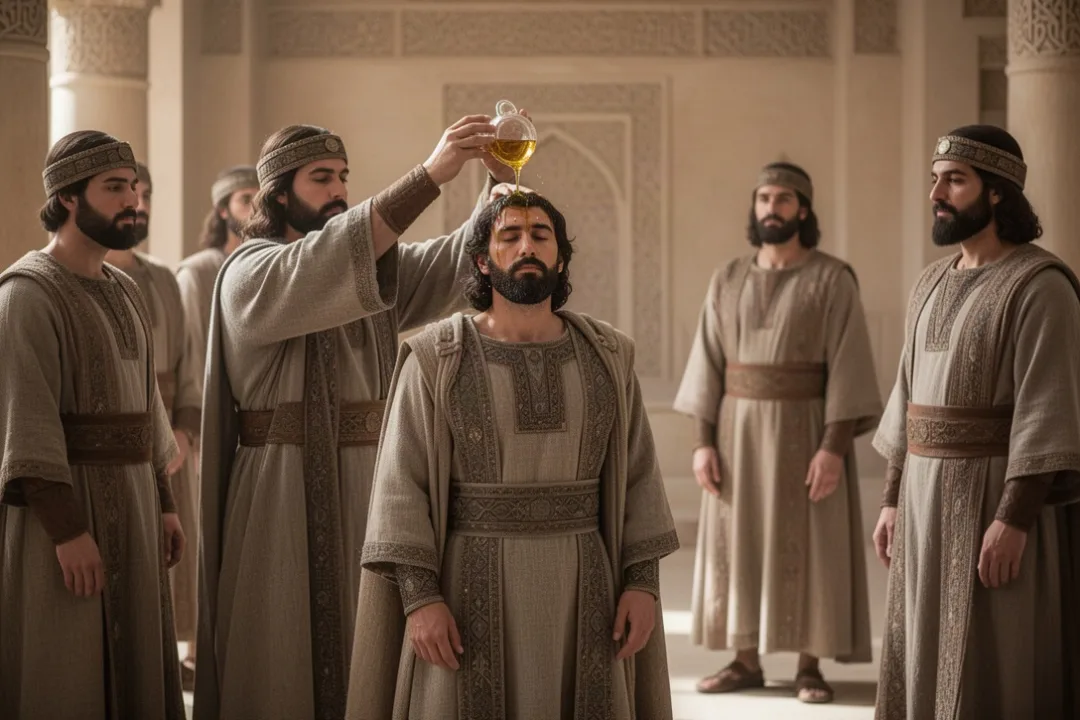
The basic meaning of messiah is not “superhero,” “miracle worker,” or simply “religious founder.” It describes someone who has been anointed or designated for a particular role. In the ancient biblical world, anointing usually involved placing oil on a person’s head as a public sign of appointment and divine favor.
Anointing could communicate several ideas at once. It could identify a new king, recognize a priest’s sacred service, or mark a person as chosen for a special responsibility. The act did not mean that the person was automatically perfect. It signified a role and a calling, while the person’s faithfulness still mattered.
The Hebrew word mashiach is related to the verb meaning “to anoint.” English translations may render it as anointed one, anointed, or messiah, depending on the passage and translation. The term itself does not always refer to the final redeemer expected in later Jewish and Christian thought.
For example, the Hebrew Bible calls Israelite kings “the Lord’s anointed” because they held a royal office. Saul and David are described in this way in the narratives of 1 Samuel. Priests could also be connected with anointing, particularly in instructions concerning Israel’s worship and sanctuary.
The Persian ruler Cyrus is another important example. Isaiah 45:1 refers to Cyrus as God’s anointed, even though Cyrus was not an Israelite king and did not fit the later popular image of a messiah. In that passage, the title emphasizes that God could use a foreign ruler to accomplish a purpose for Israel, including the return of exiles.
Key distinction: In its earliest biblical use, “messiah” describes a person appointed or anointed for a role. The idea of one future, universal redeemer developed through later interpretation and religious expectation.
How messiah expectations developed in the Hebrew Bible
The hope associated with a future messiah grew from Israel’s experience of kingship, national crisis, exile, and restoration. The biblical story includes promises that David’s royal line would continue and that a future ruler would govern with greater faithfulness than many historical kings did.
God’s covenant with David in 2 Samuel 7 became especially important. In that passage, God promises David an enduring dynasty and connects his royal line with a lasting kingdom. The passage does not present a complete, simple definition of a future messiah, but it became a foundation for later expectations about a coming Davidic ruler.
Several prophetic books describe an ideal future under a righteous king. Isaiah 9 presents a child connected with David’s throne whose rule is marked by justice and peace. Isaiah 11 portrays a ruler from Jesse’s line who judges fairly, protects the vulnerable, and brings harmony. These passages are read differently across Jewish and Christian traditions, but both have influenced the meaning of messiah.
Jeremiah 23 speaks of a future “righteous Branch” from David’s line who will reign wisely and bring security to Judah. Ezekiel 34 and 37 use shepherd and Davidic imagery for a restored people under proper leadership. Micah 5 associates a future ruler with Bethlehem, David’s ancestral town, while Zechariah 9 describes a humble king bringing peace.
The prophets did not always describe the expected figure in exactly the same way. Some passages emphasize political leadership, while others focus on justice, worship, national restoration, or universal peace. This variety helps explain why Jewish interpretations of the messiah have never been completely uniform.
Historical events also shaped messianic hope. Foreign domination, the destruction of Jerusalem, exile, and later oppression made the promise of a righteous ruler especially meaningful. For many Jews, the messiah represented not an escape from ordinary life but the restoration of a damaged community and the fulfillment of God’s purposes in history.
Daniel 7 contributes another important image: a humanlike figure receiving authority and an everlasting kingdom from God. The passage is interpreted in different ways, and its symbolism is complex. It helped broaden Jewish and Christian reflection about an end-time ruler and the eventual triumph of God’s justice.
What the promised messiah was expected to do
There was no single checklist accepted by every Jewish group, but common expectations included a Davidic connection, wise and just rule, the restoration of Israel, and a deeper recognition of God. Some traditions also associated the messianic age with the gathering of exiles, the rebuilding or restoration of the Temple, and peace among nations.
Lead with justice: The future ruler would protect the poor, judge fairly, and reject corruption.
Restore the people: Messianic hope often included national renewal, security, and the return of scattered communities.
Strengthen faithfulness: The messiah would be connected with renewed obedience to God rather than power for its own sake.
Bring peace: Many passages connect the messianic future with an end to oppression and a more peaceful world.
These expectations should not be treated as a universally agreed formula. Jewish sources and communities have interpreted the relevant passages in different ways, and some Jewish thinkers have emphasized a messianic era more than a single individual. The common thread is hope for God’s justice and restoration, not one identical description in every tradition.
What messiah means in Judaism
In Judaism, the messiah is generally understood as a future human leader, often called Mashiach ben David, or Messiah descended from David. He is expected to be a wise ruler who helps restore Israel, strengthens observance of the Torah, and contributes to an age of peace and divine recognition.
The messiah in Jewish belief is not God himself. He is a human being chosen by God for a distinctive mission. This difference is central when comparing Jewish and Christian understandings, because Christianity identifies Jesus with the divine Son of God in a way that traditional Judaism does not accept.
Jewish views also differ regarding the exact details of the messianic age. Some descriptions focus on the return of Jewish exiles, the rebuilding of the Temple, and the restoration of Jewish sovereignty. Others stress universal justice, the transformation of human society, and the widespread knowledge of God.
Judaism generally evaluates messianic claims in relation to what the expected figure actually accomplishes. A claimant who does not bring the anticipated restoration, peace, or fulfillment is not accepted as the Messiah by mainstream Jewish interpretation. This helps explain why Judaism does not identify Jesus as the messiah, despite Christianity’s use of the same Hebrew Bible passages.
Some Jewish movements have included strong messianic expectations at particular points in history, especially during periods of persecution or political upheaval. Other Jewish thinkers have been cautious about trying to identify the messiah or calculate when the messianic age will arrive. The Hebrew Bible and later Jewish writings encourage hope, but they do not make every prediction about the future equally authoritative.
The concept also has an ethical dimension. Waiting for a messiah does not necessarily mean withdrawing from responsibility in the present. Jewish teachings often connect hope for redemption with acts of justice, charity, study, prayer, and care for neighbors. The future ideal informs present conduct.
Why Christians call Jesus the Messiah
Christianity identifies Jesus of Nazareth as the Messiah, using the Greek title Christos. “Jesus Christ” therefore means “Jesus the Messiah,” not “Jesus” plus a family surname. The title expresses the Christian claim that Jesus fulfills the promises and patterns associated with Israel’s expected anointed ruler.
The four Gospels present Jesus’ identity through teachings, healings, conflicts, death, and resurrection. In Mark 8, Peter identifies Jesus as the Messiah, although the surrounding conversation shows that the disciples did not initially understand what kind of messiah Jesus would be. Their expectations included power and national restoration, while Jesus described a path involving suffering and service.
According to Christian teaching, Jesus fulfills messianic hope in a way that differs from the expectations of a conventional political king. He announces God’s kingdom, welcomes outsiders, confronts sin and injustice, heals the sick, and teaches love of God and neighbor. Christians understand his death as central to God’s saving work and his resurrection as confirmation of his messianic identity.
Christian interpretation often connects Jesus with passages such as Isaiah 7, 9, and 11; Micah 5; Zechariah 9; Psalm 2; and Psalm 22. Christians read these texts as pointing toward Jesus, describing his mission, or providing patterns that are fulfilled in him. Jewish interpretation does not generally read these passages in the same way, so citing them does not by itself settle the debate between the traditions.
The Gospel of Matthew repeatedly presents Jesus in relation to David and Bethlehem. Luke emphasizes themes such as the poor, the oppressed, and God’s faithfulness to Israel. John uses different language, presenting Jesus as the Word and emphasizing his unique relationship with God. Together, the New Testament writings give the title “Messiah” a broader meaning than royal office alone.
Why the Christian Messiah suffers and returns
One distinctive Christian belief is that the Messiah’s mission includes suffering, crucifixion, resurrection, and future return. Christians connect this belief with passages including Isaiah 52–53, Psalm 22, and the Gospel accounts of Jesus’ passion. These connections are theological interpretations rather than meanings accepted by all Jewish readers of those passages.
Christianity teaches that Jesus’ suffering deals with sin and reconciles humanity to God. The resurrection is understood as God’s vindication of Jesus and the beginning of a new creation. Christians therefore speak of Jesus as having already inaugurated salvation while also awaiting the full completion of his reign.
This creates a “already and not yet” pattern in Christian theology. Christians believe the Messiah has come and that his kingdom is present through his work and community, yet they also expect a future return, final judgment, resurrection, and complete renewal. Different Christian denominations explain the timing and details of these future events differently.
For Christians, the word “messiah” therefore includes more than a national king. It refers to Jesus as the promised anointed one, Savior, Lord, and ruler whose work reaches beyond one nation. The title remains rooted in Israel’s Scriptures, but Christianity understands its fulfillment through Jesus’ identity, death, resurrection, and promised return.
How Islam understands al-Masih
Islam also uses a form of the word messiah: al-Masih, meaning “the Messiah.” The Quran calls Jesus Isa ibn Maryam, or Jesus son of Mary, al-Masih. Muslims honor Jesus as a major prophet and messenger of God, born miraculously to Mary, but do not identify him as God or as God’s son in the Christian sense.
Islamic belief about Jesus differs substantially from both traditional Jewish and Christian views. Muslims believe Jesus performed miracles by God’s permission and received revelation, but they reject the Christian doctrine of the Trinity and the idea that Jesus’ death provides atonement through divine sonship. The Quran’s presentation of Jesus must be understood within Islam’s strict teaching that God is one and incomparable.
Islamic tradition also teaches that Jesus will have an important role near the end of history. Details come from the Quran and hadith traditions, whose interpretation can vary among Muslim scholars and communities. Broadly, Jesus is associated with truth, the defeat of falsehood, and events connected with the final period before judgment.
The Islamic use of “Messiah” shows that the term does not carry one fixed meaning across all Abrahamic religions. Judaism generally expects a future human redeemer, Christianity identifies Jesus as the divine and risen Messiah, and Islam calls Jesus the Messiah while understanding him as a human prophet and servant of God.
Comparative point: Shared vocabulary does not guarantee shared theology. Judaism, Christianity, and Islam all connect Jesus or messianic hope with God’s purposes, but they disagree about Jesus’ identity, mission, death, and future role.
The term is often used loosely in modern speech for a person who seems likely to rescue a group, solve a crisis, or transform society. That figurative use can be understandable, but it is much broader than the religious meaning. A political candidate, celebrity, or business leader may be called a “messiah” metaphorically without making any theological claim.
A messiah is also not simply anyone who has an important mission. In biblical usage, the idea is tied to anointing, divine appointment, royal or sacred authority, and redemption. The word has a specific historical and religious background that should not be reduced to “a great leader.”
Nor does the word automatically mean “the person who saves everyone from every problem.” Biblical and religious texts use several related ideas for salvation, deliverance, forgiveness, restoration, and divine rule. The meaning of messiah depends on the passage, the tradition interpreting it, and whether the speaker is discussing an anointed ruler, a future redeemer, or Jesus as the Christ.
Finally, messiah is not the same as “prophet.” A prophet speaks on God’s behalf, while a messiah is anointed or appointed for a particular role. One person can be described through more than one category, but the terms emphasize different aspects of that person’s identity and work.
How to understand the term when reading the Bible
When you encounter “messiah” or “anointed one,” begin with the immediate passage. Ask who is being described, what role that person holds, and what the surrounding verses say about God’s purpose. A reference to an anointed king in Samuel may not be making the same claim as a Christian reading of a Gospel passage.
Identify the language and translation. Check whether the original idea is Hebrew mashiach, Greek Christos, or another related term.
Read the surrounding chapter. The immediate context often shows whether the subject is a king, priest, foreign ruler, future leader, or Jesus.
Notice the historical setting. Exile, foreign rule, royal succession, and worship all influence how anointing and restoration are discussed.
Separate the original passage from later interpretation. Jewish and Christian communities may apply the same text in different ways.
Compare related passages carefully. Themes such as David’s line, justice, suffering, peace, and restoration appear in multiple books but are not identical in every setting.
It can also help to distinguish three levels of meaning. First, “anointed one” may describe a historical officeholder. Second, messiah may refer to a future figure expected to bring restoration. Third, “the Messiah” may function as a title for Jesus in Christian theology or Jesus in Islamic belief, with meanings defined by those traditions.
The most concise answer is therefore both simple and qualified: a messiah is an anointed one, especially a person appointed by God for leadership and deliverance. The fuller meaning depends on whether you are reading the Hebrew Bible, Jewish tradition, the New Testament, Islamic scripture, or ordinary modern speech.
Frequently asked questions
Is the Messiah the same as Jesus?
Christians believe Jesus is the Messiah, or Christ, and understand his life, death, resurrection, and future return as the fulfillment of messianic promises. Judaism does not accept Jesus as the Messiah because it does not consider the expected restoration and messianic age to have arrived. Islam calls Jesus “the Messiah” but understands him as a prophet, not as God or God’s divine Son.
Does “Messiah” mean “savior”?
The word literally relates to being anointed, not directly to the English word “savior.” A messiah may be understood as a ruler or appointed deliverer whose work includes rescue and restoration. Because messianic figures are associated with saving a people or establishing justice, “savior” can describe part of the role, but it does not give the word’s original meaning.
Can a woman be a messiah?
In the main biblical and traditional uses, messiah refers to a specific appointed king or expected future ruler, and Jewish tradition generally describes the expected Messiah as male. Mary, the mother of Jesus, is highly honored in Christianity and Islam, but she is not called the Messiah. Modern metaphorical uses of “messiah” may be less restricted, though they differ from traditional theology.
What is the difference between Messiah and Christ?
“Messiah” comes from the Hebrew term mashiach, while “Christ” comes from the Greek Christos. Both mean “anointed one.” “Messiah” is common in Jewish and general religious discussion, while “Christ” is the title most associated with Jesus in Christianity. Neither word was originally Jesus’ last name; both express a claim about his role.















Leave a Reply