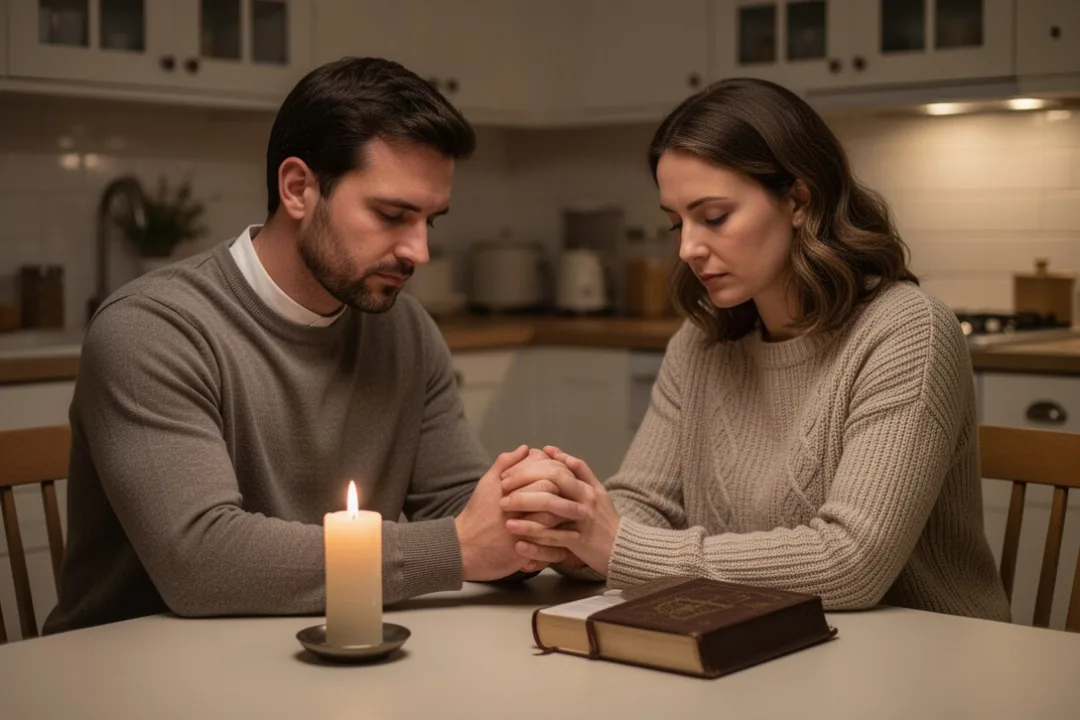
Are you looking for a Catholic prayer for marriage because your relationship needs peace, healing, or a renewed sense of closeness? You can begin with a simple prayer that places your marriage before God and asks for the grace to love with patience, truth, and faithfulness.
Marriage prayer does not need to be elaborate. A few sincere minutes together can help you listen more carefully, forgive more freely, and remember that your spouse is not an opponent but the person with whom you have entered a sacramental covenant. The prayer below can be used by newlyweds, longtime couples, spouses facing difficulty, or families praying for a marriage.
Lord God, thank you for the gift of our marriage and for the love that brought us together. Help us receive our vocation with humility, joy, and courage.
Teach us to speak with kindness, listen with patience, and forgive without keeping a record of past injuries. Protect our marriage from selfishness, dishonesty, resentment, and anything that weakens our commitment to one another.
When we are happy, make us grateful. When we are tired or afraid, give us strength. When we disagree, guide us toward truth and peace. Help us honor the promises we made and recognize your presence in our daily life together.
Bless our home, our family, our work, and the people who depend on us. Give us wisdom in decisions, tenderness in suffering, and the grace to serve one another generously. Keep our hearts faithful to you and to each other.
May our marriage reflect Christ’s self-giving love and become a source of welcome, healing, and hope. Through the intercession of the Blessed Virgin Mary and Saint Joseph, watch over our family and lead us closer to you.
Amen.
A simple way to begin: Pray this slowly, then remain quiet for one minute. Each spouse can name one blessing, one concern, and one specific intention for the marriage.
Why Catholics pray for marriage
Catholic marriage is more than a legal agreement or a private promise between two people. Between baptized Christians, it is a sacrament: a visible sign of God’s grace and a lifelong covenant ordered toward the good of the spouses and the raising of children.
Prayer helps a couple live that vocation in ordinary circumstances. It can shape the way spouses handle money, parenting, work, illness, in-laws, intimacy, and conflict. The goal is not to avoid every problem. It is to invite God into the choices and habits that determine how a couple responds to problems.
The Church describes married love as faithful, total, free, and fruitful. Those qualities can sound large and ideal, but they appear in small actions: telling the truth, keeping a promise, making room for a tired spouse, protecting time together, and choosing reconciliation instead of retaliation.
A marriage prayer also keeps the relationship from becoming self-reliant. Couples may need conversation, counseling, practical changes, or pastoral support, but prayer acknowledges that grace is also needed. It asks God to change not only circumstances but the hearts of both spouses.
How to pray together when life is busy
Many couples want to pray together but wait for a peaceful evening that rarely arrives. A better approach is to choose a modest practice that can survive ordinary responsibilities. Five focused minutes prayed consistently can be more helpful than an ambitious routine attempted once.
Choose a dependable time. Try the beginning or end of the day, after dinner, before leaving for work, or just after putting children to bed.
Settle your attention. Turn off notifications, sit near each other, and make the Sign of the Cross if that is part of your Catholic practice.
Thank God aloud. Each spouse can name one gift from the day, such as good health, a helpful conversation, work, a child’s milestone, or strength during difficulty.
Pray for a real need. Keep the intention specific: patience during a stressful week, wisdom about a decision, healing after an argument, or support for a family member.
End with a shared prayer. Use the prayer above, the Our Father, a decade of the Rosary, or another prayer familiar to both of you.
Do not treat the routine as a test of spiritual performance. If one spouse is more comfortable with formal prayer and the other prefers spontaneous words, take turns and respect the difference. Shared prayer should create connection, not become another source of pressure.
Make the Sign of the Cross and say, “Thank you, Lord, for one gift we received today.” Each spouse gives one answer. Then say, “Please help us with one need we carry today,” and name a concern without blaming the other person.
Finish by praying the Our Father together or by saying, “Lord, keep us faithful in love and help us serve each other tomorrow.” This short practice gives the marriage a daily point of contact with God, even when work, travel, or family responsibilities make a longer prayer unrealistic.
What to include in a prayer for your marriage
A strong Catholic prayer for marriage can hold several dimensions at once. You do not need to mention every one each time, but including different kinds of intentions keeps prayer connected to the whole of married life rather than only to moments of crisis.
Gratitude: Thank God for your spouse, your history together, your home, your children, your health, or a grace you noticed during the day.
Faithfulness: Ask for integrity, honesty, purity of intention, and strength to protect the promises made in marriage.
Communication: Pray for the patience to listen, the courage to speak truthfully, and the humility to admit when you are wrong.
Forgiveness: Ask for freedom from resentment and for the wisdom to seek reconciliation without pretending that serious harm did not happen.
Protection: Entrust your relationship to God during illness, financial strain, temptation, grief, relocation, or conflict.
Family life: Pray for children, relatives, friends, and anyone whose needs affect your household.
Mission: Ask how your marriage can serve others through hospitality, generosity, parish life, or care for people who are vulnerable.
Specific prayer is often more honest than vague prayer. “Help us love each other” is meaningful, but “Help me listen without interrupting when we discuss our finances tonight” gives that intention a concrete form. Prayer becomes practical when it leads to a particular act of love.
Praying with the Catholic meaning of marriage in mind
Catholic spouses can pray from the promises they made to one another. Their vows point toward permanence, fidelity, and a willing exchange of life. Recalling those promises can be especially valuable when feelings fluctuate or the relationship is passing through a demanding season.
A prayer might ask God to help you remain committed not only when marriage feels easy, but also when one spouse is sick, exhausted, disappointed, grieving, or changing. This does not mean accepting abuse or ignoring serious problems. It means asking for the courage to seek what is true, good, and safe.
The sacramental view of marriage also gives ordinary work spiritual meaning. Preparing food, caring for a child, earning income, visiting a sick relative, or making space for your spouse’s rest can become an expression of self-giving love. Prayer helps you recognize these acts as part of your vocation.
“Love is patient and kind” is the central direction of 1 Corinthians 13:4-7, paraphrased rather than quoted here: Christian love acts with patience, rejects envy and pride, and remains faithful to the good.
That passage is often read at weddings, but its value continues after the ceremony. It can serve as an examination of conscience for couples. Ask not only whether your spouse is loving enough, but also which quality of love God may be asking you to practice today.
Prayers for a struggling marriage
When a marriage is under strain, prayer should be honest rather than polished. You can tell God that you feel angry, lonely, afraid, confused, or tired. The Psalms repeatedly model this kind of direct prayer, moving from distress toward trust without pretending that pain is small.
Try this prayer when conflict has become frequent:
God of mercy, we bring you the hurt and tension between us. Show us what each of us needs to see. Remove harshness from our words, pride from our reactions, and fear from our decisions. Help us take responsibility for our own actions and protect us from causing further harm. Give us the willingness to listen, the wisdom to seek help, and the patience to rebuild trust one truthful step at a time. Amen.
Prayer should not be used to force a spouse to stay silent, surrender a legitimate concern, or accept mistreatment. If there is abuse, coercive control, threats, or fear, seek safety and qualified support. A priest, licensed therapist, domestic violence advocate, or emergency service may be appropriate depending on the situation.
Important boundary: Forgiveness does not remove the need for safety, accountability, or wise boundaries. Prayer can accompany professional and pastoral help; it should never be used as a reason to remain in danger.
A prayer after an argument
Lord, calm our emotions and keep us from words that deepen the wound. Help me recognize my own responsibility before I focus on my spouse’s faults. Show us when to pause, when to apologize, and when to return to the conversation. Give us grace to seek understanding rather than victory, and help us take one peaceful action now. Amen.
It may be unwise to force a prayer immediately after a heated argument. If either person is overwhelmed, take a respectful pause and agree on a time to return to the subject. The prayer can be said privately during that pause, then shared later when both spouses are able to listen.
Prayers for newly married couples
The first months of marriage often involve adjustments that are joyful but demanding. Two people may be combining finances, managing different household habits, moving, establishing boundaries with relatives, or learning how to make decisions together. A prayer for newlyweds can ask for patience during this process.
Father in heaven, bless our new life as husband and wife. Help us build a home marked by honesty, welcome, prayer, and peace. Teach us to make decisions together, to speak openly about our expectations, and to care for one another when we are tired or uncertain. Keep our love faithful and generous, and guide us as we discover how to serve you through our marriage. Amen.
Newly married couples can also pray for the people who supported them, including parents, friends, clergy, and members of the parish community. Gratitude for that support can help a couple see marriage as part of a wider community of faith, not an isolated private project.
Prayers for anniversaries and marriage renewal
An anniversary is a natural time to remember both the joy and the work contained in a shared history. You might look at a wedding photograph, revisit your vows, attend Mass together, or simply name the seasons you have survived as a couple. The prayer can include gratitude for growth as well as sorrow for times when you fell short.
Lord, we thank you for the years we have shared and for the grace that has sustained us. Receive our gratitude for joyful memories and our sorrow for the ways we have failed each other. Renew our commitment to love with honesty, tenderness, and perseverance. Help us carry the lessons of our past into the years ahead, and make our marriage a blessing to our family, our Church, and our neighbors. Amen.
If one spouse is deceased, the living spouse may still pray in thanksgiving for the marriage and entrust the deceased to God’s mercy. A priest or parish minister can help you find an appropriate way to mark an anniversary that carries grief as well as gratitude.
Using the Rosary and other Catholic prayers for marriage
The Rosary can be prayed for a marriage by offering each mystery for a particular intention. You might pray for humility during the Joyful Mysteries, courage during the Sorrowful Mysteries, hope during the Glorious Mysteries, or attentiveness to God’s presence during the Luminous Mysteries.
A couple does not have to pray all five decades together every time. One decade can be offered for a child, a difficult decision, a troubled relative, or renewed tenderness between the spouses. The repeated prayers provide a steady rhythm while the mind brings the marriage’s real concerns before God.
Other Catholic practices may also fit your household:
Pray the Our Father together before sleep or before an important conversation.
Ask for the intercession of Saint Joseph for work, family protection, and faithful service.
Ask the Blessed Virgin Mary to intercede for tenderness, trust, and perseverance.
Attend Mass together when possible and offer the marriage during the prayers of the faithful.
Go to Confession individually when you need sacramental reconciliation and a renewed commitment to conversion.
Pray a short blessing over your home, meals, children, or the beginning of a new season.
These practices do not compete with honest conversation or practical action. They support a pattern of living in which faith and daily responsibility belong together.
How to pray for your spouse without trying to control them
It is natural to bring a spouse’s weaknesses to prayer, especially when they affect you. Yet prayer becomes unhealthy when it is used as a disguised list of accusations: “Change my spouse so that everything feels easier for me.” A more mature prayer asks for truth, healing, and the grace for each person to take responsibility.
Instead of praying only that your spouse become more patient, ask God to help both of you understand what makes patience difficult in your home. Instead of asking only for your spouse to communicate better, ask for the courage to listen without preparing a counterargument. Intercession should remain loving, not controlling.
A private prayer may be appropriate when your spouse does not share your faith or does not want to pray together. You can pray for their well-being, freedom, healing, and openness to grace without pressuring them. Respectful witness is usually more fruitful than repeated demands.
Praying for couples who are trying to conceive or raise children
Family-related prayer can carry complicated emotions. Couples may be grateful, worried, hopeful, exhausted, or grieving. Ask God for compassion and wisdom without assuming that a particular outcome is guaranteed. Pray for medical guidance, supportive relationships, peace in uncertainty, and the strength to care for one another.
God of life and love, hold our family in your care. Give us wisdom as we make decisions, courage when the future is unclear, and tenderness toward one another. Bless the children entrusted to us and help us raise them with patience, faith, and respect. Comfort us in grief and teach us to receive support from people who love us. Amen.
Parents can adapt this prayer to a child’s age and needs. A family prayer might be as simple as thanking God for one another, asking forgiveness for a difficult moment, and praying for someone who is sick or lonely. These repeated gestures teach children that prayer is part of ordinary life rather than reserved for emergencies.
When a couple should seek help beyond prayer
Prayer can sustain a marriage, but it is not a substitute for every form of care. A couple may benefit from a licensed marriage counselor, a pastor or priest, a physician, a financial professional, or a support group depending on the concern. Seeking help is not evidence of weak faith; it can be an act of honesty and stewardship.
Consider reaching out when the same conflict repeats without progress, when communication has broken down, or when one or both spouses feel persistently hopeless or disconnected. Help is especially urgent when there is violence, sexual coercion, threats, stalking, serious substance misuse, or a fear of what may happen at home.
A priest can provide spiritual guidance and help you understand Catholic teaching, but a priest is not always the right professional for trauma, addiction, severe mental health symptoms, or domestic violence. Use the kind of support the situation requires, and continue praying for wisdom as you make that decision.
A weekly Catholic prayer practice for married couples
A weekly practice gives prayer enough structure to become dependable without making it burdensome. Choose a day when you can usually sit together for fifteen or twenty minutes. Begin with gratitude, then discuss one area of married life that needs attention, and finish by placing that concern before God.
Make the Sign of the Cross and sit quietly for a moment.
Share one gratitude each. Avoid correcting or minimizing the other person’s answer.
Review the week gently. Name one moment of closeness and one moment that needs repair.
Choose one intention. Keep it achievable, such as speaking respectfully about schedules or reserving time for rest.
Pray together. Use the marriage prayer, a decade of the Rosary, the Our Father, or spontaneous intercession.
Make one concrete agreement. Prayer bears fruit when it leads to an action, apology, conversation, or act of service.
Some weeks will not allow this routine, and that does not mean the practice has failed. Return to it without guilt. A marriage is strengthened by steady return: returning to prayer, to honest conversation, to forgiveness, to the sacraments, and to the decision to love faithfully in the circumstances you actually face.
Short intentions to pray for a marriage
On days when you do not know what to say, use a short intention and repeat it slowly. These phrases can be prayed silently during a commute, before a difficult conversation, or while preparing for the day.
Lord, help us choose patience before reaction.
Jesus, make our home a place of truth and mercy.
Holy Spirit, guide our decisions and soften our hearts.
God, heal what is wounded between us.
Give us courage to ask for help when we need it.
Teach us to protect our time, trust, and commitment.
Bless our children and help us serve them wisely.
Help me love my spouse through a concrete act today.
The most meaningful Catholic prayer for marriage is not necessarily the longest or most formal. It is the prayer that turns you toward faithful love in action: gratitude instead of entitlement, honesty instead of concealment, forgiveness instead of scorekeeping, and service instead of self-protection. Begin with the words you can sincerely pray today, and let that small act become a regular meeting place for your marriage and God’s grace.
Frequently asked questions
Can I pray for my marriage if my spouse is not Catholic?
Yes. You can pray privately for your spouse and your shared life without requiring your spouse to use Catholic prayers. If your spouse is comfortable, you might invite them to share a gratitude or intention, attend a service, or sit quietly with you. Respecting their beliefs and boundaries can itself express the patience and charity you are asking God to strengthen.
What is a good Catholic prayer for a marriage in crisis?
Use a prayer that asks for truth, humility, safety, healing, and wise help rather than simply asking God to make the conflict disappear. Pray for the grace to take responsibility for your actions and to listen honestly. If there is abuse, intimidation, or danger, seek immediate professional or pastoral support; prayer should accompany safety planning, not replace it.
Should married couples pray together every day?
Daily prayer can be valuable, but a couple does not need a perfect schedule to have a meaningful spiritual life. A brief shared intention, an Our Father, or a blessing before sleep may be enough on demanding days. Consistency matters more than length. If praying together creates pressure, maintain a private prayer life and discuss a gentler shared practice.
Can a priest bless our marriage outside the wedding ceremony?
A priest can offer pastoral guidance and may provide a blessing appropriate to your circumstances, but the exact form depends on the situation and Church practice. Contact your parish and explain what you are seeking, such as an anniversary blessing, prayer during a difficult season, or preparation for marriage. A priest can also recommend counseling or other support when needed.














Leave a Reply